
There is a specific kind of madness that comes from a dripping tap. Or a clock that ticks in an otherwise silent room. Or a neighbor’s washing machine that finishes its spin cycle, goes quiet, and then starts again. None of those sounds are loud. Most of them would be completely ignorable as a single event. Yet somehow, they can completely derail your mood, your focus, and your ability to relax in your own home.
That reaction is not you being oversensitive. It is your nervous system doing exactly what it evolved to do. Noise is processed as a potential threat signal, and your body responds accordingly even when your conscious mind insists the sound is trivial. Research has shown that noise triggers a stress response through the amygdala, the brain region that evaluates potential danger, and the consequence is a measurable release of cortisol, the body’s primary stress hormone. noise triggers a stress response in the amygdala, which releases cortisol
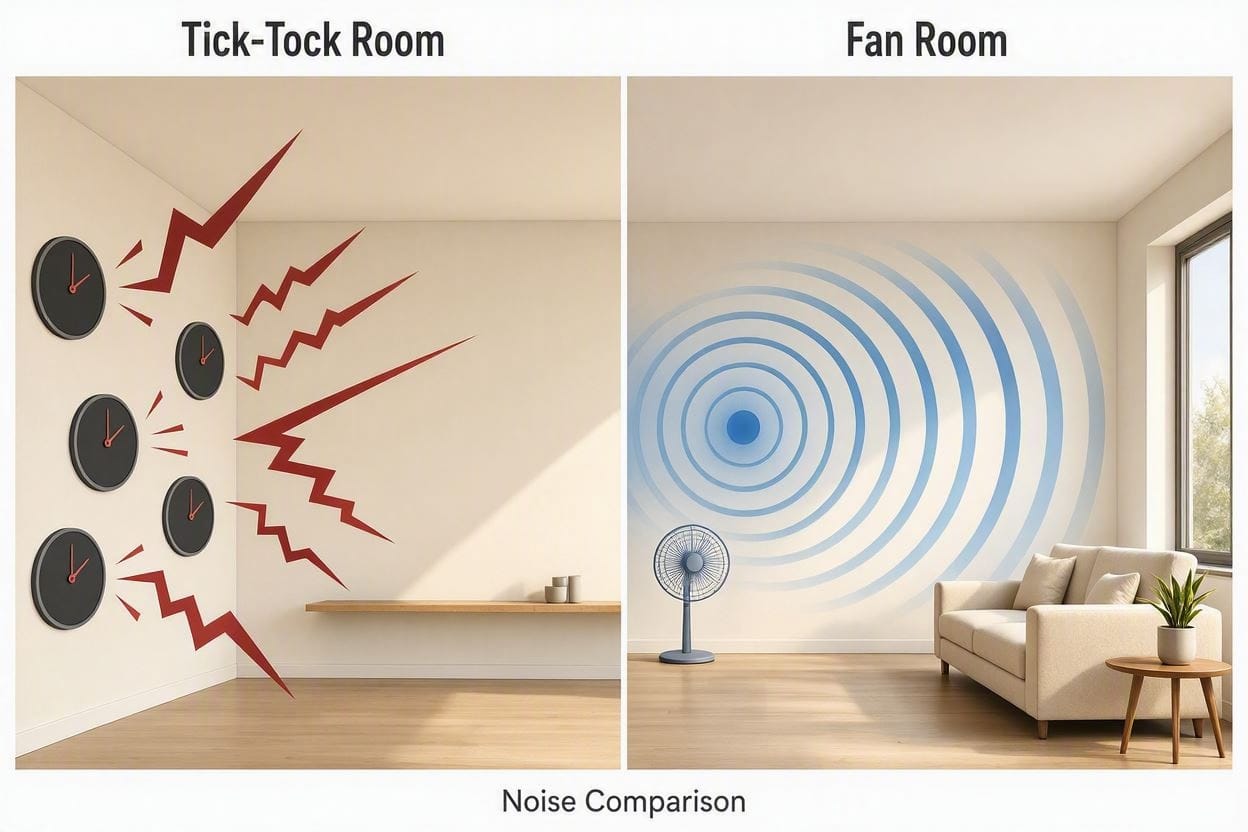
That much applies to any unwanted sound. But repetition is where things get genuinely interesting. The science explains why a steady hum can fade into the background while a repetitive click never does.
The Amygdala Never Really Learns to Ignore It
One of the most important facts about human hearing is that the auditory system never fully switches off. Unlike your eyes, which close, your ears remain permanently open, monitoring the environment even while you sleep. Sounds are routed to the amygdala quickly and below the level of conscious control, which means your body reacts to a noise before you have decided whether you care about it.
The result is what researchers call a stress response without mental coping. Your body releases stress hormones, and you cannot reason your way out of it in the moment because the reaction already happened. This is documented in research on noise-induced cortisol increase, which found that these effects occur largely without the ability to use mentally controlled coping strategies. noise triggers stress hormone release without conscious coping strategies
For a one-time noise, this is fine. The reaction fades quickly. The problem with repetitive noise is that it re-triggers the same response over and over, dozens or hundreds of times, with no opportunity for your system to settle.
Intermittent Noise Is More Annoying Than Continuous Noise
This is one of the clearest findings in environmental acoustics, and it explains a lot about household life. Intermittent noise, meaning sounds that start and stop, is consistently rated as more annoying than continuous noise at the same energy level. Audible tones also increase annoyance when they stand out above the surrounding sound. intermittent noise is considered more annoying than continuous noise, and audible tones increase annoyance further
Think about what that means in your own home. A fan running at a steady 45 decibels might be soothing. A fridge compressor that kicks on, runs, stops, and kicks on again at the same volume feels entirely different. The steady sound becomes a background texture. The intermittent one keeps demanding attention.
This also explains why the noise sources that bother people most are rarely the loudest ones in the house. A continuously running air conditioner is easier to live with than a dishwasher that beeps, gurgles, clicks, and drains in unpredictable bursts. Your brain can adapt to a constant. It struggles to adapt to a pattern it cannot predict.
Why Small Noises Feel Disproportionately Stressful
A common question that comes up in discussions of noise sensitivity is why the same noise that barely registers in a busy office can feel unbearable at home in the evening. The answer is partly about total noise, but also about the absence of other sound to compete with it.
When the house is otherwise quiet and you are trying to rest, read, or fall asleep, there is nothing to mask a repetitive sound. It becomes the dominant acoustic event in your environment, which makes it impossible to ignore. This is why the same ticking clock that never bothered you at noon can feel maddening at 11 p.m.
Studies have also found that annoyance from noise is what actually correlates with stress hormone levels. One analysis of environmental noise found that cortisol was significantly correlated with annoyance caused by noise exposure. cortisol levels correlate with noise annoyance
So it is not the decibel level alone that determines how much a sound stresses you. It is how much your body and mind perceive it as unwanted and inescapable.
The Health Consequences Are Real, Even at Low Volume
This is the part people most often underestimate. Chronic exposure to low-level noise is not just an annoyance problem. It has measurable health consequences.
Noise exposure triggers the sympathetic nervous system and endocrine system, leading to elevated stress hormones and increased activation of the body’s stress pathways. Even at lower decibel levels, this can produce stress reactions including annoyance, low mood, and mental strain. low-level noise leads to stress hormone elevation and activation of the sympathetic nervous system
Environmental noise exposure has also been linked to oxidative stress and impaired vascular function, connecting long-term noise exposure to cardiovascular and psychological health issues. noise exposure is linked to oxidative stress and vascular dysfunction The World Health Organization has estimated that traffic noise alone is responsible for a significant loss of healthy life years, much of it related to annoyance, cognitive impairment, and sleep disturbance.
For household noise specifically, the stress mechanism is the same, just scaled to a smaller environment. A washing machine that shakes the wall, a refrigerator that hums all night, a neighbor’s television bleeding through a party wall – these are not trivial problems. They are chronic stressors that your body responds to whether or not you decide to “get used to it.”
Low-Frequency Noise: The Hum You Cannot Escape
Some household noise is especially difficult because it sits in the low-frequency range, roughly 10 Hz to 200 Hz. This includes things like the deep rumble of a compressor, the drone of a ventilation system, distant traffic, and the notorious low-frequency hum that some people complain about in their homes.
Low-frequency noise is a recognized special problem in environmental acoustics, particularly affecting sensitive people in their homes. Standard A-weighted sound measurements can underestimate its effects, which means a low hum can cause significant annoyance and stress while appearing unremarkable on a basic meter reading. low frequency noise is a recognized problem particularly for sensitive people in their homes
Worse, researchers note the possibility of learned aversion, where exposure to low-frequency noise leads to annoyance and stress that grows rather than fades over time. It is one reason the problem often remains unresolved for the people suffering from it.
If you have ever read our article on low-frequency noise pollution in apartments, this connects directly. It is also a common thread in why mini fridges click and pop at night.
Why You Cannot Simply “Get Used to It”
People are often told to just adapt, ignore it, or accept that noise is part of shared living. That advice is well-meaning and largely useless, and the research explains why.
Habituation works best with predictable, continuous sounds that carry no threat signal. Repetitive intermittent noise defeats habituation because each new occurrence reads as a fresh event rather than an extension of the previous one. Your body never reaches the point of treating it as background, because it keeps stopping and starting.
On top of that, the response happens below conscious control. Even if you intellectually decide the sound is unimportant, your amygdala has already processed it and triggered the stress response. This is not a failure of willpower. It is biology operating the way it was designed to operate.
What Actually Helps
Understanding the science is useful, but the practical question is what to do about it. The approaches that work tend to fall into three categories.
Mask the sound. Creating a steady, pleasant background sound makes intermittent noise less noticeable because the contrast between moments of silence and moments of noise disappears. This is why white noise, pink noise, fans, and air purifiers are so effective. It is also why the specific type of sound matters – our guide on pink noise vs. brown noise vs. white noise explains which works better for which problem.
Remove or repair the source. Where the source is yours, fixing it is often simpler than people expect. A vibrating appliance can be damped. A rattling fan can be tightened. Our articles on how to stop a washing machine from shaking and how to quiet a noisy refrigerator compressor both deal with exactly this kind of fixable repetitive stress.
Block what you cannot fix. For noise coming through walls, floors, or windows, the solution is structural. Sealing gaps, adding mass, and decoupling surfaces genuinely reduces how much noise reaches you. The principles are covered in the four principles of soundproofing.
Final Thoughts
Repetitive household noise feels stressful because it genuinely is stressful. Your auditory system stays alert even in sleep, your amygdala responds before your conscious mind gets involved, and intermittent sounds re-trigger that response over and over without giving your nervous system a chance to settle.
The physical consequences are measurable, not imagined. Elevated cortisol, increased sympathetic nervous system activity, and long-term associations with cardiovascular and psychological strain are documented effects of chronic noise exposure, even when the source is something as mundane as a machine in the next room.
So if that dripping tap is making you feel genuinely agitated, you are not being dramatic. You are responding like a human being whose body is doing its job. The reasonable response is not to force yourself to tolerate it. It is to mask it, fix it, or block it.
Frequently Asked Questions
Why Does a Small Repetitive Noise Bother Me More than Loud Noise?
Intermittent and repetitive sounds re-trigger your stress response each time they occur, while steady sounds can fade into the background. Your brain can adapt to a constant, but it never fully adapts to a pattern that keeps stopping and starting.
Is Noise Annoyance a Real Health Issue?
Yes. Noise annoyance correlates with elevated cortisol levels, and chronic noise exposure is linked to increased sympathetic nervous system activity, oxidative stress, and cardiovascular strain.
Why Can’t I Just Get Used to the Noise?
Habituation works best with predictable, continuous sounds. Repetitive intermittent noise defeats it because each new occurrence reads as a fresh event. The stress response also happens below conscious control, so deciding not to care does not stop your body from reacting.
Does Noise Affect Sleep Even if it Does not Wake Me Up?
Yes. The auditory system remains active during sleep, and noise can trigger stress hormone release without waking you. Research confirms these effects occur below the waking threshold.
What is the Best Way to Deal With Repetitive Household Noise?
Three approaches work best: mask it with a steady background sound like white noise, fix the source if it is yours, or block it structurally if it is coming through a wall, floor, or window.

Ememobong is the lead researcher and editor at Quiet Dwelling. As a professional technical writer, he specializes in breaking down complex acoustic engineering concepts into simple, actionable steps. His goal is to help people build distraction-free environments for better sleep and deep work.