
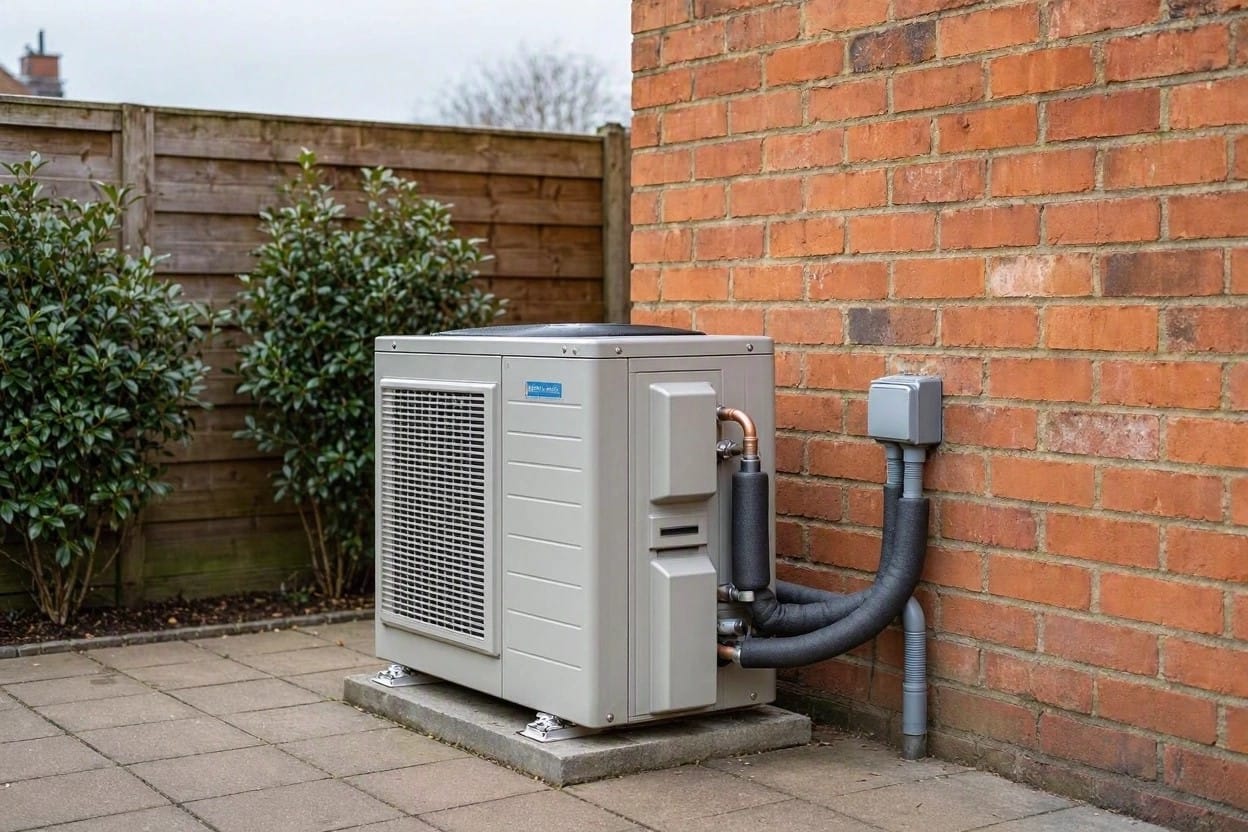
It is one of the first questions anyone asks before installing a heat pump, and it almost never gets a straight answer. Installers tend to say “they’re very quiet these days.” Neighbours who hate theirs say “it’s unbearable.” Both are describing the same machine, which tells you the honest answer is more specific than either.
So here it is: a modern heat pump is not loud in absolute terms, but it produces a continuous low-frequency sound that some people find far more intrusive than its decibel rating suggests. Both halves of that sentence matter.
This guide covers what a heat pump actually sounds like, roughly how loud it is, and the specific circumstances that turn a quiet machine into a genuine nuisance.
What A Heat Pump Actually Sounds Like
Not one sound. Three, layered on top of each other.
A low, steady hum. This is the compressor, and it is the sound people describe when they say a heat pump is annoying. It sits low in the frequency range and it runs continuously rather than in bursts. If you have ever been bothered by a fridge compressor or a neighbour’s extractor fan, it is that character — steady, low, and hard to stop hearing once you’ve noticed it.
A soft, broadband whoosh. This is the fan moving air across the outdoor coil. It is the more benign component: steady, white-ish, and it fades with distance the way normal sound does. Most people find it unobjectionable.
A defrost cycle. In cold weather, ice builds on the outdoor coil and the system periodically reverses to melt it off. This produces the loudest phase of normal operation — a whoosh, hiss or clunk lasting a few minutes. It is intermittent, and for most people it is not the complaint.
The reason this matters is that the hum and the whoosh respond to completely different fixes. The whoosh is airborne and easy to address. The hum is dominated by low frequency, and low-frequency sound travels through structure rather than air — which is why isolation matters more than enclosure. If that behaviour is unfamiliar, our guide to how to block low frequency noise explains why bass is a structural problem rather than a wall-thickness one.
How Loud Is A Heat Pump In Decibels?
Heat pump outdoor units are typically rated somewhere in the region of the low-to-mid 40s to the mid 50s dB(A), measured at a standard distance — commonly one metre from the unit, sometimes three or ten, depending on the manufacturer and the standard being quoted.
Before comparing any two figures, check the distance they were measured at. This is the single most misunderstood thing about heat pump specifications. A unit rated at 48 dB at one metre and a unit rated at 48 dB at three metres are not the same machine at all — sound falls off with distance, so the second is dramatically quieter in practice. Manufacturers sometimes quote whichever figure makes them look better, and both are legitimate.
For context on what those numbers mean in a room, our guide to what a decibel is covers how the scale works and why a 10 dB change sounds roughly twice as loud rather than 10% louder. And if sleep is the concern, how many decibels is too loud for sleep sets the practical threshold.
The number that actually matters, though, is not on the spec sheet at all. It is the level inside your bedroom with the unit running. And that depends almost entirely on three things: where the unit is mounted, what it is mounted to, and how far it is from the wall of the room you sleep in.
The sleep angle is worth taking seriously rather than tolerating — the World Health Organization identifies sleep disturbance as one of the established effects of chronic noise exposure, alongside cardiovascular and cognitive impacts. World Health Organization
For the specific thresholds regulators work to, the World Health Organization’s environmental noise guidelines recommend target night-time outdoor levels of 45 dB for road traffic, 44 dB for rail and 40 dB for air traffic — figures that give a useful sense of what “acceptable” actually means. Environmental Noise and Effects on Sleep, WHO systematic review
The Circumstances That Make A Heat Pump Loud
This is where the two conflicting opinions come from. A heat pump in a good installation is a non-issue. The same machine in a bad one is a genuine problem. Here is what separates them.
It is wall-mounted rather than ground-mounted
The single biggest factor, and the one installers most often get wrong when space is tight. A wall bracket bolted to brickwork is a direct mechanical bridge from the compressor into the structure of your house. Every pulse of the compressor enters the wall, and the wall then radiates it into the room as sound. You can end up hearing the unit more clearly inside than standing next to it outdoors.
A unit standing on a ground-mounted pad transmits almost nothing into the building, because the ground absorbs vibration instead of carrying it. If you have any choice at all at design stage, this is the decision that matters most — and it is free at installation and expensive to change later.
It is bolted to a bedroom or shared wall
The second biggest factor. Even a ground-mounted unit close to the wall of the room you sleep in will be audible, because a proportion of its noise radiates directly toward that wall. Put it on the far side of the house and the same machine becomes inaudible indoors.
Where the unit sits against a wall shared with a neighbour, you also have the relationship question. Different places have different rules and different norms, and it is worth knowing both before installation rather than after.
The pipes touch the structure
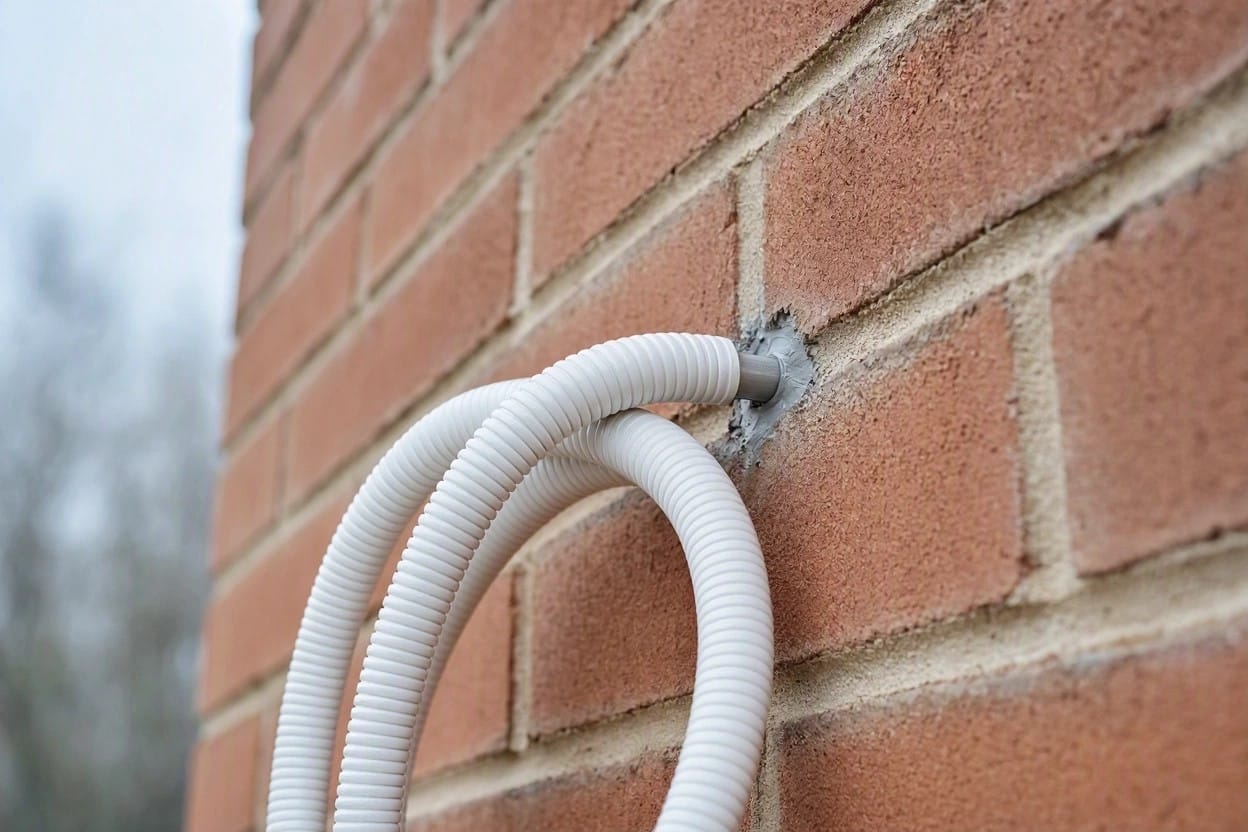
The two refrigerant pipes running from the unit into your house are excellent conductors of vibration. Where they rest against a joist, a stud or the inner face of a wall, they hand compressor vibration straight into the building — and this is frequently the reason for the “louder inside than outside” complaint.
Properly insulated and isolated pipe runs, with flexible sections and cushioned clips rather than hard contact, remove most of this pathway entirely.
It is oversized, undersized, or badly commissioned
A heat pump working flat out to meet a demand it was not sized for will be louder than one modulating gently. So will one that has been installed with settings and flow temperatures that force it into high output constantly. This is not a noise problem so much as a commissioning one, and a competent installer can usually fix it.
The unit is dirty, damaged or neglected
A clogged outdoor coil makes the fan strain and the compressor run longer. A bent fan blade produces an irregular, rougher whoosh. Debris or leaves around the base add their own rattle. All of these are free or cheap to fix, and all of them make an otherwise quiet machine noticeably louder.
Will You Notice It Inside Your Home?
Honest answer, and it depends on your installation rather than your machine:
| Installation | What You’ll Hear |
|---|---|
| Ground-mounted, far side of the house | Nothing indoors. Possibly audible in the garden within a few metres. |
| Ground-mounted, below a bedroom window | A faint fan whoosh when it runs hard. Most people stop noticing within weeks. |
| Wall-mounted on a solid, well-isolated bracket | Low hum audible in the adjacent room, particularly at night. |
| Wall-mounted on a bracket with rigid pipes and no isolation | A continuous hum clearly audible indoors, often more noticeable than outside. This is the installation behind most complaints. |
Note the pattern: the machine is the same in every row. What changes is the mechanical path between the compressor and your ears.
Are Heat Pumps Louder Than The Alternatives?
Worth comparing honestly, because the answer is not always in the heat pump’s favour.
Against a gas boiler: a boiler is louder in the moment — a short, dramatic burst of combustion and fans from a unit inside a cupboard you never open. A heat pump is quieter per moment but runs far longer. Many people find the heat pump more noticeable overall despite lower peak volume, because continuous sound is harder to ignore than an intermittent one.
Against an air conditioner: broadly comparable. Both use a compressor and a fan, both sit outside, and both produce the same character of noise. If you already live comfortably with an AC unit, a heat pump should be a similar experience.
Against oil or LPG systems: a heat pump is generally considerably quieter, because you have removed the delivery vehicle, the combustion noise, and often the plant room.
Against nothing at all: this is the comparison that actually matters in summer. A heat pump in cooling mode runs in the hottest weeks when windows are open — and that is when an outdoor unit is most likely to be noticed by you and by neighbours.
What To Do If Yours Is Louder Than You Expected
Work down. The first two steps are free and solve more complaints than anything you can buy.
- Measure it properly. Take readings at the unit and at the wall inside the room you care about, at three moments: just after startup, mid-cycle, and during defrost. What you learn tells you whether the unit is performing normally and, crucially, whether the problem is worst at the machine or at your wall — which tells you whether it is fan noise or compressor vibration.
- Check the boring things. Clean the coil, clear leaf litter from the base, check the unit is level, give it the manufacturer’s clearance on all sides, separate any pipes touching timber, and look for a bent fan blade or damaged grille.
- Isolate the unit from the structure. If it is wall-mounted, fit properly rated anti-vibration mounts — this is the highest-value paid fix for indoor noise from an outdoor unit. If it is ground-mounted, replace rigid feet with correct isolators.
- Isolate the pipework. Ensure the refrigerant lines are insulated, cushioned where they clip, and free from hard contact with joists or studs. A short flexible section near the unit absorbs vibration before it enters the pipe run.
- Call the installer. If the unit is running flat out constantly, cycling oddly, or performing worse than its rated sound power level, this is a commissioning or fault question — and it is the installer’s to answer. Go to them with measurements and times, not with “it’s too loud.”
- Address the room if needed. If the residual noise still bothers you at night, masking sound is the practical final layer. Pink or brown noise suits a low continuous hum better than white — see pink noise vs. white noise for which character fits which noise.
For the fuller version of this diagnosis and the physics behind each fix, our dedicated guide to heat pump noise walks through each source and its treatment in detail.
If You Have Not Installed One Yet
The decisions that matter are all made at design stage, and all of them are free now and expensive later:
- Ground-mount, never wall-mount, if you have any choice at all.
- Put it as far from bedrooms as the layout allows. Distance is the cheapest acoustic treatment in existence.
- Compare the sound power level in the specification, and check the distance it was measured at — a figure without a distance is not a comparison.
- Ask about the pipe route before the installers start. Insulated, cushioned, flexible where it meets the unit.
- Consider the neighbours’ windows, not just your own. It costs nothing at planning stage and avoids a difficult conversation later.
The Honest Caveat
A heat pump cannot be made silent. It moves a compressor and pushes a large volume of air, and that produces sound throughout the heating season. What you can realistically achieve is a unit you and your neighbours stop noticing — and in almost every case, that comes down to mounting, distance and pipe isolation rather than the machine itself.
If your heat pump is new and loud, do not accept it as normal, and do not assume the answer is a replacement unit. The overwhelming majority of “loud heat pump” complaints are installation problems, and installation problems have installation fixes.
Frequently Asked Questions
Are Heat Pumps Loud?
Not loud in absolute terms, but they do produce a continuous low-frequency hum that some people find more intrusive than the decibel rating suggests. A modern unit is broadly comparable to an air conditioner. Whether you notice yours indoors depends far more on how it is mounted and how far it is from your bedroom than on the machine itself.
How Many Decibels is a Heat Pump?
Outdoor units are typically rated in the low-to-mid 40s to mid 50s dB(A), measured at a set distance — commonly one metre, sometimes three or ten. Always check the measurement distance before comparing two models, because a rating taken further away represents a much quieter machine in practice.
Are Heat Pumps Louder than Gas Boilers?
Different rather than simply louder. A boiler produces short, loud bursts from inside a cupboard; a heat pump produces a quieter sound but runs for far longer each day. Many people find the heat pump more noticeable overall, because continuous noise is harder to ignore than an intermittent one — even when the peak volume is lower.
Why is My Heat Pump Louder inside than Outside?
That is the signature of structure-borne vibration rather than airborne noise. The compressor’s vibration enters your house through the mounting bracket, the wall, or the refrigerant pipes, and the building structure then radiates it into the room. It is the classic sign of a wall-mounted unit without proper isolation.
Can I Reduce Heat Pump Noise?
Yes, substantially. The highest-value fix is isolating the unit from the structure — correctly rated anti-vibration mounts for a wall installation, or isolators in place of rigid feet on the ground. After that, isolate the pipework where it touches timber, and keep the coil clean. Replacing the machine is rarely the answer.
Do Heat Pumps Make Noise at Night?
The coldest hours create the greatest heating demand, so that is when a heat pump works hardest and runs longest. Cold air is also denser, slightly increasing fan load. So the loudest operating window of the day coincides with the hours you are trying to sleep, which is why overnight noise is the most common heat pump complaint.
Does a Heat Pump Make a Loud Noise in Winter?
That is normally the defrost cycle. Ice builds on the outdoor coil in cold weather and the system briefly reverses to melt it off, producing a whoosh, hiss or clunk lasting a few minutes. It is the loudest phase of normal operation and is entirely expected. Constant or very frequent defrosting may indicate a fault.

Ememobong is the lead researcher and editor at Quiet Dwelling. As a professional technical writer, he specializes in breaking down complex acoustic engineering concepts into simple, actionable steps. His goal is to help people build distraction-free environments for better sleep and deep work.