
*This post contains affiliate links. If you use these links to buy something we may earn a commission at no extra cost to you.
You have invested time, money, and sweat into making your backyard a beautiful retreat, but if your property backs up to a busy street or highway, that investment is severely compromised. The constant, aggressive drone of tire hum, engine braking, and sirens can quickly elevate your stress levels and make outdoor conversations impossible.
When trying to fix this, most homeowners make a very expensive acoustic mistake: they plant a row of evergreen trees, assuming the foliage will act as a soundproof wall. Unfortunately, according to noise barrier guidelines published by the Federal Highway Administration (FHWA), vegetation must be at least 100 feet deep and incredibly dense to achieve even a minor 5-decibel reduction in traffic noise. A single row of arborvitae trees will provide visual privacy, but it offers absolutely zero acoustic mass.
To truly reclaim your outdoor space, you must apply the laws of architectural acoustics to your landscaping. You need a combination of Acoustic Shadowing (Mass) and Active Masking. Here is the step-by-step guide to silencing the street.
Step 1: Fortify Your Fence (The Principle of Mass)
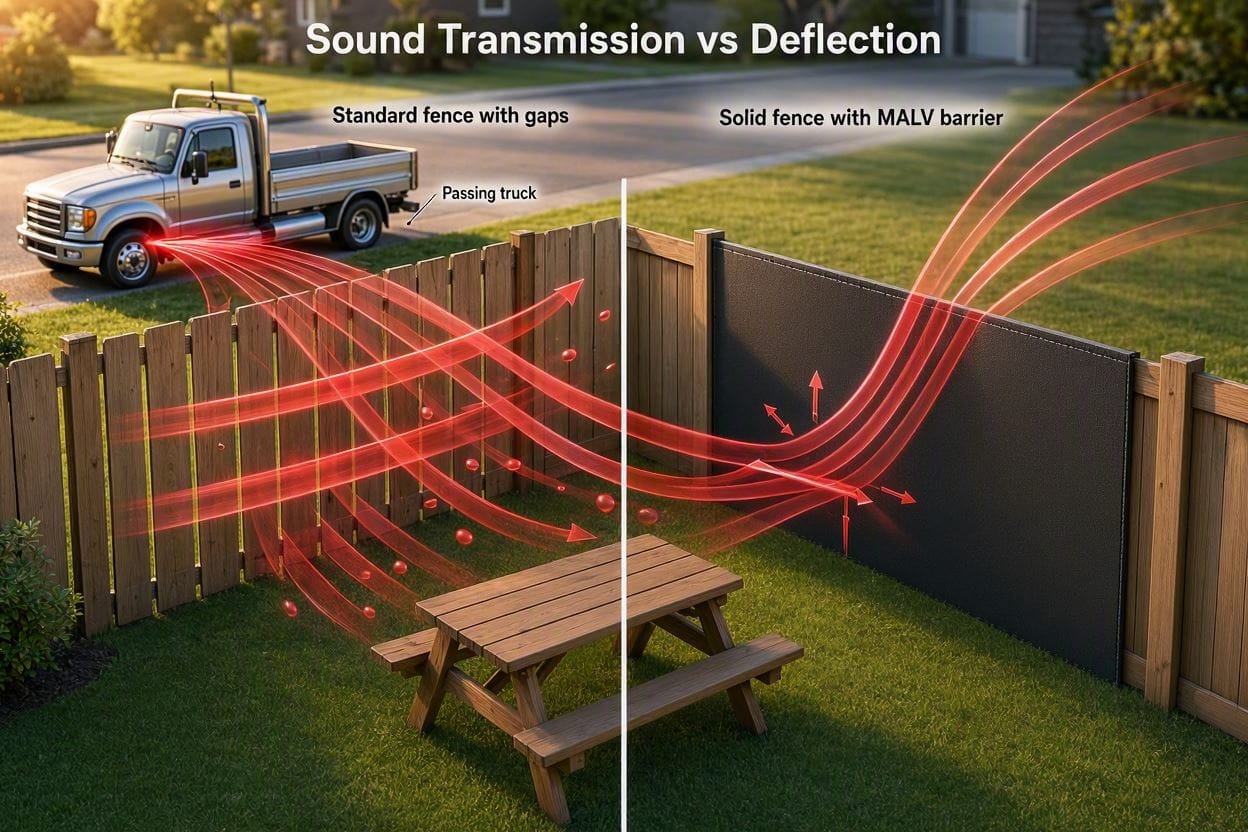
To stop sound waves from entering your yard, you must break the “line of sight” between your patio and the tires of the passing cars. A standard chain-link or spaced-picket fence is acoustically useless. Even a standard wooden privacy fence is highly flawed because wood warps, shrinks, and leaves tiny air gaps between the planks. Sound acts like water; if light and air can pass through your fence, the roar of traffic will pour right in.
To upgrade your existing fence into a true acoustic barrier, you need to add extreme density. The most effective way to do this without pouring a concrete wall is by installing Mass-Loaded Vinyl (MLV).
TMS Mass Loaded Vinyl (1lb High-Density Acoustic Barrier)
Mass-Loaded Vinyl is a heavy, flexible material infused with barium and silica to give it the acoustic density of solid lead. By unrolling MLV and stapling it directly against the street-facing side of your wooden fence, you instantly seal every air gap and create a massive reflective wall that bounces traffic noise back toward the street.
- Features an STC (Sound Transmission Class) rating of 27, drastically cutting high-frequency tire whine.
- Incredibly weather-resistant; can be painted or covered with a second layer of wood for aesthetic purposes.
- Installation Tip: Ensure the MLV goes all the way down to the dirt. If there is a gap at the bottom of the fence, sound will slip right underneath.
Step 2: Understand Acoustic Diffraction (Sound Bending)
Once you make your fence airtight and heavy, you will notice a massive reduction in the sharp, high-pitched sounds of traffic. However, you will likely still hear the low, rumbling drone of the engines. This is due to a phenomenon called acoustic diffraction.
Low-frequency sound waves have incredibly long wavelengths. When these massive waves hit the top of your newly reinforced fence, they actually bend over the top edge and curve back down into your yard. This is why we explored the profound difficulties of stopping heavy bass waves in our guide on the health effects of low-frequency noise pollution. Unless you are legally allowed to build a 15-foot-tall wall, you cannot completely stop diffraction.
Because you cannot physically block the sound from bending over the fence, your final acoustic defense must be masking.
Step 3: Introduce Active Acoustic Masking
Acoustic masking is the science of introducing a new, continuous, and pleasant sound to raise the “noise floor” of an environment. By placing a consistent sound source close to your seating area, your brain will lock onto the pleasant frequency and actively tune out the distant, muffled rumble of the highway.
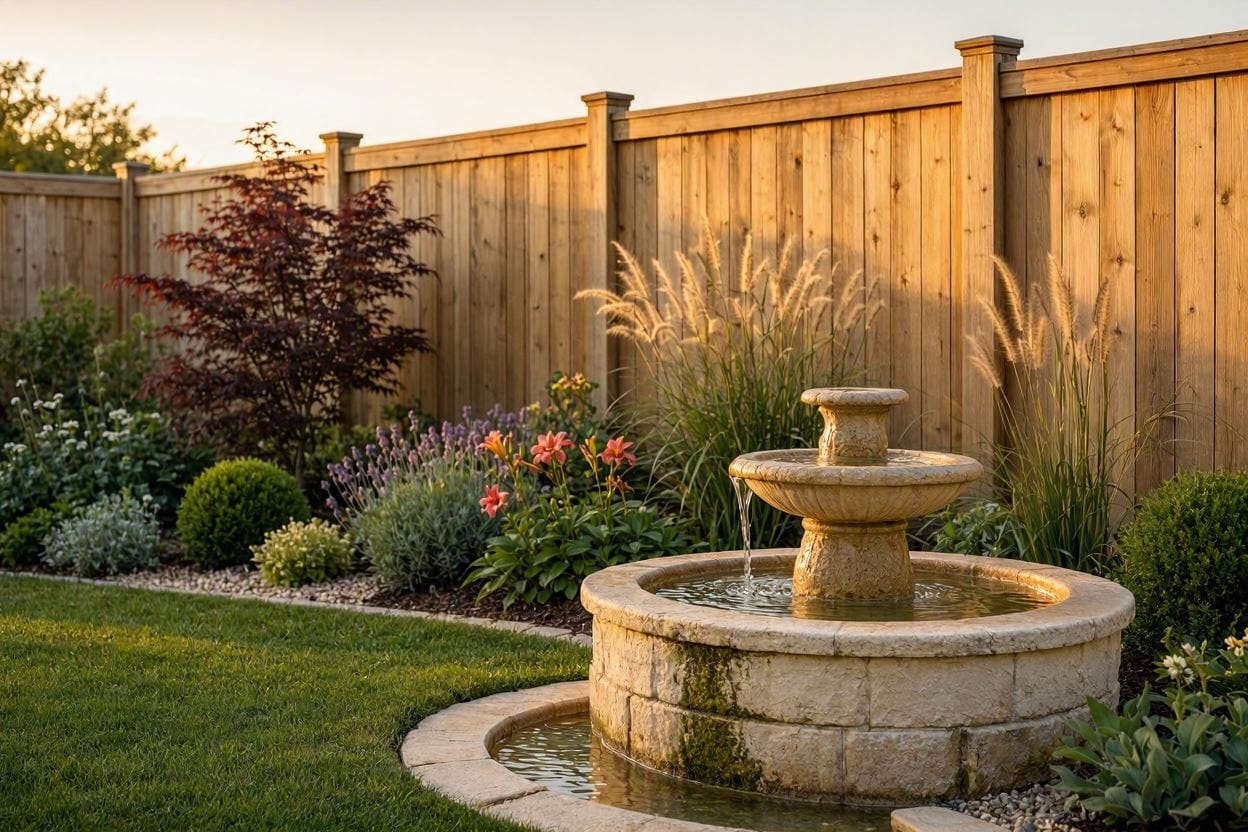
In a backyard setting, the absolute best masking agent is running water. The random, broadband frequency of splashing water perfectly scrambles the rhythmic hum of tires on asphalt.
John Timberland Modern Tiered Outdoor Water Fountain
For effective masking, a tiny tabletop fountain won’t cut it. You need volume and water disruption. This 39-inch tiered fountain features multiple drop-offs, creating a robust, multi-layered waterfall sound that is loud enough to effectively drown out ambient neighborhood noise.
- Multiple tiers generate a rich, randomized “pink noise” frequency.
- Constructed from durable, weather-resistant faux stone.
- Placement Tip: Place the fountain directly next to your patio furniture. The closer the masking sound is to your ears, the more effective it is at hiding the distant traffic.
Frequently Asked Questions
Do Trees and Hedges Block Traffic Noise?
No, this is a pervasive landscaping myth. Leaves and branches lack the physical mass required to stop sound waves. However, they do provide excellent diffusion (scattering echoes) and visual privacy. While a hedge won’t make the yard quieter on a decibel meter, removing the visual sight of the road often provides a psychological reduction in stress.
How Tall Does a Fence Need to Be to Block Highway Noise?
The general acoustic rule is that your fence must completely block the line of sight between the noise receiver (your ears when sitting on your patio) and the noise source (the exhaust pipe or tires of the vehicles). In most residential neighborhoods, a solid 6-to-8-foot fence is required to create a sufficient acoustic shadow.
Can Outdoor Acoustic Curtains Reduce Backyard Noise?
Outdoor acoustic curtains are highly effective, but only when used in semi-enclosed spaces like a pergola, a screened-in porch, or a gazebo. They absorb sound bouncing off hard patio surfaces, but they cannot replace a solid perimeter fence for blocking street noise.
Final Verdict
You cannot stop the highway from producing noise, but you can dictate how that noise behaves when it reaches your property line. Stop relying on thin wooden fences and sparse bushes. By fortifying your perimeter with the extreme density of Mass-Loaded Vinyl, you can deflect the sharpest, most irritating frequencies. Pair that reinforced boundary with the localized acoustic masking of a Tiered Water Fountain, and you can successfully transform your backyard back into a peaceful retreat.

Ememobong is the lead researcher and editor at Quiet Dwelling. As a professional technical writer, he specializes in breaking down complex acoustic engineering concepts into simple, actionable steps. His goal is to help people build distraction-free environments for better sleep and deep work.