
*This post contains affiliate links. If you use these links to buy something we may earn a commission at no extra cost to you.
Running a load of laundry shouldn’t feel like a localized earthquake. Yet, in many homes, the moment the washing machine enters its final spin cycle, the entire house begins to rattle. Picture frames shake, floors hum, and the mechanical roar makes it impossible to watch television in the next room.
Soundproofing a laundry room requires a completely different approach than soundproofing a bedroom. You are not just dealing with airborne noise (the sound of water splashing or zippers clanking); you are fighting structure-borne noise. When a heavy drum spins at 1,200 RPM, it generates massive amounts of kinetic energy. If your machines are sitting directly on tile or hardwood, that energy transfers straight into your floor joists, turning your home’s framing into a giant acoustic amplifier.
According to structural acoustic guidelines provided by the American Society of Heating, Refrigerating and Air-Conditioning Engineers (ASHRAE), isolating heavy machinery requires physical decoupling and mass addition. Here is the step-by-step guide to silencing your laundry room.
Step 1: Decouple the Machines (Vibration Isolation)
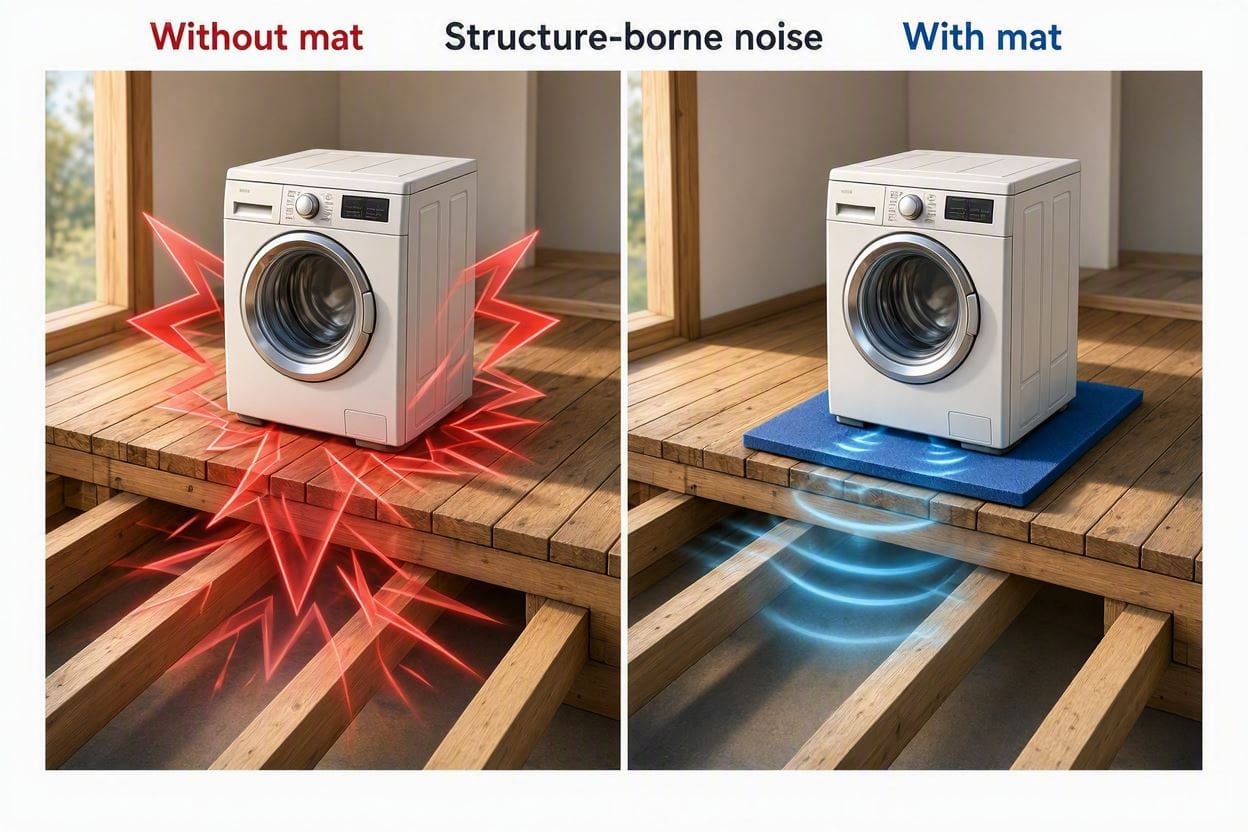
To stop structure-borne noise, you must break the physical connection between the vibrating appliance and the floor. This is achieved through acoustic decoupling—introducing a dense, shock-absorbing material that eats the kinetic energy before it can reach your joists.
RevTime Heavy Duty Anti-Vibration Mats
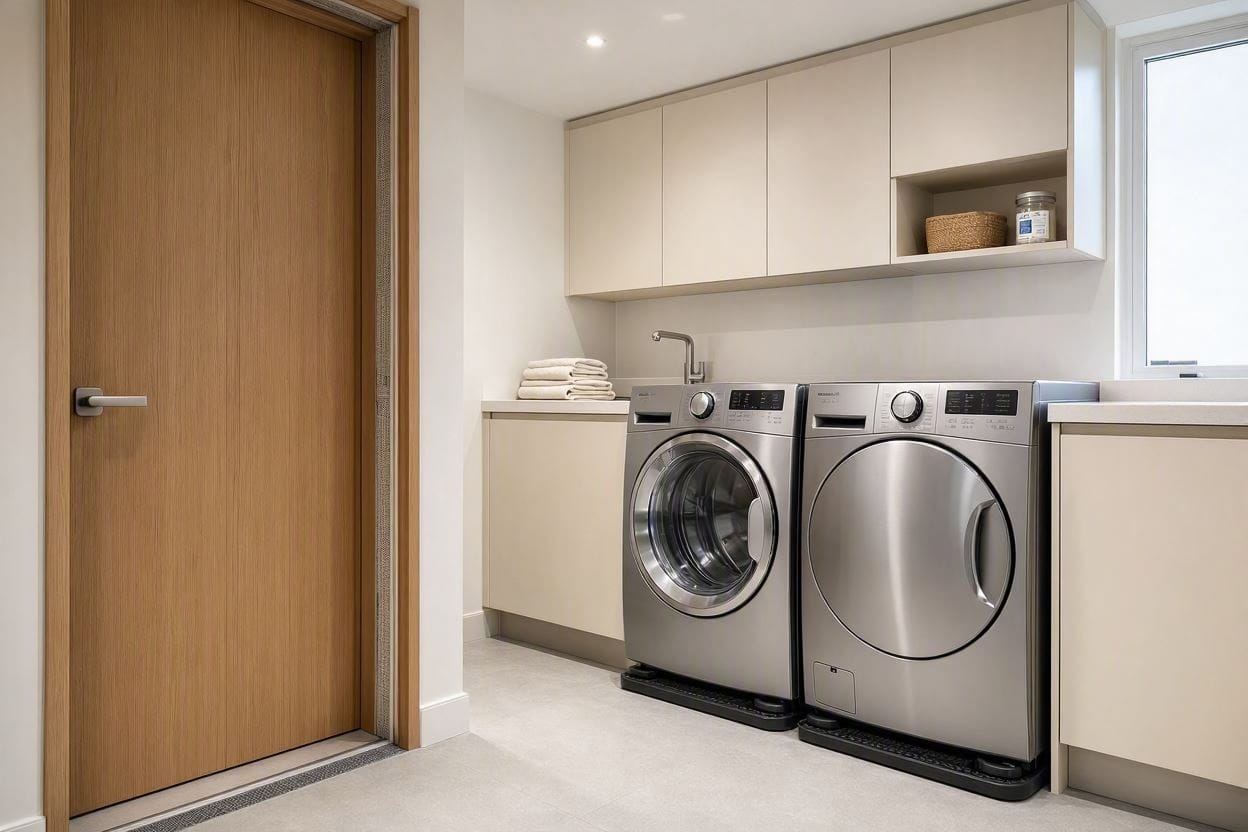
Standard rubber feet are too small to handle the violent shaking of a modern front-loader. These massive, solid rubber mats sit completely under the machine, providing a thick layer of high-density acoustic isolation that absorbs extreme mechanical vibration.
- Constructed from thick, forged rubber for maximum kinetic absorption.
- Protects tile and hardwood floors from scratching and scuffing.
- Installation Tip: Ensure your machines are perfectly leveled with a spirit level before placing them on the mat to prevent off-balance knocking.
Step 2: Fortify the Laundry Room Door
Once you have stopped the floor from shaking, you must address the airborne noise (the high-pitched motor whine and water sloshing). In residential construction, builders frequently install “louvered” doors in laundry rooms. These doors have wooden slats designed to allow HVAC airflow, but acoustically, they are basically open windows.
To block the mechanical roar, you must replace the door with a solid barrier. As we detailed in our guide on how to soundproof a hollow-core door, mass is your only defense against airborne sound transmission.
Acoustic Door Seal Kit & High-Density Sweep
If you upgrade to a solid-core wooden door, you must seal the perimeter. A dense silicone door sweep blocks the massive air gap at the bottom, while heavy-duty weatherstripping tape around the interior frame locks the sound waves inside the room.
Step 3: Treat the Hard Surfaces
Laundry rooms are typically small spaces filled with hard, reflective surfaces: tile floors, metal appliance cabinets, and bare drywall. This causes internal sound waves to violently ricochet, amplifying the noise of the machines.
You can significantly soften this acoustic environment by laying down thick, washable heavy-duty rugs in front of the machines. Additionally, ensure you leave a two-inch air gap between your washer/dryer and the surrounding walls. If a vibrating machine touches the drywall, it will instantly transmit that noise into the adjacent room.
Frequently Asked Questions
Why Does My Washing Machine Shake the Whole House?
This is usually caused by an off-balance load or an unleveled machine. When the heavy internal drum spins at high speeds on an uneven axis, it generates aggressive kinetic energy that transfers directly into your floor joists. Leveling the feet and adding an anti-vibration mat usually solves this instantly.
Will Acoustic Foam Quiet My Laundry Room?
Acoustic foam will only absorb the high-frequency “sloshing” sounds echoing off the drywall. It will do absolutely nothing to block the low-frequency mechanical vibration or the heavy motor hum escaping into your hallway. You must prioritize decoupling and door sealing before adding foam.
Final Verdict
You do not have to schedule your laundry loads around your family’s sleep schedules. By placing your appliances on heavy-duty RevTime Anti-Vibration Mats, you immediately eliminate the aggressive structural shaking that plagues most homes. Combine that with a solid door and a tight acoustic seal, and you can effectively lock the noise inside the room.

Ememobong is the lead researcher and editor at Quiet Dwelling. As a professional technical writer, he specializes in breaking down complex acoustic engineering concepts into simple, actionable steps. His goal is to help people build distraction-free environments for better sleep and deep work.