This post contains affiliate links. If you use these links to buy something, we may earn a commission.
You are lying in bed, staring at the ceiling. The house is completely silent, which somehow makes everything louder. The floorboards settle with a sharp crack. A car drives by three streets over. Your partner breathes just a little too heavily.
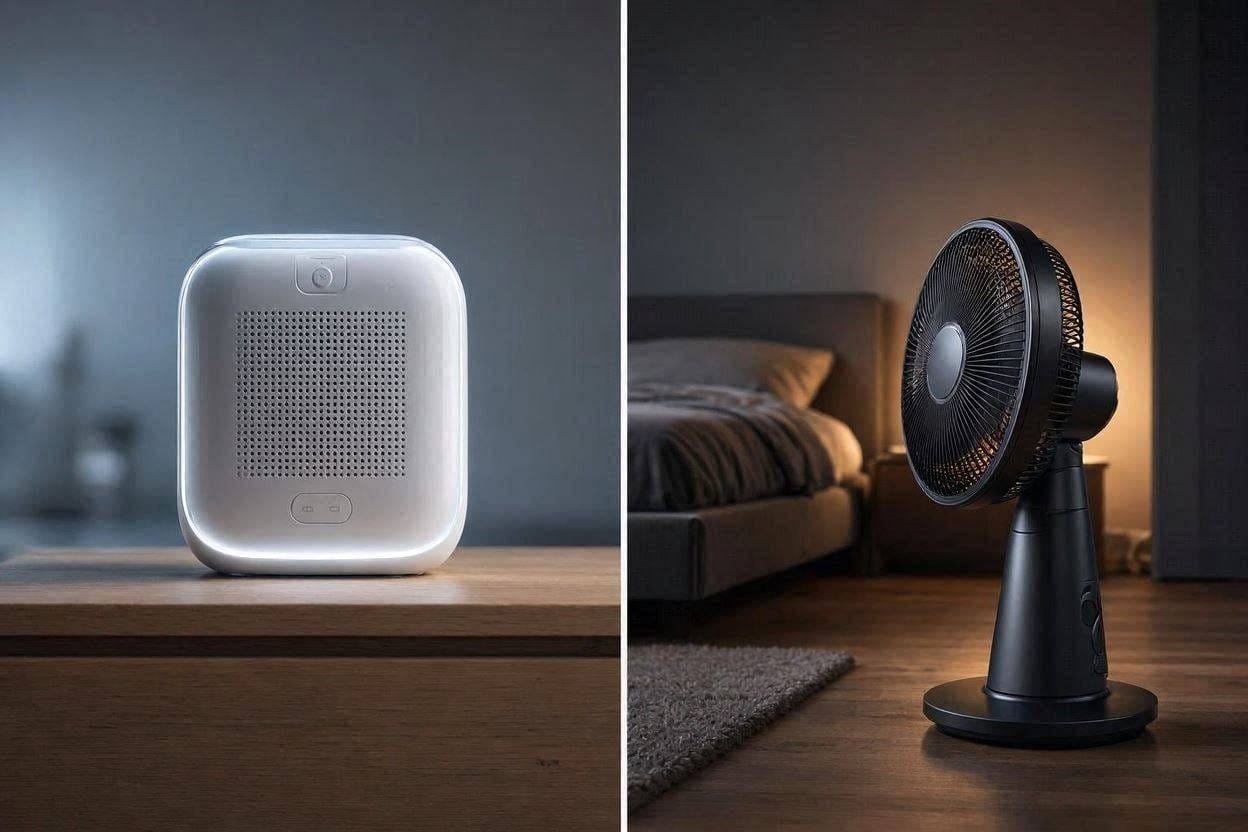
If you’re a light sleeper, you already know that dead silence is not actually relaxing, it is an acoustic trap that makes your brain hyper-focus on every tiny, unexpected sound. To fix this, millions of people rely on acoustic masking. But when it comes to drowning out the world, a fierce debate divides sleepers: Are white noise machines better than a simple bedroom fan?
At a glance, both do the exact same job. They create a consistent blanket of background sound that raises the ambient noise level of your room, masking sudden, jarring sounds. But if we look at the actual physics of sound and sleep hygiene, they are incredibly different tools.
Let’s break down the acoustic truth so you can finally get a good night’s sleep.
The Science of Sound Masking
Before we declare a winner, we need to understand why either of these devices works in the first place.
When a dog barks in the middle of the night, it is not necessarily the volume (the decibels) that wakes you up; it’s the sudden change in your acoustic environment. Your brain is hardwired to treat unexpected noises as threats. According to experts at the Sleep Foundation, introducing a continuous background sound reduces the difference between the baseline noise in your room and the sudden noise of a slamming door.
This concept is called sound masking. The continuous sound “fills in” the acoustic spectrum, smoothing out the audio spikes that yank you out of deep REM sleep.
The Case for the Bedroom Fan
For decades, the standard box fan or oscillating tower fan has been the ultimate sleep companion. But is it actually ideal for audio masking?
The Pros of Using a Fan:
- Dual-Purpose Comfort: The most obvious benefit of a fan is that it cools the room. Studies show that a cooler bedroom (around 65°F or 18°C) is highly conducive to better sleep. You get climate control and sound masking in one device.
- Organic, Non-Looping Sound: A fan produces a mechanical, organic hum. Because it’s a physical motor spinning physical blades through the air, the sound never “loops.” It is a truly random, continuous audio stream that your brain easily tunes out.
- Lower Frequency Profile: Most fans don’t actually produce “white noise.” Because of the deep hum of the motor and the buffeting of the air, fans lean much closer to pink noise or brown noise. These deeper frequencies are highly effective at masking low-end thuds, like footsteps from the apartment above you.
The Cons of Using a Fan:
- Lack of Volume Control: You cannot separate the noise from the air output. If your noisy neighbors are throwing a party and you need louder masking, turning your fan up to “High” might turn your bedroom into a freezing wind tunnel.
- Maintenance Issues: Fans collect dust quickly. If they aren’t cleaned, they can trigger allergies, and older fans are notorious for developing irritating clicks or rattles in their bearings as they age.
The Case for White Noise Machines
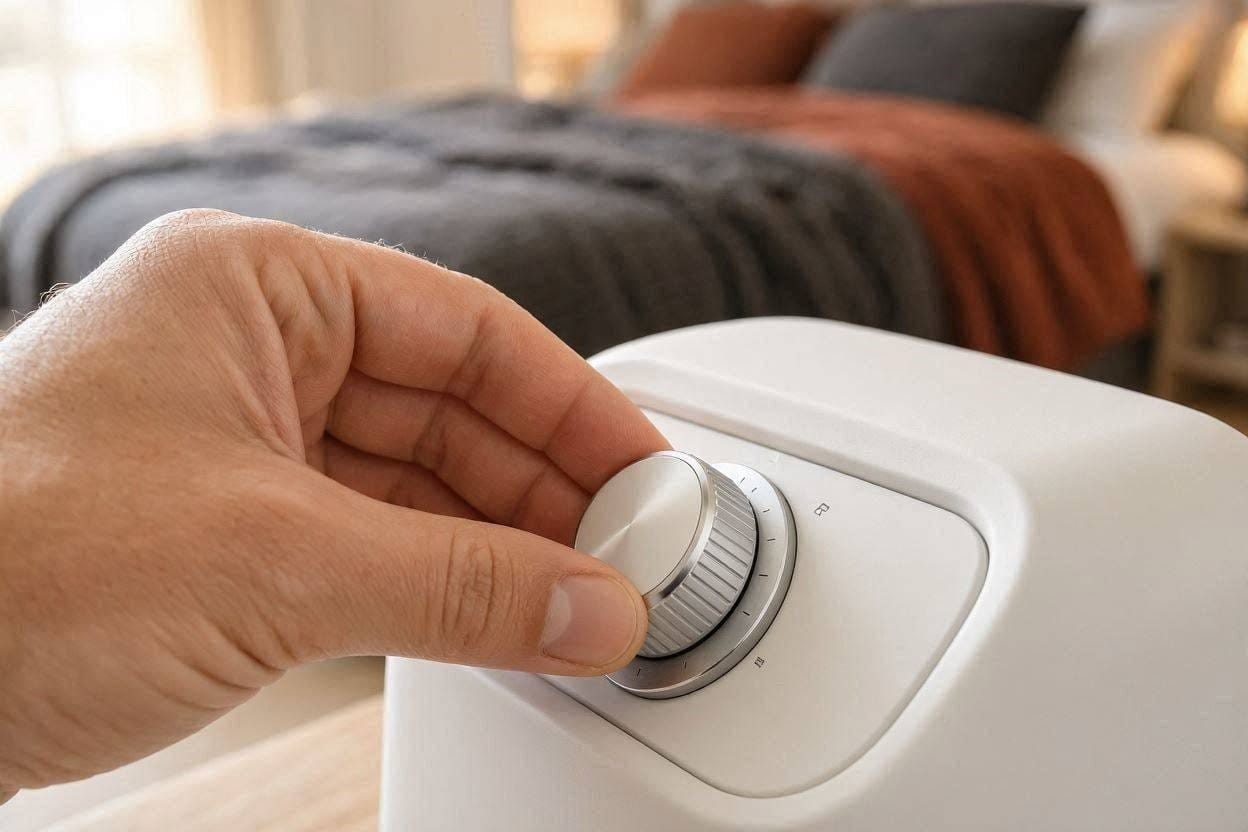
Dedicated sound machines have exploded in popularity, evolving from basic analog devices to high-tech digital units with endless sound profiles.
The Pros of White Noise Machines:
- Total Acoustic Control: This is the biggest advantage. You can adjust the exact volume to match your environment without changing the room’s temperature. If you need 70 decibels of sound to drown out street traffic, a machine can deliver that easily.
- Customizable Frequencies: Digital machines let you choose your preferred audio frequency. True “white noise” (which sounds a bit like static or a hissing TV) contains equal energy across all sound frequencies. If that’s too harsh for you, you can easily switch to the deeper, more soothing tones of pink or brown noise with the push of a button.
- Portability: You can’t easily pack a 3-foot tower fan into a carry-on bag. White noise machines are compact, making it easy to take your familiar sleep environment with you to a noisy hotel room.
The Cons of White Noise Machines:
- The “Looping” Problem: Cheaper digital sound machines use pre-recorded audio tracks. If the audio loop is too short, your brain will eventually recognize the pattern (e.g., a specific “whoosh” that repeats every 10 seconds). Once your brain notices the loop, it can be infuriatingly difficult to ignore.
- Speaker Quality: Low-quality machines with tiny speakers often sound “tinny” or artificial, completely failing to mask deep, low-frequency impact noises.
The Mechanical Exception: The Best of Both Worlds
If you hate the artificial sound of a digital machine but hate the wind from a fan, there is a third option: Mechanical White Noise Machines.
Devices like the famous Yogasleep Dohm actually contain a real, spinning fan inside an acoustic housing. No air blows out, but you get the rich, organic, non-looping sound of rushing air. You can adjust the tone and volume simply by twisting the outer shell to open or close acoustic vents.
🏆 Top Recommendation: If you want the natural sound of a fan without the cold breeze, we highly recommend a mechanical white noise machine.
The Final Verdict: Which Should You Choose?
So, which device reigns supreme for sleep?
You should choose a FAN if:
- You are a “hot sleeper” who absolutely needs air circulation to stay comfortable at night.
- You prefer a deep, organic, mechanical hum over digital audio tracks.
- You only need mild noise masking for quiet neighborhoods.
You should choose a WHITE NOISE MACHINE if:
- You live in a loud apartment, near a busy street, or have a snoring partner and need precise volume control to mask the noise.
- You travel frequently and need a portable solution.
- You share a bed with someone who hates having a fan blowing on them all night.
Ultimately, a dedicated white noise machine offers vastly superior acoustic control, making it the better tool for true sound masking. However, if your room is already fairly quiet and you just need a gentle hum to keep the silence at bay, you simply can’t beat the comforting breeze of a good old-fashioned bedroom fan.

Ememobong is the lead researcher and editor at Quiet Dwelling. As a professional technical writer, he specializes in breaking down complex acoustic engineering concepts into simple, actionable steps. His goal is to help people build distraction-free environments for better sleep and deep work.