This post contains affiliate links. If you use these links to buy something, we may earn a commission at no extra cost to you.
If you live in an apartment, an older home, or just have heavy-footed kids running around upstairs, you already know the struggle. Every footstep sounds like a bowling ball dropping. Every scraped dining chair feels like a localized earthquake.
In a desperate bid for peace, you’ve probably thrown down a thick, plush area rug, hoping it would soak up all that irritating noise. But let us be brutally honest, it did not do much, did it? Your downstairs neighbor is still complaining, and the thudding hasn’t stopped.
That is usually the exact moment when people start looking into soundproof rug pads. But before you pull out your credit card and invest in an acoustic underlay, you need to ask a crucial question: Do you really need one, or are they just an overpriced marketing gimmick?
The short answer is yes, you absolutely need one if you want a noticeably quieter room. But understanding exactly why and how they work comes down to the strict physics of sound. Let’s cut through the myths and look at the acoustic truth.
The Brutal Truth: Rugs Alone Don’t Block Sound
One of the most common misconceptions in home acoustics is that soft things automatically block noise. While it’s true that throwing a thick rug on a bare hardwood floor will slightly reduce the “echo” inside your room, it does absolutely nothing to stop sound from traveling through the floor assembly to the room below.
To understand why your rug is failing you, we have to look at the two distinct ways noise travels through a building.
Airborne Noise is sound traveling freely through the air. Think of people talking, a television playing, or a dog barking in the hallway. Impact Noise (Structure-Borne Noise), on the other hand, is physical energy striking a surface. Footsteps, dropped toys, or dragging furniture create kinetic vibrations that travel directly through your floorboards, vibrate the joists, and resonate out through your downstairs neighbor’s ceiling like a drum.
A regular area rug is simply too light and too porous to stop either of these. It doesn’t have the mass to block airborne noise, and it severely lacks the structural density required to absorb the heavy physical energy of impact noise.
How A Soundproof Rug Pad Actually Works
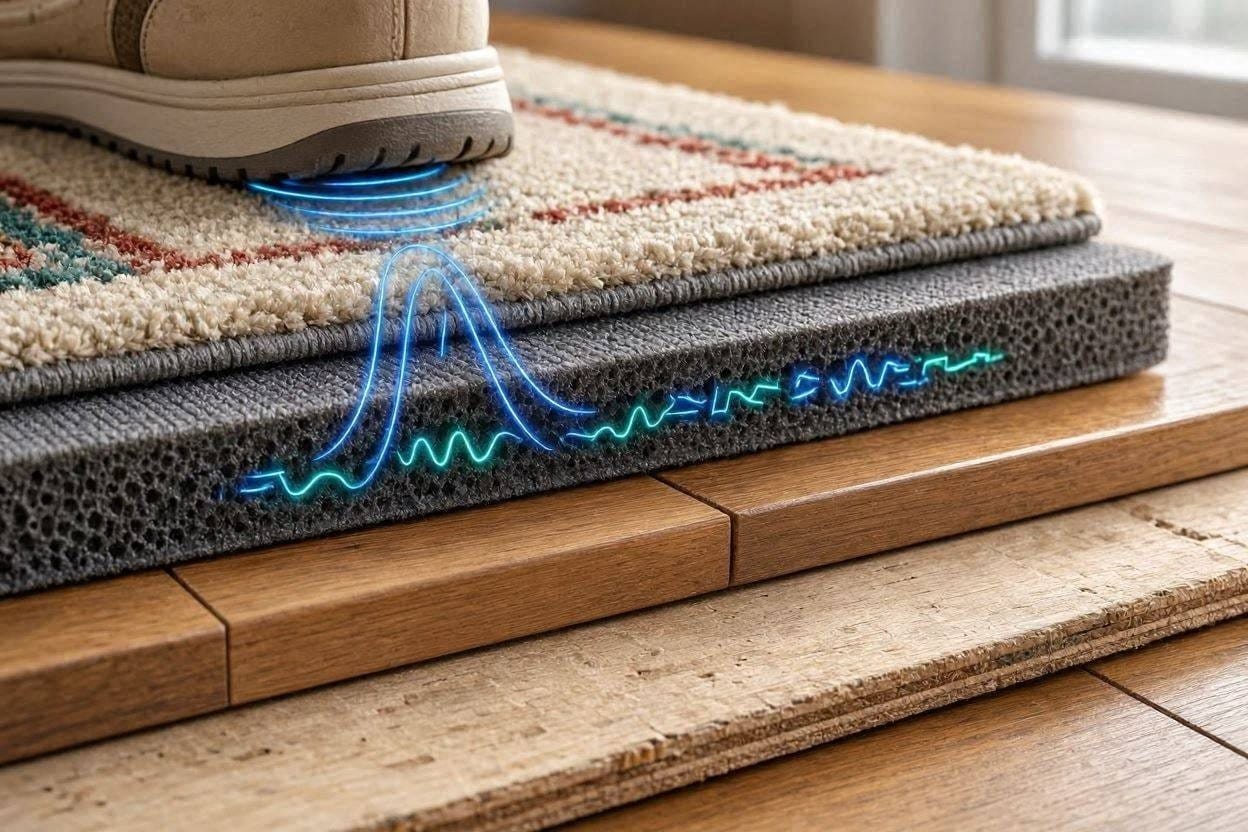
This is where a high-quality, purpose-built rug pad completely changes the game. But we aren’t talking about a cheap, waffle-weave rubber mat from a discount store. True soundproofing rug pads rely on the core principles of acoustics, specifically Decoupling and Absorption.
When you place a dense, thick pad under your rug, you are essentially creating a heavy-duty shock absorber.
Instead of a hard shoe heel striking the hardwood floor and sending a massive vibration straight into the wood, the dense rug pad intercepts it. The kinetic energy of the footstep is forced to travel through thousands of densely packed, heavy fibers. These fibers absorb the physical vibration and safely dissipate it before the energy ever reaches the subfloor below.
According to structural acoustic experts at The Soundproofing Company, effectively treating a noisy floor requires you to physically break the path of vibration. If you rent your home and cannot rip up the floors to install professional acoustic subflooring, a high-density rug pad is the absolute best renter-friendly alternative.
What About Airborne Noise? Will A Rug Pad Block Voices?
It’s important to manage your expectations here. If your downstairs neighbor is blasting the heavy bass on their home theater system, or you can hear them having loud conversations through the floorboards, a standard rug pad is not going to be a magic bullet.
To stop airborne noise, especially the deep, rumbling low frequencies, you need extreme mass and airtight density. The golden rule of acoustics is that only mass stops mass.
However, if you upgrade to a specialized acoustic underlayment that incorporates Mass Loaded Vinyl (MLV), you can actually make a noticeable dent in airborne noise. MLV is incredibly heavy and dense, acting as a deadening barrier that airborne sound waves struggle to penetrate.
Choosing the Right Material: Not All Pads Are Created Equal
If you’ve decided you do need a rug pad to save your sanity, you need to know exactly what materials to look for. Walking into a big-box home improvement store and buying the cheapest pad on the shelf will leave you severely disappointed. Here is how the materials break down acoustically:
1. 100% Recycled Felt (The Best All-Rounder)
Thick, densely compressed felt is excellent for soaking up heavy impact noise. Because the fibers are tightly packed and heavy, they offer incredible resistance to foot traffic. Aim for a thickness of at least 1/4 inch to 1/2 inch. Pro Tip: Look for felt pads that feature a natural rubber backing. The rubber grips the hardwood floor to prevent slipping, while the thick felt handles the heavy acoustic lifting.
2. High-Density Memory Foam (Maximum Cushioning)
If your primary goal is making a plush, luxurious living space that also deadens the sound of kids playing or toddlers falling, high-density memory foam is fantastic. It absorbs sudden kinetic energy exceptionally well, though it doesn’t offer as much airborne sound resistance as a dense felt pad.
3. PVC Waffle Pads (Avoid For Soundproofing)
You know those cheap, grid-like, sticky rubber pads with all the holes in them? Throw them away immediately if soundproofing is your goal. While they are decent at keeping a small rug from sliding around a hallway, they offer exactly zero acoustic benefits. They have absolutely no mass, no structural density, and air passes right through them.
The Verdict: Do You Really Need One?
If you are dealing with impact noise—heavy footsteps, dragging dining chairs, jumping pets, or dropping objects—yes, you absolutely need a soundproof rug pad. It is the single most effective, non-invasive acoustic upgrade you can make to a room without tearing up the floorboards.
Furthermore, if you live in a multi-story house or an upper-level apartment, utilizing a good rug pad is just common courtesy. It minimizes structural vibrations and prevents flanking noise, ensuring that your normal daily living doesn’t inadvertently become someone else’s nightmare below you.
Just remember to manage your expectations: a rug pad is a highly effective shock absorber, not a magical brick wall. It will completely kill the heavy thuds and squeaks, but you’ll need heavier structural modifications if you want to completely block out a loud, booming television from downstairs. Invest in a thick, dense felt or rubber-backed pad, lay it down properly beneath your favorite rug, and enjoy a much quieter, more peaceful dwelling.

Ememobong is the lead researcher and editor at Quiet Dwelling. As a professional technical writer, he specializes in breaking down complex acoustic engineering concepts into simple, actionable steps. His goal is to help people build distraction-free environments for better sleep and deep work.