We have all experienced it: you walk into an empty room, a bare apartment, or a modern office with glass walls, and every single word you speak seems to ring in your ears. Dropping a set of keys sounds like a shattering glass, and having a normal conversation feels chaotic and exhausting.
This harsh, ringing acoustic environment is caused by sound waves bouncing off walls.
But in the science of acoustics, not all bouncing sound is the same. Acoustic engineers categorize this bouncing energy into two distinct phenomena: Echo and Reverberation. While people often use these terms interchangeably, they are physically different, and treating them requires understanding how sound energy interacts with the structural surfaces of your home.
In this guide, we will explore the physics of acoustic reflection, explain the critical differences between an echo and reverberation, and show you exactly how to tame a loud, chaotic room.
The Physics of Acoustic Reflection
To understand why a room sounds terrible, you have to look at how sound travels. Sound is a kinetic wave of pressure moving through the air. When you speak, that pressure wave radiates outward in all directions. According to the Physics Classroom’s study on wave mechanics, sound energy must interact with a medium or a boundary.
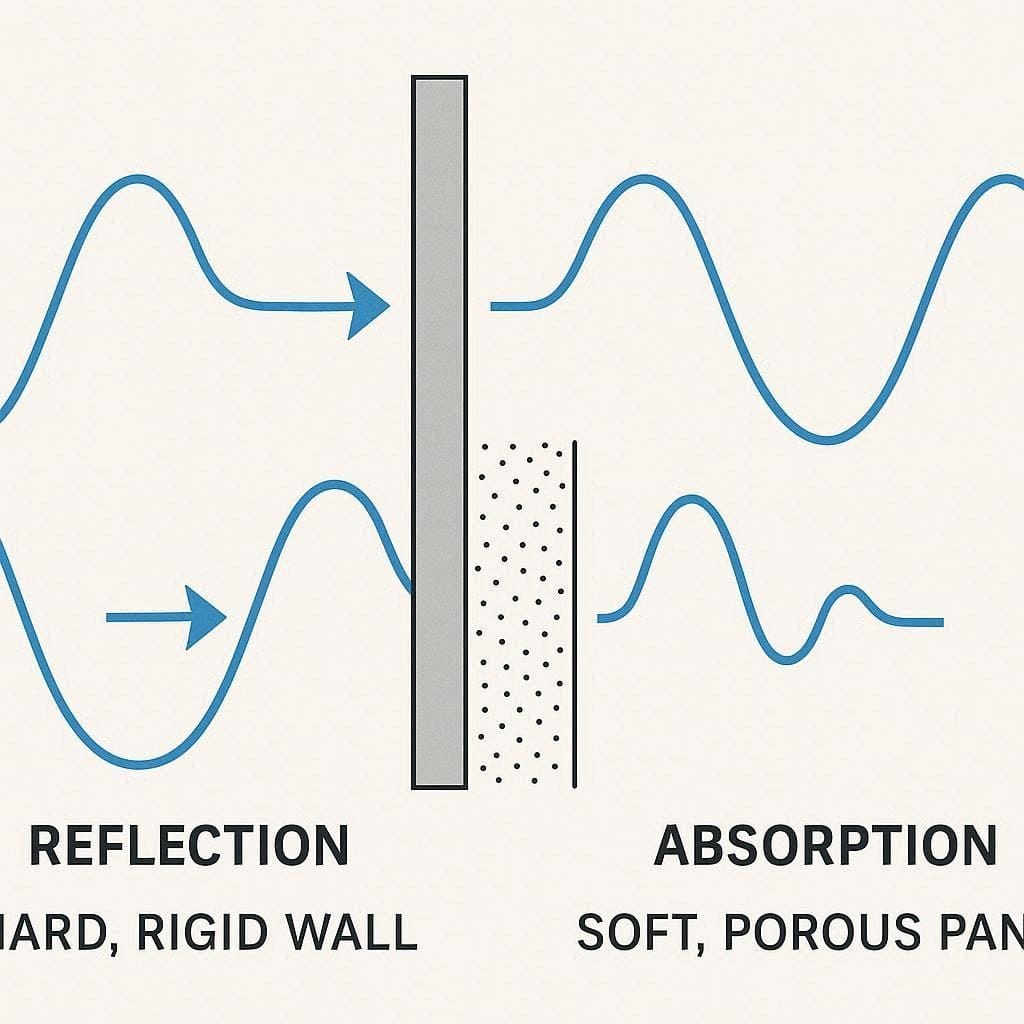
When this wave hits a physical boundary—like a drywall ceiling, a hardwood floor, or a glass window—one of three things happens:
- Transmission: The sound wave passes completely through the wall into the next room.
- Absorption: The wall acts like a sponge, absorbing the kinetic energy and converting it into heat.
- Reflection: The wall acts like a mirror, bouncing the kinetic energy straight back into the room.
Most modern homes are built using highly reflective materials: painted drywall, concrete, glass, and luxury vinyl floors. Because these materials are rigid, heavy, and smooth, they absorb practically zero acoustic energy. Instead, they force nearly 100% of the sound waves to bounce back.
This continuous bouncing of sound waves is what creates both echoes and reverberation.
What is an Echo?
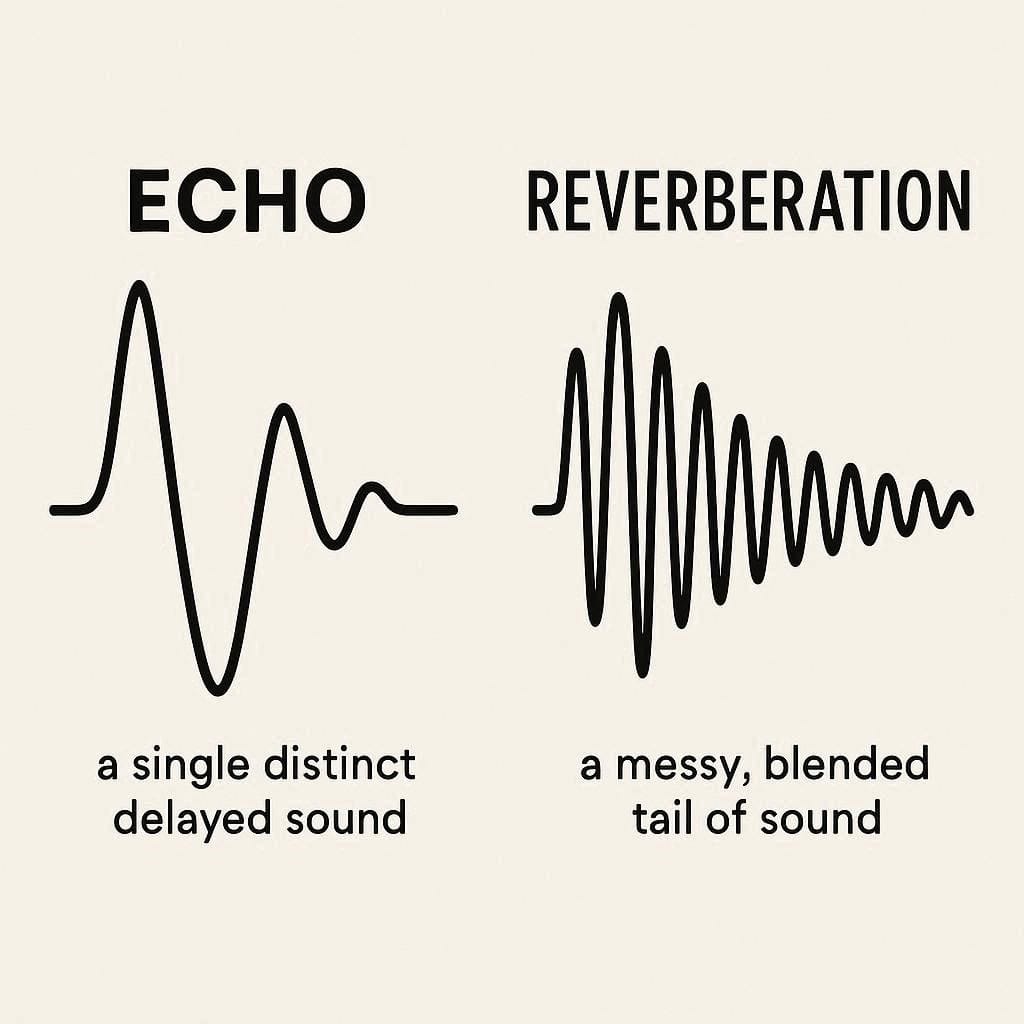
An echo is a single, distinct reflection of sound that arrives at your ear with a noticeable delay after the original sound has stopped.
For an echo to occur, the sound wave must travel a relatively long distance, bounce off a hard surface, and travel all the way back to you. The human brain needs a delay of at least 0.1 seconds (100 milliseconds) to distinguish the original sound from the reflected sound, a threshold studied extensively in Acoustical Society of America documentation. Because sound travels so fast, the reflective surface usually needs to be at least 50 feet (15 meters) away to create a true echo.
Real-World Example: Shouting into a massive canyon or a massive empty gymnasium. You shout “Hello!”, there is a moment of silence, and then you clearly hear “Hello!” bounce back.
Flutter Echo: The Homeowner’s Nightmare
While true echoes are rare in small residential bedrooms, a specific type of echo called a flutter echo is incredibly common. This happens when you have two flat, parallel, hard walls facing each other (like a narrow hallway). The sound wave bounces rapidly back and forth between the two walls like a ping-pong ball, creating a sharp, metallic, ringing sound.
What is Reverberation (Reverb)?
If an echo is a single, distinct bounce, reverberation is the chaotic blending of thousands of bounces.
In a standard-sized room (like a living room or office), the walls are too close together to create the 0.1-second delay required for an echo. Instead, when you speak, the sound waves hit the walls, floor, and ceiling almost instantly. They bounce around the room hundreds of times per second.
Because the reflections hit your ears so quickly and overlap with one another, your brain cannot separate them. Instead of hearing a distinct repeated word, you hear a sustained, messy “tail” of sound that slowly fades away. This duration of time it takes for the sound to fade to silence is called the Reverberation Time (RT60).
Real-World Example: Clapping your hands in an empty tiled bathroom or a large cathedral. You don’t hear distinct individual claps bouncing back; you hear a long, blended “whoosh” of sound that slowly decays.
Echo vs. Reverberation: Quick Summary
| Feature | Echo | Reverberation (Reverb) |
|---|---|---|
| Definition | A distinct, delayed repetition of the original sound. | A continuous, blended wash of overlapping reflections. |
| Required Distance | Usually requires large spaces (50+ feet). | Occurs easily in small to medium-sized rooms. |
| How it Sounds | “Hello… (pause)… Hello” | A sustained, lingering ring that muddies speech. |
How to Stop Sound Waves from Bouncing
Whether you are dealing with a harsh flutter echo in a home recording studio or exhausting reverberation in your living room, the solution is exactly the same: you must introduce Acoustic Absorption.
You cannot change the laws of physics, but you can change the surfaces the sound waves hit. By replacing smooth, reflective surfaces with soft, porous materials, you force the sound waves into a physical maze of fibers. The friction of the air moving through these fibers converts the acoustic energy into trace amounts of heat, killing the reflection instantly.
To stop sound from bouncing off your walls, implement these three highly effective treatments:
1. Install Acoustic Absorption Panels
Hanging specialized acoustic panels made of dense mineral wool or rigid fiberglass is the most effective way to kill reverberation. To understand exactly how much sound these panels absorb, read our guide to understanding NRC (Noise Reduction Coefficient) ratings. Focus on placing these panels at “first reflection points”—the spots on the wall exactly halfway between your mouth and the listener’s ears.
2. Treat the Floor with High-Pile Rugs
Hardwood and tile floors are massive acoustic mirrors. Covering a large portion of the floor with a thick, high-pile rug (paired with a dense felt rug pad) instantly eliminates floor-to-ceiling flutter echoes. If you need to verify the density of your materials, look for data from ASTM International standards regarding sound absorption coefficients.
3. Break Up Flat Walls (Diffusion)
If you don’t want to use absorption panels, you can use diffusion. Diffusers are irregular, 3D shapes (like a heavily stocked bookshelf) that scatter incoming sound waves in dozens of different directions. While this doesn’t absorb the sound, it shatters the organized wave, preventing a harsh echo from forming.
Important Note: Stopping sound from bouncing inside your room will make the room sound beautiful, but it will not stop sound from traveling through the wall into your neighbor’s apartment. To learn the difference between fixing echoes and physically blocking noise, read our complete guide to Soundproofing vs. Sound Absorption.
Frequently Asked Questions (FAQ)
Will Egg Cartons Stop Sound from Bouncing Off My Walls?
No. Egg cartons are made of thin, rigid cardboard. They lack the porous depth required to trap and absorb sound waves. While their irregular shape might offer a tiny microscopic amount of high-frequency diffusion, they are completely ineffective at stopping reverberation and serve only as a major fire hazard.
Why Does My New House Have So Much Echo?
Empty rooms lack soft furnishings. When you remove couches, thick curtains, rugs, and beds, you remove all the natural acoustic absorbers in the room. Without these soft items, sound waves are free to bounce continuously between the bare drywall and hard floors, resulting in massive reverberation.
Does Soundproofing Paint Actually Stop Echoes?
No. “Acoustic paint” is highly deceptive marketing. Standard paint dries to form a hard, rigid film. Even if the paint contains microscopic sound-absorbing particles, the physical layer is far too thin to slow down a kinetic sound wave. To stop a wave from bouncing, you need materials that are at least 1 to 2 inches thick.

Ememobong is the lead researcher and editor at Quiet Dwelling. As a professional technical writer, he specializes in breaking down complex acoustic engineering concepts into simple, actionable steps. His goal is to help people build distraction-free environments for better sleep and deep work.