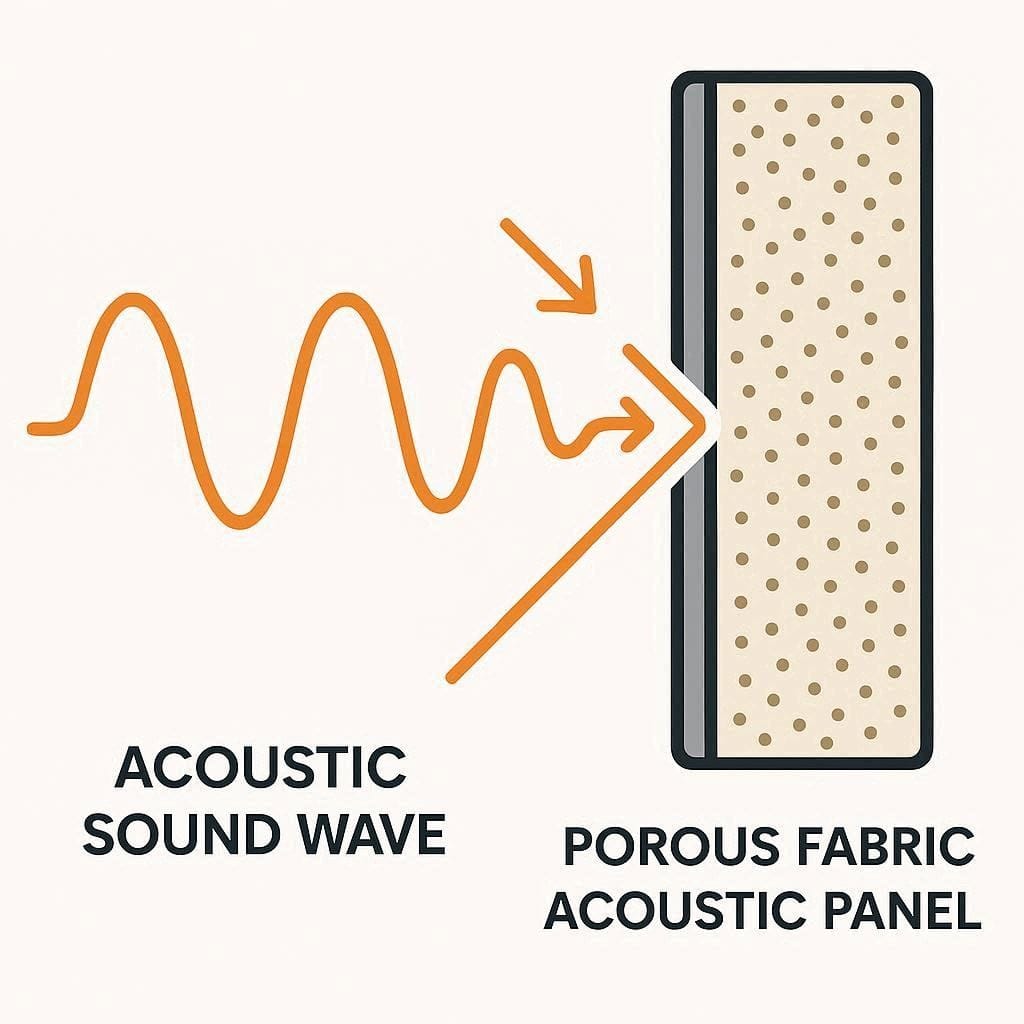
If you are trying to silence an echoey home office, build a quiet recording space, or tame the noise in a lively living room, you have likely shopped for acoustic foam, fabric-wrapped panels, or ceiling tiles. While browsing these products, you will repeatedly encounter a specific decimal rating: NRC.
But what actually is an NRC rating, and how does it impact your bedroom or studio acoustics? Why does one panel have an NRC of 0.85 while another cheap foam triangle is rated at a measly 0.30?
In home acoustics, selecting the wrong materials is a fast track to wasting hundreds of dollars. To design a comfortable, quiet dwelling, you must understand exactly how the Noise Reduction Coefficient works, how it is calculated, and when it is the right tool to use.
In this comprehensive guide, we will break down the science of NRC ratings, explore the limits of acoustic absorption, and help you choose the perfect treatment to reclaim your quiet space.
What is an NRC Rating?
NRC stands for Noise Reduction Coefficient. It is a standard, single-number rating system that measures how much sound energy a specific material absorbs when sound waves strike its surface.
The rating is expressed as a decimal scale ranging from 0.0 to 1.0:
- An NRC rating of 0.0 represents perfect acoustic reflection. Absolutely zero sound is absorbed, and 100% of the acoustic energy bounces straight back into the room (similar to a smooth, thick concrete wall).
- An NRC rating of 1.0 represents perfect acoustic absorption. All sound energy striking the material is absorbed, and 0% is reflected back into the room (similar to an open window).
Sometimes, premium high-performance acoustic materials can achieve an NRC rating greater than 1.0 (such as 1.05 or 1.15). This is not a scientific error; it is a result of the standardized physical testing methods, where three-dimensional panel edges absorb additional sound waves that strike the panel from the sides.
The Physics of NRC: How It Is Calculated
To calculate an NRC rating, acoustics laboratory technicians test materials inside a highly specialized, echo-prone room known as a reverberation chamber. These tests are conducted under strict international guidelines, such as the ASTM C423 standard in North America and ISO 354 globally.
They play sound waves at four highly specific frequencies that represent the standard range of human speech and typical ambient noise: 250 Hz, 500 Hz, 1,000 Hz, and 2,000 Hz.
The absorption coefficient (the percentage of sound absorbed) is measured at each frequency, and the technician calculates the mathematical average of those four points. The formula is incredibly straightforward:
α250 + α500 + α1000 + α2000
4
For example, if an acoustic fiberglass panel absorbs 60% of sound at 250 Hz, 80% at 500 Hz, 90% at 1,000 Hz, and 90% at 2,000 Hz, the math looks like this:
This final rating of 0.80 NRC tells us that, on average, the material absorbs 80% of the sound energy that hits it, while reflecting the remaining 20% back into your room.
NRC vs. STC: The Absolute Core Difference
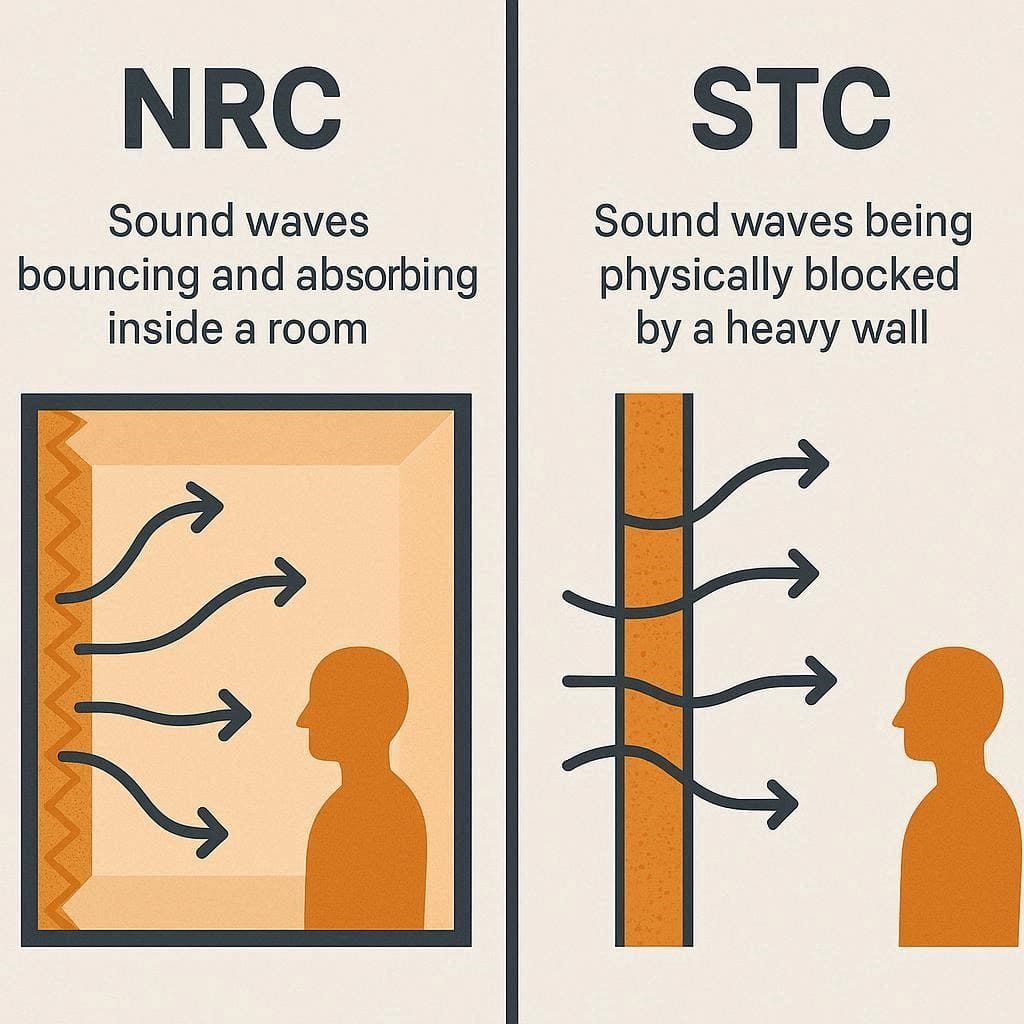
The single most common mistake in DIY home soundproofing is confusing an NRC rating with an STC (Sound Transmission Class) rating. Many homeowners purchase lightweight acoustic foam triangles with a high absorption rating, tape them to their walls, and are shocked when they can still hear their neighbor’s television perfectly.
To avoid this expensive mistake, you must understand the two distinct pillars of acoustics:
- NRC (Noise Reduction Coefficient) measures sound absorption. Its only job is to stop sound from echoing and bouncing around inside the room. It controls the internal acoustics but does virtually nothing to stop sound from traveling through the wall.
- STC (Sound Transmission Class) measures sound blocking. Its job is to stop sound from passing from Room A to Room B. STC relies on dense mass, decoupling, and damping compounds. You can read our master guide to understanding STC ratings to see how to actually block physical sound transmission.
To put it simply: You use high-NRC panels to make your home recording microphone sound crisp, but you use high-STC wall assemblies to keep from waking up your family at night. To understand how these two principles cooperate, check out our master article on soundproofing vs. sound absorption.
The Limitations of NRC Ratings
While the Noise Reduction Coefficient is highly useful, it is not a perfect metric. The biggest limitation of NRC is that it completely ignores low-frequency bass notes.
Because the standard calculation only averages frequencies down to 250 Hz, a material’s performance against deep bass (like the rumble of a home theater subwoofer, highway traffic, or heavy structural machinery) is entirely ignored.
Most thin acoustic foams have an impressive-looking NRC of 0.70, but their absorption at 125 Hz or lower is virtually 0.0. The long, high-energy wavelengths of deep bass pass straight through thin foam without even noticing it. To stop those deep, rattling structural vibrations, you must pair your acoustic treatments with dense structural barriers. Read how density and weight block these pathways in our comprehensive guide to the 4 principles of soundproofing.
Common Materials and Their NRC Ratings
To help you select the right materials for your quiet dwelling, refer to the typical NRC ratings of common household and building materials below:
| Material Type | Typical NRC Rating | Acoustic Behavior |
|---|---|---|
| Concrete / Brick Wall | 0.05 | Highly reflective (Creates heavy echoes) |
| Standard Window Glass | 0.05 | Almost entirely reflective |
| Plush Carpet on Pad | 0.25 to 0.40 | Moderate high-frequency absorption |
| 1-inch Polyurethane Foam | 0.30 to 0.45 | Poor low-end; basic high-frequency control |
| 2-inch Rigid Fiberglass Panel | 0.80 to 0.95 | Elite mid-to-high frequency absorption |
| 3-inch Acoustic Mineral Wool | 1.00+ | Elite broad-spectrum absorption (Some bass control) |
Frequently Asked Questions (FAQ)
Does Paint Affect the NRC Rating of Acoustic Ceiling Tiles or Panels?
Yes, significantly. Standard latex paint dries to form a solid, non-porous physical skin over the surface of a material. If you paint a porous acoustic ceiling tile, you seal off the tiny microscopic openings that let sound waves enter. The sound waves will bounce off the dried paint film, dropping the tile’s NRC rating closer to 0.10 and creating an echo chamber.
Is a Higher NRC Rating Always Better?
Not necessarily; it depends entirely on your room’s purpose. If you are building a home recording studio or home theater, a high average NRC (0.85+) is great to eliminate flutter echoes. However, if you cover every single surface in high-NRC panels, you will make the room sound completely “dead,” which is highly unnatural and uncomfortable for normal conversations. A balance of absorption and reflection is key.
Can Egg Cartons be Used as Cheap Absorption Panels?
No. This is an incredibly common, persistent myth. Egg cartons are made of thin, pressed cardboard. They have practically zero mass and no internal porous fiber network, which are the physical properties required to trap sound waves. Using egg cartons on your walls will do absolutely nothing to absorb sound or improve your room’s NRC—it is simply a fire hazard.

Ememobong is the lead researcher and editor at Quiet Dwelling. As a professional technical writer, he specializes in breaking down complex acoustic engineering concepts into simple, actionable steps. His goal is to help people build distraction-free environments for better sleep and deep work.