If you live in a noisy apartment building, you probably know the frustration. You close your heavy front door, turn the deadbolt, and yet, you can still hear every single footstep, conversation, and slamming door echoing down the hallway as if your door were wide open.
In a desperate attempt to reclaim your peace and quiet, you head to the hardware store, buy a roll of cheap foam weatherstripping, and line your doorframe. But when you close the door, the noise is still there.
This leads to a very common question in home acoustics: does weatherstripping actually block noise?
The scientific answer is yes, but only if you use the correct type of seal, and only against specific types of sound. Standard thermal weatherstripping fails completely at soundproofing because it ignores the fundamental laws of acoustic physics.
In this guide, we will break down exactly how sound behaves like fluid, explain the “1% Rule” of acoustic leaks, and show you the professional-grade seals required to actually silence your doors and windows.
The 1% Rule: How Sound Leaks Through Doors
To understand why weatherstripping is necessary, we must understand how airborne noise travels. Sound is a mechanical wave of kinetic energy moving through the atmosphere. Because it relies on air pressure, sound behaves exactly like water.
If your door is perfectly watertight, it is soundproof. If your door has even a microscopic crack that would let a drop of water through, sound will easily pour through it.
In architectural acoustics, there is a terrifying principle known as the 1% Rule. It dictates that if a wall or door has an open air gap that makes up just 1% of its total surface area, that tiny gap will allow up to 50% of the airborne sound to pass through the barrier.
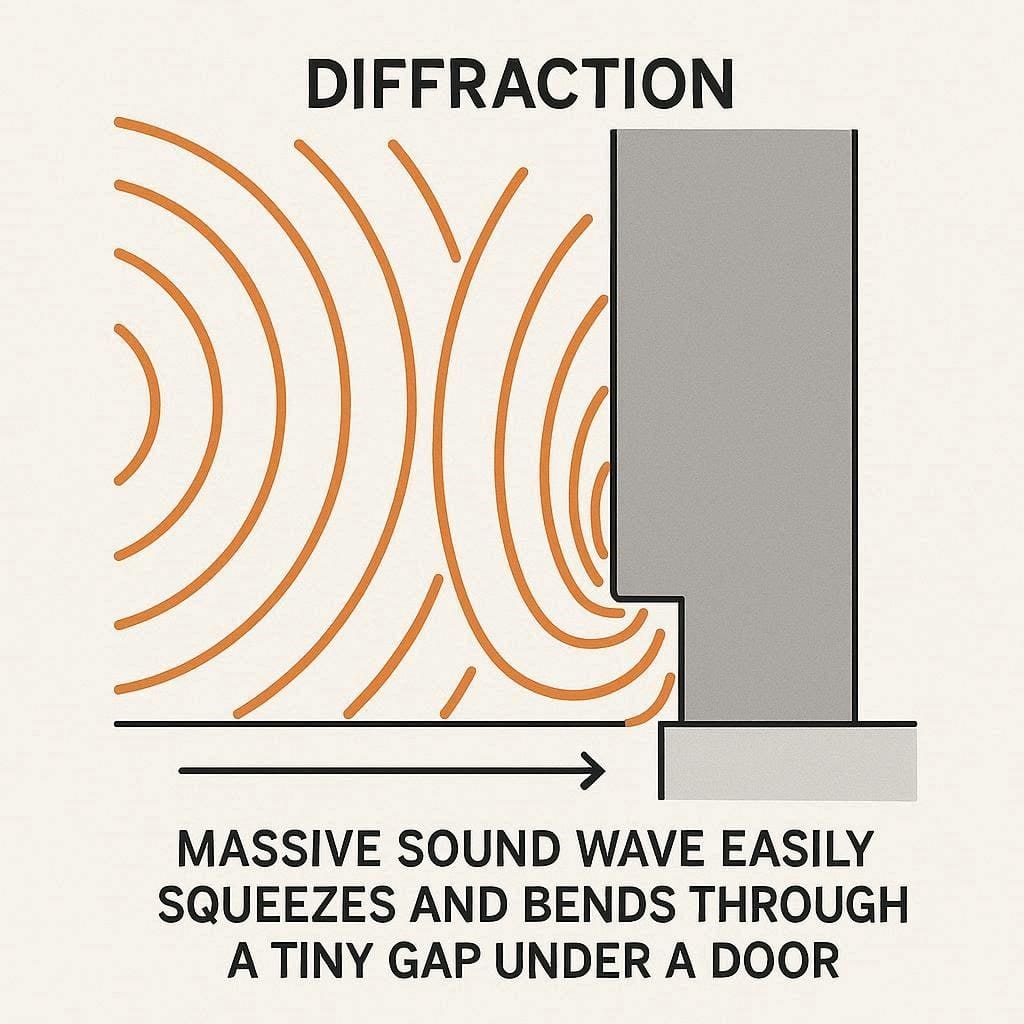
When sound waves hit a tiny gap (like the space under your bedroom door), the wave does not just travel in a straight line. According to the physical principles of acoustic diffraction, the sound wave squeezes through the crack and immediately spreads out in all directions on the other side, filling your room with noise.
This means you can install a massive, solid-oak door, but if there is a 1/4-inch gap at the bottom, your investment is completely ruined. You must seal the perimeter.
Why Standard Foam Weatherstripping Fails
If sealing gaps is so important, why did that roll of hardware store foam fail to stop the hallway chatter?
It comes down to mass and density.
Standard cheap weatherstripping is designed for thermal insulation (stopping drafts of cold air). It is made of open-cell polyurethane foam. Open-cell foam is incredibly light, porous, and filled with air.
When a heavy, kinetic sound wave hits open-cell foam, it doesn’t even slow down. The sound wave simply pushes straight through the microscopic air pockets in the foam. The foam may stop the wind, but it lacks the heavy structural density required to stop a physical wave of acoustic energy.
To learn more about how heavy mass is required to stop sound waves, read our complete guide to understanding STC (Sound Transmission Class) ratings.
The Best Weatherstripping for Soundproofing
If you want to actually block noise, you must use acoustic weatherstripping. These seals are specifically engineered to be dense, airtight, and heavy.
Here are the three materials professionals use to seal doors and windows:
Solid Silicone Bulb Seals
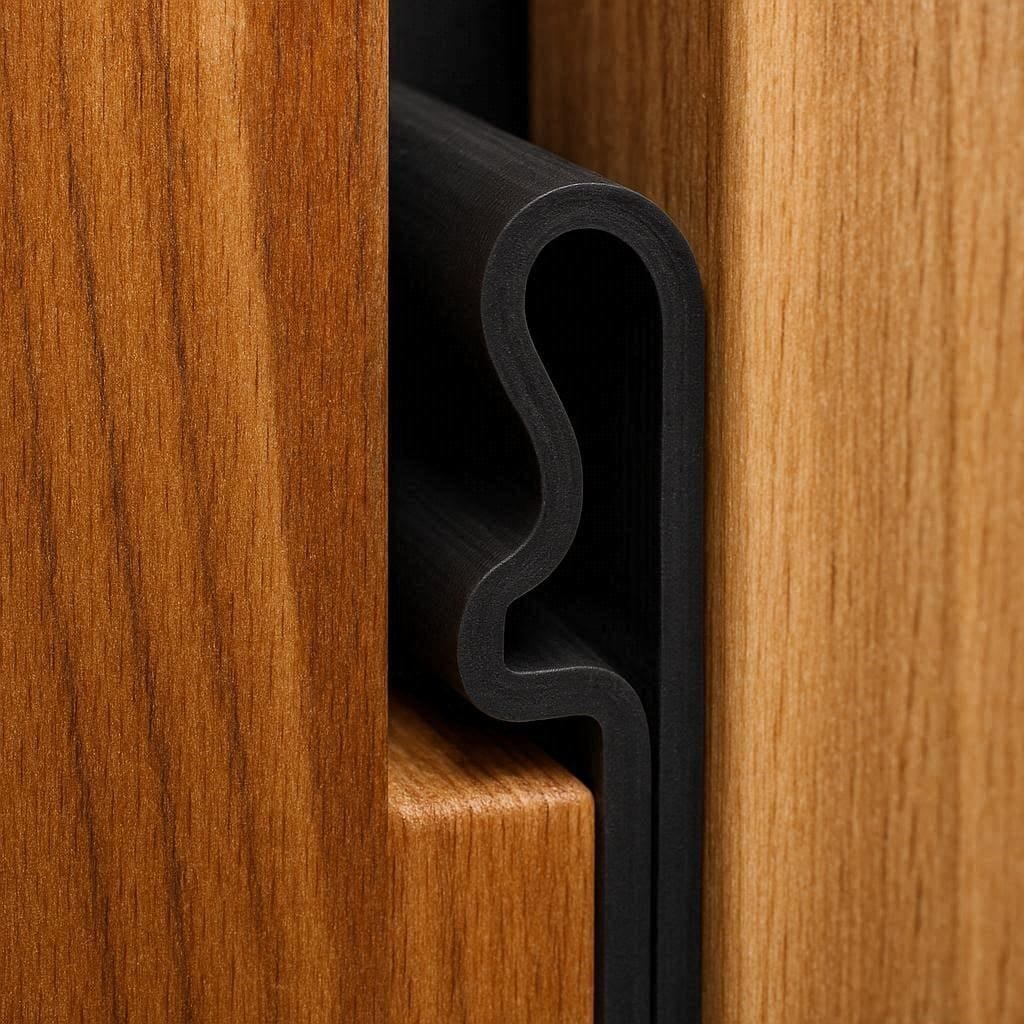
Unlike porous foam, high-grade silicone is dense and completely airtight. A silicone teardrop or bulb seal is installed along the door jamb. When the door closes, it compresses the silicone tube, creating a dense, airtight, heavy gasket that completely blocks high-frequency airborne noise.
Neoprene Rubber Tape
If you need a peel-and-stick option, closed-cell neoprene rubber is vastly superior to standard foam. Neoprene is a dense synthetic rubber. Because it is “closed-cell,” there are no interconnected air pockets for the sound to travel through. It provides excellent acoustic mass.
Automatic Door Bottoms (Drop Sweeps)
The largest gap on any door is at the threshold (the floor). Standard brush sweeps do absolutely nothing to block sound, as the noise simply passes between the bristles. An automatic door bottom is a heavy mechanical aluminum track fitted with a thick neoprene gasket. When you close the door, a plunger is pressed, and the heavy rubber gasket physically drops down to crush against the floor, creating an airtight acoustic seal.
When Weatherstripping Won’t Work
While sealing the air gaps is a mandatory first step, weatherstripping is not a magic cure-all. There are two scenarios where even the best acoustic seal will fail:
- You Have a Hollow Core Door: If your interior bedroom door is hollow (made of two thin sheets of wood veneer over a cardboard honeycomb), sealing the edges will only do so much. The sound will simply bypass the weatherstripping by vibrating straight through the thin, hollow center of the door. You must upgrade to a solid-core door or add mass to the door itself.
- You Are Dealing with Impact Noise: Weatherstripping only blocks airborne sound (like voices and TVs). If you are trying to block the booming vibration of heavy footsteps from the floor above, weatherstripping will do nothing. Impact noise travels through the rigid framing of the building, completely bypassing your door seals.
To truly achieve a quiet dwelling, you must combine airtight seals with heavy structural mass. By understanding how sound behaves like fluid, you can meticulously seal the leaks in your home and finally enjoy the silence.
Frequently Asked Questions (FAQ)
Does Weatherstripping Block Low-Frequency Bass Noise?
No. Low-frequency bass waves (like a subwoofer or a heavy truck engine) are incredibly long and carry massive kinetic energy. They will easily vibrate the solid wood of your door and the drywall surrounding it, bypassing the weatherstripping entirely. To block low frequencies, you need massive structural density and structural decoupling.
Is Magnetic Weatherstripping Better For Soundproofing?
Yes. Magnetic weatherstripping (similar to the seal on your refrigerator door) provides one of the best acoustic seals available. Because the magnet actively pulls the weatherstripping tight against a metal door frame, it ensures a 100% airtight compression seal, eliminating the risk of human error or warped door frames leaving microscopic gaps.
Can I Use Acoustic Caulk Instead of Weatherstripping?
Acoustic caulk and weatherstripping serve two different purposes. Weatherstripping is used for operable joints (things that open and close, like doors and windows). Acoustic caulk is used for fixed joints (sealing the permanent cracks where the door frame meets the drywall). You should use both: caulk the frame, and weatherstrip the swinging door.

Ememobong is the lead researcher and editor at Quiet Dwelling. As a professional technical writer, he specializes in breaking down complex acoustic engineering concepts into simple, actionable steps. His goal is to help people build distraction-free environments for better sleep and deep work.