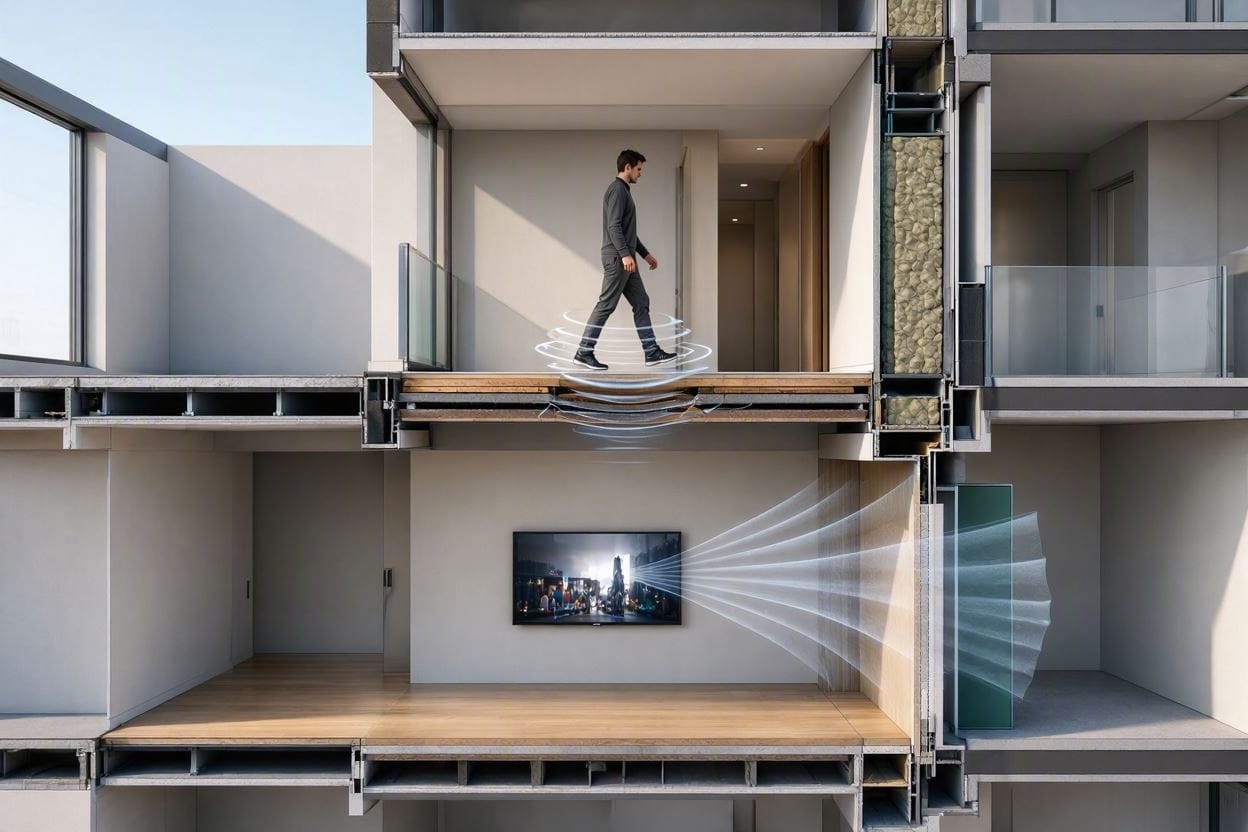
I will never forget my first apartment. The guy next door loved late-night action movies, and the couple upstairs apparently wore concrete boots while practicing Riverdance at 6:00 AM.
Desperate for sleep, I spent hundreds of dollars on cheap acoustic foam panels. I taped them all over my ceiling and shared walls, put in my earplugs, and waited for the magic to happen. The result? Absolutely nothing changed. I could still feel every single footstep vibrating in my teeth, and I could hear every explosion from my neighbor’s TV.
My mistake is the most common and expensive mistake in the soundproofing world. I didn’t understand that noise isn’t just “noise.” In the field of architectural acoustics, sound is split into two entirely different physical categories: airborne noise and impact noise.
If you try to treat impact noise using a method designed for airborne noise, you will fail 100% of the time. In this guide, I will break down the physical science behind both types of sound, how they invade your home, and the exact structural methods you need to block them for good.
🎯 The Quick Science
Airborne Noise: Sound that travels through the air (voices, TV, dogs barking). It behaves like water, slipping through tiny air gaps under doors and vibrating through thin walls. The Fix: Add heavy mass and airtight seals.
Impact Noise: Kinetic energy from physical collisions (footsteps, dropping objects, rattling appliances). It bypasses the air entirely and travels straight through the wood and metal framing of your house. The Fix: Structural decoupling (breaking the physical bridge).
What is Airborne Noise?
Airborne noise is exactly what it sounds like: sound waves that travel through the atmosphere.
When you speak, your vocal cords vibrate, creating pressure waves in the surrounding air. These waves travel outward in all directions until they collide with a physical barrier—like your bedroom door or a shared drywall partition. When the wave hits the wall, the kinetic energy forces the drywall itself to vibrate. That vibrating drywall then pushes the air on the other side of the wall, sending the sound wave into your neighbor’s ears.
Common examples of airborne noise include:
- People talking, shouting, or laughing.
- Televisions, home theaters, and acoustic instruments.
- Sirens, car horns, and highway traffic.
Because airborne noise relies on air to travel, even the microscopic gaps around your door frame can let massive amounts of sound enter your room. To better understand how sound leaks through seemingly solid walls, you can read our complete guide to understanding STC (Sound Transmission Class) ratings.
What is Impact Noise? (Structure-Borne)
If airborne noise is a gust of wind hitting a wall, impact noise is a hammer striking it.
Impact noise—often called structural noise or structure-borne noise—occurs when an object physically collides with a building material. Instead of vibrating the air, it instantly injects raw kinetic energy directly into the rigid structure of the house.
According to the Acoustical Society of America, physical vibrations travel incredibly fast and efficiently through rigid, continuous structures like wooden floor joists, concrete slabs, and copper pipes. This energy shoots down the walls and radiates outward as an audible, booming noise in the rooms below.
Common examples of impact noise include:
- Heavy footsteps or children jumping on the floor above.
- Furniture dragging across a hardwood or tile floor.
- Slamming doors that shake the entire wall frame.
- Vibrations from heavy home appliances, such as loud dishwashers or washing machines on a spin cycle.
This direct physical transmission is why impact noise is notoriously difficult to quiet. You can build a 10-inch thick wall that easily blocks a shouting neighbor, but if their floor joists are connected to your ceiling, you will still feel every footstep.
The Measurement Scales: STC vs. IIC
Because these two sound pathways behave completely differently, architectural engineers require two entirely different metric systems to measure a building’s performance.
| Feature | Airborne Noise | Impact Noise |
|---|---|---|
| Initial Medium | Air (Atmospheric Pressure) | Solid Structure (Physical Collision) |
| Acoustic Metric | STC (Sound Transmission Class) | IIC (Impact Insulation Class) |
| How it Behaves | Flows like fluid through gaps and thin barriers. | Telegraphs rapidly through connected wood/metal frames. |
For impact noise, building codes rely on the IIC (Impact Insulation Class). Technicians measure IIC ratings in a lab by dropping a standardized steel “tapping machine” onto a test floor and measuring the decibels of vibration that pass through to the ceiling below. According to building standards established by the International Code Council (ICC), multi-family apartment buildings require a minimum IIC rating of 50 to keep footstep noise within legally tolerable levels.
How to Actually Stop Both Noises
Now that you know how these sounds travel, you can select the perfect physical treatment method for your home. We cover these methods extensively in our master guide to the 4 principles of soundproofing, but here is the exact strategy for each noise type.
How to Stop Airborne Noise
Because airborne noise behaves like fluid, the key is heavy mass and absolute containment:
- Seal the Leaks: Even a tiny 1% air gap under your door can let up to 50% of the hallway noise inside. Use acoustic caulk around window frames and heavy rubber drop-sweeps on your doors.
- Add Massive Density: Sound waves lack the physical power to vibrate heavy objects. Adding a second layer of 5/8-inch drywall or installing Mass Loaded Vinyl (MLV) inside your walls is highly effective at stopping airborne speech and television noise.
How to Stop Impact Noise
Because impact noise relies on direct physical connections to travel, adding mass will not work. You must use Decoupling (breaking the physical path) and Cushioning:
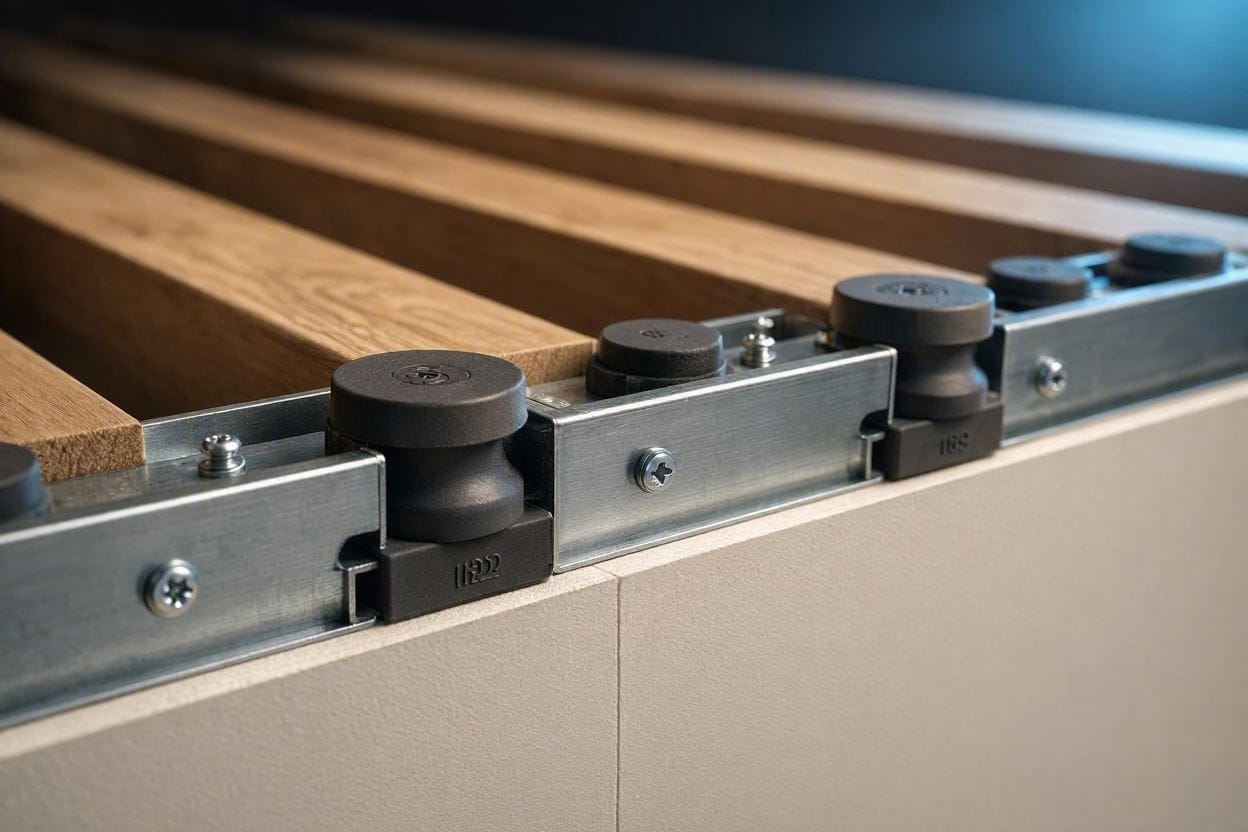
- Decoupling the Ceiling: If you own the home, you can install rubber sound isolation clips and metal “resilient channels” between your ceiling drywall and the wooden floor joists above you. When the upstairs neighbor walks, the rubber clips act as shock absorbers, preventing the vibration from shaking your drywall. This stops flanking noise transmission dead in its tracks.
- Isolate Your Appliances: If your washing machine sounds like an earthquake, place a 1-inch thick, dense vulcanized rubber mat under the four feet of the machine. If you want to solve the problem at its source, upgrading to a modern quiet washing machine with a direct-drive motor will eliminate the violent impact vibrations entirely.
Frequently Asked Questions (FAQ)
Can I Use Acoustic Foam to Stop Impact Noise from Upstairs Neighbors?
No. This is the single most common soundproofing myth. Lightweight acoustic foam panels only absorb sound echoes inside your own room. They have virtually zero mass and cannot decouple structural elements, making them completely useless against footsteps and impact vibrations from upstairs.
Is Low-Frequency Bass (Like a Subwoofer) Airborne or Impact Noise?
It is actually a hybrid of both! A subwoofer produces incredibly powerful, long airborne sound waves. When those massive waves hit your drywall, they are so strong that they physically vibrate the wood framing, turning the airborne noise into structure-borne impact vibrations. Blocking deep bass requires a combination of massive density and structural decoupling.
Is Carpet a Good Solution for Impact Noise?
Yes, absolutely. If you are the upstairs neighbor, placing a thick, high-pile carpet paired with a dense acoustic rug pad is the most cost-effective dampener for impact noise. The soft fibers cushion the kinetic energy of your heel strikes, preventing the initial impact vibration from entering the rigid subfloor in the first place.

Ememobong is the lead researcher and editor at Quiet Dwelling. As a professional technical writer, he specializes in breaking down complex acoustic engineering concepts into simple, actionable steps. His goal is to help people build distraction-free environments for better sleep and deep work.