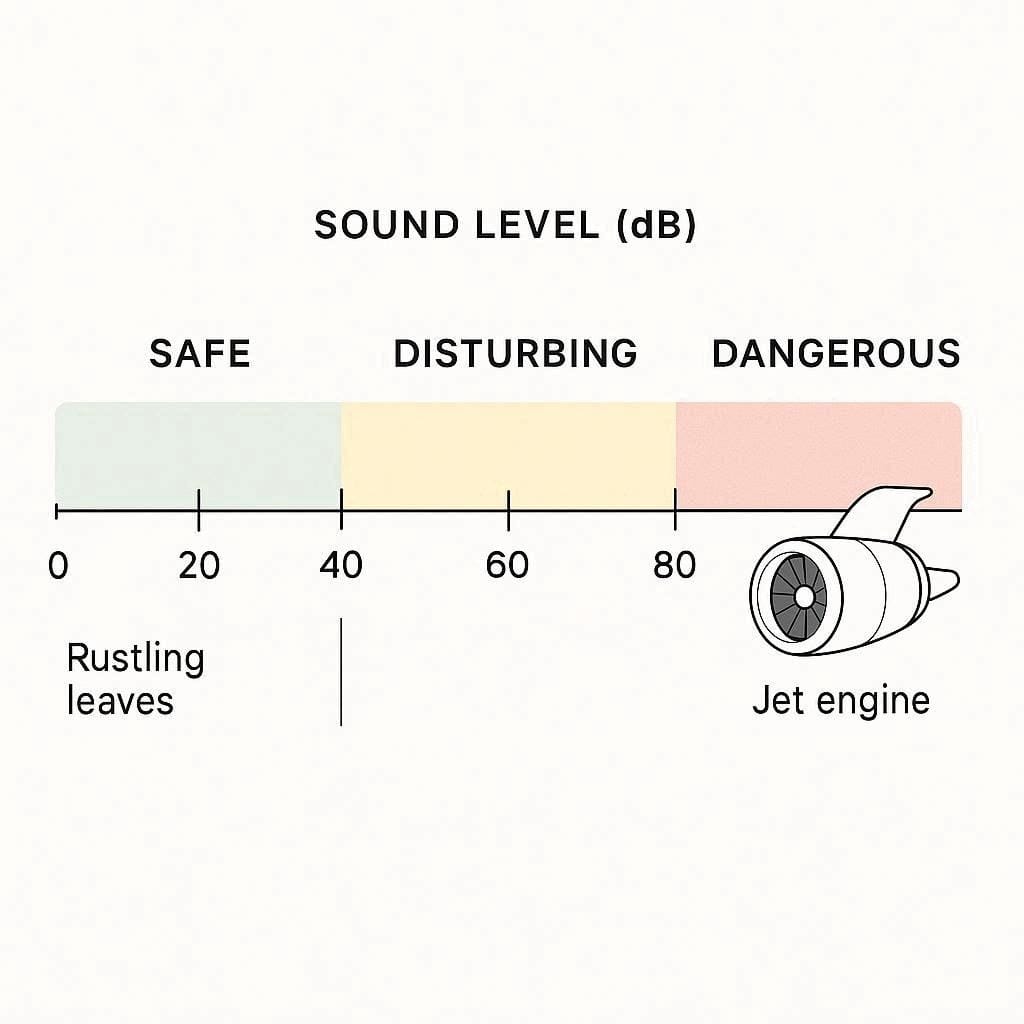
When you are shopping for home appliances like mini-fridges, ceiling fans, or dishwashers, you will inevitably run into a technical specification that looks like this: 35 dB, 45 dB, or 50 dBA.
Manufacturers love to throw these numbers around to prove their products are “whisper-quiet.” But what does a decibel actually mean in the real world? Why does an appliance rated at 40 dB sound twice as loud as one rated at 30 dB, when the math tells you it should only be a tiny fraction louder?
In architectural acoustics, understanding the decibel scale is essential to designing a quiet home. Because the human ear does not perceive sound in a simple, linear way, the math behind sound levels can be highly counterintuitive.
In this guide, we will explain the science of decibel levels, show you how to read the sound scale, and break down what levels are safe for your sleep, concentration, and long-term hearing.
What is a Decibel (dB)?
A decibel (abbreviated as dB) is the unit of measurement used to express the intensity or loudness of a sound.
However, unlike inches or pounds, a decibel is not an absolute unit of measurement. It is a comparative unit that measures the ratio between two values—specifically, the pressure of a sound wave compared to the quietest sound a healthy human ear can physically detect.
This baseline of absolute silence for human hearing is set at 0 dB. It does not mean there is zero physical sound energy in the air; it simply means the sound waves are too weak to vibrate your eardrum.
The Logarithmic Mind-Bender: Why Decibel Math is Different
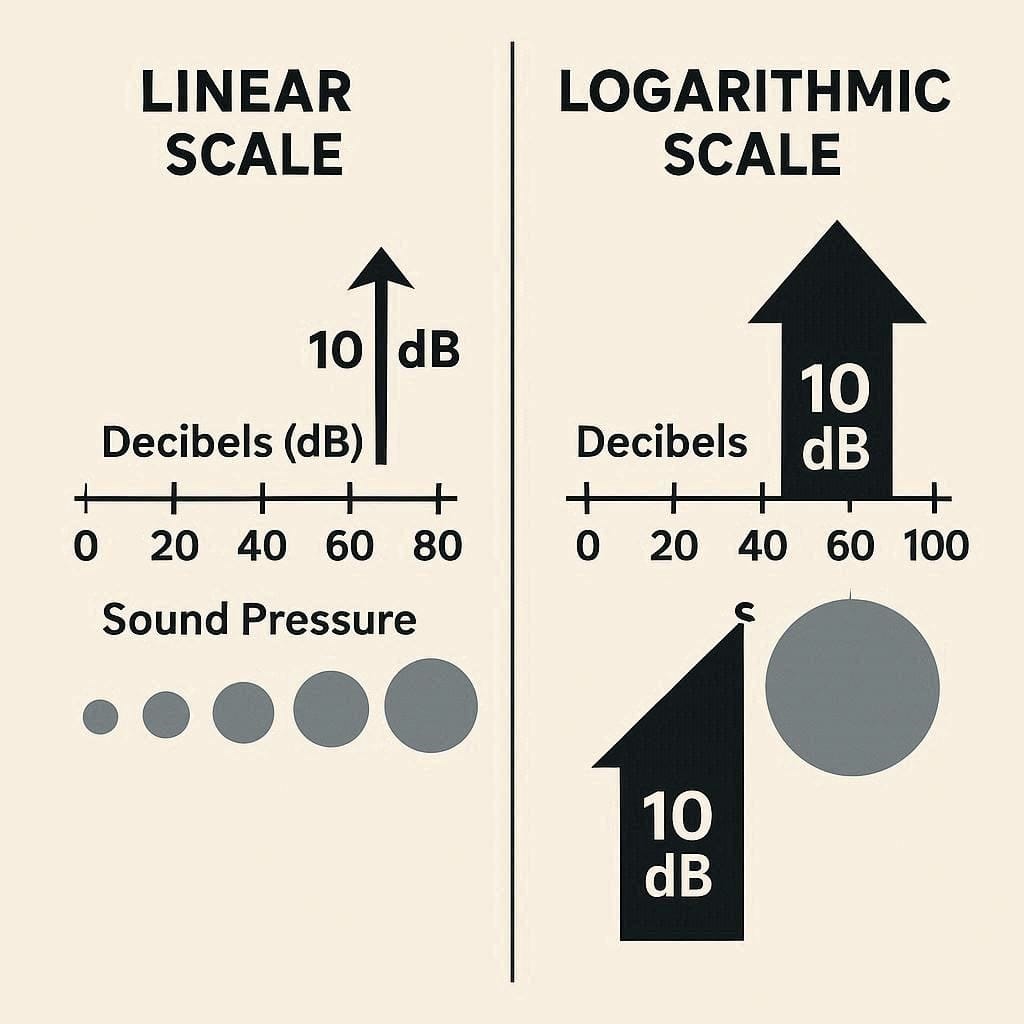
The most confusing aspect of sound measurement is that the decibel scale is logarithmic, not linear.
Our ears are incredibly sensitive instruments. They can detect everything from the microscopic rustle of a leaf to the earth-shaking roar of a jet engine. If we used a linear scale to measure sound pressure, the scale would run from 1 to over 10,000,000,000,000. Managing numbers that large is practically impossible.
To keep the scale manageable, acoustics engineers use logarithms. On a logarithmic scale, the values grow exponentially.
Every increase of 10 decibels represents a ten-fold increase in physical sound energy (intensity).
- A sound at 10 dB is 10 times more intense than 0 dB.
- A sound at 20 dB is 100 times more intense than 0 dB.
- A sound at 30 dB is 1,000 times more intense than 0 dB.
- A sound at 60 dB is 1,000,000 times more intense than 0 dB.
The “Double the Loudness” Rule of Thumb
While physical sound intensity multiplies by ten every 10 dB, the human brain perceives loudness differently. For human hearing, a change of 3 dB is the smallest change you can actively notice, while a jump of 10 dB is perceived as making the sound feel exactly twice as loud.
This is why a 40 dB appliance does not sound slightly louder than a 30 dB appliance—it sounds twice as loud to your brain, even though it is releasing ten times more physical sound energy into your room.
Real-World Decibel Comparison Chart
To help you visualize where typical household noises and appliances land on the decibel scale, refer to this reference chart:
| Sound Level (dB) | How It Feels | Common Examples |
|---|---|---|
| 0 dB | Threshold of Hearing | Absolute silence (laboratory cleanroom) |
| 20 – 30 dB | Whisper-Quiet | Library reading room, rustling leaves, quiet bedroom at night |
| 40 dB | Quiet Ambient | Modern refrigerator hum, soft rain, hum of computer fan |
| 50 – 60 dB | Moderate | Normal conversation, quiet dishwasher, light traffic outside |
| 70 dB | Loud | Vacuum cleaner, hair dryer, busy office environment |
| 85+ dB | Dangerous (Long exposure) | Lawn mower, heavy city traffic, food blender |
| 120+ dB | Threshold of Pain | Siren, live rock concert, jet takeoff at close range |
What Decibel Level is Safe for Sleep?
Because your ears function as a 24-hour warning radar, loud or inconsistent sounds will instantly trigger your brain’s alarm centers.
According to extensive public environmental guidelines established by the Centers for Disease Control and Prevention (CDC), continuous environmental noise in a bedroom should remain below 30 dB to ensure deep, restorative sleep. Any individual sound event that spikes above 45 dB (like a car horn or a loud pipe rattle) is highly likely to cause a micro-arousal or full awakening.
If your bedroom is chronically exposed to sound levels above these thresholds, your vascular system stays under constant, low-level stress. To discover how this invisible, constant hormone trigger affects your body and immune system, read our comprehensive guide on the health effects of noise pollution.
The dBA Scale: Tuning the Mic to the Human Ear
When reading acoustic specs, you will often see decibels written as dBA instead of just dB.
This is called A-weighting. The human ear is not equally sensitive to all sound frequencies. We are highly sensitive to mid-range frequencies (like human voices and crying babies) but struggle to hear very low frequencies (like deep bass) or very high frequencies (like dog whistles).
If an acoustic meter measures a deep, low-frequency hum, the physical dB reading might be very high, but to your ears, it sounds incredibly quiet. A-weighting adjusts the raw decibel reading using a mathematical curve to match how the human ear actually perceives the volume.
When you are buying home appliances, always look for the dBA spec, as it represents the actual, real-world volume you will perceive while using it in your kitchen or bedroom.
How to Apply This to Your Home
When designing a quiet dwelling, understanding these decibel levels allows you to select the perfect physical mitigation tactics:
- For High-Decibel Low Frequencies (Bass & Machinery): Standard drywall cannot stop these deep waves. You must decouple your partitions. Learn how to isolate structural vibrations in our guide on the four principles of soundproofing.
- For Medium-Decibel High Frequencies (Voices & TVs): These are blocked through massive density. Upgrading standard 1/2-inch drywall to heavy 5/8-inch Type X sheets is highly effective.
Frequently Asked Questions (FAQ)
What is Considered a Quiet Decibel Level For Appliances?
For an appliance that runs constantly (like a refrigerator or air purifier), any rating below 40 dBA is considered exceptionally quiet and suitable for bedroom environments. For appliances that run periodically (like a dishwasher), anything below 45 dBA is considered virtually silent in an open-concept kitchen.
Can Human Ears Detect 0 dB?
Yes. 0 dB is defined as the absolute threshold of human hearing for a healthy young adult. It is not “absolute silence” in physical physics—sounds can exist in negative decibel levels (such as -5 or -10 dB)—but these are completely silent to the human ear.
How Can I Measure the Decibel Level in My Bedroom?
While professional acousticians use expensive, calibrated sound level meters, you can get a highly accurate baseline reading using a smartphone app (like the NIOSH Sound Level Meter app). Ensure you measure the room in complete silence at night to find your room’s “ambient noise floor.”

Ememobong is the lead researcher and editor at Quiet Dwelling. As a professional technical writer, he specializes in breaking down complex acoustic engineering concepts into simple, actionable steps. His goal is to help people build distraction-free environments for better sleep and deep work.