For years, I made a massive mistake with my sleep hygiene. I lived in a noisy apartment building, and to drown out the sounds of my upstairs neighbors, I bought a cheap “white noise” machine off the internet. I turned it up to maximum volume, placed it next to my pillow, and tried to sleep.
Instead of waking up refreshed, I woke up with a headache. My ears felt fatigued. The sound coming out of that machine was a harsh, aggressive, high-pitched hiss that sounded like a broken television channel from the 1990s.
I eventually learned that the entire consumer sleep industry has a terrible habit of using the phrase “white noise” as a universal catch-all for any background sound. But to an acoustic engineer or a neurologist, white noise is a very specific, aggressive acoustic frequency. And frankly, it is terrible for long-term sleep.
If you are trying to block out a snoring partner, street traffic, or just want to fall asleep faster, you need to stop listening to TV static and switch to the acoustic frequency that actually mimics nature. In this guide, we are going to break down the cold, hard science of pink noise vs. white noise, and explain why one is a biological hack for your brain.
🎯 The Quick Verdict
White Noise contains equal energy across all frequencies. It sounds like harsh, hissing TV static. It is great for blocking out sharp, sudden noises (like a dog barking), but it causes ear fatigue and is generally too abrasive for 8 straight hours of sleep.
Pink Noise turns down the high-pitched frequencies and boosts the deep bass. It sounds like a rushing river or heavy rainfall. Clinical studies show it actively synchronizes with your brain waves to trigger deep, restorative slow-wave sleep. Pink noise is the undisputed champion for sleeping.
1. What is White Noise? (The Wall of Sound)
To understand why white noise sounds so abrasive, we have to look at the physics of the audio spectrum. Human hearing generally spans from 20 Hertz (very deep bass) up to 20,000 Hertz (a piercing, high-pitched whistle).
In physics, true white noise contains equal energy across all measurable sound frequencies. Just as white light is a combination of all colors in the visual spectrum shining at once, white noise is a combination of every frequency the human ear can hear playing simultaneously.
Because the energy is distributed equally, the thousands of high-frequency sounds overpower the low-frequency bass. This is why white noise sounds incredibly bright, hissing, and sharp.
When Should You Use White Noise?
While it isn’t great for relaxing, white noise is the ultimate acoustic shield. If you work the night shift and need to sleep during the day while a construction crew is using a jackhammer outside, white noise is your best friend. Because it contains so much high-frequency energy, it forms a dense “wall of sound” that effortlessly masks sharp, sudden spikes in environmental noise.
2. What is Pink Noise? (The Biological Hack)
If white noise is a screeching wall of static, pink noise is the sound of nature.
In pink noise, the acoustic power decreases by half (a drop of 3 decibels) every time the frequency doubles (an octave). To put it simply: Pink noise heavily boosts the deep, soothing bass frequencies, and drastically turns down the harsh, high-pitched frequencies.
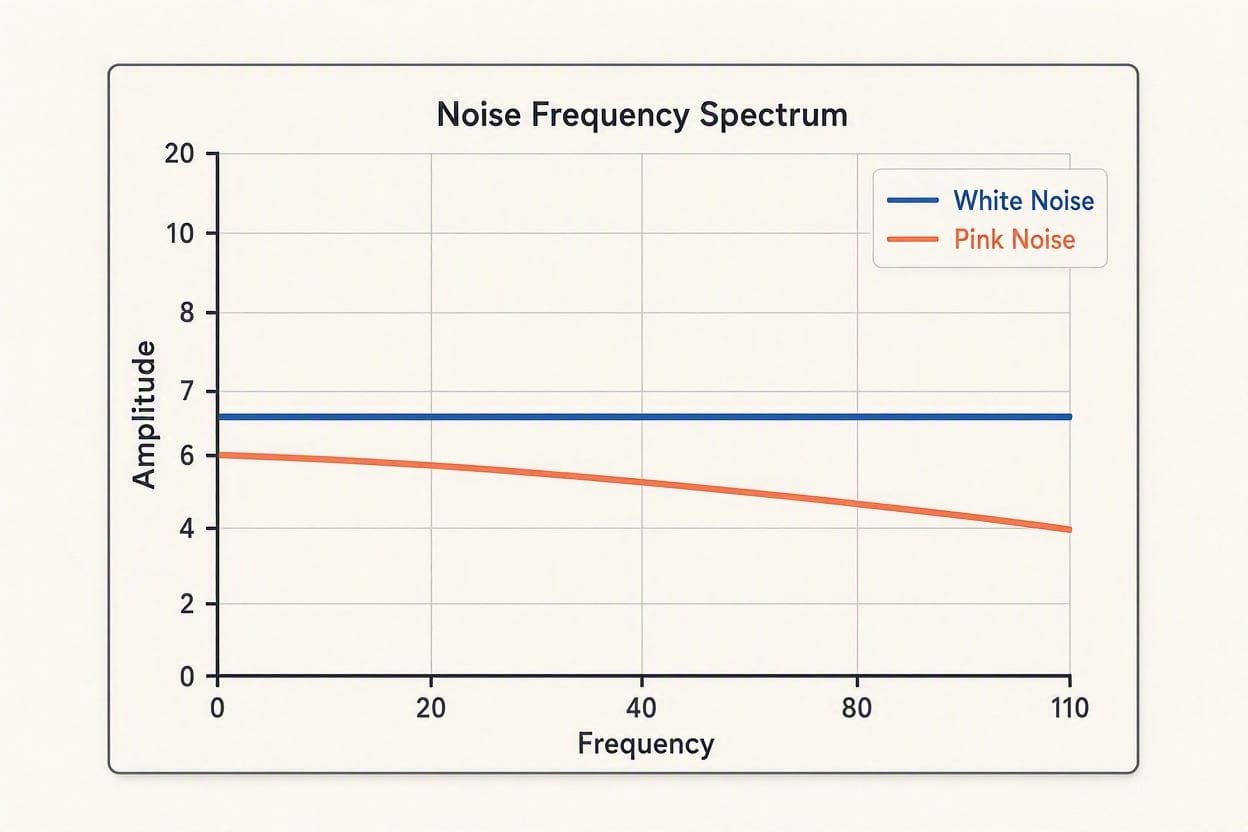
Because the high frequencies are rolled off, pink noise sounds incredibly warm, heavy, and soothing. It mimics the exact acoustic profiles found in the natural world: the steady rustling of leaves in a dense forest, heavy rainfall on a roof, or the continuous rush of a deep river.
The Neurological Proof: Why Pink Noise Wins
The debate between pink noise vs white noise was officially settled by neurologists. Pink noise doesn’t just sound better to your ears—it physically interacts with your brain to improve the quality of your sleep architecture.
According to a landmark clinical study published by Frontiers in Human Neuroscience, listening to steady pink noise during the night actually synchronizes with the brain waves of older adults. The researchers found that the rhythm of pink noise matches the rhythm of human brain waves during slow-wave sleep (Deep Sleep).
By playing pink noise, the brain is coaxed into staying in this deep, restorative sleep stage longer. The patients in the study who slept with pink noise demonstrated significantly improved memory retention and cognitive recall the next morning compared to those who slept in silence.
As we covered in our deep dive into the health effects of nighttime decibel levels, sudden noises pull you out of slow-wave sleep. Pink noise acts as a double-edged sword: it masks those sudden noises, and chemically encourages your brain to stay asleep.
What About Brown Noise?
If you have spent any time on TikTok or Reddit lately, you have probably heard people raving about “Brown Noise” as a cure for ADHD or lack of focus.
Brown noise (sometimes called Red Noise) takes the concept of pink noise and pushes it to the absolute extreme. It completely eliminates all high and mid-range frequencies, leaving nothing but a heavy, rumbling bass. It sounds like a roaring waterfall or the deep hum of a commercial jet cabin mid-flight.
While brown noise is fantastic for deep cognitive focus, reading, or providing relief for people who suffer from Tinnitus (ringing in the ears), it is usually too heavy and “boomy” for sleeping. For a full breakdown of the entire acoustic spectrum, you can read our master guide on The Colors of Noise Explained.
Head-to-Head Comparison Summary
| Feature | White Noise | Pink Noise |
|---|---|---|
| Frequency Profile | Equal energy across all frequencies. | Lower frequencies boosted, highs rolled off. |
| What it Sounds Like | Harsh, hissing TV static or a vacuum. | Steady rainfall or a rushing river. |
| Acoustic Benefit | Exceptional at blocking sharp, sudden sounds. | Synchronizes with deep brain waves. |
| Best Daily Use | Loud offices, shift workers sleeping during the day. | Nighttime sleep, nurseries, and memory consolidation. |
How to Get Pink Noise in Your Bedroom (Without an App)
While there are thousands of ten-hour pink noise videos on YouTube, playing them through a tiny smartphone speaker ruins the effect. Small phone speakers physically cannot produce the deep bass frequencies required for true pink noise; they will just make it sound like harsh white noise again.
To get real pink noise, you need a physical machine that moves air. You can buy a dedicated mechanical sound machine (like the classic Dohm), but I highly recommend a dual-purpose appliance.
Buying one of the best quiet air purifiers and running it on a medium fan setting produces a flawless, organic pink noise. It provides the deep acoustic masking your brain craves while simultaneously stripping dust, pet dander, and allergens out of your bedroom air, ensuring you breathe as perfectly as you sleep.
Frequently Asked Questions (FAQ)
Is it Safe to Listen to Pink Noise all Night Long?
Yes, but volume is critical. The Sleep Foundation and health experts agree that continuous background noise should be kept at a safe, ambient level—ideally under 45 to 50 decibels. You should never place a sound machine directly next to your pillow; place it across the room, ideally between your bed and the source of the outside noise (like a window or door).
Should I Use Pink Noise or White Noise For My Baby’s Nursery?
Pink noise is highly recommended for infants. A baby’s developing auditory system is highly sensitive to high-frequency sounds. Pumping harsh white static into a crib can be irritating and cause ear fatigue. Pink noise provides the gentle, bass-heavy acoustic womb-like environment that soothes them without the sharp acoustic spikes.
Can a Ceiling Fan Create Pink Noise?
Yes! A high-quality ceiling fan or a quiet bedroom tower fan is one of the best organic generators of pink noise. The steady, low-frequency “whoosh” of the air rolling off the blades perfectly mimics the downward-sloping acoustic profile of pink noise, providing excellent sound masking.

Ememobong is the lead researcher and editor at Quiet Dwelling. As a professional technical writer, he specializes in breaking down complex acoustic engineering concepts into simple, actionable steps. His goal is to help people build distraction-free environments for better sleep and deep work.