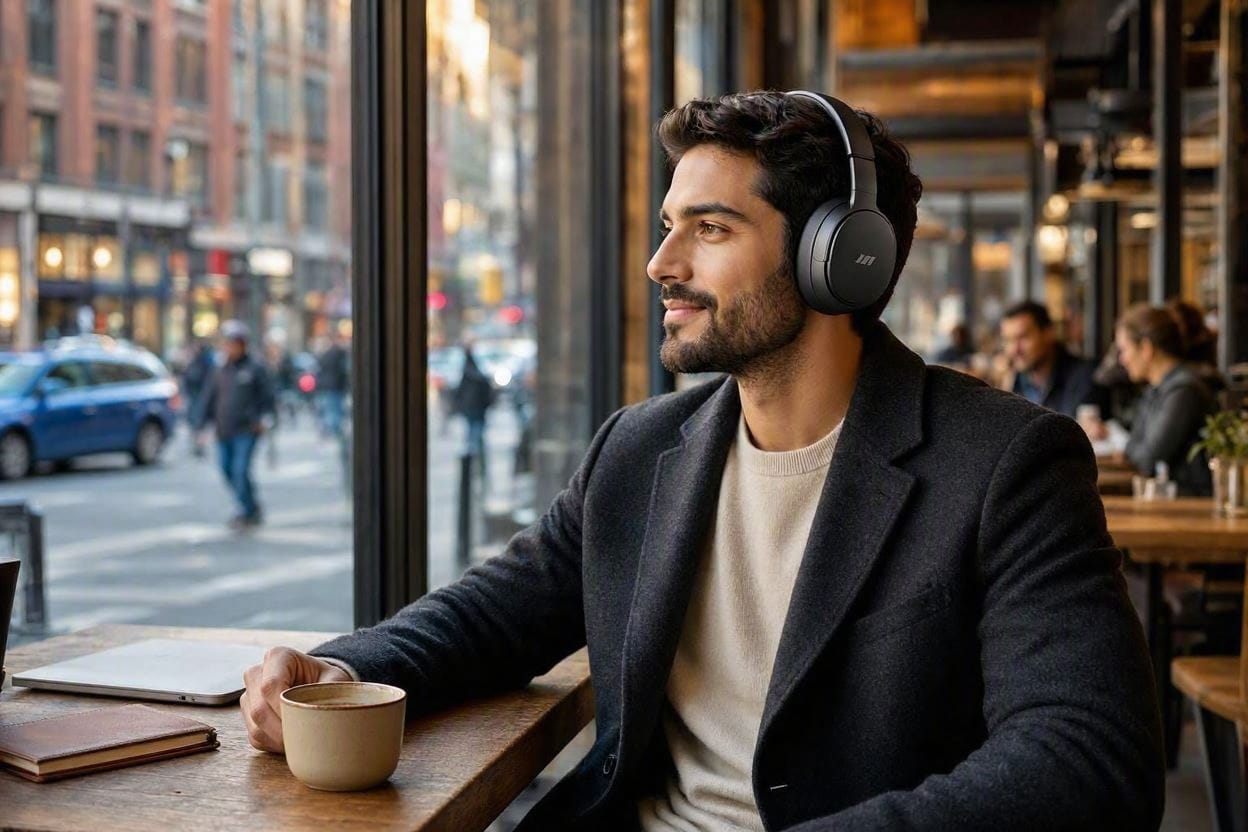
We all remember the first time we experienced it. You put on a pair of premium headphones while sitting in a loud office or on a rumbling airplane. You press a single button on the side of the ear cup, and instantly, the chaotic roar of the world is sucked out of the room. It feels like someone just hit the “mute” button on reality.
Active Noise Cancellation (ANC) feels like absolute magic. But it isn’t magic; it is an incredible feat of high-speed acoustic mathematics.
Unlike traditional soundproofing, which relies on heavy physical mass (like thick drywall or solid doors) to block sound from traveling, ANC uses electronic processing to fight sound with sound. By understanding the physics behind this technology, you can better understand why it is so effective at saving your sanity on a flight—and why it suddenly fails when a baby starts crying.
In this guide, we are going to break down the science of destructive interference, explain the microscopic hardware inside your headphones, and reveal the physical limitations of ANC technology.
🎯 The Quick Science
The Mechanism: Microphones on your headphones “listen” to the outside noise. An internal computer instantly calculates the exact mathematical opposite of that sound wave (the anti-noise) and plays it into your ear. When the two waves collide, they destroy each other, leaving zero sound pressure (silence).
The Limitation: ANC is phenomenal at blocking constant, low-frequency drones (like airplane engines or AC units). It struggles to block sudden, high-frequency noises (like speech or barking dogs) because the computer cannot predict them fast enough.
The Physics of Sound Waves
To understand how a headphone destroys noise, we first have to understand what noise actually is.
Sound is not a solid object; it is a kinetic wave of mechanical energy. When an airplane engine roars, it vibrates the air molecules around it. Those molecules bump into the next molecules, creating a chain reaction of high-pressure and low-pressure zones that travel through the air until they hit your eardrum.
If we graph this energy, it looks like a traditional wave with peaks (the high points) and troughs (the low points). As explained by The Physics Classroom, the height of the wave dictates the volume (measured in decibels), and the distance between the waves dictates the pitch (measured in Hertz).
The Secret Weapon: Destructive Interference
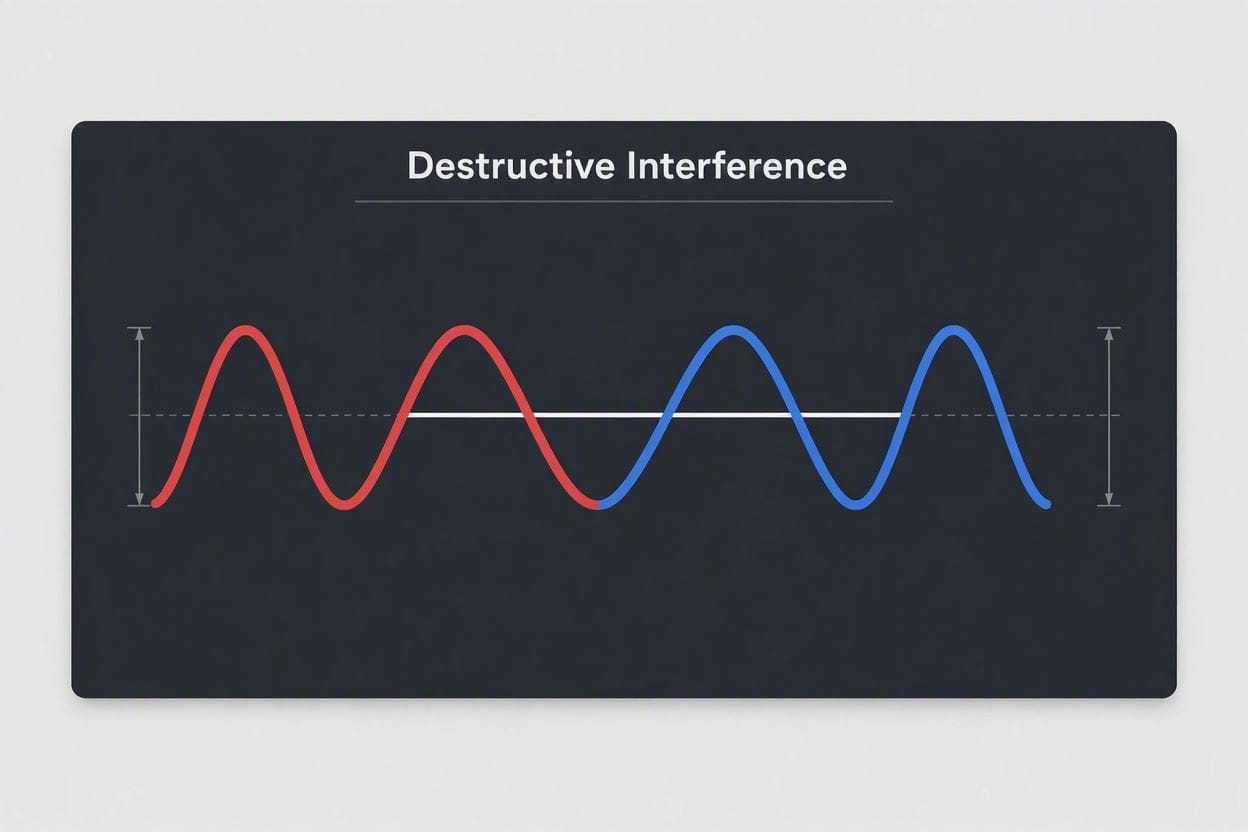
When two sound waves traveling through the air collide, they don’t bounce off each other—they interact. This is called wave interference.
If you take two identical sound waves and align them perfectly (peak to peak), they will combine their energy and become twice as loud. This is called constructive interference.
But what happens if you take one of those sound waves and shift it exactly 180 degrees so that it is entirely upside down? Now, the peak of the first wave aligns perfectly with the trough (the bottom) of the second wave.
When a high-pressure peak collides with a low-pressure trough of equal force, they push against each other and completely cancel out. The energy is neutralized. The air stops vibrating, and the result is absolute silence. In physics, this is called destructive interference. To put it into simple math:
How Your Headphones Do It (The Hardware)
Generating a perfectly inverted anti-noise wave in real-time requires incredibly sophisticated hardware. When you look at our top picks for the best noise-canceling headphones for flying (like the Sony WH-1000XM5 or Bose QuietComfort), they all use this same 3-step loop:
- The Microphones Listen: Tiny, highly sensitive microphones mounted on the outside (and sometimes inside) of the headphone earcups constantly record the ambient noise around you.
- The DSP Calculates: The microphone sends this raw audio data to the Digital Signal Processor (DSP)—a lightning-fast microchip inside the headphones. The DSP analyzes the wave and mathematically inverts it.
- The Speaker Fires: The headphone’s internal speaker plays your music, but it simultaneously plays the inverted anti-noise wave. The outside noise and the anti-noise collide right inside your ear canal, destroying the background drone while leaving your music completely untouched.
The Latency Bottleneck: Why ANC Fails at Sudden Noises
If ANC is so brilliant, why can you still hear your coworker talking or a dog barking when you have your headphones on?
It comes down to a problem called the Latency Bottleneck.
For the DSP chip to generate an anti-noise wave, it takes a fraction of a millisecond. If you are sitting on an airplane, the deep, low-frequency hum of the jet engine is long, repetitive, and entirely predictable. The computer chip knows exactly what the sound wave will look like a millisecond from now, so it can perfectly match the anti-wave to it.
However, a baby crying, a dog barking, or a glass dropping on the floor are sudden, high-frequency, unpredictable acoustic spikes. By the time the microphone hears the baby cry and the computer calculates the inverted wave, the original sound has already passed your eardrum. The computer is simply too slow to catch it.
This is why ANC is a godsend for low-frequency rumbles, but you still need passive sound isolation (like thick memory foam ear pads or heavy, dense earplugs) to block high-frequency chatter. To understand how density blocks these higher frequencies in your home, read our guide on how STC ratings block airborne noise.
Side-by-Side: Active vs. Passive Soundproofing
To summarize how to protect your hearing in different environments, here is how active electronics compare to passive physical barriers:
| Feature | Active Noise Cancellation (ANC) | Passive Isolation |
|---|---|---|
| How it Works | Destructive interference (Anti-sound waves) | Physical blocking via density and mass |
| Best For | Low-frequency, constant hums (Planes, AC units) | High-frequency, sudden noises (Voices, sirens) |
| Power Requirement | Requires constant battery power | Zero power needed |
| Real-World Example | Sony/Bose Headphones | Foam earplugs, thick drywall, solid doors |
Frequently Asked Questions (FAQ)
Does Active Noise Cancellation Emit Harmful Radiation?
No, this is a common myth. ANC technology does not emit radiation or dangerous frequencies. It simply uses standard audio speakers to play a sound wave. The “anti-noise” wave is acoustically identical to normal sounds you hear every day; it is just perfectly timed to collide with and neutralize the incoming background noise.
Why Do Noise-Canceling Headphones Make My Ears Feel Weird or Pressurized?
Many users report a feeling of “eardrum suck” or false cabin pressure when they turn on ANC. Because ANC aggressively deletes low-frequency ambient sounds, your brain is suddenly deprived of the baseline background noise it expects to hear. Your brain registers this sudden lack of low-frequency sound as a physical change in atmospheric pressure (similar to the feeling of driving up a steep mountain or taking off in an airplane).
Can ANC Protect My Hearing at a Loud Concert?
No, you should never rely on ANC to protect your hearing at a live music event. Concerts regularly exceed 110 decibels of highly erratic, dynamic sound. The immense sound pressure can actually overwhelm the internal microphones of ANC earbuds, causing the DSP chip to panic and emit sharp bursts of electronic static. For concerts, you must use passive high-fidelity earplugs.

Ememobong is the lead researcher and editor at Quiet Dwelling. As a professional technical writer, he specializes in breaking down complex acoustic engineering concepts into simple, actionable steps. His goal is to help people build distraction-free environments for better sleep and deep work.