
*This post contains affiliate links. If you use these links to buy something we may earn a commission at no extra cost to you.
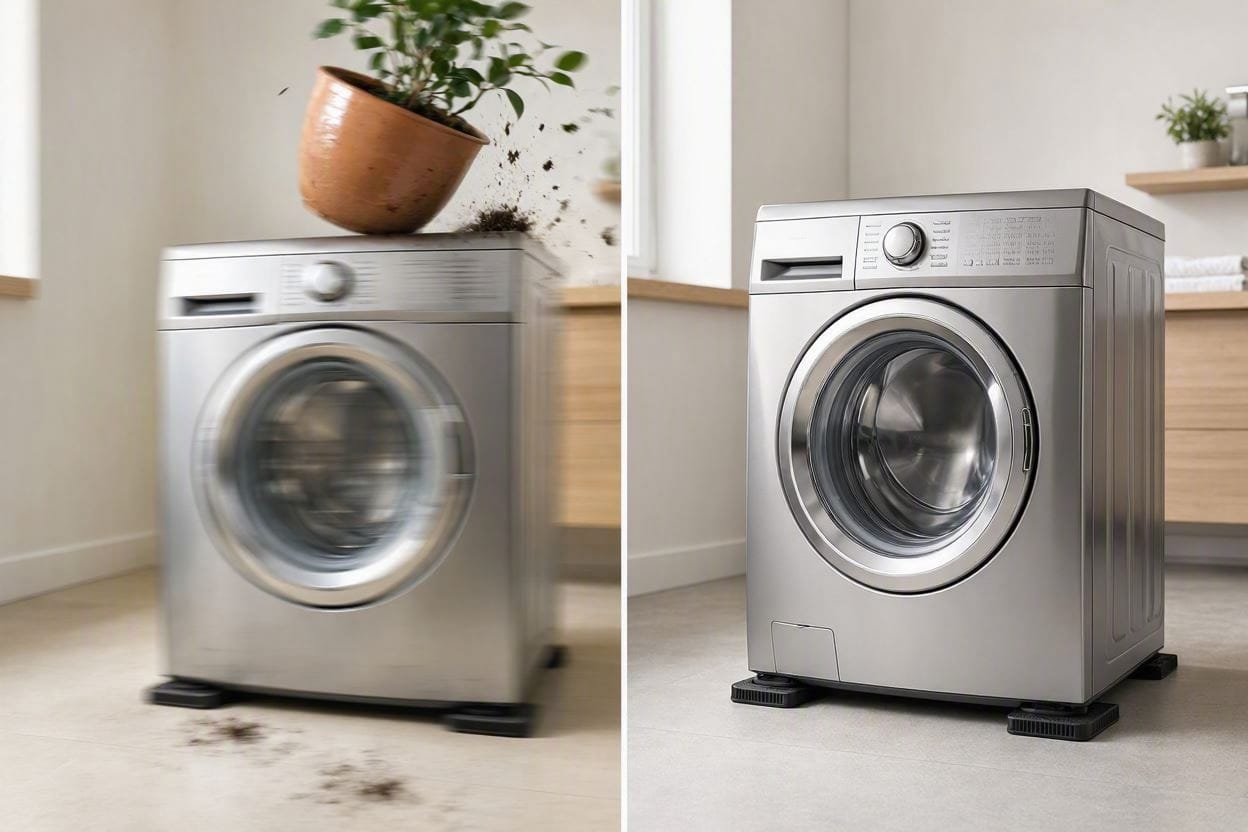
There are few household noises more stressful than the violent, rhythmic banging of an unbalanced washing machine entering its spin cycle. When a heavy appliance shakes uncontrollably, it doesn’t just create airborne noise—it sends kinetic energy directly into your home’s structural framing.
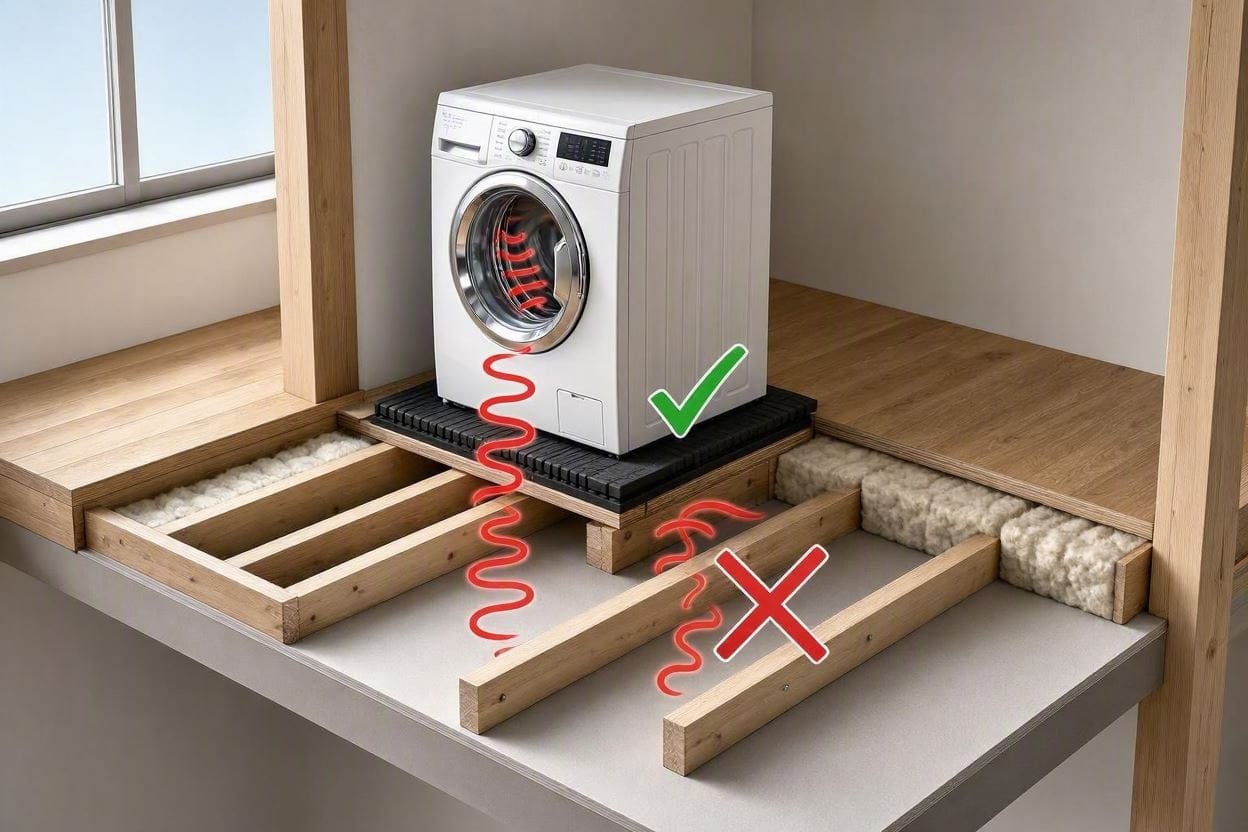
This is known in acoustic engineering as structural resonance or flanking noise. When a machine spins at 1,200 RPMs on a wooden subfloor, the floor joists act like a giant speaker diaphragm, amplifying the sound and transmitting it into the rooms below. This is why second-floor laundry rooms often sound like an earthquake is occurring.
Fortunately, you do not always need to buy a new appliance to fix the problem. By applying the physics of mechanical decoupling and proper leveling, you can silence a violently shaking washing machine in an afternoon.
Step 1: Check the Level (The Most Common Culprit)
A washing machine spins an incredibly heavy drum filled with wet clothes at high speeds. If the machine is tilted even a fraction of an inch, centrifugal force will throw the drum off its center of gravity, causing the entire chassis to violently wobble.
The Fix: Place a standard bubble level on top of your washing machine—check it both side-to-side and front-to-back. If the bubble is not dead center, you need to adjust the machine’s feet. Most washers have threaded leveling legs. Use a wrench to loosen the locking nut, twist the leg up or down until the machine is perfectly level, and then tighten the locking nut firmly against the chassis.
Step 2: Implement Mechanical Decoupling (Anti-Vibration Pads)
Heavy-Duty Rubber Anti-Vibration Pads
If your machine is level but the floor still shakes, you need to break the physical connection between the appliance and the floorboards. High-density rubber pads absorb the kinetic energy before it enters your home’s framing.
- Prevents “walking” or skidding across tile and wood.
- Absorbs low-frequency mechanical thumping.
- Incredibly easy to install (just lift each corner and slide them under).
In structural acoustics, mechanical decoupling is the process of placing a soft, vibration-absorbing material between two rigid surfaces. According to the National Council of Acoustical Consultants (NCAC), isolating heavy machinery from structural elements is the most effective way to eliminate low-frequency impact noise.
Step 3: Remove the Shipping Bolts (For New Machines)
If you just bought a brand new machine and it sounds like a jackhammer on its very first cycle, immediately stop the wash. Manufacturers secure the internal drum with long steel shipping bolts in the back of the unit to prevent damage during transit.
If these bolts are not removed before running a cycle, the drum has zero suspension. The kinetic energy bypasses the internal shock absorbers and transfers directly to the metal frame. Check the back panel of your washer and remove any brightly colored plastic bolts.
Step 4: Reinforce a Weak Subfloor
Sometimes, the washing machine isn’t the problem—the floor is. If you live in an older home, or if your laundry room was retrofitted onto a second floor, the wooden floor joists may lack the rigidity required to support 200+ pounds of spinning water and metal.
If you have leveled the machine and installed rubber isolation pads, but the floor still feels like a trampoline, you may need to reinforce the subfloor. Slipping a 3/4-inch piece of dense plywood underneath both the washer and dryer can help distribute the weight across multiple floor joists, reducing the localized flexing that causes severe vibration.
Is Your Machine Beyond Repair?
If your washing machine is older than 10 years, the internal shock absorbers or suspension springs may have completely snapped. At that point, anti-vibration pads will not save it.
If it is time for an upgrade, check out our guide to the best quiet washing machines for 2026. If your laundry room is upstairs, you will want to specifically read our breakdown of the quietest washing machines for second-floor laundry to ensure you buy an appliance engineered with internal balance rings.
Frequently Asked Questions
Why Does My Washing Machine Only Bang During the Spin Cycle?
During a normal wash cycle, the drum rotates slowly to agitate the clothes. However, during the final spin cycle, the machine hits speeds of up to 1,200 RPMs to extract water. If the load is unbalanced (like washing a single heavy blanket) or the machine is unlevel, this extreme centrifugal force causes the drum to repeatedly strike the outer chassis.
Do Anti-Vibration Mats actually Work?
Yes, provided they are made from high-density rubber or specialized acoustic foam. They work through mechanical decoupling, acting as a shock absorber between the hard metal feet of the washer and the rigid material of your floor. They are highly effective for stopping vibration on wood, laminate, and tile floors.
How Do I Know if My Washer’s Suspension Springs are Broken?
If you open the door of your front-load or top-load washer and press down firmly on the inner drum, it should bounce back smoothly with resistance. If the drum clanks violently against the metal sides with very little pressure, the internal suspension rods or springs have likely failed and need to be replaced.

Ememobong is the lead researcher and editor at Quiet Dwelling. As a professional technical writer, he specializes in breaking down complex acoustic engineering concepts into simple, actionable steps. His goal is to help people build distraction-free environments for better sleep and deep work.