
*This post contains affiliate links. If you use these links to buy something we may earn a commission at no extra cost to you.
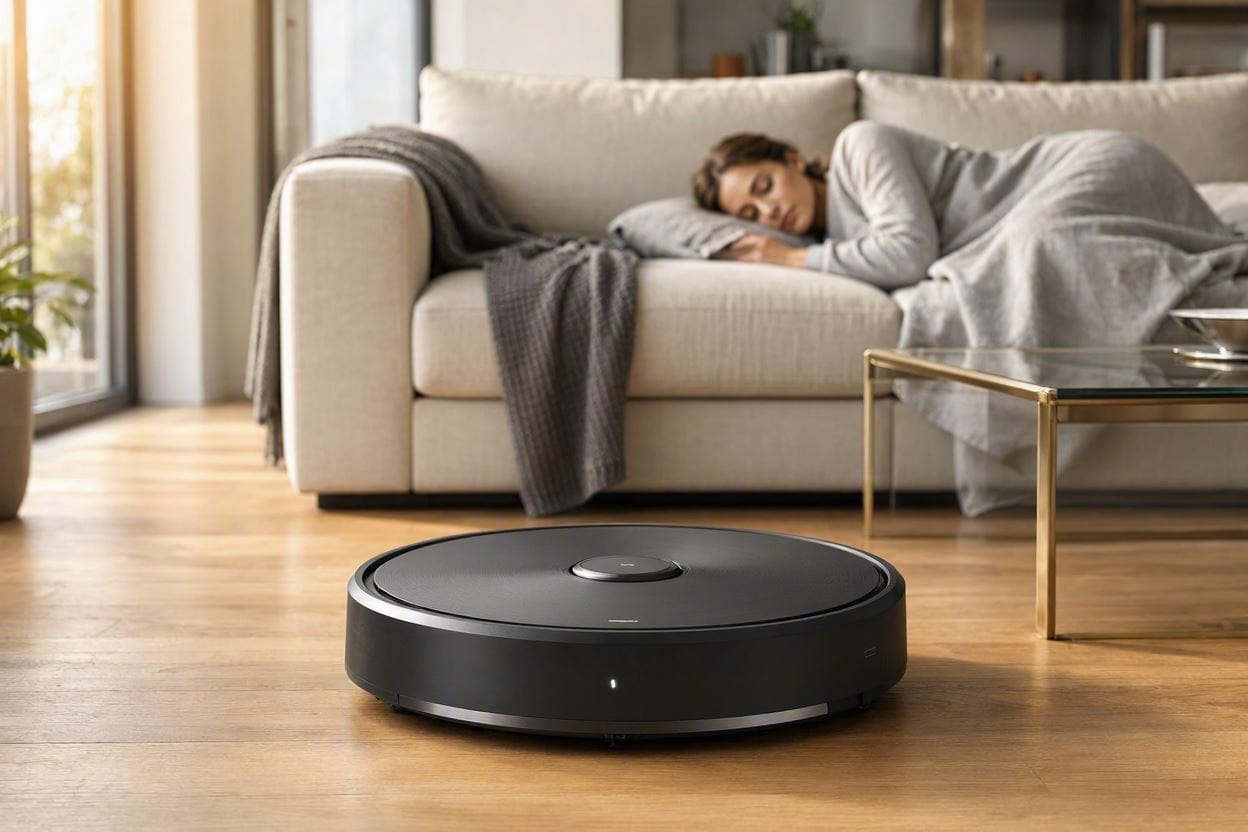
Robot vacuums were designed to bring convenience to your daily routine, but for many homeowners, that convenience comes with a massive acoustic cost. Standard automated vacuums sound like a tiny jet engine roaming through your house, effectively preventing you from watching television, taking a phone call, or concentrating on remote work while they run.
The problem stems from the aggressive suction requirements combined with cheap, uninsulated plastic housings. Fortunately, top-tier floorcare brands have realized that true automation means not having to hear the cleaning happen. By utilizing brushless motors, aerodynamic exhaust channeling, and rubberized components to reduce impact noise, the newest generation of vacuums has finally solved the noise issue.
If you want spotless floors without the headache, here are the best quiet robot vacuums on the market that operate well below the disruptive 60 dBA threshold.
The Science of Vacuum Acoustics: Suction vs. Impact Noise
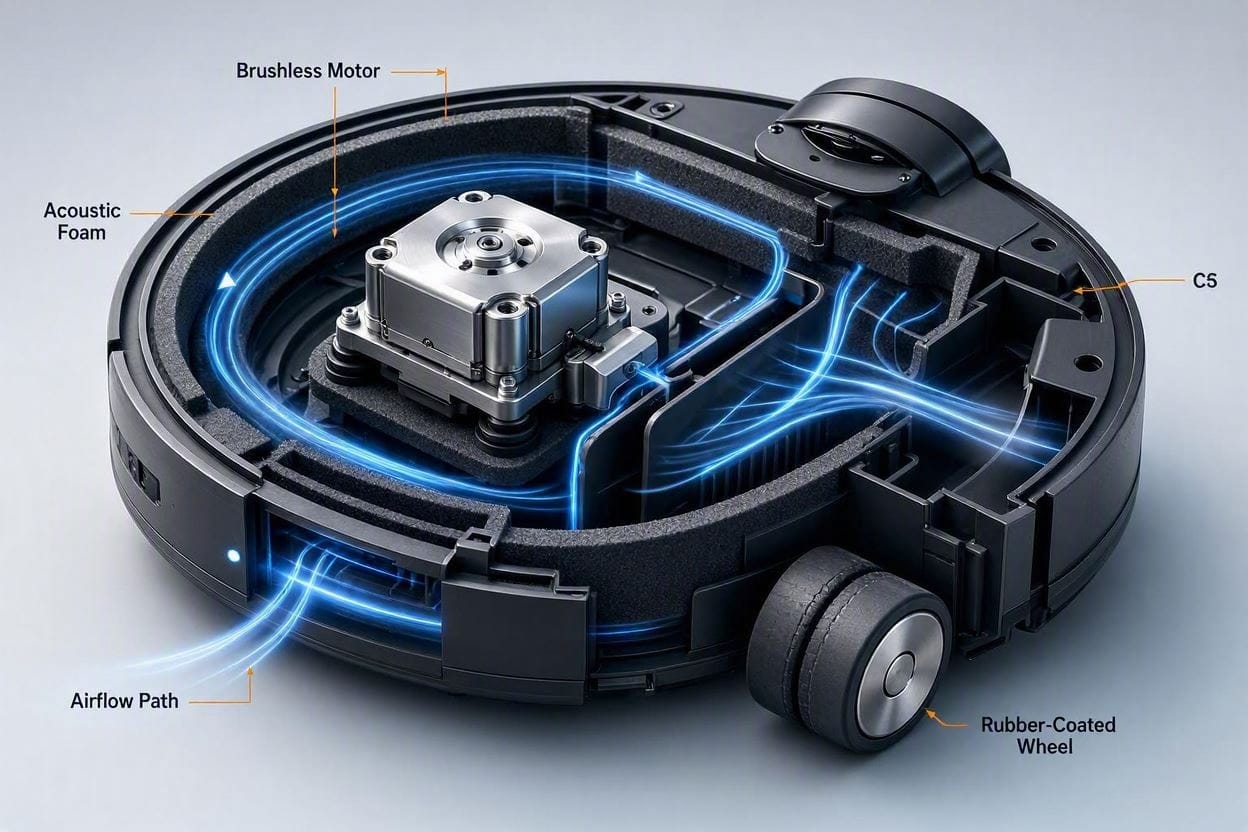
When evaluating a robot vacuum for a quiet living space, you are actually battling two distinct types of acoustic interference: Aerodynamic Noise and Impact/Mechanical Noise.
Aerodynamic noise is the “whistling” or “rushing” sound caused by air being forced through the unit’s filters and exhaust vents at high speeds. High-end brands mitigate this by utilizing insulated chassis designs and “Quiet Modes,” which dynamically reduce the motor’s RPMs when transitioning to hard floors where max suction isn’t required.
According to the National Institute on Deafness and Other Communication Disorders (NIDCD), normal human conversation sits between 60 and 70 dBA. Dropping the vacuum’s ambient noise below this threshold ensures it doesn’t disrupt your daily household activities.
However, impact noise is often the more disruptive factor. If a robot vacuum lacks advanced LiDAR or AI navigation, it cleans by literally “bumping” into your baseboards, furniture, and doors. This structural vibration travels through the floor joists (known as flanking noise), creating a continuous low-frequency thumping sound. The best quiet vacuums pair low-decibel motors with flawless, impact-free navigation.
1. Roborock S8 Pro Ultra (The Ultimate Silent Ecosystem)
If budget is not a constraint and you want the absolute pinnacle of automated, low-noise cleaning, the Roborock S8 Pro Ultra is a masterpiece of modern household engineering. While it boasts an incredibly powerful 6000Pa suction capacity, its true brilliance lies in its acoustic management.
When engaged in its dedicated “Quiet Mode,” the S8 Pro Ultra drops down to roughly 53 dBA. To put that in perspective, conversational speech sits around 60 dBA. Furthermore, the unit features a dual-rubber roller brush design that completely eliminates the “bristle slapping” noise commonly heard when traditional vacuums transition over tile grout lines or hardwood joints.
The Pros
- Operates at a phenomenally quiet 53 dBA in Quiet Mode.
- VibraRise mopping system scrubs silently without loud mechanical water pumps.
- Flawless LiDAR navigation ensures it never violently rams into your furniture.
The Cons
- It is one of the most expensive models on the consumer market.
- The auto-empty docking station is momentarily loud (roughly 15 seconds) when extracting dirt.
2. Eufy RoboVac 11S MAX (The Budget Whisperer)
The “S” in 11S literally stands for “Slim and Silent.” Eufy built their entire brand reputation on this specific model by targeting consumers who were tired of loud, obtrusive vacuums. At standard suction, this unit operates at an incredibly low 55 dBA, making it sound more like a quiet oscillating fan than a vacuum cleaner.
Because it utilizes a brushless motor and a highly optimized internal airway, the 11S MAX avoids the high-pitched mechanical whine associated with budget electronics. Its ultra-slim profile (only 2.85 inches tall) also allows it to glide under beds and sofas where acoustic noise is naturally muffled by the furniture above it.
The Pros
- Unbeatable price-to-noise ratio in the current market.
- Consistently tests at or below 55 dBA, allowing you to comfortably watch TV while it runs.
- Tempered glass top cover provides a solid acoustic mass that dampens internal motor vibrations.
The Cons
- Relies on “bounce” navigation rather than laser mapping, meaning it occasionally taps baseboards.
- Lacks smart mapping zones and advanced room exclusion features.
3. iRobot Roomba j7+ (The Anti-Impact Champion)
While the Roomba j7+ is slightly louder in pure motor noise than the Roborock or the Eufy (rating closer to 59 dBA), it secures its spot on this list for a different acoustic reason: it possesses the best obstacle avoidance software in the industry.
Using PrecisionVision Navigation, the j7+ flawlessly identifies cables, pet waste, and furniture legs. It actively slows down and redirects before making contact. If you live in an apartment where structural impact noise (banging into shared walls) is a larger concern than ambient motor noise, this intelligent avoidance makes the j7+ a spectacularly quiet neighbor.
The Pros
- Eliminates structural “thumping” noises by avoiding physical contact with walls and furniture.
- Dual multi-surface rubber brushes are specifically designed to reduce floor-slapping sounds.
- Incredible app integration for scheduling cleans only when you are out of the house.
The Cons
- The motor itself sits closer to the 59-60 dBA limit, which is audible in a silent room.
- The Clean Base automatic dirt disposal is very loud during its brief empty cycle.
How to Choose a Truly Quiet Robot Vacuum (Acoustic Buyer’s Guide)
Decibel ratings only tell part of the story. When assessing robot vacuums for low-noise living spaces, consider these mechanical and design factors before purchasing:
- Brush Roll Material: Traditional bristle brushes create a continuous “flapping” noise against hard surfaces. Dual rubber rollers (found on premium units) stay flush against the floor without mechanical slapping.
- Chassis Acoustic Dampening: High-end manufacturers line the motor chamber with sound-absorbing open-cell foam to trap high-frequency whine before exhaust air exits the rear vents.
- Optical vs. Bumper Navigation: Basic vacuums rely on physical bumper impact to navigate rooms, generating low-frequency structural thumps against baseboards. LiDAR and camera-based obstacle avoidance eliminate impact noise entirely.
- Eco and Quiet Modes: Look for models with granular app controls that allow manual RPM adjustments. Running a vacuum at 50% suction on hardwood floors maintains cleanliness while keeping sound output near 50 dBA.
Frequently Asked Questions About Quiet Robot Vacuums
What Decibel Level is Considered Quiet For a Robot Vacuum?
A robot vacuum operating at or below 60 dBA is considered quiet. Units running between 50 dBA and 55 dBA blend into background ambient room noise. For context, the World Health Organization (WHO) recommends keeping general environmental noise at or below 70 dBA for safe long-term exposure. Keeping your automated appliances well below this limit reduces acoustic stress in your living space.
Can You Run a Quiet Robot Vacuum While Sleeping?
Yes, provided the unit operates around 50–55 dBA and you set it to clean areas outside the bedroom. For light sleepers, the occasional change in motor pitch or transition over threshold ramps can still cause micro-arousals, so running it in living areas is recommended.
Why are Auto-Empty Docks So Loud Even on Quiet Vacuums?
Auto-empty bases require an intense burst of high-pressure suction (often exceeding 75–80 dBA) to pull debris out of the vacuum’s internal dustbin into the dock bag. However, this cycle only lasts between 10 and 15 seconds, and most companion apps allow you to set “Do Not Disturb” hours to prevent docking evacuations at night.
Do Quiet Vacuums Have Weaker Suction Power?
Not necessarily. While running a vacuum in its lowest decibel mode reduces instantaneous Pa (Pascal) suction ratings, modern brushless motors and sealed airflow designs compensate by maintaining effective pickup on hard surfaces without needing maximum motor RPMs.
Final Verdict: Which Quiet Robot Vacuum Should You Buy?
Maintaining clean floors should never require sacrificing peace and quiet. Here is the bottom-line breakdown:
- If you want total automation with cutting-edge LiDAR navigation and the quietest operational mode, get the Roborock S8 Pro Ultra.
- If you want an affordable, ultra-slim vacuum that easily slips under low furniture with minimal motor hum, choose the Eufy RoboVac 11S MAX.
- If you live in an apartment where avoiding baseboard and furniture impact noise is your top priority, choose the iRobot Roomba j7+.

Ememobong is the lead researcher and editor at Quiet Dwelling. As a professional technical writer, he specializes in breaking down complex acoustic engineering concepts into simple, actionable steps. His goal is to help people build distraction-free environments for better sleep and deep work.