*This post contains affiliate links. If you use these links to buy something we may earn a commission at no extra cost to you.
Moving the laundry room from a dark, dingy basement up to the second floor near the bedrooms is one of the greatest modern architectural upgrades. You no longer have to carry heavy, overflowing laundry baskets up and down two flights of stairs. It is incredibly convenient.
But that convenience comes with a massive, house-shaking acoustic penalty.
When you place a standard washing machine on a concrete basement floor, the earth absorbs the vibration. When you place that exact same washing machine on a wooden second-story floor, the hollow space between the floor joists turns into an acoustic amplifier. The moment the machine hits its 1,200 RPM high-speed spin cycle, it feels like a helicopter is landing on your roof. The floor bounces, the walls shake, and picture frames rattle downstairs.
You shouldn’t have to schedule your laundry around your sleep or your Zoom meetings. Appliance engineering has finally solved the second-floor laundry nightmare. By replacing noisy rubber belts with frictionless magnetic motors and utilizing 3D balancing sensors, you can wash heavy loads in complete, absolute stealth. Here are the quietest washing machines for second-floor laundry on the market today.
The Science of the Shake: Direct Drive vs. Belts
To fix the noise problem, we have to understand that a washing machine generates two completely different types of acoustic chaos: Airborne Noise (the motor whining) and Impact Noise (the physical vibration shaking your house). We detail the physics of these pathways extensively in our master guide on Airborne vs. Impact Noise.
Most cheap washing machines use a Belt-Drive system. A motor sits at the bottom of the machine, spinning a long rubber belt attached to a pulley on the back of the drum. Over time, that rubber belt stretches and slips. As it slips, the motor has to work harder, generating a high-pitched, agonizing mechanical screech.
The premium models on this list kill the airborne screech using Direct-Drive Inverter Motors.
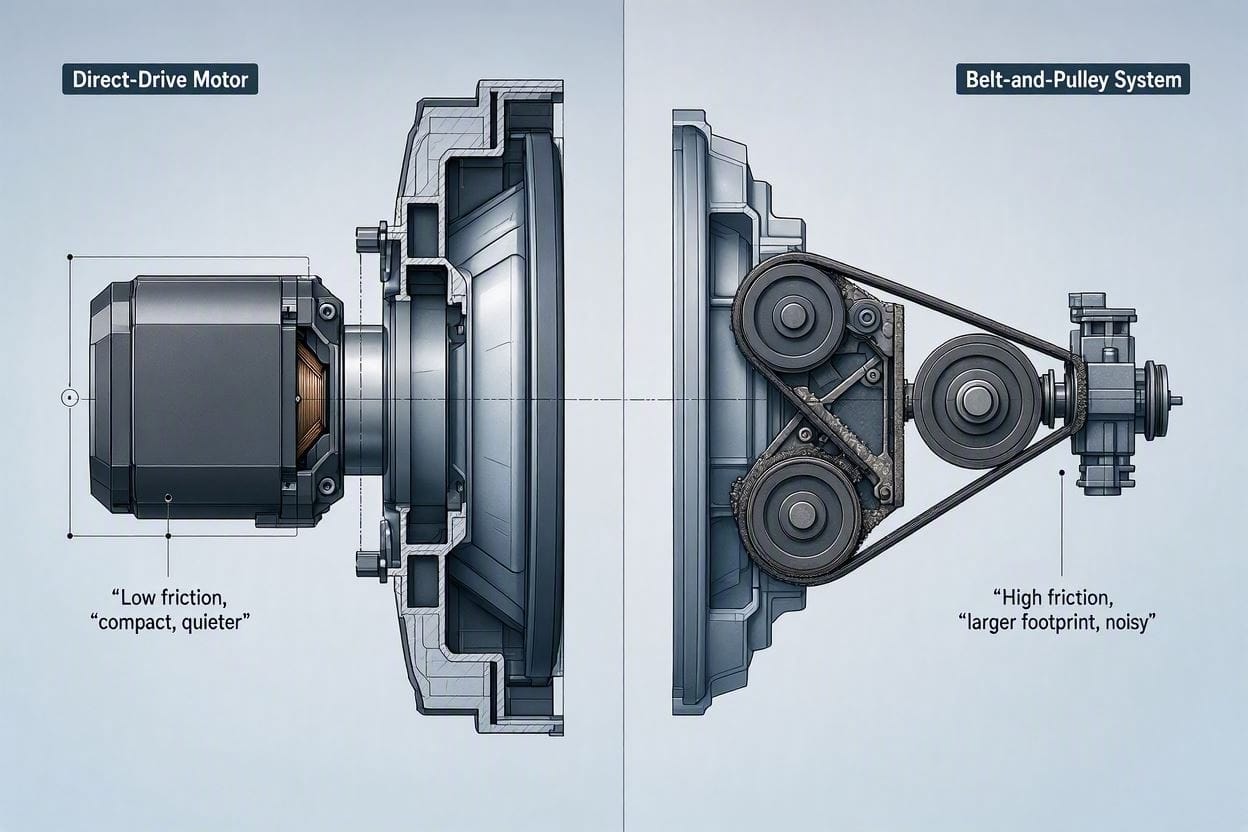
A direct-drive motor is bolted directly to the back of the wash drum. There are no belts and no pulleys. According to Energy Star efficiency guidelines, these brushless magnetic motors use vastly less electricity, but the real benefit is that they are practically frictionless. No friction means no whining.
To solve the second problem—the heavy impact vibration—these machines use internal 3D gyroscopic sensors. If the machine detects that a heavy, wet towel is stuck on one side of the drum, it doesn’t just keep spinning and slamming into the walls. It instantly stops, tumbles the clothes gently to redistribute the weight, and then ramps back up into a perfectly balanced, silent spin cycle.
1. Bosch 800 Series (The Gold Standard)
Bosch is the undisputed king of acoustic appliance engineering. Just like their legendary whisper-quiet dishwashers, the Bosch 800 Series washing machine is a masterclass in acoustic dampening.
Bosch uses their proprietary EcoSilence Motor to kill the electrical humming, but the real magic is the physical chassis. Look at the side panels of a Bosch washer; they feature distinct, circular indentations. This isn’t just an aesthetic choice. This “AntiVibration Design” radically increases the rigidity of the steel side panels. When the heavy drum spins, the reinforced walls absorb the kinetic energy rather than flexing and transferring it to your wooden floorboards.
This is a compact, 24-inch unit, making it the absolute perfect size to slide into a tight second-floor hallway closet.
The Pros
- Unmatched AntiVibration side panels kill structural impact noise instantly.
- EcoSilence motor operates at a library-quiet 48 dBA during normal wash.
- Compact 24-inch design fits seamlessly into second-floor closets.
The Cons
- High premium price tag for German engineering.
- The compact 2.2 Cu. Ft. drum cannot wash a king-sized comforter easily.
2. LG WM4000HBA Front Load (The Best Value Pick)
If you have a large family and absolutely must have a full-size, 4.5 cubic foot drum to handle massive piles of laundry, the Bosch will be too small for you. LG pioneered putting high-end direct-drive technology into full-size, affordable consumer machines.
The LG WM4000HBA utilizes their TrueBalance Anti-Vibration System. This system is so finely tuned that even while spinning a heavy load of soaking wet jeans at 1,300 RPMs, the machine stays perfectly planted on the floor. It completely eliminates the horrifying “walking” effect where older washing machines would literally bounce their way across the laundry room floor during a spin cycle.
The Pros
- Direct-drive motor eliminates all the high-frequency whining of belt drives.
- Massive 4.5 Cu. Ft. capacity means fewer wash cycles overall.
- TrueBalance tech keeps the machine perfectly stationary on wooden floors.
The Cons
- The water intake valve makes a very noticeable “clunk” when turning on and off.
- The end-of-cycle musical chime is very long and loud (but can be disabled in settings).
3. Samsung Front Load with VRT Plus (The Heavy Duty Pick)
If you live in a very old house and your second-story floorboards are notoriously flimsy, flexible, or prone to bouncing, you are highly vulnerable to structural noise. Samsung designed their VRT Plus™ (Vibration Reduction Technology) specifically for these difficult environments.
Samsung’s system uses a ring of heavy stainless steel ball bearings placed around the front of the drum. During the high-speed spin cycle, centrifugal force pushes these heavy ball bearings into the exact opposite position of your wet, clumpy clothes. This physical counterweight perfectly offsets the out-of-balance load. It reduces overall floor vibration by up to 40% compared to traditional washers, ensuring your downstairs living room stays perfectly peaceful.
The Pros
- VRT Plus bearing system acts as a brilliant, physical counterweight.
- Exceptional at protecting weak or flexible wooden floor joists.
- Self-Clean+ feature runs silently to keep the drum smelling fresh.
The Cons
- The drain pump can gurgle quite loudly when emptying the water.
- Requires dedicated leveling during installation for the VRT system to work perfectly.
The 10-Minute Fix: How to Silence Your Existing Washer
If you cannot afford a brand new $1,200 washing machine right now, the problem might not actually be your motor. The vast majority of second-floor laundry noise is caused by Impact Noise. The heavy vibration of the drum is transferring directly down the metal legs into your floorboards.
As we detail extensively in our master guide on how impact noise disrupts sleep, you can solve this using the principle of structural decoupling.
The 10-Minute Fix: First, grab a spirit level and place it on top of your machine. Adjust the threaded metal feet at the bottom until the machine sits perfectly level; an unlevel machine will always violently rattle. Second, go to the hardware store and buy a set of four thick, heavy-duty vulcanized rubber anti-vibration pads (do not use cheap foam). Lift each corner of the machine and slide a heavy rubber pad under the foot. The rubber acts as an acoustic shock absorber, trapping the kinetic energy before it enters your floorboards. The booming rattle will instantly disappear.
Frequently Asked Questions (FAQ)
Are Front-Load Washers Quieter than Top-Load Washers?
Yes, significantly. Top-loading washers use a central agitator or impeller to aggressively twist and smack clothes back and forth in a deep pool of water, which is inherently loud and unbalanced. Front-loading washers use gravity, picking the clothes up and gently tumbling them through the water. This requires less violent mechanical force and allows the internal suspension systems to operate much more smoothly.
Why Does My Quiet Washer Suddenly Sound Like a Jet Taking Off?
If your previously quiet direct-drive washer suddenly starts screaming with a deafening, metallic roar during the high-speed spin cycle, you have a failed drum bearing. Over years of use (especially if you frequently overload the machine with heavy, soaking wet bedding), the metal bearings that hold the heavy drum in place wear out and lose their grease. This requires professional repair.
Will Closing the Laundry Room Door Block the Noise?
Only if the door is solid. Most builder-grade interior doors are “hollow core,” meaning they are essentially empty cardboard structures that actually amplify low-frequency rumbles. To block the noise of your washer, you must upgrade your laundry room door to a heavy “solid core” door and install an acoustic sweep at the bottom to seal the air gap. We explain how this works in our guide on how to soundproof a hollow core door.

Ememobong is the lead researcher and editor at Quiet Dwelling. As a professional technical writer, he specializes in breaking down complex acoustic engineering concepts into simple, actionable steps. His goal is to help people build distraction-free environments for better sleep and deep work.