
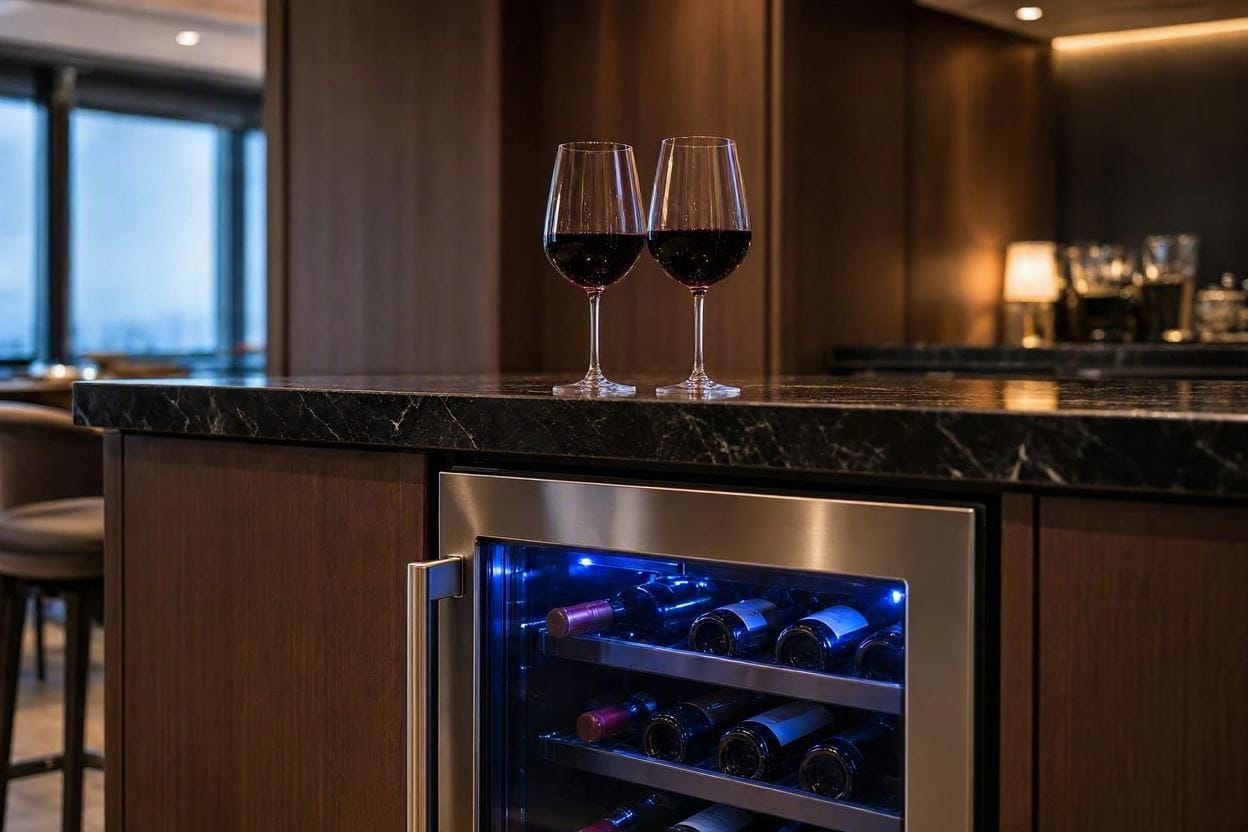
*This post contains affiliate links. If you use these links to buy something we may earn a commission at no extra cost to you.
You have set the perfect mood. The lights in your dining room are dimmed, a great record is playing softly in the background, and you sit down to pour a nice glass of wine with your friends. Suddenly, the mood is completely shattered.
The appliance sitting in the corner kicks on with a violent, metallic CLANK, followed by the relentless, groaning rumble of an overworked compressor. You find yourself having to raise your voice just to maintain a conversation over your own wine cooler.
Wine coolers are notoriously problematic when it comes to home acoustics. Most people buy them intending to add a touch of luxury to their living room or home office. But if you buy a cheap, builder-grade unit, you are essentially placing a vibrating engine right next to your couch.
What’s worse, that loud vibration isn’t just ruining your evening—it is actually ruining your wine. To protect your peace and your vintages, you need an appliance built for true acoustic stealth. I have reviewed the top storage options on the market. By utilizing solid-state thermoelectric cooling and heavy-duty compressor decoupling, here are the absolute best quiet wine coolers available today.
The Science: Why Vibration Ruins the Room (And the Wine)
We detailed the mechanics of refrigeration in our guide to the best quiet mini fridges, but wine coolers require an entirely different level of acoustic scrutiny.
A loud wine cooler is suffering from two physical failures: the motor itself, and structural impact noise. When a cheap compressor kicks on, it physically shakes the metal chassis of the cooler. If that cooler is sitting on your hardwood floor, the kinetic vibration travels directly into your floor joists, turning your entire living room into a booming acoustic amplifier.
But this vibration isn’t just annoying for your ears—it is scientifically disastrous for wine.
According to experts at Wine Spectator, continuous kinetic vibration prevents the natural sediment in wine from settling at the bottom of the bottle. Furthermore, the micro-vibrations actually agitate the complex organic molecules, accelerating invisible chemical reactions and artificially aging the wine, which completely ruins the flavor profile of a good vintage.
To protect your home’s acoustics and your wine collection, you must choose between two highly specific technologies: Thermoelectric Cooling or Decoupled Compressors.
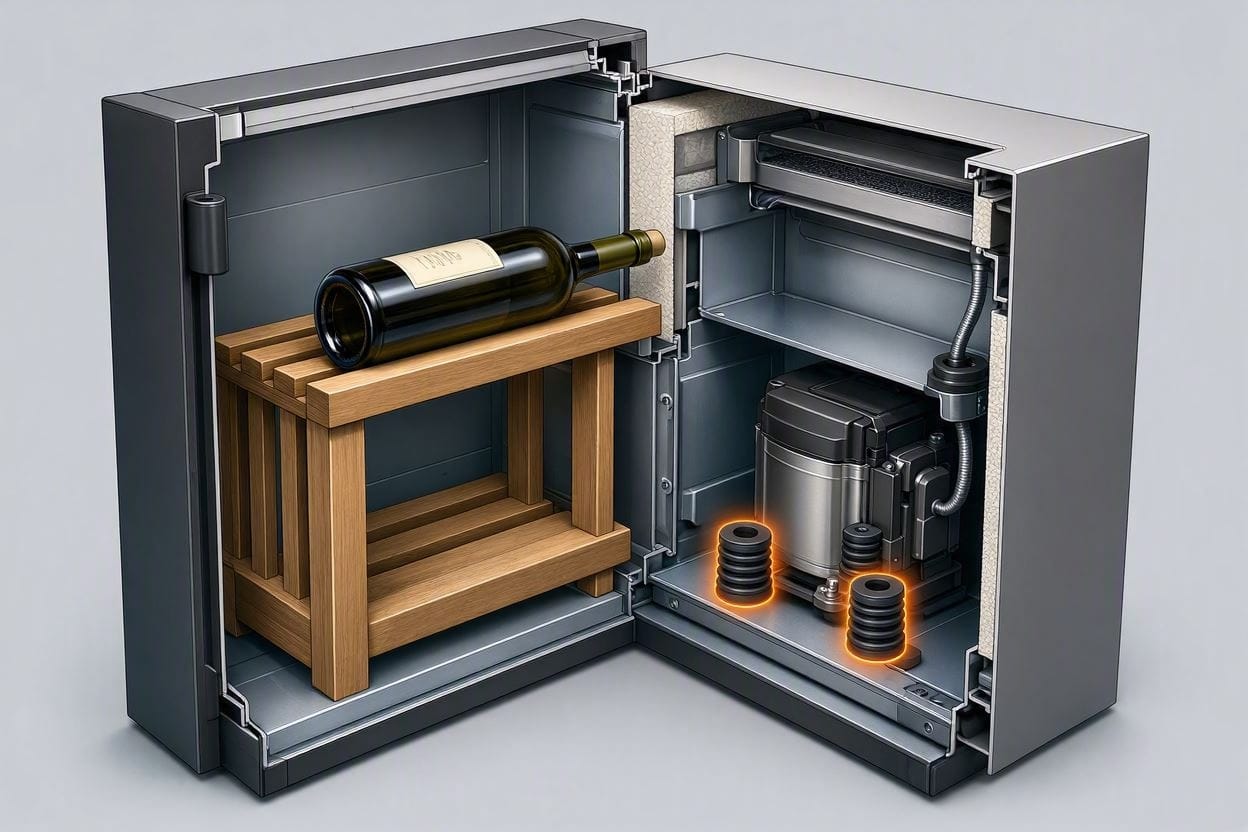
1. Kalamera 15-Inch Compressor (Best Built-In Overall)
If you are remodeling a kitchen or home bar and want a cooler that seamlessly slides under the counter, you absolutely must have a compressor unit (thermoelectric units will overheat if enclosed in cabinetry). The Kalamera 15-inch is the undisputed king of quiet, built-in refrigeration.
Kalamera solves the acoustic problem by heavily upgrading the compressor mounting system. The heavy motor sits on dense rubber isolation pads, which completely decouple the motor from the chassis. This traps the kinetic energy before it reaches the metal walls. When the compressor triggers, you hear a very smooth, low-frequency hum (around 38 dB) rather than a sharp, metallic clatter.
Because the vibration is isolated, the internal wooden shelves remain perfectly still, allowing your wine to rest undisturbed while your room stays peaceful.
The Pros
- Rubber-mounted compressor eliminates structural rattling and protects wine.
- Front-venting exhaust means it can be safely built into tight cabinetry.
- Gorgeous double-pane, UV-resistant glass door provides massive acoustic density.
The Cons
- Single-zone cooling only (cannot store reds and whites at different temps).
- Premium price tag for the advanced compressor tech.
2. Wine Enthusiast 18-Bottle (The 100% Silent Pick)
What if you want a freestanding wine cooler to sit openly in your dining room, office, or bedroom, and you literally cannot tolerate a single decibel of mechanical humming?
You need Thermoelectric Cooling. The Wine Enthusiast 18-Bottle cooler completely abandons the compressor. It relies on the Peltier effect, using electrical currents passing through solid metal plates to draw heat out of the interior. The only moving part in the entire machine is a tiny, microscopic computer exhaust fan on the back.
It operates consistently under 28 decibels. If you review our master guide on how many decibels are safe for sleep, you know that 28 dB is quieter than a gentle whisper. It is the absolute pinnacle of silent wine storage.
The Pros
- Virtually silent operation; perfectly safe to put in a bedroom or quiet office.
- Absolutely zero physical vibration, ensuring your wine ages perfectly.
- Very lightweight and easy to move around the house.
The Cons
- Thermoelectric tech cannot be built into cabinets (it will overheat and fail).
- Can only cool to about 20°F below the ambient room temperature.
3. Schmecke 33-Bottle Dual Zone (Best for Collectors)
If you are a serious collector, you know that red wine and white wine require vastly different temperatures. You need a Dual-Zone cooler. However, dual-zone coolers are typically loud because they require the compressor to push cold air to two different, insulated compartments.
Schmecke handles this acoustic challenge brilliantly. They utilize an incredibly dense, thick metal chassis paired with double-paned thermopane glass. The heavy glass isn’t just for blocking UV light; it acts as a massive acoustic barrier that traps the internal fan and compressor noise inside the unit.
While you will hear it running (roughly 40 dB), the dense materials prevent any high-frequency whining or hollow echoing. It provides professional-grade, multi-temperature storage while maintaining a very respectable acoustic footprint.
The Pros
- Dual-zone cooling allows perfect storage for both reds and whites simultaneously.
- Heavy thermopane glass traps internal motor noise brilliantly.
- Built-in lock to keep kids (or thirsty roommates) out of your expensive vintages.
The Cons
- Freestanding only; the rear exhaust fans need breathing room.
- Larger champagne or Pinot Noir bottles can be a tight squeeze on the racks.
The Acoustic Rubber Hack: Stopping Floor Vibrations
If you are forced to buy a compressor wine cooler (because you need to build it into your cabinets), you might turn it on and hear a deep, rumbling noise vibrating through your floors or countertops.
This is caused by Impact Noise. The heavy mechanical vibration of the compressor transfers directly into the hard wood of your cabinetry or floorboards. The hollow wood acts exactly like an acoustic amplifier, turning a gentle hum into a booming bass note. We detail the physics of this extensively in our master guide on Airborne vs. Impact Noise.
The 5-Minute Fix: You must decouple the machine from the hard surfaces of your home. Buy four thick, dense vulcanized rubber anti-vibration pads (the kind sold for washing machines) and place them directly underneath the four feet of your wine cooler. The heavy rubber acts as an acoustic shock absorber, trapping the kinetic vibration before it can enter the wood. The rattling will instantly disappear, leaving only a gentle hum.
Frequently Asked Questions (FAQ)
Can I Put a Freestanding Wine Cooler Inside a Cabinet to Muffle the Sound?
Absolutely not. This is a massive fire hazard. A “freestanding” wine cooler vents its hot exhaust air out of the back or sides. If you trap it inside a tight wooden cabinet to block the noise, the hot air cannot escape. The compressor will rapidly overheat, spin at maximum screaming RPMs, and eventually burn out and fail. If you want it inside a cabinet, you must buy a “front-venting” built-in unit.
Why Does My Wine Cooler Suddenly Sound Like it is Gurgling?
If you own a compressor unit, this is completely normal. The gurgling or “rushing water” sound is simply the liquid chemical refrigerant flowing through the evaporation tubes on the back of the unit after the compressor shuts off. It usually only lasts for a few moments as the internal pressure equalizes.
Will a Quiet Wine Cooler Keep My Beer Cold?
Yes, but with a caveat. Wine is meant to be stored between 45°F and 65°F. Most people prefer their beer much colder (around 35°F). A Thermoelectric wine cooler usually bottoms out around 46°F, which might leave your beer tasting slightly warm. If you want to use the unit as a hybrid beverage cooler for icy beer, you must buy a powerful Compressor unit.

Ememobong is the lead researcher and editor at Quiet Dwelling. As a professional technical writer, he specializes in breaking down complex acoustic engineering concepts into simple, actionable steps. His goal is to help people build distraction-free environments for better sleep and deep work.