

If you live in an apartment, you probably know the sensation. You are lying in bed at midnight. The room is quiet. There is no yelling, no loud television, and no dog barking. Yet, you cannot sleep. There is a deep, rhythmic, throbbing hum vibrating through your pillow.
It might be the rooftop HVAC unit kicking on. It might be the idling engine of a delivery truck down on the street. It might be your downstairs neighbor playing music with a heavy subwoofer. Whatever it is, you don’t just hear it—you feel it in your chest.
When you complain to your landlord or your neighbors, they often look at you like you are crazy. “I can barely hear anything,” they say. But you aren’t crazy. You are experiencing Low-Frequency Noise (LFN).
Unlike normal sound, low-frequency noise operates by its own set of terrifying physical rules. It passes through concrete walls as if they were made of paper, and worse, your body treats it as a biological threat. I have researched architectural acoustics for years, and the truth is staggering: this “phantom rumble” is actively destroying your health. Let’s dive into the invisible world of low-frequency noise and exactly what it is doing to your body.
🎯 The Quick Science
What is it? Low-frequency noise (LFN) consists of sound waves typically between 20 Hz and 100 Hz. These are massive, high-energy waves that easily pass through heavy building materials.
The Health Risk: Because you physically feel the vibration, LFN triggers your brain’s “fight-or-flight” response even while you sleep. Chronic exposure is scientifically linked to sleep fragmentation, chronic fatigue, anxiety, and elevated blood pressure.
The Physics: Why Does Bass Go Through Walls?
To understand why this is happening to you, we have to look at the shape of a sound wave. High-frequency sounds (like a whistle or a baby crying) have very short wavelengths. They carry very little kinetic energy and are easily stopped by a closed door or a pane of glass.
Low-frequency sounds are completely different. A 40 Hz bass wave has a physical wavelength of over 28 feet long. As we explained in our master guide on how to block low-frequency noise, these massive waves carry immense kinetic energy. When a 28-foot wave hits your apartment building, it doesn’t bounce off. It physically vibrates the concrete, the wooden floor joists, and your drywall.
This is why your neighbor’s music sounds so strange. The walls filter out the high-frequency vocals and guitars, leaving nothing but the raw, rumbling kinetic energy of the bass line. It literally turns the entire structure of your apartment building into a vibrating mechanical amplifier.
The Biological Toll: Your Brain on Bass
So, why does a distant rumbling truck bother you so much more than a loud television? It comes down to evolution.
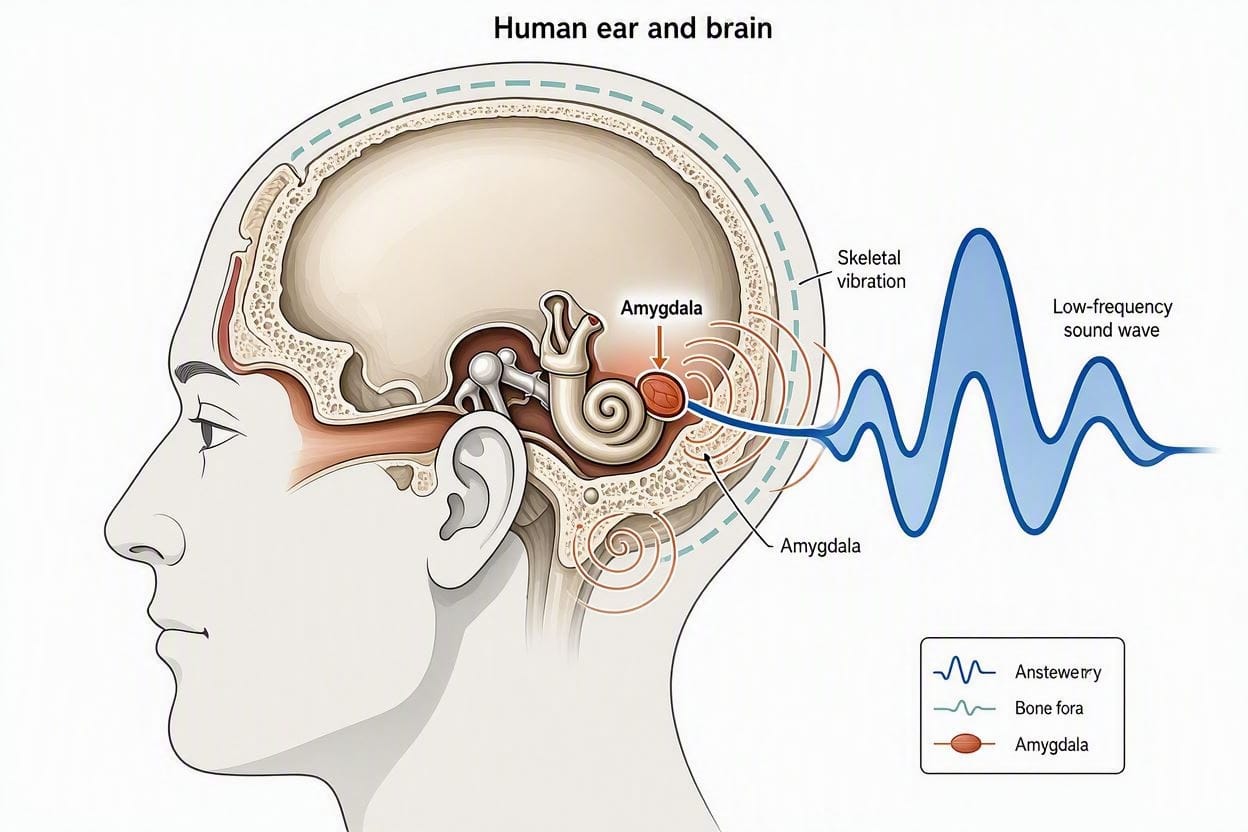
For thousands of years, humans evolved to interpret deep, low-frequency vibrations as a sign of immediate, massive danger—think an approaching earthquake, a stampeding herd of animals, or a severe thunderstorm. Your amygdala (the brain’s emotional fear center) is hard-wired to panic when it senses these vibrations.
When you lay your head on your pillow and feel the hum of the rooftop AC unit, your body subconsciously prepares for disaster. It activates the Hypothalamus-Pituitary-Adrenal (HPA) axis. Your body is flooded with cortisol (the stress hormone) and adrenaline.
According to a landmark report by the National Institutes of Health (NIH), chronic exposure to environmental noise causes your cardiovascular system to remain in a constant state of tension. Because you are constantly releasing stress hormones, you are at a significantly higher risk for:
- Chronic Hypertension: Constantly elevated blood pressure.
- Tachycardia: An abnormally fast resting heart rate.
- Cognitive Fatigue: The inability to concentrate or focus during the day due to a taxed nervous system.
Sleep Architecture Destruction
The most immediate and brutal health effect of low-frequency noise is the destruction of your sleep architecture.
You may fall asleep despite the rumbling, and you may not consciously remember waking up. But your brain is suffering. As the low-frequency noise pulses through the room, your brain experiences micro-arousals. A micro-arousal violently shifts your brainwaves out of Deep (Slow-Wave) Sleep and back into a lighter stage of sleep.
Deep sleep is the only time your body physically repairs cellular tissue, builds bone and muscle, and cleanses the brain of neurotoxins. By chronically fracturing this sleep cycle, LFN leaves you waking up feeling as if you were hit by a bus, regardless of how many hours you stayed in bed. To see exactly how loud a room should be to prevent this, review our clinical guide on safe decibel levels for sleep.
The “Acoustic Foam” Myth (What NOT to do)
If you are suffering from neighbor noise, you will inevitably end up on Amazon looking at cheap, egg-crate acoustic foam. Do not buy it. It will not work.
This is the most dangerous myth in the soundproofing industry. Acoustic foam is almost entirely made of air. It is practically weightless. When a massive, 28-foot low-frequency sound wave hits a 1-inch thick piece of foam, the wave ignores it completely. The foam does not possess the density or physical mass required to slow down the kinetic energy.
If you want to understand the exact physical difference between sticking foam to your wall and actually stopping noise, read our master breakdown of Soundproofing vs. Sound Absorption.
Real Strategies to Defend Your Apartment
As a renter, you cannot rip the drywall down and pack the walls with lead and concrete. However, you can use acoustic science to heavily mitigate the trauma to your body.
Tactic 1: Decouple Your Bed
If the low-frequency vibration is traveling through the floor joists (like the impact noise of a washing machine or subwoofer), it will travel straight up the wooden legs of your bed frame and into your head. You must physically disconnect the bed from the floor. Buy thick, heavy-duty vulcanized rubber anti-vibration pads (the kind sold for heavy gym equipment) and place them under every leg of your bed. The rubber will absorb the kinetic energy before it reaches your mattress.
Tactic 2: Acoustic Masking (Brown Noise)
If you cannot stop the rumble, you must mask it. Standard “white noise” is too thin and high-pitched to cover the sound of a deep bass hum. You need to use Brown Noise. Brown noise contains massive amounts of low-frequency energy (sounding like the deep roar of an ocean storm or an airplane cabin). Playing brown noise loudly through a high-quality speaker raises the “noise floor” of the room, completely swallowing your neighbor’s bass so your brain stops registering it as a threat. You can learn more about this in our guide to the colors of noise.
Tactic 3: Negotiate the “Subwoofer Pad”
If the noise is coming from a downstairs neighbor’s stereo, the problem is that their subwoofer is sitting directly on the hardwood floor. If you have a decent relationship with them, offer to buy them a Subwoofer Isolation Pad. These are thick foam and steel platforms that sit under the speaker. They cost about $40 and instantly stop the speaker from vibrating the floor joists, solving the problem at the source.
Frequently Asked Questions (FAQ)
Why Doesn’t My Decibel Meter App Show the Low-Frequency Noise?
Most smartphone decibel apps measure sound using the “dBA” (A-weighted) scale. The A-weighted scale was explicitly designed to mimic human hearing, which naturally filters out deep bass. Therefore, your app literally ignores low-frequency noise. If you want to measure the rumble in your apartment, you must switch your app’s settings to the dBC (C-weighted) scale, which accurately captures heavy bass.
Can Noise-Canceling Headphones Stop Low-Frequency Noise?
Yes, absolutely. Active Noise Cancellation (ANC) was actually invented specifically to target the low-frequency, constant drone of airplane engines. If you are trying to study or relax while a truck idles outside, wearing a premium pair of ANC headphones will completely erase the rumble from your ears via destructive interference.
What is Vibroacoustic Disease (VAD)?
Vibroacoustic Disease is an occupational health condition discovered by researchers studying aircraft technicians who spent decades working in extreme low-frequency noise environments. Prolonged, intense exposure to physical vibration causes cellular thickening in cardiovascular tissues. While the noise in your apartment is not loud enough to cause full VAD, the research proves that human tissue is biologically damaged by constant acoustic vibration.

Ememobong is the lead researcher and editor at Quiet Dwelling. As a professional technical writer, he specializes in breaking down complex acoustic engineering concepts into simple, actionable steps. His goal is to help people build distraction-free environments for better sleep and deep work.