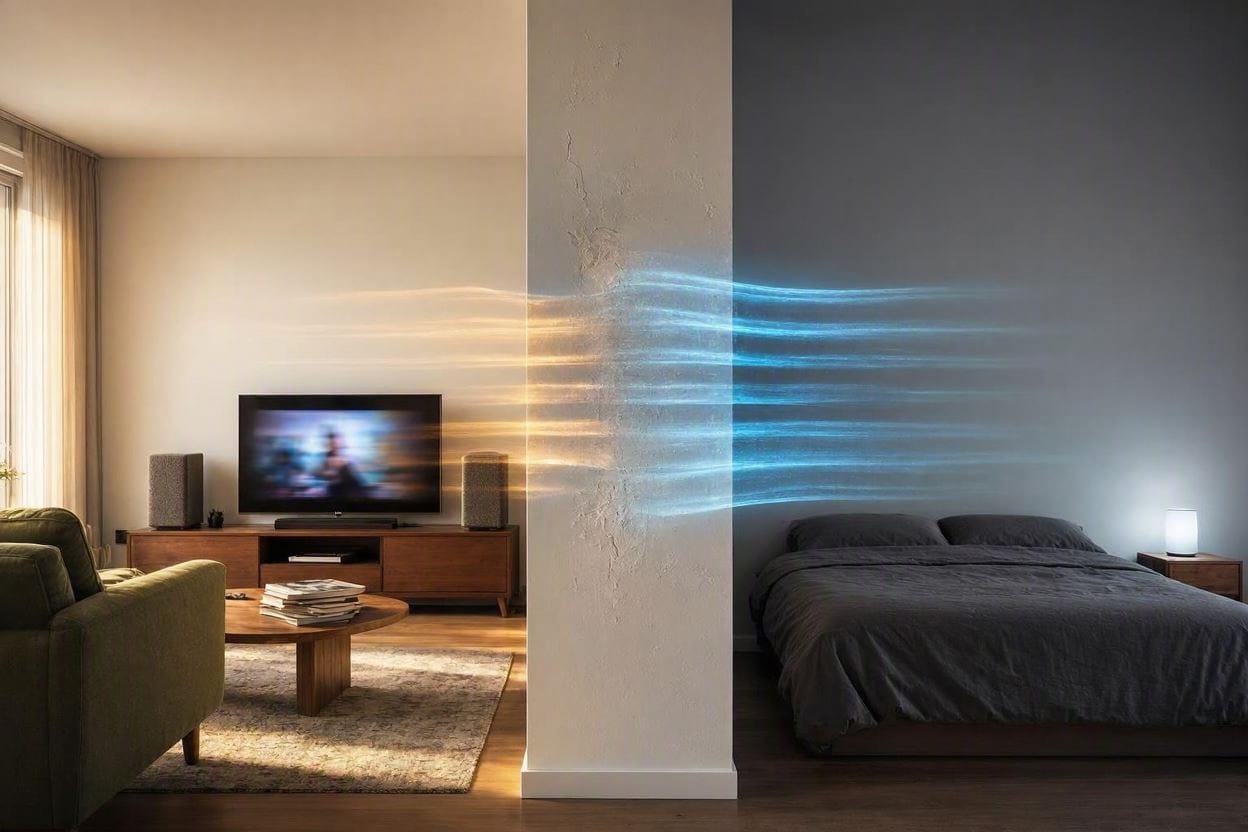
There is a deeply uncomfortable realization that happens when you first move into a poorly built home or apartment. You are lying in bed, reading a book in total silence, and suddenly, you hear your neighbor’s phone ring. A minute later, you can perfectly understand every word of their private phone conversation.
The illusion of privacy is instantly shattered. If you can hear their quiet conversation through a supposedly solid wall, it means they can hear everything you are doing, too.
When this happens, it feels like the sound is magically passing through the solid matter of the building like a ghost. But sound is not magic. It is a physical wave of kinetic energy. It behaves according to very strict, predictable laws of physics.
If you want to reclaim your privacy and build a quiet dwelling, you have to stop looking at your wall as a solid barrier. You have to start looking at it as an acoustic transmission engine. Let’s dive into the fascinating physics of how sound travels through walls, why standard drywall acts like an amplifier, and how you can actually stop it.
🎯 The Quick Science
The “Drum” Effect: Sound waves don’t float through holes in the wall; they physically vibrate the solid drywall. The drywall pushes the air on the other side, essentially turning your shared wall into a giant speaker cone.
The Fix: To stop a physical vibration, you cannot use soft, lightweight foam. You must add heavy density to block the wave (Mass) and physically disconnect the wall frames so the vibration cannot travel (Decoupling).
The Physics of the Wave: Kinetic Energy Transfer
To understand transmission, we have to look at how a sound wave is born. When your neighbor speaks, their vocal cords vibrate the air molecules in their throat. Those air molecules bump into the air molecules in front of them, creating a pressurized chain reaction of kinetic energy that travels across the room.
According to researchers at the Acoustical Society of America, when this pressurized wave of air hits a solid boundary—like a sheet of drywall—the energy does not simply stop. It attempts to transfer its kinetic energy into the solid object.
Because standard residential drywall is only 1/2-inch thick and relatively lightweight, it is easily manipulated by the sound wave. The acoustic energy literally forces the drywall to bend and vibrate on a microscopic level.
When the drywall vibrates, it pushes against the air molecules on your side of the wall. Your wall has now become a mechanical speaker cone, recreating the exact acoustic frequency of your neighbor’s voice and broadcasting it directly into your ears.
The Structural Bridge (How the Studs Betray You)
You might be thinking: “But my wall has two sheets of drywall with empty space in the middle. Why doesn’t the empty space stop the vibration?”
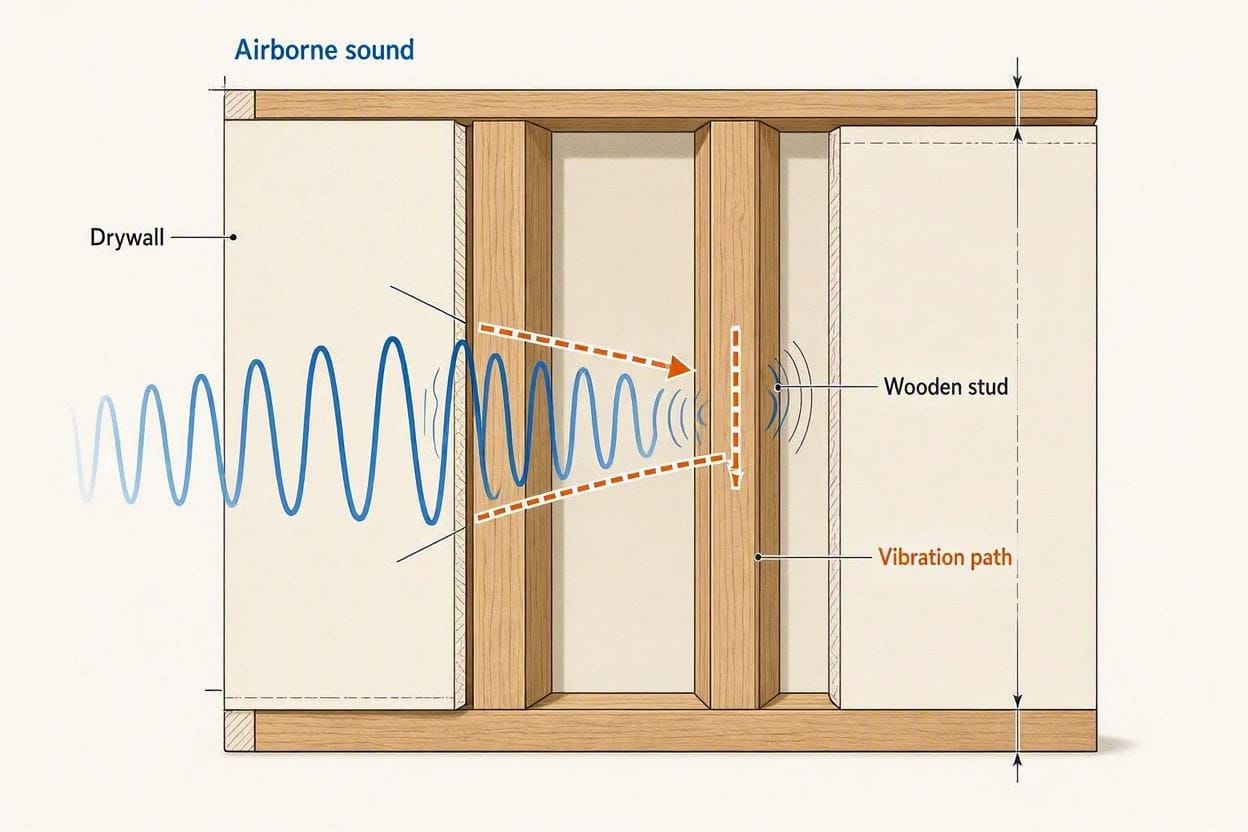
This is where standard home construction completely fails at acoustics. A normal interior wall consists of two sheets of drywall screwed directly into a shared frame of 2×4 wooden studs.
Wood is a highly rigid, dense material. Sound travels through rigid solids significantly faster and more efficiently than it travels through the air. When the sound wave hits your neighbor’s drywall, the vibration instantly travels into the wooden stud. Because your drywall is screwed into that exact same wooden stud, the vibration travels across the wood and violently shakes your side of the wall.
This direct physical connection is called a “structural bridge,” and it is the primary reason why standard walls have terrible STC (Sound Transmission Class) ratings.
Mass-Air-Mass Resonance (The Double Wall Dilemma)
If the wooden studs are the problem, what happens if we fill the empty space between the studs with insulation?
Filling the wall cavity with acoustic mineral wool is a great step, but it reveals another fascinating phenomenon of physics: Mass-Air-Mass Resonance.
When you have two heavy masses (the sheets of drywall) separated by a pocket of air, the trapped air acts like a compressed spring. When a low-frequency sound wave (like the deep rumble of a home theater subwoofer or heavy traffic) hits the wall, the first sheet of drywall vibrates, compressing the trapped air spring.
The compressed air violently pushes against the second sheet of drywall. At certain low frequencies, this “air spring” actually amplifies the sound, making the bass louder on the other side of the wall than it was in the original room! This is why you can easily hear the deep bass of your neighbor’s music, but not the high-pitched vocals. We cover this exact phenomenon in our guide on how to block low-frequency noise.
The Flanking Pathways (Sound Leaks)
Even if you build a heavy, thick wall, sound behaves exactly like fluid water. It will always seek the path of least resistance. If the direct path through the wall is blocked, the acoustic energy will simply travel around the wall.
This is known as Flanking Transmission. Common flanking paths include:
- Back-to-Back Electrical Outlets: If you and your neighbor have electrical outlets installed in the same wall cavity, the builder has essentially cut a giant, uninsulated hole straight through your shared wall.
- Shared Floor Joists: If you share a continuous hardwood floor that runs under the wall framing, the sound will vibrate the floorboards and travel completely under the drywall.
- Air Ducts: Metal HVAC ducts act as highly efficient acoustic speaking tubes, carrying voices from one room to the next, completely bypassing the wall structure.
To successfully quiet your home, you must identify and seal these leaks. We provide a complete diagnostic checklist in our master guide: Understanding Flanking Noise.
How to Stop Acoustic Transmission
Once you understand how sound travels through walls, you understand why taping lightweight acoustic foam or egg cartons to your drywall is a complete failure. Foam has zero mass, so it cannot stop the wall from vibrating.
To actually stop sound from passing through a wall, you must employ the strict, scientifically proven four principles of soundproofing:
- Mass: Add incredibly heavy, dense materials (like 5/8-inch Type X drywall or Mass Loaded Vinyl) to the wall. Heavy objects require massive amounts of kinetic energy to vibrate.
- Decoupling: You must break the structural bridge. By installing rubberized “sound isolation clips” and hat channels, you physically disconnect your drywall from the wooden studs. The vibration hits the rubber and dies before it reaches your room.
- Damping: If you sandwich a layer of viscoelastic damping compound (like Green Glue) between two sheets of drywall, it forces the drywall to shear. This friction literally converts the kinetic sound waves into trace amounts of heat, killing the resonance.
- Absorption: Fill the empty wall cavities with dense mineral wool to stop internal air spring resonance.
Frequently Asked Questions (FAQ)
Why Can I Hear My Neighbor Walking, But Not Talking?
This comes down to the difference between Airborne vs. Impact noise. Talking is an airborne noise that struggles to penetrate the heavy mass of a ceiling. Walking is an impact noise; the physical strike of a heavy heel injects kinetic energy straight into the structural floor joists, which vibrates your ceiling drywall like a drum.
Does Sound Travel Up or Down a Building More Easily?
Sound travels equally well in all directions through structural framing. However, because impact noises (like footsteps and dropping objects) happen on the floor, the energy is driven downward via gravity into the ceiling below. This is why downstairs neighbors suffer significantly more structural noise pollution than upstairs neighbors.
Can Sound Travel through Concrete Walls?
Yes. While concrete is incredibly heavy (making it fantastic at blocking airborne voices and high-frequency noise), it is highly rigid. This extreme rigidity allows low-frequency impact vibrations (like drilling, hammering, or train rumbles) to travel long distances through the solid slab with very little energy loss.

Ememobong is the lead researcher and editor at Quiet Dwelling. As a professional technical writer, he specializes in breaking down complex acoustic engineering concepts into simple, actionable steps. His goal is to help people build distraction-free environments for better sleep and deep work.