
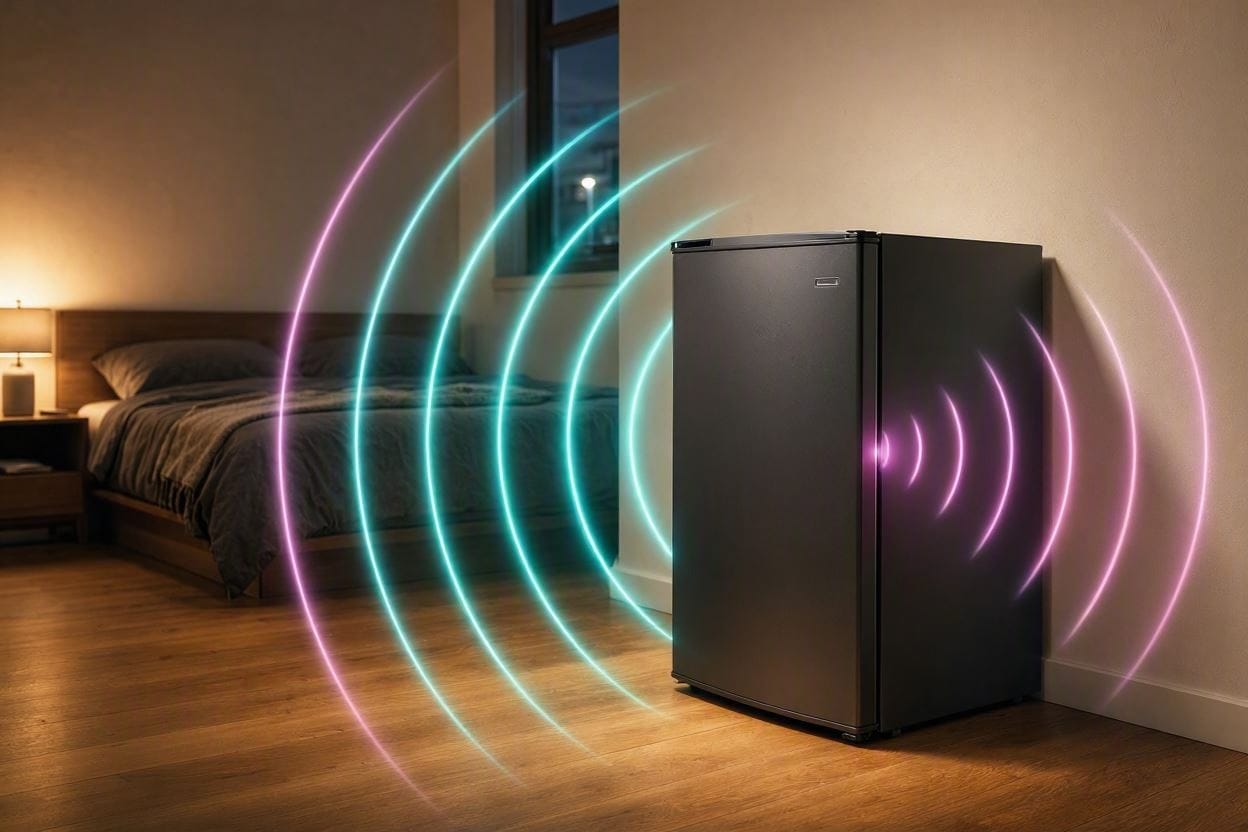
We all know the midnight jump-scare. You are lying in bed, the house is perfectly quiet, and you are just beginning to drift off to sleep. Suddenly, a sharp, metallic CLICK echoes from the corner of the room, immediately followed by a low, vibrating rumble and the sound of cracking plastic.
If you keep a mini fridge in your bedroom, dorm, or home office, you have experienced this acoustic nightmare. It sounds as if the machine is breaking, dropping ice, or tearing itself apart from the inside. But the truth is much less dramatic—and much more scientific.
A standard mini fridge is essentially a complex thermodynamic engine packed into a cheap plastic and metal box. When temperatures fluctuate, physics takes over. As we covered in our clinical guide on safe decibel levels for sleep, it isn’t the steady hum of a machine that ruins your rest; it is the sudden, unpredictable spikes in volume that trigger your brain’s fight-or-flight response.
If you want to reclaim your sleep, you have to understand exactly what your appliance is doing in the dark. Let’s break down the mechanical “click,” the thermodynamic “pop,” and how you can silence your mini fridge for good.
🎯 The Quick Science
The “Click”: This is the PTC Starter Relay. It is a physical electrical switch that snaps closed to send a massive surge of power to the compressor motor when the fridge gets too warm.
The “Pop & Crack”: This is Thermal Expansion. As the inside of the fridge rapidly cools down and then warms back up, the cheap plastic walls and metal pipes physically shrink and expand, rubbing against each other and popping.
The “Gurgle”: This is the chemical refrigerant liquid boiling into a gas as it extracts heat from your drinks.
The Anatomy of the “Click” (The PTC Relay)
Standard mini fridges do not run continuously. They use a “fixed-speed” compressor. This means the motor is either running at 100% full power, or it is completely shut off.
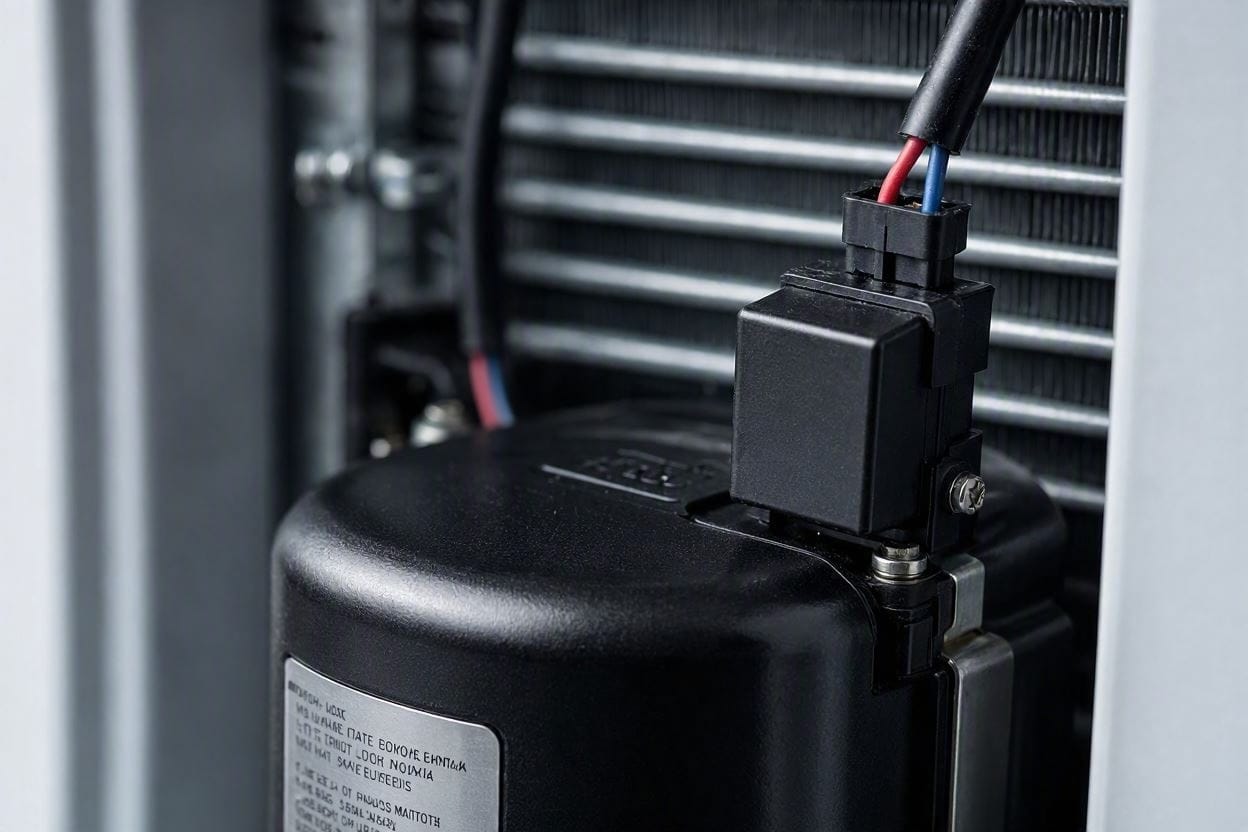
When the internal thermostat senses that your drinks are getting too warm, it sends a signal to a tiny device mounted on the side of the compressor called the PTC (Positive Temperature Coefficient) Starter Relay. To get the heavy metal compressor motor spinning from a dead stop, it requires a massive, instantaneous surge of electricity.
The PTC relay contains a physical mechanical switch. When it activates, the metal contacts violently snap together to deliver that surge of voltage. That sharp, high-frequency metallic SNAP is the first thing you hear.
Once the compressor is running, it creates a low-frequency hum. But if the fridge is sitting on a hard wooden floor, that hum turns into Impact Noise. The motor’s kinetic vibration travels down the legs of the fridge, turning your floorboards into a booming acoustic amplifier. (You can read exactly how this vibration travels in our master guide on Airborne vs. Impact Noise).
The Anatomy of the “Pop” (Thermal Expansion)
A few minutes after the compressor kicks on, you usually hear a loud cracking or popping sound, similar to someone stepping on a plastic cup. This is Thermal Expansion and Contraction.
According to the basic laws of thermodynamics detailed by the U.S. Department of Energy (DOE), a refrigerator does not actually “make cold air.” It extracts existing heat from the inside of the box and dumps it out the back into your room.
As the heat is aggressively sucked out of the interior, the internal temperature drops rapidly. Cold materials physically contract (shrink). The inner plastic lining of the mini fridge, the styrofoam insulation, and the metal cooling pipes all contract at slightly different speeds. As these differing materials shrink, they grind against each other. When the friction builds up and suddenly releases, it results in a sharp, plastic POP.
When the compressor shuts off and the fridge slowly warms back up, the materials expand, resulting in more popping. It is completely normal, but it is acoustically terrible for a bedroom.
How to Silence Your Mini Fridge (3 DIY Fixes)
You cannot change the laws of physics, but you can alter your appliance’s environment to heavily muffle these annoying sounds.
Fix #1: The Rubber Mat Hack (Decoupling)
If your fridge sits on hardwood, laminate, or tile, the mechanical “click” and motor hum are being heavily amplified by your floor. You must decouple the machine. Buy a thick, high-density vulcanized rubber anti-vibration mat (often sold for washing machines) and place it directly under the fridge. The heavy rubber acts as an acoustic shock absorber, trapping the vibration before it can enter the wood.
Fix #2: Pull it Away From the Wall
Never push a mini fridge completely flush against the drywall. If the compressor is crammed against the wall, the sound waves will bounce immediately off the hard drywall, amplifying the hum and the clicks. Furthermore, choking the airflow causes the compressor to overheat, meaning it will click on much more frequently. Leave at least 3 to 5 inches of breathing room behind the unit.
Fix #3: Level the Feet
If your fridge is tilted even slightly, the chemical refrigerant liquid (freon) struggles to flow evenly through the pipes, causing aggressive gurgling and hissing noises. Grab a bubble level, place it on top of the fridge, and adjust the threaded legs at the bottom front of the unit until it sits perfectly flat.
When to Give Up (The 100% Silent Alternative)
If you have leveled the fridge, put it on a rubber mat, and you are still being jolted awake by the clicking relay, it is time to accept a hard truth: standard compressor fridges do not belong in a bedroom with light sleepers.
If you want absolute, 0-decibel perfection, you must switch cooling technologies. As we detail in our master review of the best quiet mini fridges for bedrooms, there are two alternatives that completely eliminate clicking and popping:
- Thermoelectric Coolers: These use electrical currents passing through solid metal plates to draw heat out. There is no compressor, no relay switch, and no freon. The only moving part is a tiny computer exhaust fan. They produce a constant, whisper-soft hum (under 28 dB) that acts as soothing white noise.
- Absorption Fridges: This is the holy grail of silent cooling (used in luxury hotel rooms). They use heat to circulate a mixture of ammonia and water. Because there is no compressor and no fan, there are absolutely zero moving parts. They produce exactly 0 decibels of sound.
Frequently Asked Questions (FAQ)
When is a Clicking Noise Actually Dangerous?
A single click followed by a low hum is normal. However, if your fridge clicks, buzzes loudly for 5 seconds, clicks again, and shuts off (repeating this cycle every few minutes without getting cold), your PTC starter relay is broken. The compressor is trying to start, failing, and overheating. Unplug the fridge immediately to prevent a fire hazard and replace the relay.
Why Does My Fridge Sound Like Running Water?
This gurgling or “rushing water” sound is completely normal. It is the sound of the liquid chemical refrigerant boiling into a gas and flowing through the evaporation tubes on the back of the unit. It usually lasts for just a few moments after the compressor shuts off as the internal pressure equalizes.
Will Putting My Fridge On a Carpet Make it Quieter?
While a plush carpet will absorb some vibration, you should never place a compressor mini fridge directly on a thick carpet. The compressor sits at the bottom back of the unit and requires constant airflow to cool down. A thick carpet will choke off the ventilation grilles on the bottom, causing the motor to severely overheat.

Ememobong is the lead researcher and editor at Quiet Dwelling. As a professional technical writer, he specializes in breaking down complex acoustic engineering concepts into simple, actionable steps. His goal is to help people build distraction-free environments for better sleep and deep work.