
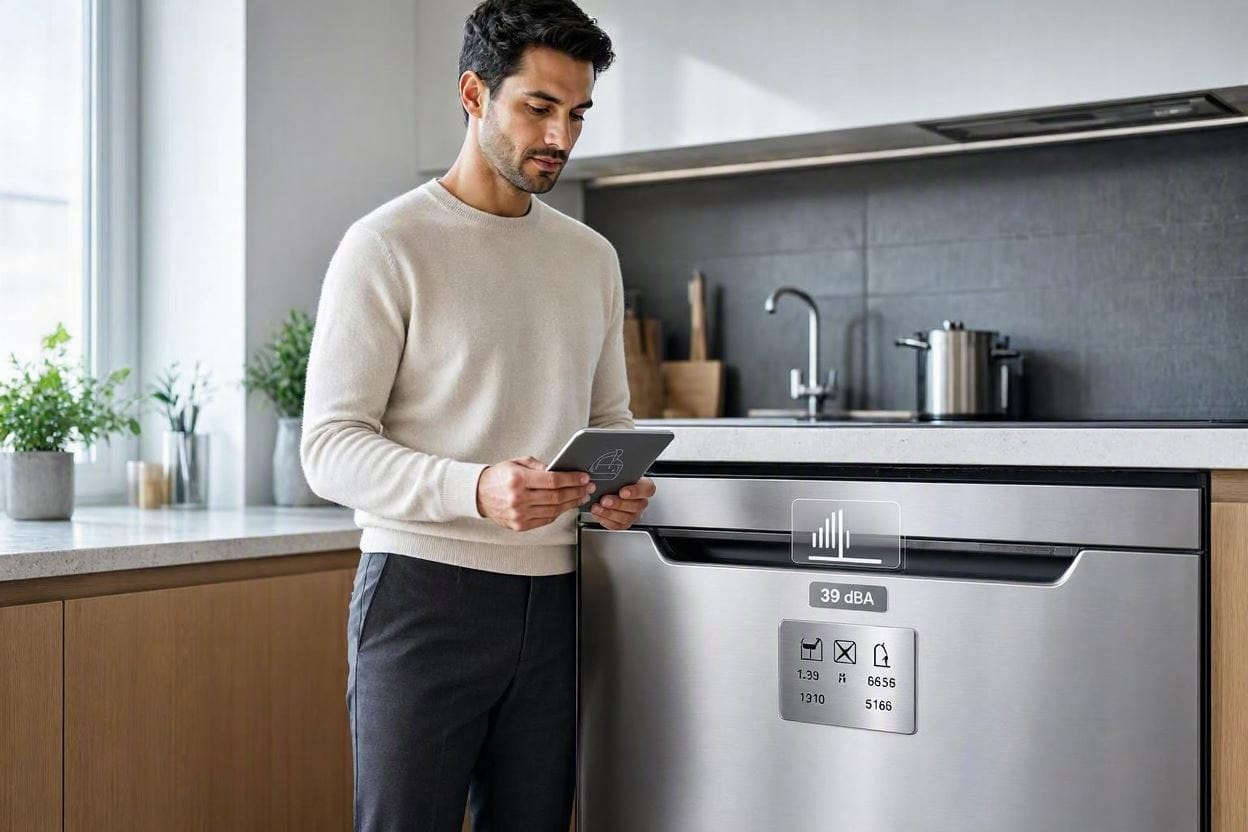
We have all been victims of deceptive appliance marketing. You spend hours researching online, looking for a machine that won’t disrupt your peaceful home. You finally buy a blender, a washing machine, or an air purifier that proudly boasts “Whisper-Quiet Technology™” in bold letters on the box.
You plug it in, press the power button, and immediately wince. It sounds like a lawnmower starting up in your kitchen. The “whisper” was a complete lie.
The dirty little secret of the home appliance industry is that words like Ultra-Silent, Quiet-Core, and Eco-Quiet are completely unregulated marketing buzzwords. They mean absolutely nothing. If you want to protect your home’s acoustic hygiene, you have to ignore the marketing copy and look at the cold, hard math printed in the back of the owner’s manual: the decibel rating.
However, the decibel scale does not work like a normal ruler or thermometer. It uses highly counterintuitive math. In this guide, we will break down exactly how to read the decibel scale, the sneaky testing loopholes manufacturers use to fake their numbers, and the exact decibel targets you need to look for when buying home appliances.
🎯 The Quick Science
The Logarithmic Trap: The decibel scale is not linear. A machine rated at 50 dB is not “slightly louder” than a machine rated at 40 dB. To human ears, it is exactly twice as loud.
dB vs. dBA: Always look for “dBA.” The “A” means the sound was mathematically weighted to measure only the frequencies the human ear can actually hear, giving you a true representation of how annoying the appliance will be in your house.
The Logarithmic Scale (Why 50 is Double 40)
If a recipe calls for two cups of flour instead of one, you doubled the flour. If you drive 60 miles per hour instead of 30, you are going twice as fast. Because we are used to linear math, we apply this logic to sound.
But the human ear is too sensitive for linear math. According to the Centers for Disease Control and Prevention (CDC), our ears can detect everything from the microscopic rustle of a leaf to the earth-shaking roar of a jet engine. If we measured sound linearly, the scale would be in the trillions. To compress this massive range, acousticians use a logarithmic scale.
On a logarithmic scale, the acoustic energy multiplies exponentially. For human perception, the golden rule of acoustics is the Rule of 10:
- An increase of just 3 dB means the physical sound energy has doubled (though your ear barely registers the change).
- An increase of 10 dB means the sound is perceived by your brain as twice as loud.
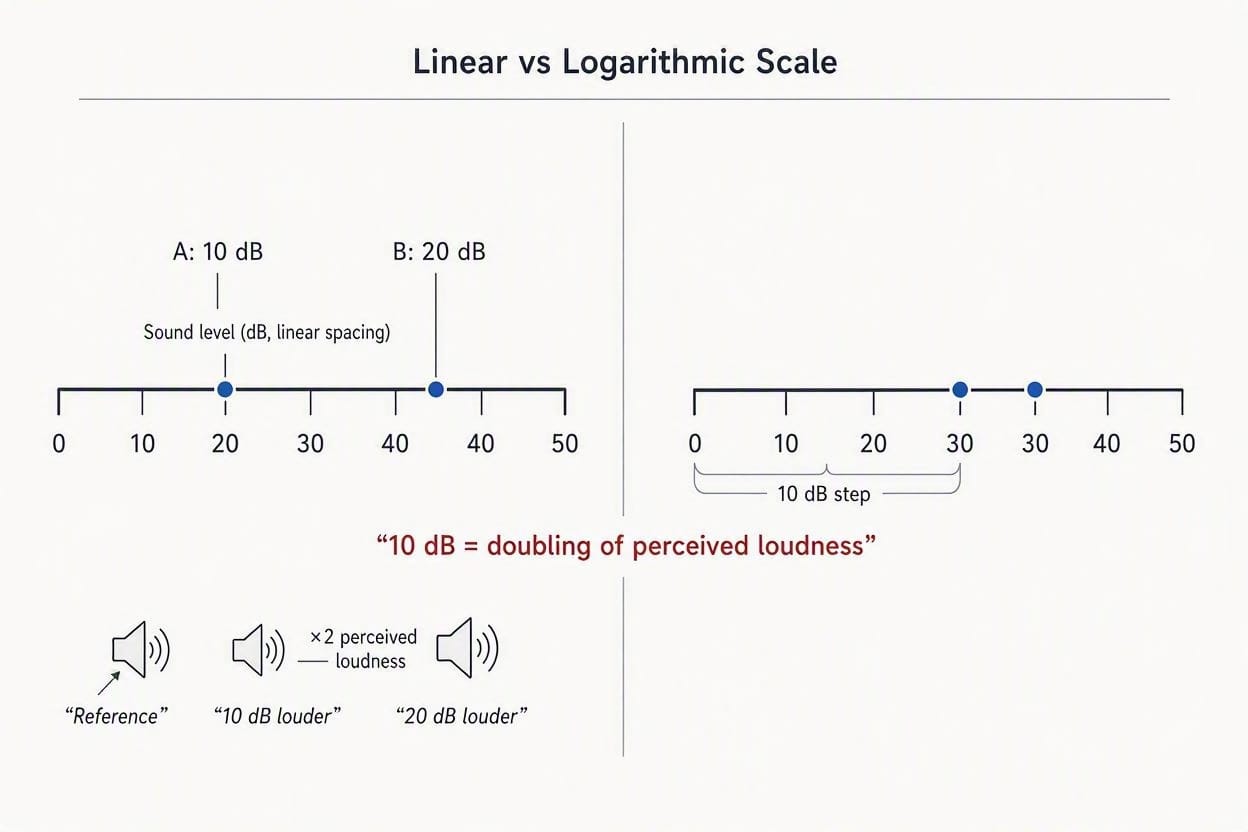
This is where consumers get tricked. If you are comparing two dishwashers, and one is rated at 42 dB and the other is rated at 52 dB, you might think the difference is negligible. In reality, the 52 dB dishwasher is going to sound exactly twice as loud in your kitchen. Every single decibel counts.
What Does “Quiet” Actually Mean for Appliances?
To help you navigate the appliance aisle, here is a real-world translation of decibel ratings for common home appliances. Keep in mind that a completely silent room at night naturally rests at around 25 to 30 dB.
| Decibel Level | What It Sounds Like | Appliance Examples |
|---|---|---|
| 20 – 30 dBA | A quiet whisper. Virtually inaudible. | Premium thermoelectric mini-fridges, sleep-mode air purifiers. |
| 38 – 45 dBA | A quiet library. A very soothing, low hum. | High-end dishwashers (e.g., Bosch 800 Series), inverter portable ACs. |
| 50 – 60 dBA | Normal indoor conversation. Intrusive to sleep. | Standard refrigerators, quiet washing machines, microwave motors. |
| 70 – 85 dBA | Loud traffic. Requires raising your voice to speak. | Cheap vacuum cleaners, standard garbage disposals, hair dryers. |
If you are placing an appliance in a bedroom (like a fan or a mini fridge), you must ensure it operates below 45 dBA. We extensively cover the medical reasons behind this in our guide: How Many Decibels is Too Loud for Sleep?
The Testing Loopholes (How Brands Cheat)
Even if you find a product with a printed decibel rating, you cannot blindly trust it. The appliance industry does not have a strict, universally enforced acoustic testing standard for all products. This allows brands to exploit two major loopholes:
The Distance Loophole
When a manufacturer tests the decibels of an air compressor or a portable air conditioner, where do they place the microphone? Premium brands measure the sound from 3 feet away. Cheap brands will place the microphone 15 or 20 feet away to get a lower number. Before buying, check the manual to see the “testing distance.”
The “Minimum Speed” Loophole
If a blender or an air purifier claims it operates at “an ultra-quiet 24 dB,” read the fine print. That rating is almost always recorded when the machine is on its lowest, weakest possible setting (often called “Sleep Mode”). When you turn the machine up to actually clean the air or crush ice, it will easily jump to 60 dB.
When Decibels Lie (Airborne vs. Impact Noise)
You can buy a washing machine boasting a phenomenally low 45 dB rating. But when you install it on the second floor of your house, it shakes the entire building and sounds like an earthquake. Why?
Because the decibel meter only measured Airborne Noise (the sound the motor makes in the air). It completely ignored Impact Noise (the physical, kinetic vibration the machine sends into your floorboards).
If a heavy appliance has a powerful motor but lacks internal shock absorbers, the vibration will bypass the air entirely, travel down its legs, and vibrate the wooden structure of your house. The house acts like an acoustic guitar body, amplifying the vibration into a booming bass note. If you want to understand how to decouple your appliances from your floor to stop this, read our master guide on Airborne vs. Impact Noise.
Frequently Asked Questions (FAQ)
What is the Difference Between dB and dBA?
Human ears do not hear all sound frequencies equally; we are terrible at hearing deep bass, but highly sensitive to mid-range frequencies (like a baby crying or a siren). A raw “dB” measurement counts all acoustic energy equally. A “dBA” (A-weighted) measurement runs the math through a filter that mimics the human ear. You should always look for dBA, because it tells you how loud the appliance will actually feel to your brain.
Why are Sones Used Instead of Decibels For Bathroom Fans?
The ventilation industry uses Sones because they are a linear measurement, unlike logarithmic decibels. A 2.0 Sone fan is exactly twice as loud as a 1.0 Sone fan, which makes it much easier for consumers to understand the math. For context, 1.0 Sone is roughly equivalent to 28 dBA (the hum of a quiet refrigerator).
Can I Test Appliance Decibels With My Smartphone?
Yes! While smartphone microphones are not perfectly calibrated laboratory instruments, free apps like the NIOSH Sound Level Meter are fantastic for getting a highly accurate baseline reading of your current appliances, allowing you to establish a benchmark before you buy a new one.

Ememobong is the lead researcher and editor at Quiet Dwelling. As a professional technical writer, he specializes in breaking down complex acoustic engineering concepts into simple, actionable steps. His goal is to help people build distraction-free environments for better sleep and deep work.