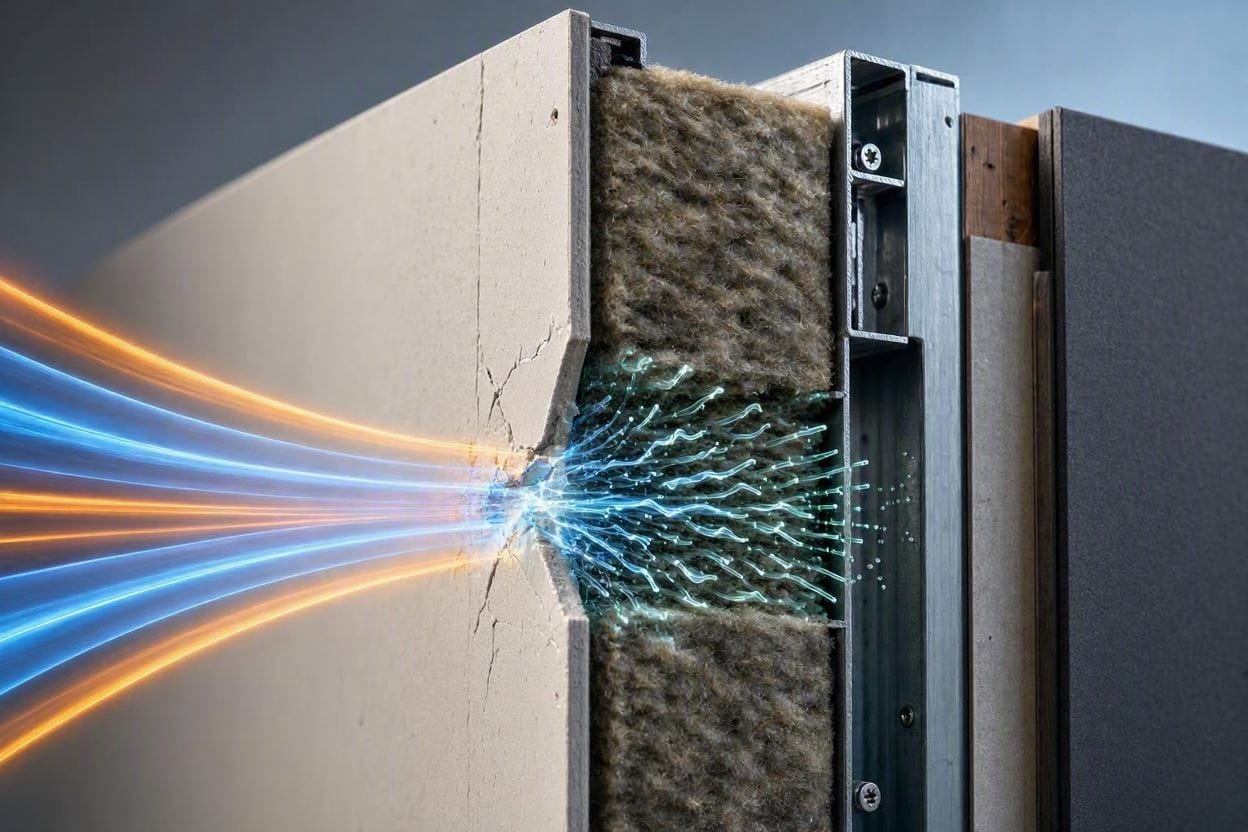
If you have ever tried to soundproof a room, you have inevitably run into a wall of confusing acoustic jargon. Whether you are looking at specialized drywall, acoustic doors, or soundproof windows, every product proudly advertises its “STC Rating.”
As a consumer, you are led to believe that a higher number means absolute silence. So, you spend a fortune on materials with a high STC rating, install them perfectly, and sit down to enjoy your quiet sanctuary—only to realize you can still hear the low, thumping bass from your neighbor’s home theater system.
How did this happen? Because STC is one of the most misunderstood and heavily manipulated marketing metrics in the acoustic industry.
In this guide, we are going to break down exactly what Sound Transmission Class (STC) measures, what it completely ignores, and how to use this rating to actually achieve a peaceful, quiet dwelling.
What Exactly Is An STC Rating?
STC stands for Sound Transmission Class. It is a standardized integer rating (established by ASTM International) that calculates how well a building partition—like a wall, ceiling, door, or window—attenuates airborne sound.
To calculate an STC rating, acoustic engineers blast a specific range of frequencies at a wall in a testing laboratory and measure how many decibels (dB) are lost as the sound travels through the materials. Roughly speaking, the STC rating equals the number of decibels the wall successfully blocks.
- If a wall has an STC rating of 40, it reduces airborne noise by approximately 40 decibels.
- If your neighbor is playing a TV at 80 decibels, and your shared wall is STC 40, the noise on your side of the wall will be reduced to a faint 40 decibels.
The STC Scale Explained (What The Numbers Mean)
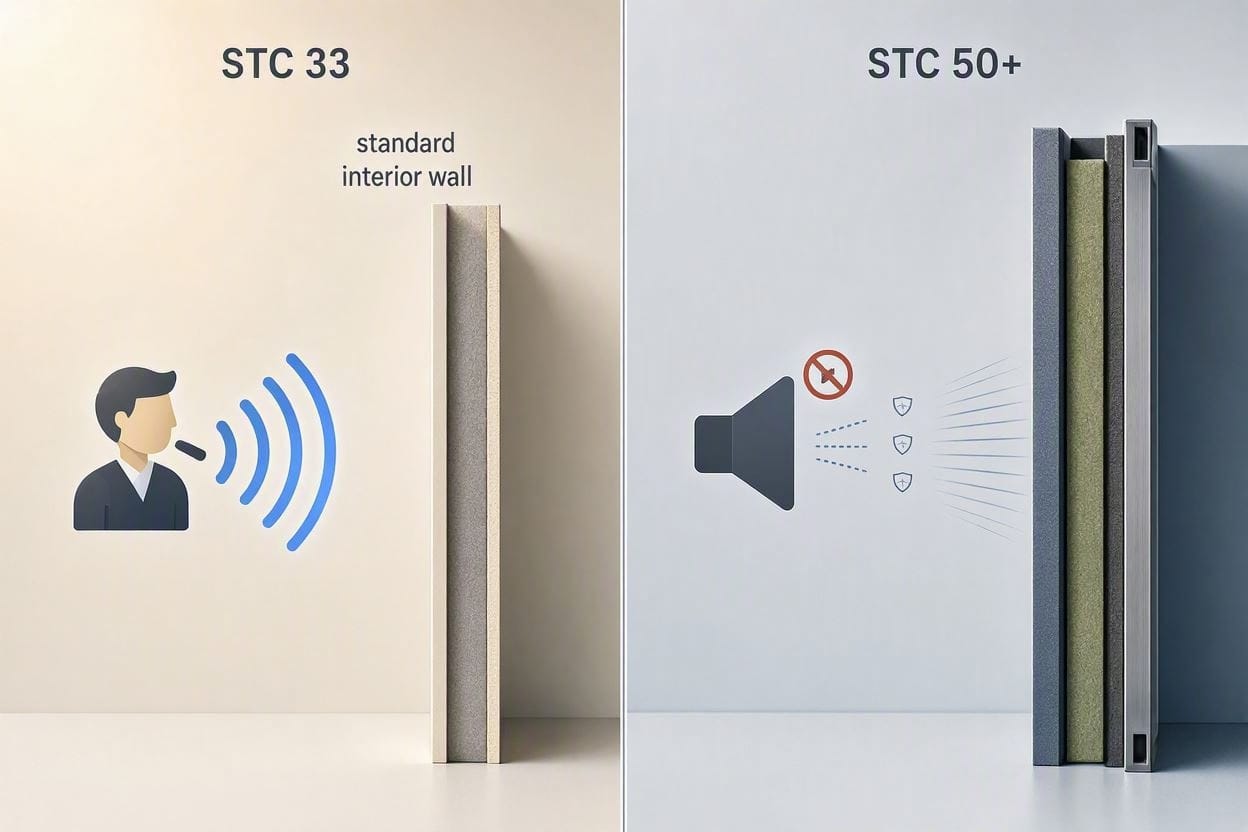
Because the decibel scale is logarithmic, the STC scale is not linear. A jump from STC 30 to STC 40 is a massive, highly noticeable difference in acoustic comfort. Here is how the numbers translate to real-world scenarios:
- STC 25 (Paper-Thin Walls): Normal speech can be understood easily and distinctly through the wall.
- STC 33 (Standard Interior Wall): Loud speech can be heard and understood. Normal speech is audible but muffled. This is typical for basic residential drywall over wooden studs without insulation.
- STC 45 (Good Privacy): Loud speech is barely audible. You will know someone is yelling, but you likely cannot make out the exact words.
- STC 50 (Building Code Standard): The International Building Code (IBC) requires an STC of 50 for shared walls in multi-family apartments and hotels. Loud sounds are very faint.
- STC 60+ (Elite Soundproofing): Specialized acoustic construction. Most airborne sounds are completely blocked. Excellent for recording studios and home theaters.
The Two Things STC Does Not Measure
The biggest mistake homeowners make is assuming that a high STC rating equals “soundproof.” It doesn’t. If you are dealing with specific types of noise pollution, focusing solely on STC will result in thousands of wasted dollars. STC fails to account for two major noise categories:
1. Impact Noise (Structure-Borne Vibrations)
STC only measures airborne noise (sound traveling through the air). It does not measure impact noise, which is kinetic energy traveling physically through the building’s structure. If your upstairs neighbor drops a bowling ball or walks around in heavy boots, that is impact noise. To measure a ceiling’s resistance to footsteps, you must look at the IIC (Impact Insulation Class) rating, not the STC.
2. Low-Frequency Airborne Noise
Because the STC formula cuts off at 125 Hz, it is heavily biased toward middle and high frequencies. If you live near a busy highway or an airport, a wall with an STC of 50 might still let the deep, vibrating rumble of traffic straight into your bedroom. For low-frequency outdoor noise, acoustic engineers prefer the OITC (Outside-Inside Transmission Class) rating, which specifically tests down to 80 Hz to account for transportation noise.
How to Actually Improve Your Wall’s STC Rating
If you want to genuinely increase the STC rating of a wall, you cannot just stick egg cartons or cheap acoustic foam to the drywall. Acoustic foam absorbs echoes inside a room, but it does absolutely nothing to block sound from leaving or entering. To block sound, you must utilize the four principles of soundproofing:
- Mass: Heavy materials block airborne sound waves. Adding a layer of Mass Loaded Vinyl (MLV) or a second sheet of 5/8″ drywall drastically increases the density of the wall.
- Decoupling: Sound vibrations travel easily through connected wooden studs. Using resilient channels or staggered studs physically separates the drywall from the framing, breaking the sound’s path.
- Damping: Applying an acoustic viscoelastic compound (like Green Glue) between two layers of drywall converts sound wave energy into microscopic heat, effectively killing the vibration.
- Absorption: Filling the empty air cavity inside the wall with dense mineral wool insulation prevents the hollow space from acting like an acoustic drum.
Mass Loaded Vinyl (MLV)
The industry standard for adding extreme mass to thin walls and floors. MLV stops airborne sound waves dead in their tracks.
Acoustic Damping Compound
Apply Green Glue between two layers of drywall to dramatically boost your STC rating by converting sound vibrations into heat.
Acoustic Sealant
Even a 1% air gap can ruin a wall’s STC rating. Use professional acoustic caulk to seal baseboards, outlets, and window frames.
Creating a quiet dwelling requires more than just chasing a high number on a spec sheet. By understanding what STC ratings actually measure—and more importantly, what they miss—you can stop wasting money on ineffective products and invest in the structural materials that will genuinely transform your home into a sanctuary.

Ememobong is the lead researcher and editor at Quiet Dwelling. As a professional technical writer, he specializes in breaking down complex acoustic engineering concepts into simple, actionable steps. His goal is to help people build distraction-free environments for better sleep and deep work.