When you struggle to fall asleep or need to block out a noisy open-office environment, your first instinct is probably to search YouTube or Spotify for a “white noise” track. We use the term white noise as a universal catch-all for any steady, background hum.
But in the realm of acoustic engineering, “white noise” is just one specific color in a vast audio spectrum.
Just as visible light is made up of different colors depending on their wavelengths, sound is categorized into “colors” based on the distribution of acoustic energy across different frequencies. Choosing the wrong color of noise can actually irritate your nervous system, while selecting the right one can mask disruptive sounds, enhance focus, and trigger deep, restorative sleep.
In this guide, we will break down the physical science behind white noise, pink noise, and brown noise, explain how they affect the human brain, and help you choose the perfect acoustic background for your quiet dwelling.
White Noise: The Audio Equalizer
White noise is the most famous color on the acoustic spectrum, but it is often misunderstood.
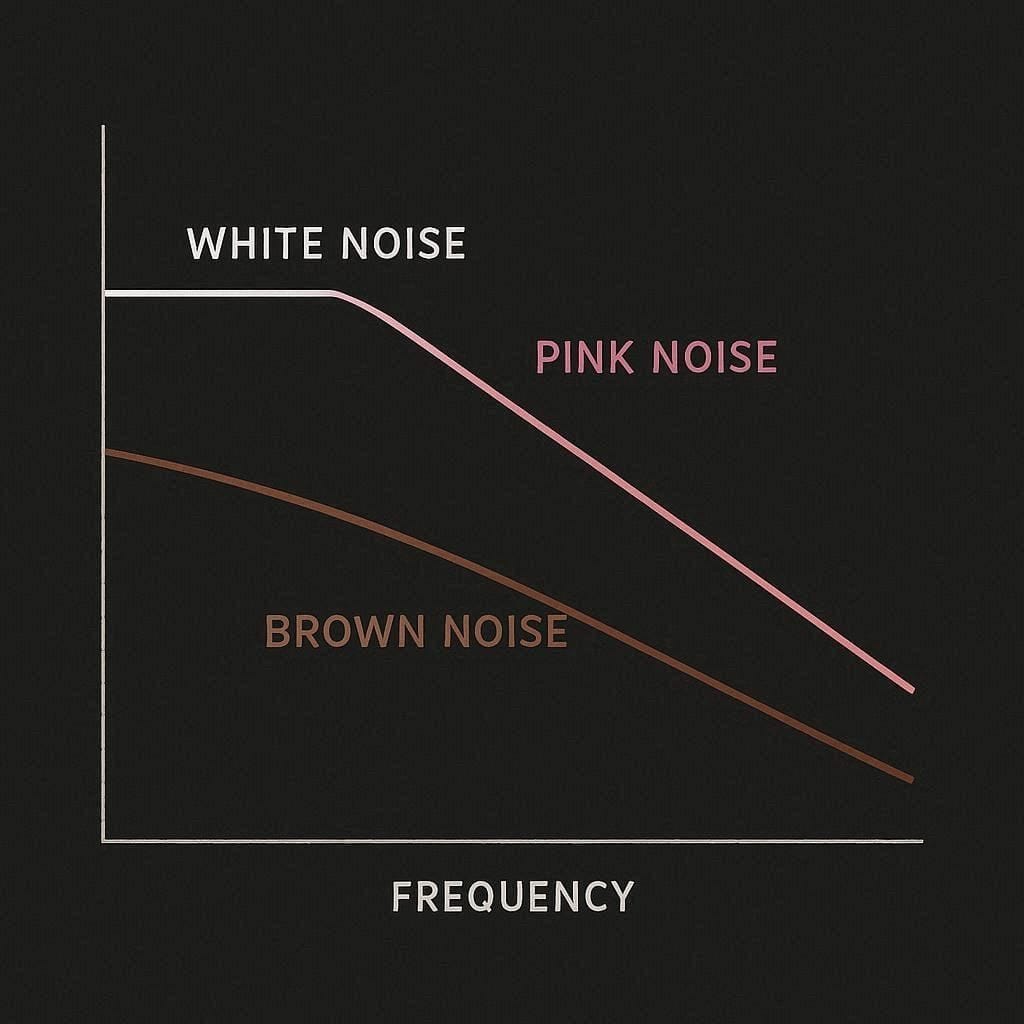
In physics, true white noise contains equal energy across all measurable sound frequencies. Just as white light is a combination of all colors in the visual spectrum shining at once, white noise is a combination of every frequency the human ear can hear (from a deep 20 Hz rumble to a piercing 20,000 Hz whine) playing simultaneously at the exact same amplitude.
What Does White Noise Sound Like?
Because it contains so much high-frequency energy, true white noise sounds very bright, harsh, and static-heavy. It is commonly compared to the “shhh” sound of television static, a hissing steam pipe, or a high-velocity fan.
Best Use Case: Extreme Sound Masking
Because the human ear is highly sensitive to high frequencies, white noise is the ultimate acoustic shield. If you are trying to mask sharp, sudden, high-frequency sounds—like a dog barking, a baby crying, or a slamming door—white noise provides a dense acoustic “wall” that absorbs those disruptive spikes.
However, because of its harshness, many people find true white noise too abrasive to listen to at high decibel levels for eight hours straight during sleep.
Pink Noise: The Sound of Nature
If white noise is too harsh for your ears, pink noise is the scientific upgrade. It has rapidly become the gold standard in sleep clinics and acoustic therapy.
Like white noise, pink noise contains all the frequencies of the audible spectrum. However, the energy is not distributed equally. In pink noise, the acoustic power decreases by half (a drop of 3 decibels) every time the frequency doubles (an octave).
In simple terms: Pink noise is heavily weighted toward the lower, deeper frequencies, while the harsh, high-pitched frequencies are significantly dialed back.
For a deeper dive into how these two specific frequencies impact your sleep cycle, read our direct comparison of pink noise vs. white noise for sleeping.
What Does Pink Noise Sound Like?
Because it mimics the way sounds occur in the natural world, pink noise is incredibly soothing. It sounds like a steady, heavy rainfall, rustling leaves in a dense forest, or the continuous rush of a river.
Best Use Case: Deep Sleep and Memory Consolidation
Pink noise is considered the absolute best color for sleeping. According to a landmark neurological study published by Frontiers in Human Neuroscience, listening to steady pink noise during the night actually synchronizes with your brain waves, increasing the duration and stability of deep, slow-wave sleep. This enhanced sleep architecture directly combats the health effects of environmental noise pollution and improves overnight memory retention.
Brown Noise (Red Noise): The Deep Rumble
Brown noise—sometimes referred to as red noise—takes the concept of pink noise and pushes it to the extreme.
In brown noise, the high frequencies are almost entirely eliminated, and the energy is heavily concentrated in the lowest end of the bass spectrum. The acoustic power decreases by 6 decibels per octave as the frequency rises.
Fun Fact: Brown noise is not named after the color brown! It is actually named after Robert Brown, the scientist who discovered “Brownian motion” (the random movement of particles in a fluid), which generates this specific sound pattern.
What Does Brown Noise Sound Like?
Brown noise is a deep, powerful, and heavy rumble. It has no harsh hissing or static. It sounds like the distant roar of an ocean storm, a powerful waterfall, or the low-end hum of a commercial jet cabin mid-flight.
Best Use Case: Deep Focus and Tinnitus Relief
Because it completely removes distracting high frequencies, brown noise is heavily favored by writers, programmers, and students for deep cognitive focus. Furthermore, individuals who suffer from tinnitus (a chronic ringing in the ears) often use brown noise because the deep, heavy bass frequencies provide a soothing contrast that masks the internal high-pitched ringing without irritating the eardrum.
Black Noise: The Acoustic Void
While white, pink, and brown noise add sound to your environment, black noise represents the theoretical absence of sound.
In physics, black noise is a spectrum that has zero power level across all frequencies, except for a few microscopic spikes. For residential purposes, black noise simply refers to absolute silence.
Achieving a black noise environment in a modern home is incredibly difficult, requiring massive structural decoupling, thick drywall, and the elimination of all internal mechanical sounds. If you are highly sensitive to noise and require a black noise environment to sleep, your first step should be eliminating the acoustic “drip” of household items. You can start by replacing step-motor clocks with completely silent wall clocks and turning off humming appliances.
Comparison Summary: Which Color is Right for You?
To quickly find the perfect acoustic background for your specific needs, use this comparison table:
| Noise Color | Frequency Profile | What it Sounds Like | Best Real-World Application |
|---|---|---|---|
| White Noise | Equal energy across all frequencies. | TV static, hissing steam, harsh fan. | Masking sharp, sudden noises (dogs, sirens). |
| Pink Noise | Louder low frequencies, softer high frequencies. | Heavy steady rain, rushing river, wind. | Enhancing deep sleep and overnight memory. |
| Brown Noise | Heavy bass, virtually zero high frequencies. | Distant thunder, deep ocean waves, jet cabin. | Deep work focus, reading, and tinnitus relief. |
Frequently Asked Questions (FAQ)
Is it Safe to Listen to Pink or Brown Noise all Night?
Yes, it is entirely safe to listen to these sounds throughout the night, provided the volume is kept at a safe, ambient level. The CDC recommends keeping continuous bedroom noise below 45 to 50 decibels to prevent long-term hearing fatigue. Ensure your sound machine or speaker is placed across the room, not directly next to your pillow.
Can I Just Use a Standard Bedroom Fan for White Noise?
A standard bedroom fan is an excellent, cost-effective sound masker, but it usually produces a sound closer to pink or brown noise (depending on the motor size and blade shape) rather than true, harsh white noise. This is actually a benefit, as the mechanical hum of a fan is deeply soothing to the human brain.
Do I Need Special Speakers to Play Brown Noise?
Because brown noise relies heavily on deep, low-frequency bass, playing it through a tiny smartphone speaker will often sound weak and “tinny,” as small speakers cannot reproduce low bass waves. To truly feel the soothing rumble of brown noise, you should play it through a high-quality Bluetooth speaker with a dedicated subwoofer or wear premium headphones.

Ememobong is the lead researcher and editor at Quiet Dwelling. As a professional technical writer, he specializes in breaking down complex acoustic engineering concepts into simple, actionable steps. His goal is to help people build distraction-free environments for better sleep and deep work.