
When you share a thin wall with a noisy neighbor or live near a busy street, tearing down drywall to install professional soundproofing isn’t always an option. Out of desperation, many renters and homeowners turn to interior design, asking a very common question: does furniture help soundproof a room?
You have likely heard the old advice to “just push a heavy bookshelf against the wall” or “buy a thicker couch.” It sounds like a perfect, budget-friendly hack.
However, when we look at the strict laws of architectural acoustics, the answer is complicated. Furniture can drastically change the way a room sounds, but it is rarely effective at physically blocking noise from entering.
In this guide, we will break down the exact physics of how sound interacts with your furniture, debunk common soundproofing myths, and show you how to strategically arrange your room for maximum peace and quiet.
The Big Difference: Soundproofing vs. Sound Absorption
To understand if your furniture is actually working, you must understand the difference between the two main pillars of acoustics. If you confuse these two concepts, you will end up disappointed.
- Soundproofing (Blocking Noise): This is the act of stopping kinetic sound waves from entering or leaving a room. It requires massive, heavy, airtight structural density (like concrete or heavy drywall).
- Sound Absorption (Treating Echoes): This is the act of stopping sound from bouncing around inside the room you are already sitting in. It requires soft, porous materials (like foam, fabric, or rugs).
The vast majority of household furniture acts as an acoustic absorber, not a sound blocker. To fully grasp why this distinction is so critical, read our master guide on Soundproofing vs. Sound Absorption.
Soft Furniture: The Echo Killers (Absorption)
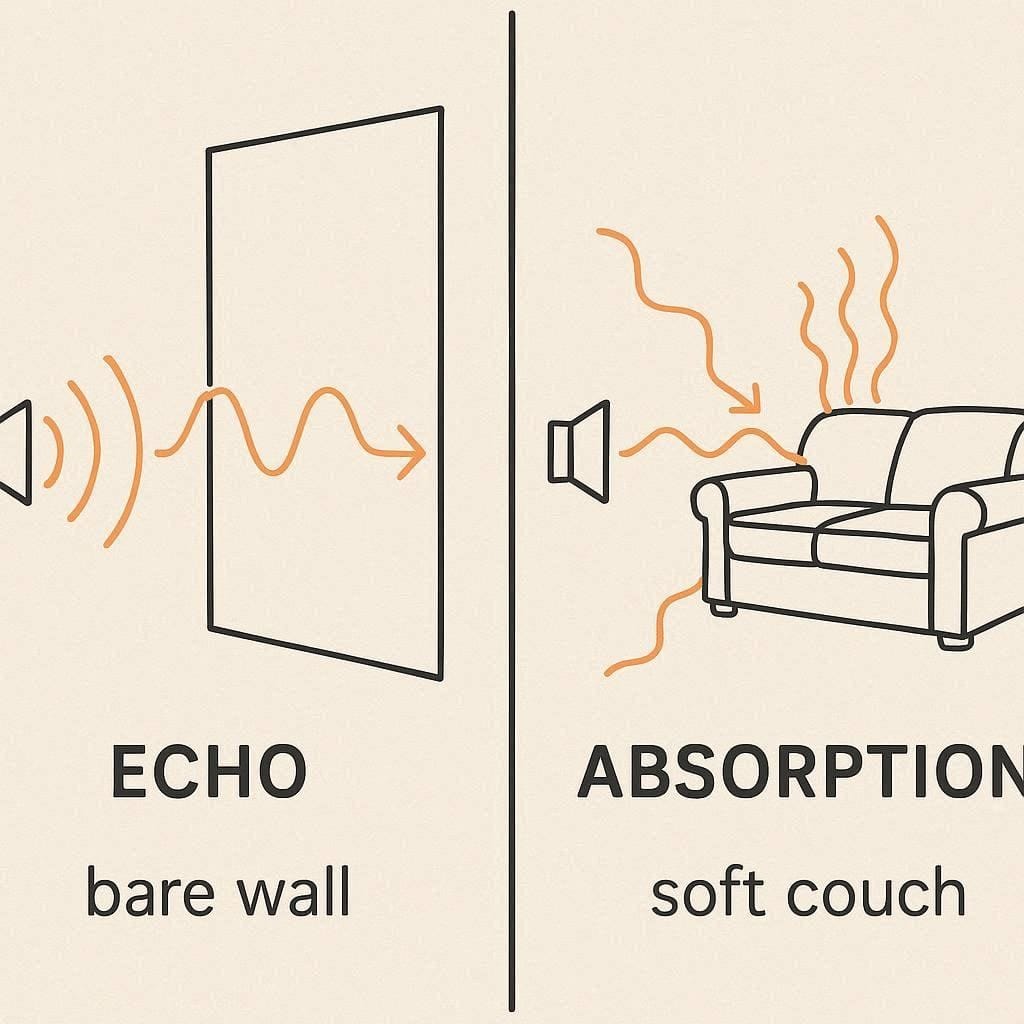
If you have ever stood in an empty house with no furniture, you know how terrible it sounds. Every word you speak bounces off the bare walls, creating a harsh, ringing reverberation.
When you move soft furniture into the room, that echo disappears. Why? Because materials like plush velvet couches, thick mattresses, and heavy armchairs are porous. When a sound wave hits your couch, it enters the microscopic fabric fibers. The friction of the air rubbing against the fabric converts the acoustic energy into trace amounts of heat, killing the echo.
What Soft Furniture Can Do:
- Make your voice sound warmer and clearer on phone calls.
- Stop the “ringing” sound in a large living room.
- Absorb the high-frequency reflections from your television speakers.
What Soft Furniture CANNOT Do:
- Stop the deep, low-frequency rumble of a passing truck.
- Block your neighbor’s dog from barking through the wall.
Hard Furniture: The Bookshelf Myth (Adding Mass)
The most famous soundproofing myth is that pushing a massive, heavy bookshelf against a shared wall will block the sound of your loud neighbors.
Does it work? Yes, but only slightly, and only if done perfectly.
To block airborne noise (like voices or a TV), you must add heavy mass to the wall. A massive, solid-wood bookcase packed tightly with hundreds of heavy books does introduce significant mass to the room. If the bookshelf covers the entire wall from floor to ceiling, the incoming sound waves have to expend extra kinetic energy to vibrate the books before the sound reaches your ears.
However, there are major physical limitations:
- The Flanking Gaps: Sound behaves like fluid. If your bookshelf only covers 80% of the wall, the sound will simply flow around the edges of the bookshelf and enter the room anyway.
- Lack of Decoupling: If the bookshelf is touching the drywall, any structural impact vibration (like a door slamming on the other side) will transfer directly into the wood of the bookshelf, radiating the noise into your room.
If you genuinely need to block noise through a shared wall, do not rely on books. You must use specialized, high-density materials designed for the job. Read our complete guide on how Mass Loaded Vinyl (MLV) blocks sound to see the professional alternative.
Rugs and Curtains: Treating the Floor and Windows
What about the floor and windows? Can decorative elements save your sleep?
Do Heavy Rugs Stop Footsteps?
If you live in a downstairs apartment, a heavy rug will do absolutely nothing to stop the sound of your upstairs neighbor walking. That is because footsteps are a form of impact noise traveling through the ceiling joists.
However, if you are the upstairs neighbor, placing a thick, high-pile rug paired with a dense acoustic rug pad over your hardwood floors is highly effective. It cushions your heel strikes, preventing the impact vibration from entering the floorboards in the first place.
Do Soundproof Curtains Block Street Noise?
As we discussed in our detailed breakdown of acoustic curtains, heavy drapes are fantastic at absorbing internal room echoes. However, standard fabric curtains completely lack the heavy structural mass required to stop the low-frequency rumble of street traffic. They will make your room feel cozier, but they will not stop a car horn.
How to Strategically Arrange Your Room for Quiet
While you cannot rely on furniture to structurally soundproof your home, you can arrange it to minimize auditory annoyance. Here are three strategic layout tips:
- Move Your Bed Away from the Shared Wall: According to the Inverse Square Law of sound (a foundational physics principle), every time you double your distance from a noise source, the sound pressure drops by 6 decibels. Simply pulling your bed to the opposite side of the room drastically reduces the volume of a noisy neighbor.
- Use Wardrobes as Baffles: Place large, heavy wardrobes or solid-wood dressers against the noisiest wall. Fill them with dense winter clothing to create a thick, absorptive buffer zone.
- Create Irregular Shapes: Parallel bare walls create harsh “flutter echoes.” Break up these flat surfaces by placing bookshelves, tall plants, or decorative acoustic panels irregularly around the room to scatter the sound waves.
Frequently Asked Questions (FAQ)
Does a Bed Headboard Block Sound From the Wall?
No. While a thick, upholstered headboard might absorb a tiny amount of high-frequency echo directly behind your pillows, it lacks the physical mass and total wall coverage required to stop sound waves from transmitting through the drywall.
Can Pushing a Couch Against the Wall Stop Vibrations?
Actually, it can make it worse. If a loud, low-frequency sound (like a subwoofer) is vibrating the shared drywall, and your couch is pushed tightly against that wall, the vibration will transfer directly into the frame of the couch. You will physically feel the bass while you sit. Always leave a small air gap between your furniture and a noisy wall.
Do Acoustic Room Dividers Actually Work?
Acoustic room dividers (often made of dense PET felt) are excellent at absorbing high-frequency office chatter and preventing echoes in open-concept spaces. However, because they do not form an airtight seal from floor to ceiling, they cannot physically block sound from traveling around them.

Ememobong is the lead researcher and editor at Quiet Dwelling. As a professional technical writer, he specializes in breaking down complex acoustic engineering concepts into simple, actionable steps. His goal is to help people build distraction-free environments for better sleep and deep work.