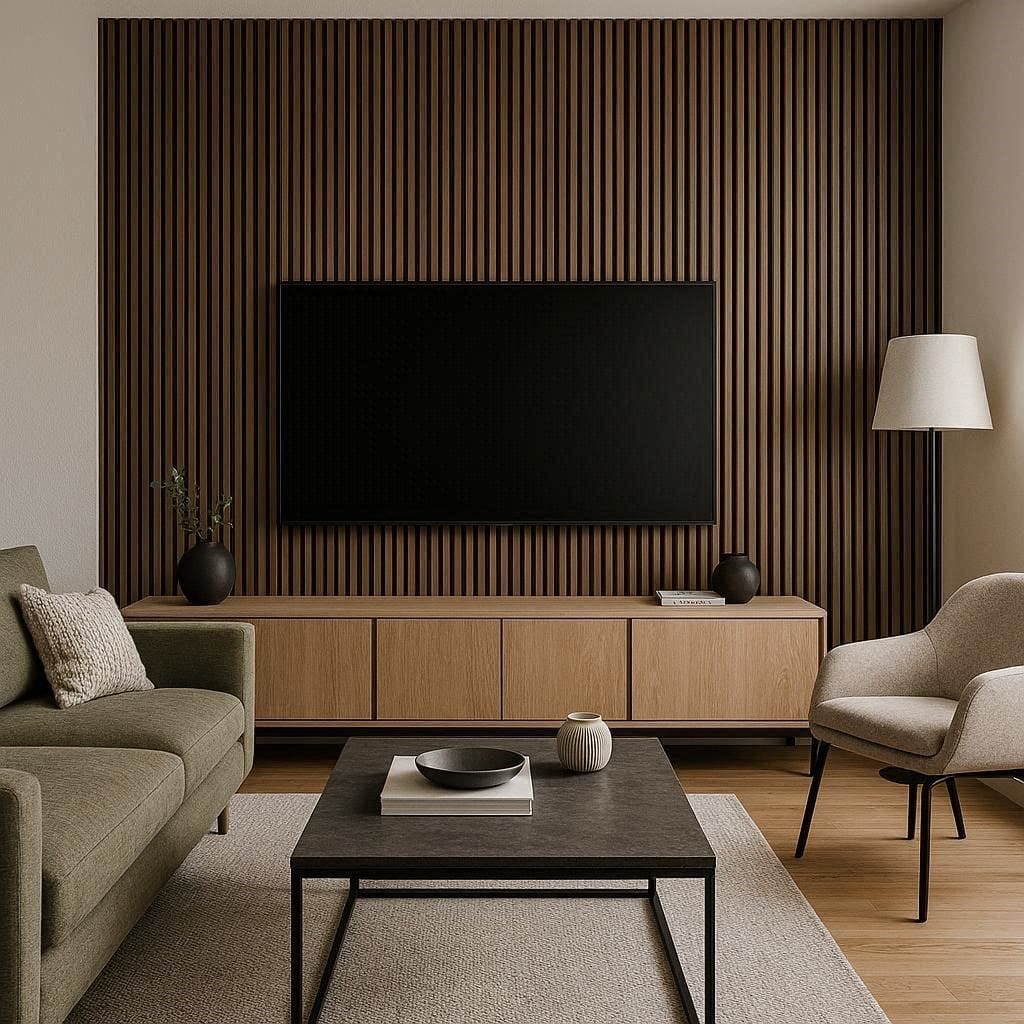
When asking do acoustic wood panels work, you have to look past the incredibly popular interior design trends on TikTok and Instagram. Right now, vertical wood slat walls are the hottest architectural feature in modern homes, home theaters, and recording studios.
The marketing surrounding these beautiful panels often promises “premium soundproofing” and a “quiet room.” Because they are relatively expensive and look highly professional, thousands of homeowners are buying them with the hope of finally blocking out their noisy neighbors or silencing a loud street.
But before you cover your drywall in wooden slats, we have to look at the cold, hard science of acoustics.
The short, scientific answer to whether or not these panels will block noise from leaving or entering your room is No. They do absolutely nothing to soundproof a wall. However, they do drastically improve the audio quality inside the room you are already sitting in.
In this guide, we will break down the exact acoustic physics of the wood slat trend, explain what these panels actually do, and show you what materials you really need to reclaim your quiet dwelling.
The Big Myth: Do Acoustic Wood Panels Work for Blocking Noise?
To understand why a wood slat wall fails to stop the sound of a barking dog or a loud television next door, we must understand the difference between Soundproofing and Sound Absorption.
Sound is a physical, mechanical wave of kinetic energy. When a heavy sound wave (like a deep male voice or a bass speaker) hits your shared wall, it forces the solid drywall to physically vibrate, transferring the sound into your bedroom.
To stop a physical wave of energy from passing through a wall, you must obey the Law of Mass. It requires massive, heavy, dense structural materials. You can read exactly how much heavy mass is required to stop these waves by reading our complete guide to understanding STC (Sound Transmission Class) ratings.
This is exactly why the answer to “do acoustic wood panels work to block noise” is a resounding no:
- Lack of Density: These panels consist of thin MDF (Medium Density Fiberboard) slats glued to a porous, lightweight felt backing. They weigh very little and add virtually no structural mass to your wall.
- Kinetic Bypass: When a massive sound wave hits a wood slat panel, the kinetic energy passes straight through the porous felt, vibrates the rigid drywall underneath, and enters your ears without losing any power.
The Physics: What Do They Actually Do?
If they do not block noise from your neighbors, why are they called “acoustic” panels, and why do audio professionals love them?
While they fail at soundproofing, they are phenomenal at Acoustic Treatment. Acoustic treatment is the process of making a room sound better on the inside by eliminating harsh echoes and reverberation. For a deep dive into this distinction, read our master guide on Soundproofing vs. Sound Absorption.
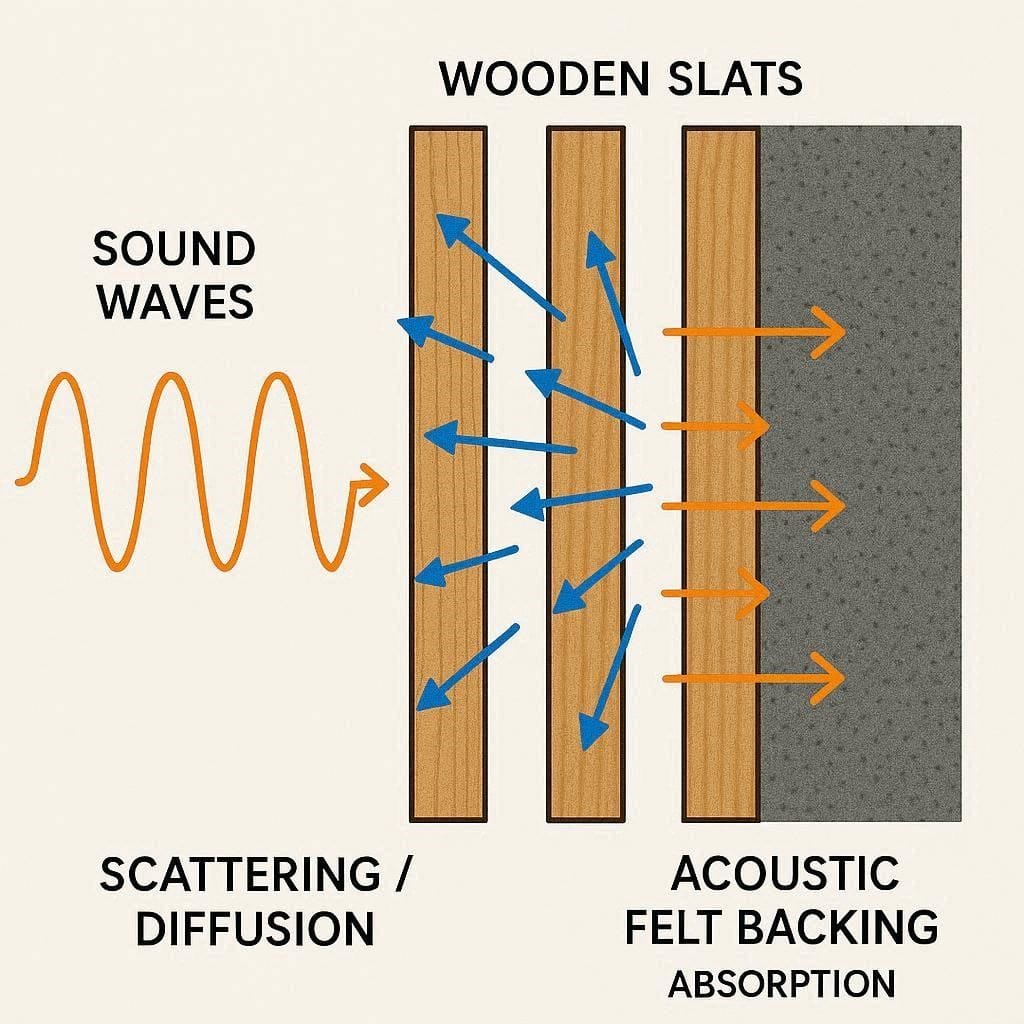
Acoustic wood panels perform two distinct physical actions simultaneously to tame a chaotic room:
Action 1: Sound Diffusion (The Wood Slats)
When you speak in an empty room with flat, bare drywall, the sound waves bounce straight back like a mirror, creating a harsh echo. The vertical wooden slats on these panels are rigid and convex. When a sound wave hits the wooden slats, the wave shatters and scatters in dozens of different directions. This is called diffusion, and it prevents the harsh ringing echo known as “flutter echo.”
Action 2: Sound Absorption (The Felt Backing)
The gaps between the wooden slats expose a thick layer of recycled acoustic PET felt. When high-frequency sound waves pass between the wood and enter the felt, they are forced into a microscopic maze of fibers. The friction of the air rubbing against the felt converts the acoustic energy into trace amounts of heat, killing the echo entirely. To learn how this absorption is measured, read our guide on understanding NRC ratings.
Do Acoustic Wood Panels Work for Home Theaters?
When clients ask us do acoustic wood panels work for a media room or home theater, the answer is a massive Yes.
Because these panels combine diffusion (scattering) and absorption (trapping), they create an incredibly balanced acoustic environment. If you completely cover a room in cheap foam, the room sounds “dead” and unnatural. By using wood slats, the room retains a natural, lively brightness (thanks to the wood reflecting some sound) while the felt backing removes the muddy, overlapping echoes that make movie dialogue hard to understand.
Best Use Cases for Wood Slat Panels:
- Behind the television in a home theater to crisp up dialogue.
- On the back wall of a home office to eliminate harsh Zoom call echoes.
- In a living room with tall ceilings and hard floors to reduce ambient chatter reverberation.
If Wood Panels Fail, What Actually Blocks Sound?
If you are suffering from the sleep-disrupting health effects of noise pollution, you cannot rely on felt and thin wood. You must introduce real structural changes to your walls.
Whenever someone asks do acoustic wood panels work to stop loud neighbors, we redirect them to the true structural materials used by professional acousticians:
Mass Loaded Vinyl (MLV)
Unlike lightweight felt, Mass Loaded Vinyl is an incredibly heavy, dense, limp-rubber membrane. It is installed directly behind your drywall to act as a massive acoustic dead-weight, stopping airborne sound waves dead in their tracks. Read more in our guide: What is Mass Loaded Vinyl?
Adding a Second Layer of Drywall
The most cost-effective way to stop noise through a shared apartment wall is to simply make the wall heavier. Adding a second layer of 5/8-inch Type X fire-rated drywall over your existing wall (preferably with a layer of viscoelastic Green Glue damping compound sandwiched in between) will drastically cut down on airborne noise.
Frequently Asked Questions (FAQ)
Do Acoustic Wood Panels Work for Stopping Upstairs Footsteps?
No, absolutely not. Footsteps from an upstairs neighbor are classified as structural impact noise. The heavy vibration travels directly through the wooden floor joists and vibrates your ceiling drywall. Slatted panels have zero ability to decouple the ceiling or cushion the physical impact. Read our full guide on Airborne vs. Impact Noise to learn how to fix this.
Are Wood Slat Panels better than Acoustic Foam?
Yes. Acoustic foam only absorbs high-frequency sounds, which can leave a room sounding unnatural and “boomy” in the low frequencies. Wood slat panels provide a much more balanced acoustic profile by diffusing sound waves while absorbing them, resulting in a cleaner, more professional audio environment.
Can I Install Acoustic Wood Panels Myself?
Yes! One of the reasons these panels are so popular is the ease of installation. Most panels come in large sheets (typically 24 inches wide by 94 inches tall) and can be easily trimmed with a fine-tooth saw. They can be installed by simply screwing through the felt backing directly into your drywall using black drywall screws to hide the hardware.

Ememobong is the lead researcher and editor at Quiet Dwelling. As a professional technical writer, he specializes in breaking down complex acoustic engineering concepts into simple, actionable steps. His goal is to help people build distraction-free environments for better sleep and deep work.