
If you live near a busy highway, a bustling city street, or a loud neighborhood, your windows are almost certainly the weakest acoustic link in your home. In a desperate attempt to get a good night’s sleep, millions of people search for a quick, cheap fix, which usually leads them to a single question: do soundproof curtains work?
You can find hundreds of “acoustic curtains” and “noise-reducing drapes” online, boasting thousands of five-star reviews. But before you spend your hard-earned money to cover your bedroom windows, you need to understand the acoustic reality behind the marketing claims.
The short answer is: No, standard soundproof curtains do not physically block loud exterior noise. However, they do alter the acoustics of your room in a way that can make it feel quieter.
In this guide, we will break down the physical science of how sound travels through glass, debunk the myth of “sound-blocking” fabrics, and show you what actually works to silence your windows.
The Short Answer: Do Soundproof Curtains Work?
To understand why a heavy velvet curtain fails to block the sound of a passing garbage truck, we have to look at the two distinct pillars of architectural acoustics: Sound Absorption and Sound Blocking.
Most curtains sold online as “soundproof” are actually just sound-absorbing. They are made of thick, porous fabrics (like velvet, heavy polyester, or suede).
- What they DO: Porous fabrics trap acoustic echoes inside your room. If you clap your hands in an empty room, it echoes. If you hang heavy curtains, the echo disappears. This lowers the reverberation and makes the room sound cozier.
- What they DO NOT do: Porous fabrics have practically zero structural mass. They cannot stop a powerful kinetic sound wave from passing through your window from the outside.
A standard heavy curtain might have a decent NRC (Noise Reduction Coefficient) to stop internal echoes, but it has a terrible STC (Sound Transmission Class) rating for blocking noise. To fully understand this critical difference, read our master guide on understanding STC vs NRC ratings.
Why Your Windows Leak So Much Noise
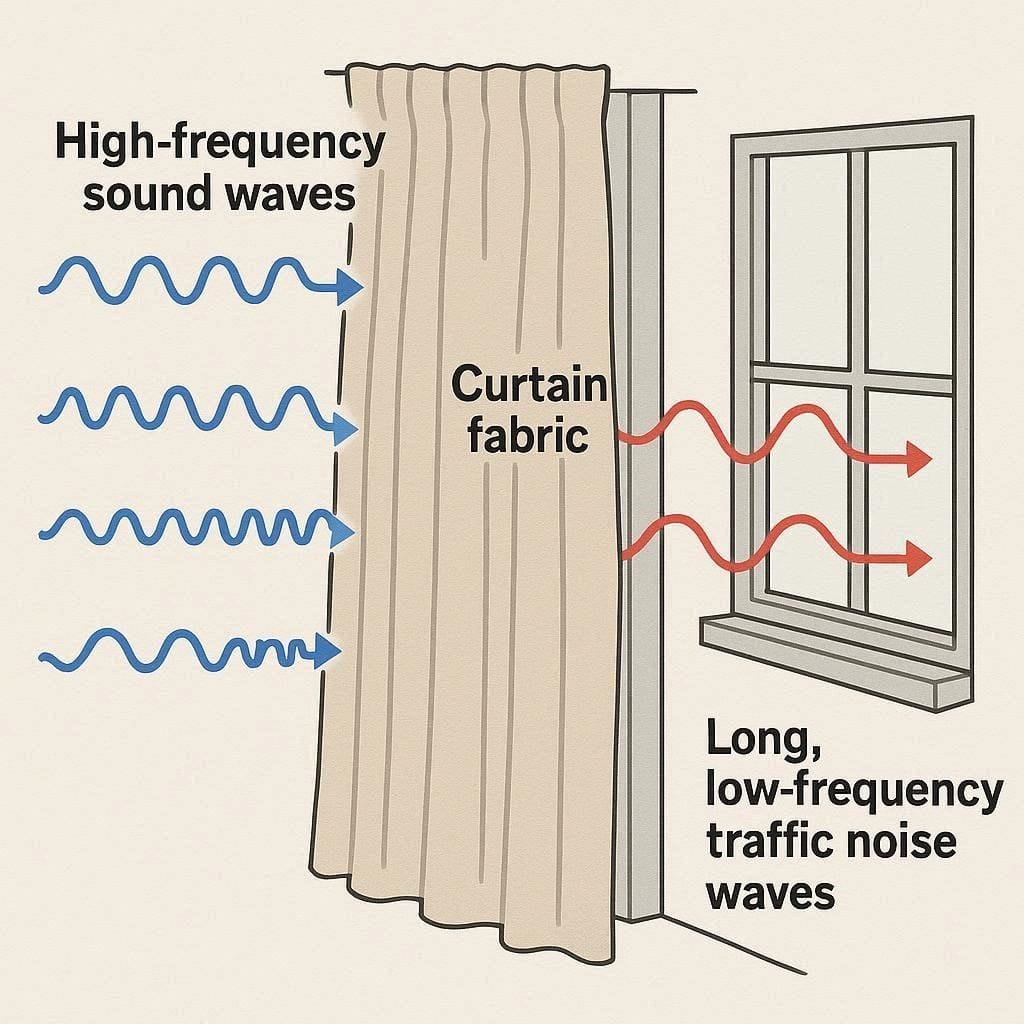
To block airborne sound waves coming from the street, you need two things: heavy mass and an airtight seal.
Standard residential windows fail on both fronts:
- Lack of Mass: Standard single-pane or cheap double-pane glass is incredibly thin and rigid. When the deep rumble of a car engine hits the glass, the glass easily resonates, vibrating the sound straight into your bedroom.
- Air Leaks: Sound behaves like fluid. It will slip through the microscopic gaps in your window frame, the sliding tracks, and the weatherstripping. If air can get through a crack, sound can get through it perfectly intact.
Hanging a piece of fabric in front of this structural weakness is like holding up a bedsheet to stop a gust of wind. The heavy traffic noise simply passes through the glass, pushes right through the woven fibers of the curtain, and enters your ears.
The Exception: Curtains with Mass Loaded Vinyl (MLV)
There is one specific type of curtain that does genuinely block sound, but you will rarely find them on standard home decor websites.
True sound-blocking curtains are industrial-grade products. Instead of relying purely on thick fabric, these curtains contain a heavy, internal core of Mass Loaded Vinyl (MLV). MLV is a dense, limp rubber-like barrier engineered specifically to stop sound transmission. You can read exactly how this material deadens kinetic energy in our guide: What is Mass Loaded Vinyl?
The Catch: True MLV curtains are incredibly heavy (often weighing over 15 to 20 pounds per panel) and very expensive. They require heavy-duty industrial curtain rods anchored directly into your wall studs, as standard drywall anchors will easily rip out under their weight.
If Curtains Don’t Work, What Does? (3 Proven Methods)
If you are suffering from the cardiovascular and sleep-related health effects of noise pollution, you cannot rely on drapes. You must structurally treat the window.
Here are the three most effective, scientifically proven ways to stop street noise from entering your windows:
Method 1: Acoustic Window Inserts (The Best Balance)
If you cannot replace your windows, window inserts are the ultimate solution. These are custom-cut panes of heavy acrylic or laminated glass edged with acoustic rubber weatherstripping. You press-fit them tightly into the inside of your existing window frame. They create a massive 2-to-3-inch dead-air gap between your exterior glass and the insert, providing a massive boost to the window’s ability to block low-frequency sounds.
Method 2: Upgrading to Laminated Glass (The Permanent Fix)
If you are replacing your windows, do not just buy “double-pane” thermal glass. You must specifically ask for laminated glass or asymmetrical glazing. Laminated glass sandwiches a layer of PVB plastic between the glass panes, which physically dampens vibrations. To understand why this is required for traffic noise, read our complete guide on STC vs OITC window ratings.
Method 3: Seal the Air Gaps (The Budget Fix)
Before you do anything else, check the perimeter of your window. Use a specialized acoustic caulk (which remains permanently flexible) to seal the cracks where the window frame meets the drywall. Then, apply high-density closed-cell weatherstripping tape to the window tracks to ensure an airtight seal when the window is closed and locked.
Frequently Asked Questions (FAQ)
Do Soundproof Curtains Block Low-Frequency Bass and Traffic Rumble?
No. Low-frequency sound waves (like diesel engines, subwoofers, and airplanes) are incredibly long and carry massive kinetic energy. They pass straight through standard heavy curtains without losing any power. The ASTM International standards for acoustic testing show that fabrics are entirely ineffective against frequencies below 125 Hz.
Will Blackout Curtains Help With Noise?
Blackout curtains are excellent at blocking UV light because of their tight weave and synthetic backing, but they are not soundproof. While they might slightly muffle the high-frequency chirping of a bird, they do not have the heavy physical mass required to block standard street noise.
Are Moving Blankets Good For Soundproofing Windows?
In a desperate pinch, a heavy moving blanket tacked tightly over a window frame is slightly more effective than a standard curtain because it is denser and often covers the air gaps around the window frame. However, like all porous fabrics, it acts as an acoustic absorber, not a true structural sound blocker.

Ememobong is the lead researcher and editor at Quiet Dwelling. As a professional technical writer, he specializes in breaking down complex acoustic engineering concepts into simple, actionable steps. His goal is to help people build distraction-free environments for better sleep and deep work.