*This post contains affiliate links. If you use these links to buy something we may earn a commission at no extra cost to you.
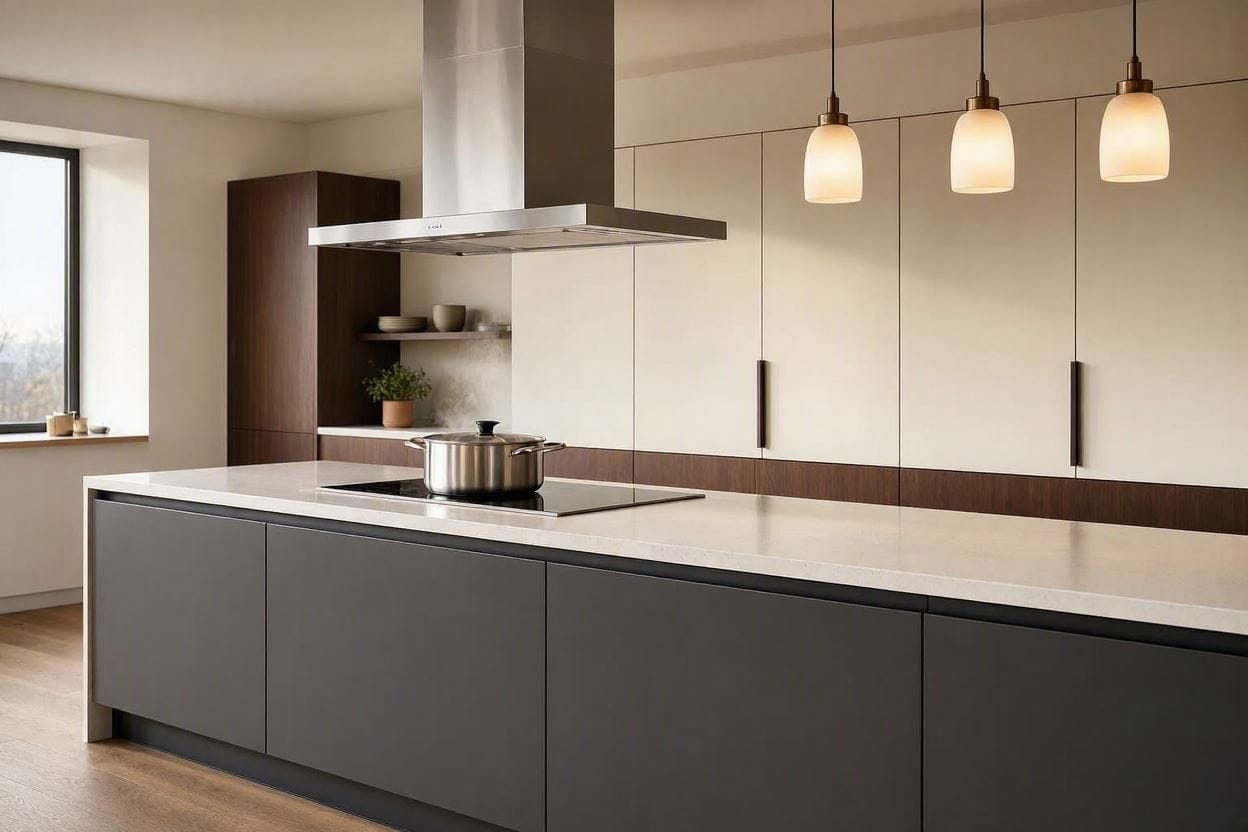
The kitchen is supposed to be the heart of the home. You have friends sitting at the island with a glass of wine, music playing softly in the background, and dinner sizzling on the stove. But the moment you turn on the range hood to clear the smoke, the entire vibe is destroyed.
Suddenly, everyone has to shout just to be heard over the deafening, industrial roar of the exhaust fan. It is so obnoxious that many people simply refuse to turn their hoods on at all, opting to open a window instead.
This is a massive health hazard. According to the Environmental Protection Agency (EPA), cooking on a gas or electric stove releases harmful particulate matter (PM2.5), nitrogen dioxide, and volatile organic compounds directly into your breathing air. Running a properly vented range hood is non-negotiable for indoor air quality.
You shouldn’t have to choose between clean lungs and intact eardrums. By upgrading to a hood with dual squirrel-cage blowers, acoustic baffling, and properly sized ducts, you can clear the smoke in absolute silence. Here are the best quiet range hoods that will let you cook in peace.
The Science of Sones and Ducting (Why Your Hood is So Loud)
Just like bathroom exhaust fans, range hoods are not rated in decibels; they are rated in Sones. While decibels measure raw sound pressure, Sones measure how the human ear actually perceives loudness.
A standard builder-grade range hood operates at around 6.0 to 8.0 Sones on high—which sounds like a loud television. A truly quiet hood will operate between 1.0 and 2.0 Sones on its normal cooking speed, which sounds more like the quiet hum of a modern refrigerator.
But the motor isn’t always the culprit. The biggest reason your vent hood is screaming at you is Wind Shear.
If you attach a massive 900 CFM (Cubic Feet per Minute) motor to a tiny 4-inch exhaust pipe, you are forcing an impossible amount of air through a microscopic hole. The air violently crashes against the sides of the ductwork, creating an abrasive, high-frequency whistling sound. To fix this, premium quiet hoods require 6-inch to 8-inch smooth metal ducting. A wider pipe means the air glides out of your house smoothly, eliminating the wind tunnel effect.
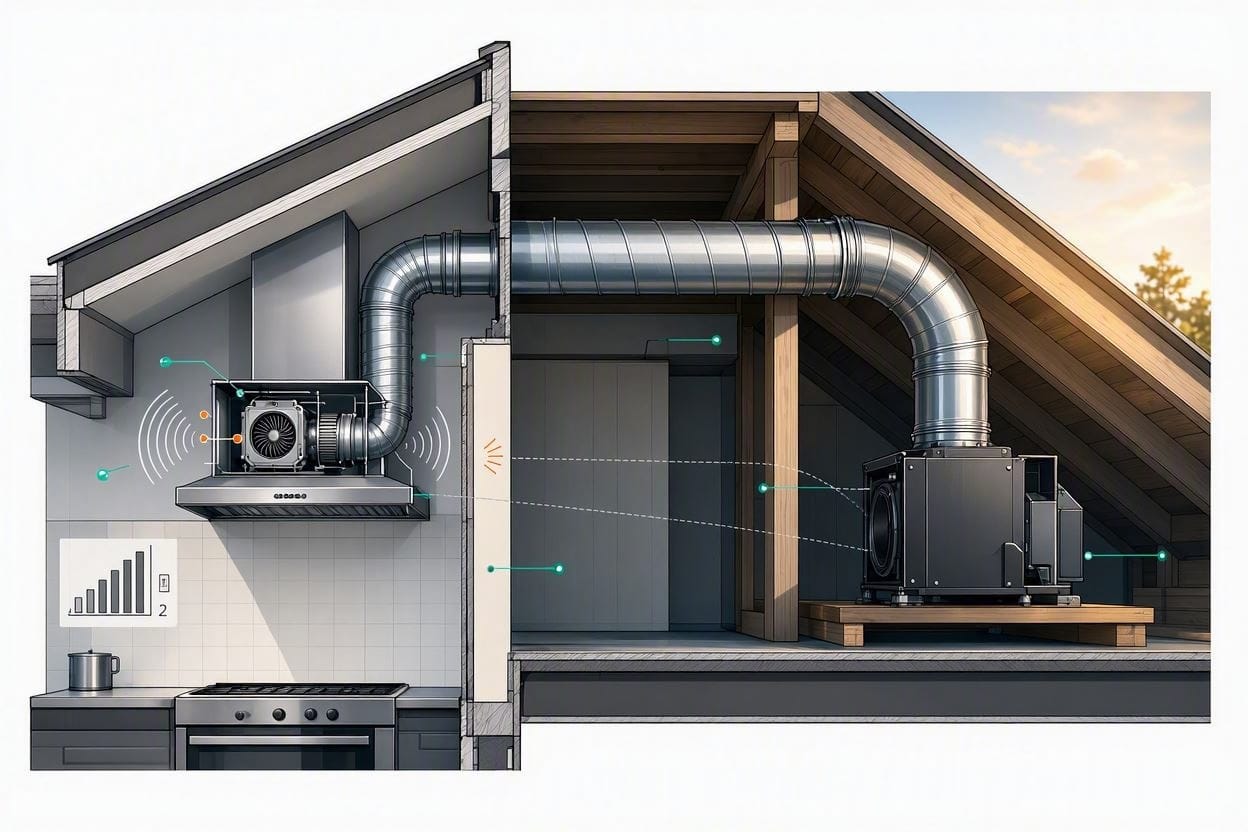
Finally, we have the ultimate soundproofing hack: The Remote Blower. Instead of putting the heavy, vibrating motor inside the stainless steel hood right next to your ears, premium systems place the motor high up in your attic or on your roof. The hood simply acts as an empty funnel. By physically moving the noise source 20 feet away, your kitchen becomes virtually silent.
1. Hauslane Chef Series Under Cabinet (Best Overall)
If you do a lot of high-heat cooking (like searing steaks or stir-frying), you need massive suction power. Usually, massive power means massive noise. The Hauslane Chef Series solves this by using dual-motor technology.
Instead of one single fan screaming at maximum RPM, the Hauslane uses two smaller motors working in tandem. Because they share the workload, they can spin much slower to pull a massive 900 CFM of air. On its normal working speed, it registers around 1.5 Sones, keeping your kitchen free of grease and smoke while allowing you to easily talk to your family at the island.
It also features heavy-duty stainless steel baffle filters, which are dishwasher safe and help break up the sound waves entering the unit.
The Pros
- Dual motors provide commercial-level suction at whisper-quiet RPMs.
- Baffle filters are infinitely better at trapping grease than cheap mesh filters.
- Fits cleanly under standard kitchen cabinets for an easy retrofit.
The Cons
- Requires a 6-inch duct. If your house has a 4-inch duct, you will have to upgrade your piping.
- It is a very heavy unit; installation requires two people.
2. ZLINE Wall Mount Range Hood (The Premium Pick)
If you are completely remodeling a luxury kitchen and want a stunning visual centerpiece that is functionally invisible to your ears, ZLINE is the premium choice.
ZLINE is famous for their wood and stainless steel aesthetics, but their true acoustic secret is the option for a Remote Blower. By purchasing the remote blower kit, your contractor will mount the actual exhaust motor high up in your attic. The beautiful wooden hood above your stove is simply an empty capture area.
Even if you opt for the internal motor version, the solid wood chassis acts as massive acoustic insulation, dampening the motor vibration significantly better than thin sheet metal.
The Pros
- Allows for remote attic blowers, ensuring absolute, 100% kitchen silence.
- Stunning, custom luxury aesthetics (wood, copper, or stainless).
- Massive suction capability for professional gas ranges.
The Cons
- High premium price tag.
- Remote blower installation requires a professional HVAC contractor.
3. Broan-NuTone Glacier (The Best Budget Pick)
If you just bought an older home and are desperately trying to replace a rattling, 20-year-old exhaust fan without spending a fortune, the Broan-NuTone Glacier is the ultimate budget upgrade.
Often coming in under $300, it is a sleek, low-profile under-cabinet hood that utilizes a Captur exhaust system to maximize airflow efficiency. On its lowest setting (which is perfectly adequate for boiling water or light sautéing), it registers at an incredible 1.2 Sones. While it will get louder on its maximum 400 CFM setting, it lacks the aggressive, high-pitched screech of cheap unbranded models.
The Pros
- Unbeatable value for genuine acoustic reduction.
- Very quiet 1.2 Sone rating on the normal working speed.
- Excellent, bright LED lighting perfectly illuminates the stove.
The Cons
- At 400 CFM max, it will struggle to clear smoke from 6-burner professional gas ranges.
- The sheet metal housing is slightly thinner than premium brands.
How to Silence a Rattling Range Hood (DIY Fixes)
If you already own a decent range hood but it suddenly sounds like it is tearing itself apart, the problem is likely structural impact vibration. Try these 5-minute acoustic fixes before you buy a new one:
- Check the Damper Flap: Where your hood connects to the ductwork, there is a metal “butterfly” flap designed to stop cold air from blowing backward into your kitchen. If this flap gets stuck or the spring breaks, the exhaust air will violently slap the metal flap back and forth, creating a loud, rapid clicking noise.
- Tighten the Mounting Screws: The kinetic vibration of a heavy motor will eventually loosen the screws holding the hood to your cabinetry. A loose screw allows the thin metal casing to buzz aggressively against the wood. Grab a screwdriver and tighten every visible mounting bolt.
- Clean the Grease Filters: Just like a quiet dishwasher that suddenly gets loud when the filter is clogged, a grease-choked range hood filter starves the motor of air. The motor has to spin twice as fast, creating a high-pitched whine. Soak your metal filters in hot soapy water and baking soda once a month!
Frequently Asked Questions (FAQ)
Are Ductless (Recirculating) Range Hoods Quieter?
No, they are actually louder and vastly less effective. A ductless hood sucks up the smoke, forces it through a thick charcoal filter, and then blows it right back into your kitchen. Because the motor has to fight the heavy resistance of the charcoal filter, it creates a loud, strained whirring sound while doing absolutely nothing to remove the heat or moisture from the room.
How Much CFM Do I Actually Need?
The standard rule of thumb for an electric stove is 100 CFM for every 10 inches of stove width (so a 30-inch stove needs 300 CFM minimum). For gas stoves, calculate the total BTUs of all your burners and divide by 100. If your burners total 60,000 BTUs, you need a 600 CFM hood. Buying a massive 1200 CFM hood for a tiny electric stove will just add unnecessary noise to your kitchen.
What is Makeup Air?
If you buy a massive, powerful range hood (over 400 CFM) and live in a newly built, highly insulated airtight home, the hood will suck all the air out of the kitchen, creating a vacuum. This can cause dangerous back-drafting (pulling carbon monoxide down your chimney). Many local building codes require you to install a “makeup air damper” that automatically opens to let fresh air into the house when a heavy-duty hood is turned on.

Ememobong is the lead researcher and editor at Quiet Dwelling. As a professional technical writer, he specializes in breaking down complex acoustic engineering concepts into simple, actionable steps. His goal is to help people build distraction-free environments for better sleep and deep work.