*This post contains affiliate links. If you use these links to buy something we may earn a commission at no extra cost to you.
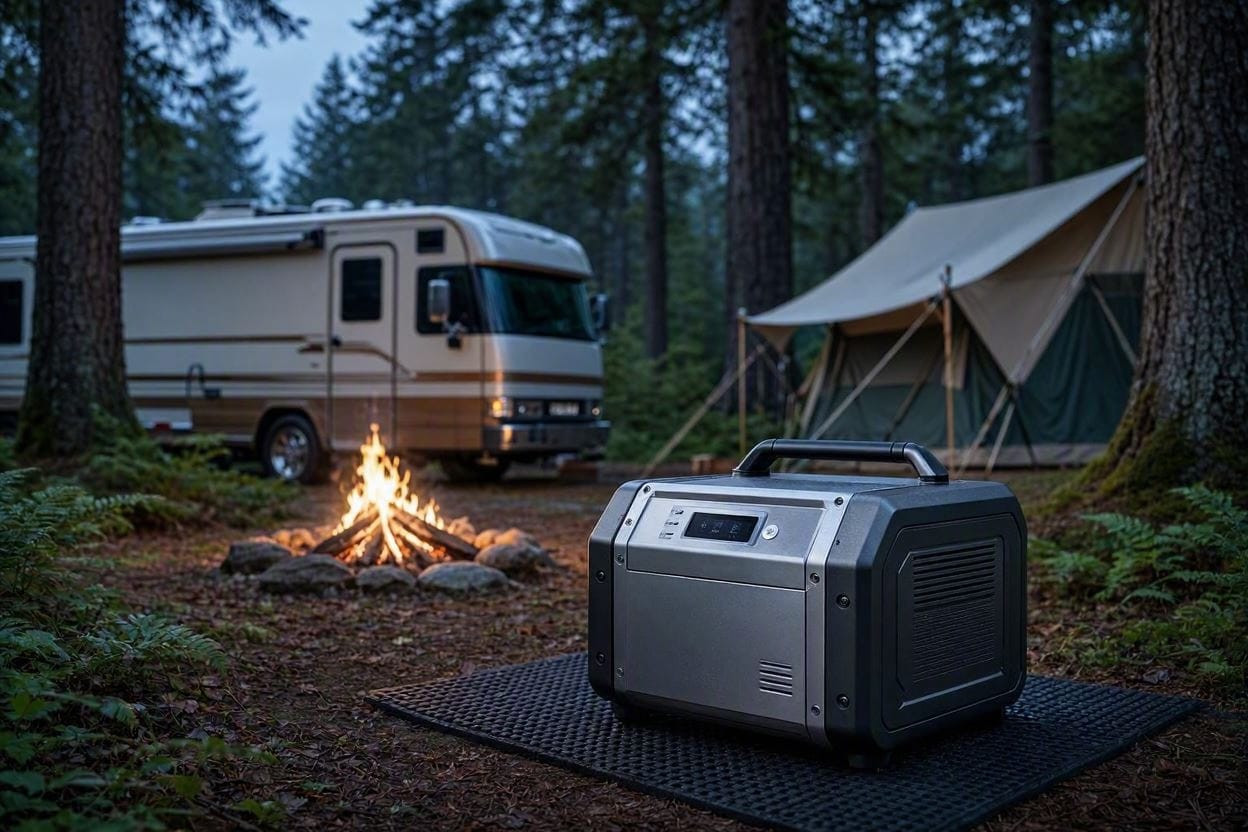
We all know “that guy” at the campground. You spend hours driving out to a beautiful, remote forest to escape the noise of the city and enjoy the sounds of nature. Then, the guy in the RV next to you yanks the pull-cord on a massive, open-frame construction generator. For the rest of the weekend, you are forced to listen to a 95-decibel mechanical roar that sounds like a riding lawnmower running at full throttle.
The exact same nightmare applies to home power outages. When the neighborhood goes dark during a storm, firing up a cheap, screeching gas generator doesn’t just annoy your neighbors—it broadcasts to the entire block exactly who has power, making you a target for noise complaints.
In fact, according to regulations enforced by the National Park Service (NPS), traditional generators are explicitly banned in many campgrounds because they vastly exceed the strict 60 dBA noise limit.
To keep the lights on and the peace intact, you must abandon outdated open-frame models and upgrade to an Inverter Generator. By utilizing smart microprocessors, variable-speed throttles, and fully enclosed acoustic chassis, you can run refrigerators, air conditioners, and sensitive electronics in near-total silence. Here are the absolute best quiet inverter generators on the market today.
The Science of Silence: Open Frame vs. Inverter
To buy a truly quiet generator, you have to understand why old-school generators are so agonizingly loud. A traditional “Open Frame” generator (the kind where you can clearly see the metal bars and the bare engine) is mechanically stupid.
To produce the standard 60Hz alternating current (AC) required by your home appliances, a traditional generator engine must spin at exactly 3,600 RPM (Revolutions Per Minute) continuously. It does not matter if you are powering a massive air conditioner or just charging a single iPhone. The engine runs at 100% full, screaming throttle at all times to maintain the frequency. This creates a deafening 80+ decibel roar.
Inverter generators solve this using two massive acoustic upgrades:
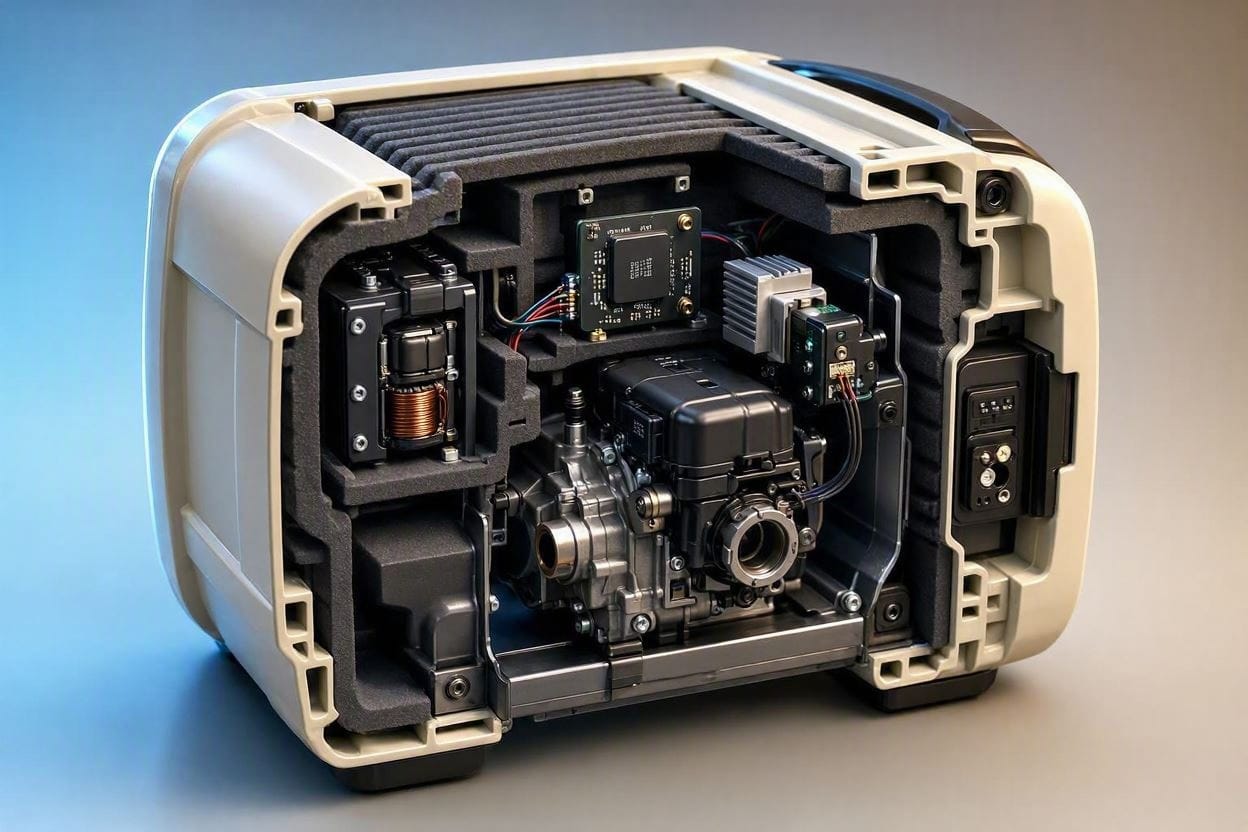
- The Smart Microprocessor (Eco-Mode): An inverter generator generates electricity in Direct Current (DC) first, and then a computer digitally “inverts” it back to clean AC power. Because the computer handles the frequency, the engine does not have to spin at 3,600 RPM. If you only plug in a phone, the engine will throttle down to a smooth, whisper-quiet idle. It only revs up when you demand heavy power.
- The Acoustic Chassis: Open-frame generators leak sound in all directions. Inverter generators encase the engine completely inside a thick, heavy plastic shell lined with dense acoustic foam. This acts as a physical sound barrier, trapping the mechanical engine noise inside the box.
1. Honda EU2200i (The Undisputed King of Quiet)
If you ask any professional contractor, seasoned RV owner, or outdoor enthusiast what the best generator on the planet is, 99% of them will say the Honda EU2200i. It is the absolute gold standard by which every other generator is measured.
Acoustically, this machine is a marvel. When operating at a quarter load (which is plenty for running lights, charging laptops, and watching TV), it registers at an astonishingly low 48 dBA. As we explain in our guide to understanding decibel levels, 48 dBA is quieter than a normal conversational voice. You can stand right next to this generator while it is running and comfortably talk to your partner without raising your voice.
It also produces “Pure Sine Wave” electricity, meaning it is 100% safe for plugging in highly sensitive electronics like medical CPAP machines or expensive gaming laptops.
The Pros
- The absolute quietest gas-powered generator on the market (48 dBA on Eco-Mode).
- Legendary Honda engine reliability (often runs flawlessly for 10+ years).
- Incredibly lightweight and easy to carry with one hand (47 lbs).
The Cons
- High premium price tag (you pay for the Honda name and engineering).
- At 2200 watts, it cannot run a massive RV air conditioner by itself.
Check Honda EU2200i Price on Amazon
2. Champion 4500-Watt Dual Fuel Inverter (Best Heavy Duty / RV Pick)
What if you need to run a 15,000 BTU roof-mounted air conditioner on your RV, or keep your full-size kitchen refrigerator running during a hurricane blackout? The Honda 2200 is too small for that. You need heavy-duty wattage.
The Champion 4500-Watt Inverter is a beast, pushing out massive power while maintaining a highly impressive 61 dBA noise level (measured from 23 feet away). While it is louder than the tiny Honda, 61 dBA is roughly the volume of a standard background conversation, easily complying with strict campground noise ordinances.
The greatest feature of this unit is that it is Dual Fuel. It runs on both standard gasoline and liquid propane. Propane is incredibly stable, never goes bad sitting in the tank, and runs slightly quieter and cleaner than gasoline.
The Pros
- Massive 4500 starting watts easily runs heavy home appliances and RV AC units.
- Dual fuel capability gives you incredible flexibility during emergency shortages.
- Includes a dedicated 30A RV outlet built right into the front panel.
The Cons
- It is a heavy unit (nearly 100 lbs); you will need the built-in wheels to move it.
- Running on propane slightly reduces the maximum peak wattage output.
3. WEN 56203i 2000-Watt (The Best Budget Pick)
If you only go camping twice a year, or just want a cheap, reliable insurance policy in the garage to keep your deep freezer cold during a summer blackout, spending $1,200 on a Honda is hard to justify. WEN has stepped up to offer the ultimate budget inverter.
Often priced under $400, the WEN 56203i directly copies the form factor of the premium brands. It offers 2000 starting watts and an Eco-Mode switch that drops the engine noise down to a highly impressive 51 dBA. While it lacks the legendary 10-year durability of a Honda motor, it is arguably the best “bang-for-your-buck” stealth generator for casual residential users.
The Pros
- Unbeatable value for genuine, pure sine wave inverter technology.
- Operates at an incredibly quiet 51 decibels on Eco-Mode.
- Weighs only 39 pounds, making it one of the most portable generators on the market.
The Cons
- The plastic housing feels a bit cheaper/thinner than premium brands.
- Requires you to drain the carburetor manually before long-term storage to prevent clogs.
The Acoustic Ground Hack: Stopping Impact Vibrations
Buying a quiet inverter solves the problem of airborne noise (the screaming engine). But if you take your new Honda or WEN generator and place it directly on a wooden deck, a hollow RV bumper tray, or a concrete driveway next to your house, you will hear a deep, low-frequency rumble vibrating through your floors.
This is caused by Impact Noise. The heavy mechanical vibration of the internal engine transfers straight down into whatever hard surface it is sitting on. The surface acts as an acoustic amplifier, turning kinetic energy into a booming bass note. We explain the exact physics of this phenomenon in our master guide on Airborne vs. Impact Noise.
The 5-Minute Fix: You must apply structural decoupling. Buy a thick, heavy-duty vulcanized rubber mat (like the ones used for horse stalls or washing machines). Place this mat underneath your generator. The dense rubber acts as a massive shock absorber, trapping the kinetic vibration before it can enter the hard ground. It will instantly silence the low-frequency rumble echoing into your home or RV.
Want to ditch gasoline entirely? If the thought of storing gas and maintaining carburetors stresses you out, battery technology has caught up. Check out our guide to the best quiet portable power stations (silent solar generators) that you can safely run right inside your living room!
Frequently Asked Questions (FAQ)
Can I Build a Wooden Box Around My Generator to Silence it?
You can, but you must be incredibly careful. This is known as a “baffle box.” Generators produce massive amounts of heat and lethal carbon monoxide exhaust. If you simply trap the generator under a tight wooden box, it will quickly overheat, melt the plastic components, and catch fire. A safe baffle box must be built with forced-air intake fans and dedicated, heat-resistant exhaust piping.
Can a 2000-Watt Inverter Run a Refrigerator?
Yes. A modern, full-size kitchen refrigerator typically requires about 400 to 800 continuous watts to run. However, the compressor requires a “surge” of up to 1,500 watts for just a second when it first kicks on. A 2000-watt inverter (like the Honda or WEN) can handle this starting surge effortlessly, keeping your food cold during a blackout while humming quietly.
Can I Run an Inverter Generator in the Rain?
No. While the outer casing is plastic, these are electrical machines with open outlets. Running them in open rain poses a severe electrocution hazard and can fry the inverter computer board. If you must run it during a storm, you should purchase a dedicated, ventilated “generator tent” (like a GenTent) that straps securely over the unit while allowing the exhaust to escape safely.

Ememobong is the lead researcher and editor at Quiet Dwelling. As a professional technical writer, he specializes in breaking down complex acoustic engineering concepts into simple, actionable steps. His goal is to help people build distraction-free environments for better sleep and deep work.