This post contains affiliate links. If you use these links to buy something, we may earn a commission.
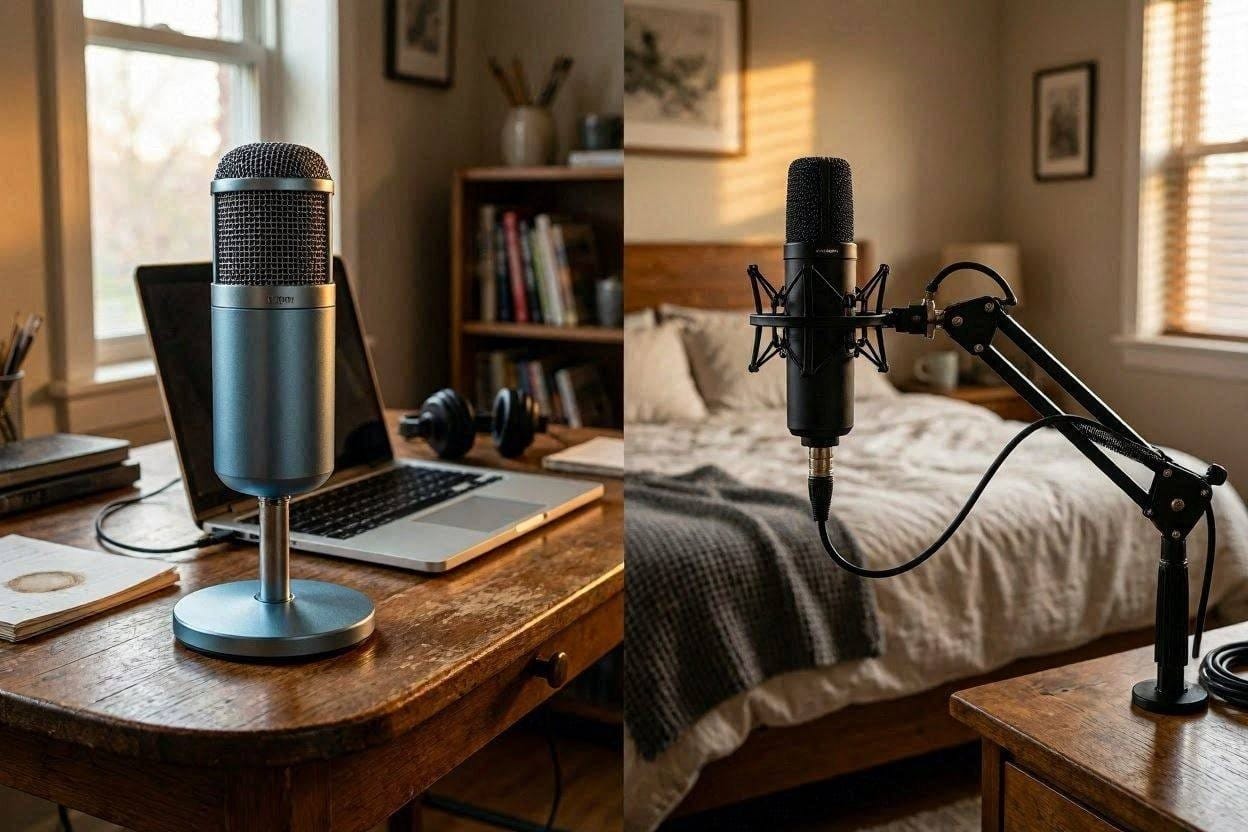
If you are setting up a home studio for podcasting, YouTube, or recording vocals, you have inevitably come across the two biggest heavyweights in the beginner audio space: the Blue Yeti and the Audio-Technica AT2020.
Every tech reviewer on the internet claims these are the ultimate starter microphones. You buy one, plug it in, and excitedly hit record. But when you listen to the playback, your heart sinks. Instead of a rich, radio-ready voice, you hear a hollow, metallic echo. You can hear your computer fan whirring. You can even hear a dog barking three houses down.
Welcome to the harsh reality of recording in an untreated room.
A standard bedroom is an acoustic nightmare full of hard, parallel walls that bounce sound waves around endlessly. When choosing a microphone for a space with zero acoustic foam and thin windows, the most important factor isn’t how the mic looks; it is how well it rejects background noise. Let’s pit the Blue Yeti against the AT2020 to see which one actually survives in a noisy, untreated bedroom.
The Acoustic Problem: Why Condenser Mics Struggle
Before we crown a winner, we need to address a fundamental piece of audio physics. Both the Blue Yeti and the AT2020 are condenser microphones.
According to audio engineering experts at Sweetwater, condenser microphones are designed to be hyper-sensitive. They utilize an incredibly thin, electrically charged diaphragm to capture the most microscopic nuances of the human voice. This makes them sound beautifully crisp and detailed.
However, this hyper-sensitivity is exactly why they struggle in untreated rooms. A condenser mic doesn’t just hear your voice; it hears the sound of your voice bouncing off the drywall behind you. It picks up the high-frequency hiss of your air conditioner and the low-frequency rumble of traffic outside.
If you are going to use either of these microphones, you absolutely must implement some basic sound absorption in your room. Even a few heavy blankets will make a massive difference.
Contender 1: The Blue Yeti (USB)
The Blue Yeti is arguably the most famous microphone in the world. It is a plug-and-play USB microphone, meaning you don’t need any extra audio interfaces or cables. You just plug it straight into your laptop and start talking.
How it handles an untreated room: The Yeti is notoriously sensitive. Out of the box, it will pick up the sound of you blinking. However, the Yeti has a secret weapon on its back: a polar pattern switch. By switching it from “Omnidirectional” (which records the whole room) to “Cardioid” (which only records what is directly in front of it), you can instantly reject a significant amount of background noise. Furthermore, it has a built-in “Gain” dial. By turning the gain almost all the way down and speaking closer to the mic, you can artificially cut out a lot of room echo.
The ultimate beginner microphone. While it is highly sensitive to room noise, its built-in gain dial and selectable polar patterns allow you to tweak it to reject a decent amount of background echo.Check the current price on Amazon ➔
Contender 2: The Audio-Technica AT2020 (XLR)
The AT2020 is a true, professional-grade studio microphone. Unlike the Yeti, it is an XLR microphone, meaning you cannot plug it directly into your computer. You must purchase a separate USB Audio Interface (like the Focusrite Scarlett) to provide it with 48v phantom power.
How it handles an untreated room: Because it is a pure cardioid condenser, it naturally rejects noise coming from the back of the microphone. In terms of raw audio quality, the AT2020 destroys the Blue Yeti. Your voice will sound significantly warmer, deeper, and more professional. However, it is slightly *less* forgiving of an echoing room than a dialed-down Yeti. Because it captures such a wide frequency range, any metallic room reverb will be captured in stunning, crystal-clear high definition.
If you are willing to buy an audio interface and hang a few acoustic moving blankets, this microphone will deliver true, professional studio-quality vocals that blow USB microphones out of the water.Check the current price on Amazon ➔
The Plot Twist: You Should Probably Buy A Dynamic Mic
Here is the brutal, honest truth that most audio blogs won’t tell you: if your room sounds terrible, you shouldn’t buy the Blue Yeti or the AT2020. You shouldn’t be using a condenser microphone at all.
You need a Dynamic Microphone.
Dynamic microphones (like the ones you see radio hosts and live singers use) require a massive amount of acoustic energy to move their internal coils. Because of this mechanical design, they are incredibly “deaf” to background noise. If you don’t speak directly into the front of a dynamic mic, it won’t pick you up. This makes them the ultimate cheat code for recording in an untreated, noisy bedroom.
If your room echoes heavily or you have noisy neighbors, skip the condensers entirely. This dynamic microphone naturally rejects background noise and features both USB and XLR outputs, making it the ultimate hybrid.Check the current price on Amazon ➔
The Final Verdict
If you are strictly choosing between the two heavyweights and you refuse to treat your room, the Blue Yeti slightly edges out the AT2020 solely because you can aggressively turn down the onboard gain dial to artificially choke out the room echo. It is easier to manipulate in a bad environment.
However, if you want your voice to sound truly professional, the AT2020 is a vastly superior piece of hardware. Just be prepared to hang a few heavy blankets or build a small acoustic isolation shield around it to control those nasty room reflections!

Ememobong is the lead researcher and editor at Quiet Dwelling. As a professional technical writer, he specializes in breaking down complex acoustic engineering concepts into simple, actionable steps. His goal is to help people build distraction-free environments for better sleep and deep work.