
If your living room sounds slightly hollow every time someone talks, laughs, claps, or turns on the TV, you are not imagining it. That “empty” sound is usually echo and reverberation, and it tends to show up in exactly the kinds of rooms people love visually: open-plan spaces, hardwood floors, big windows, high ceilings, and minimal decor.
The problem is that beautiful living rooms are often acoustically brutal. Sound hits hard, flat surfaces like glass, painted drywall, tile, wood, and bare ceilings, then bounces around the room instead of being absorbed. The result is a space that looks calm but sounds chaotic. Acoustics experts consistently point to reflective surfaces and a lack of soft, porous materials as the main cause of indoor echo. Acoustical Solutions
The good news is that you do not need to turn your home into a podcast studio to fix it. You can reduce echo in a living room with a handful of tasteful changes that make the space sound softer, warmer, and more expensive – not more cluttered.
Why Living Rooms Echo So Much in the First Place
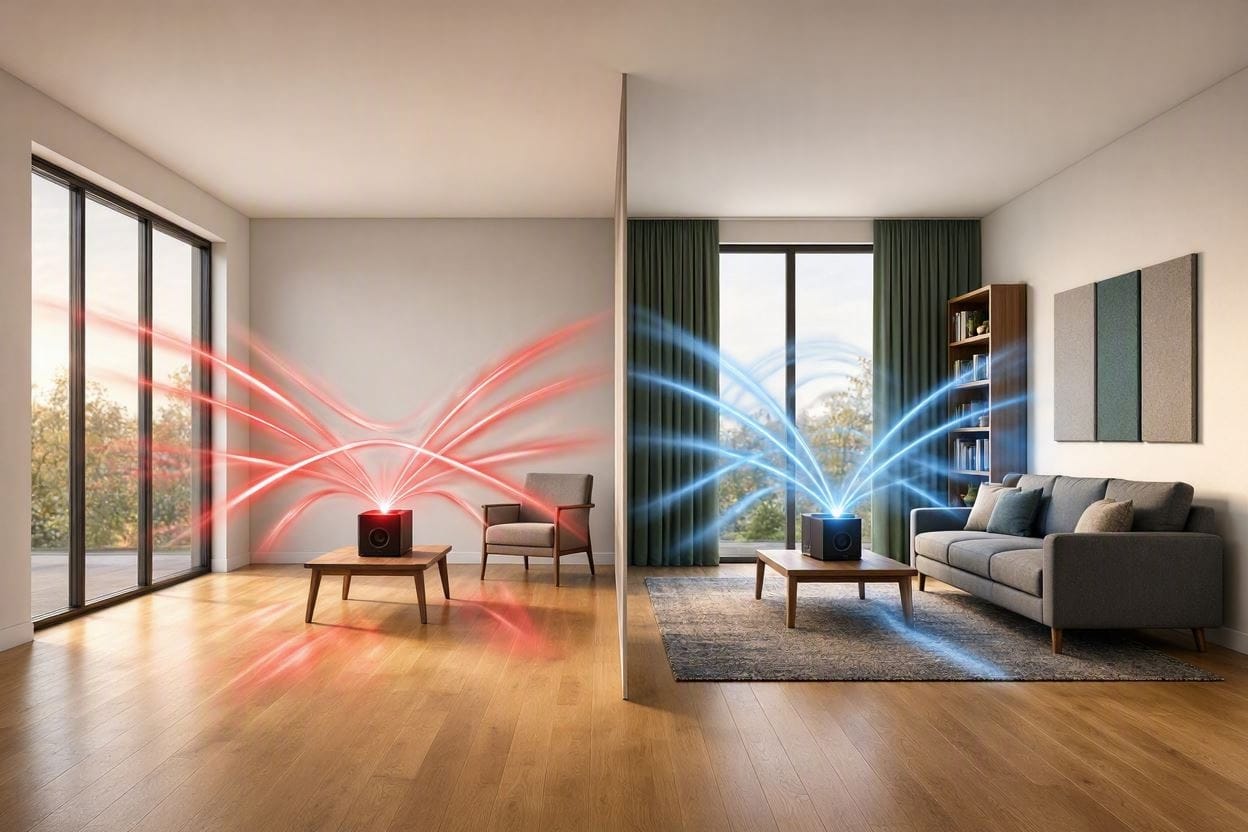
Echo is what happens when sound reflects off hard surfaces and keeps bouncing instead of dying out quickly. In a living room, the usual culprits are:
- Bare floors like hardwood, laminate, tile, or polished concrete
- Large uncovered windows that reflect sound almost as efficiently as mirrors reflect light
- Empty walls with no soft or textured treatment
- Minimal furniture with lots of open air and too few absorbent materials
- High ceilings or open-plan layouts that give sound extra room to bounce
If that sounds familiar, it is because modern living rooms are often designed around clean lines and hard finishes. Visually, that can look fantastic. Acoustically, it creates a small reverberation chamber.
This is also why people confuse soundproofing and sound absorption. If you are trying to stop echoes inside the room, you are mostly dealing with sound absorption, not blocking outside noise.
Start With the Floor: Rugs Do More Than Decorate
If your living room has hardwood, tile, or laminate floors, the biggest easy win is usually a large rug. Not a tiny accent rug floating under the coffee table like a napkin, but a properly sized rug that covers meaningful floor area.
Why it works is simple. Floors are one of the largest uninterrupted reflective surfaces in most homes. A thick rug adds porous, fibrous material that absorbs some of the mid and high-frequency reflections that create speech harshness and TV slap-back.
The rug does not need to be ugly, shaggy, or “acoustic looking.” In fact, some of the most effective living room improvements are also the most design-friendly. A dense wool rug with a good pad underneath can quietly do more acoustic work than a lot of people expect.
If your space still feels lively after adding a rug, consider pairing it with one of the solutions in our guide to soundproof rug pads for hardwood floors. The pad will not magically soundproof the room, but it can help reduce impact noise and add a bit more softness underfoot.
Use Full-Length Curtains Instead of Bare Glass
Big windows are beautiful right up until you hear what they do to your room. Glass is one of the most reflective surfaces in a home, which means large uncovered windows can make a living room sound brighter, sharper, and more echoey than it looks.
That is why full-length curtains are one of the most elegant echo fixes available. They soften one of the hardest surfaces in the room while also making the space feel finished and intentional.
For best results, choose curtains with real body: velvet, heavy linen blends, blackout curtains, or layered drapery. Thin sheer curtains look lovely in photos, but acoustically they do almost nothing. You want fabric with enough mass and folds to break up reflections and absorb some of the sound energy.
This is one place where style and acoustics genuinely align. Thoughtful curtains can improve both the sound and the visual warmth of the room at the same time.
Bring In Upholstered Furniture If the Room Feels “Hard”
A living room full of leather, glass, metal, and exposed wood may look sleek, but it usually sounds terrible. Upholstered furniture helps because it introduces soft, irregular, absorbent surfaces exactly where speech and TV sound tend to bounce.
A fabric sofa, padded accent chairs, ottomans, and even thick cushions all help reduce that harsh, pingy quality that makes a room feel empty. No, a couch is not an acoustic panel. But in a normal home, it absolutely contributes to better sound.
This is also why sparsely furnished rooms feel so echoey right after moving in. Once you add a sofa, textiles, cushions, and soft surfaces, the room often calms down dramatically without any specialty products.
If you want the most design-friendly version of this approach, lean into pieces that already fit your aesthetic. A better-sounding room does not need more stuff. It needs softer surfaces in the right places.
Break Up Empty Walls With Art That Actually Helps
Large, uninterrupted walls are echo magnets. Every broad flat surface gives sound another place to ricochet. That is why one of the smartest ways to reduce echo without making the room ugly is to use decor that interrupts reflection paths.
Framed textile art, canvas pieces, slatted wood acoustic decor, wall hangings, and fabric-wrapped acoustic panels all work better than leaving a huge wall blank. The goal is not simply to “cover the wall.” The goal is to introduce texture, softness, depth, or absorption.
This is where people often go wrong with minimalist design. Minimal does not have to mean acoustically barren. A few well-placed decorative wall treatments can reduce reverberation and make the room feel more curated, not less.
If you are considering dedicated treatments, our guide to acoustic panels that actually look good is a good place to start, even if your living room is not a studio. The core design logic is the same.
Bookshelves Work Because Irregular Surfaces Scatter Sound
One of the most underrated echo fixes is the humble bookshelf. Not because books magically absorb everything, but because shelves create depth, variation, and uneven surfaces that scatter reflections instead of sending them straight back into the room.
A filled bookshelf is especially useful on a long, bare wall that otherwise acts like a giant sound mirror. Books, decor objects, woven baskets, and staggered shapes all help break up reflections in a way flat drywall cannot.
This is one reason older, more layered homes often sound better than ultra-minimal new ones. They have more acoustic complexity built in.
And yes, this also means that empty built-ins are acoustically disappointing. Fill them.
Acoustic Panels Are Fine – You Just Need Better Ones
A lot of people reject acoustic panels because they imagine gray foam squares that make the living room look like a teenager started a podcast and never stopped. That fear is understandable, but outdated.
Modern acoustic panels can look like framed art, upholstered wall sections, slatted wood features, or sculptural decor. More importantly, they work because sound absorption materials reduce reverberation by converting a portion of sound energy into tiny amounts of heat inside the material’s porous structure. That is the basic science behind acoustic panels and other absorptive treatments. Arturel
The key is placement. In a living room, panels tend to work best:
- Behind the sofa
- On the TV wall
- On large parallel side walls
- In double-height or especially reflective spaces
Design-oriented acoustic brands also point out that slatted wall systems and decorative absorptive panels can reduce reverberation without making a room feel overfilled or clinical.
Just remember: if the issue is echo inside the room, acoustic panels help. If the issue is traffic noise coming through the wall or window, that is a different problem entirely.
Room Layout Matters More Than People Think
Sometimes the room is not too echoey because it lacks acoustic products. Sometimes it is too echoey because everything hard is facing everything else hard.
For example, if you have a large TV wall opposite a big window wall, with a bare floor between them, you have basically built a reflection runway. Moving furniture so the room has more soft interruptions can help more than many people expect.
Try these adjustments:
- Pull seating into the room instead of shoving everything against the perimeter walls
- Angle a chair or side table slightly to break up straight reflection paths
- Use a console table, ottoman, or textile bench to add more surface variety
- Balance hard materials with soft ones instead of clustering all the soft furnishings in one corner
Good acoustics is often about distribution. One rug in a giant hard room will help, but a rug plus curtains plus upholstery plus one treated wall will help much more.
Do Plants Help With Echo?
A little, but not in the miraculous way Instagram sometimes suggests.
Large leafy plants can help scatter sound and make a room feel less acoustically stark, especially when placed in empty corners that otherwise reflect sound. But they are not dense, porous absorbers in the same league as rugs, curtains, upholstered furniture, or actual acoustic panels.
So yes, use plants if you like them. They contribute to a softer room in both visual and acoustic terms. Just do not expect a fiddle-leaf fig to solve a serious reverberation problem by itself.
What Usually Does Not Work
There are a few common mistakes people make when trying to reduce echo in a living room:
- Tiny rugs that cover almost no reflective floor area
- Thin curtains with no real mass or pleating
- Decor-only fixes that add visual interest but no softness or absorption
- Confusing soundproofing with echo control
- Only treating one surface in a highly reflective room
This is also why myths like acoustic wood panels working for everything can be misleading. Some products help with reverberation. Far fewer help with actual sound isolation.
The Best Order To Fix an Echoey Living Room
If you want the most improvement for the least visual disruption, this is the order I would start with:
- Add a large rug with a quality pad
- Install full-length curtains on major windows
- Increase upholstered seating or soft furnishings
- Treat one large reflective wall with art, shelving, or decorative panels
- Adjust layout if the room still sounds harsh
That sequence works because it addresses the biggest reflection surfaces first. Floors and windows are often doing more acoustic damage than people realize.
Final Thoughts
The best way to reduce echo in a living room without making it ugly is to stop thinking like a studio engineer and start thinking like a designer with acoustic awareness. You do not need foam tiles everywhere. You need a room with fewer hard reflections and more soft, textured, irregular surfaces.
In most homes, the winning formula is simple: a larger rug, heavier curtains, upholstered furniture, one intelligently treated wall, and a layout that does not let sound bounce endlessly between glass, drywall, and bare floor. That is usually enough to make the room feel calmer, warmer, and far more comfortable to live in.
And as a bonus, the room usually looks better too.
Frequently Asked Questions
What Causes Echo in a Living Room?
Echo usually happens when sound reflects off hard, flat surfaces like glass, drywall, hardwood, tile, and bare ceilings. If the room lacks soft, absorbent materials, those reflections linger and make the room sound hollow.
Do Rugs Really Help Reduce Echo?
Yes, especially in rooms with hard flooring. A large dense rug helps absorb mid and high-frequency reflections that would otherwise bounce off the floor and add to the room’s reverberation.
Will Curtains Reduce Echo in a Living Room?
Yes. Full-length curtains with real thickness can soften one of the most reflective surfaces in the room: the windows. They work much better than thin sheer curtains for echo control.
Are Acoustic Panels Ugly?
Not anymore. Many modern acoustic panels are designed to look like framed art, slatted wood features, or upholstered wall decor, which makes them far easier to use in a living room without ruining the aesthetic.
Do Plants Help With Echo?
A little. Large plants can scatter some sound and soften empty corners, but they are not powerful enough to replace rugs, curtains, upholstered furniture, or proper wall treatments.

Ememobong is the lead researcher and editor at Quiet Dwelling. As a professional technical writer, he specializes in breaking down complex acoustic engineering concepts into simple, actionable steps. His goal is to help people build distraction-free environments for better sleep and deep work.