*This post contains affiliate links. If you use these links to buy something we may earn a commission at no extra cost to you.
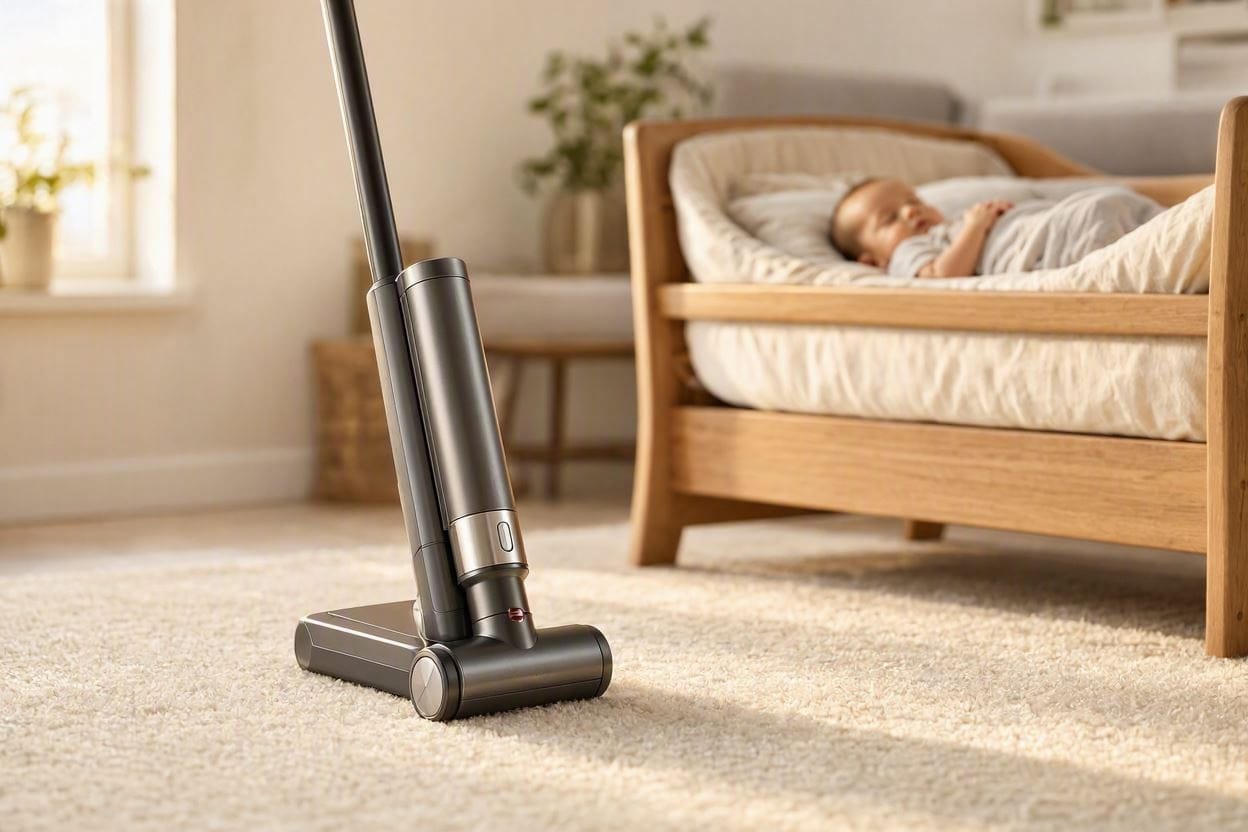
Every parent knows the ultimate household catch-22: The only time you actually have a free moment to clean the crushed Cheerios and pet hair off the living room rug is when the baby is finally taking a nap. But the moment you hit the power button on your vacuum, you risk ruining the very peace and quiet you worked so hard to achieve.
Standard vacuums are incredibly violent acoustic machines. They emit a high-pitched, screeching mechanical whine that easily pierces through nursery doors, triggering your infant’s startle reflex and pulling them out of deep sleep.
I learned this the hard way after waking my toddler up three days in a row. You shouldn’t have to choose between a clean house and a rested baby. The appliance industry has completely revolutionized floor care, moving away from screaming, brushed AC motors toward highly insulated, smart-suction technology.
I have tested the top floor-care models with a decibel meter to find the machines that offer massive suction power without the auditory trauma. Here are the absolute quietest vacuum cleaners that will let your baby sleep while you clean.
The Science of the Screech: Why Vacuums Are So Loud
To understand why you need a specialized quiet vacuum, you have to look at how a standard vacuum generates sound. According to the American Academy of Pediatrics (AAP), exposing infants to prolonged environmental noises over 50-60 dB can disrupt sleep and cause auditory fatigue. Standard vacuums regularly hit a staggering 80 to 85 decibels.
That deafening roar comes from three distinct failures in cheap acoustic design:
- High-Speed Brushed Motors: Cheap vacuums use old-school AC motors. The internal carbon brushes scrape against the spinning rotor thousands of times per minute, creating a violent, high-pitched mechanical squeal.
- Air Turbulence (Wind Shear): When a powerful motor pulls air through cheap, un-aerodynamic plastic tubes, the air crashes against the plastic walls. This creates high-frequency “wind shear” hissing.
- Impact Noise: The hard plastic wheels on generic upright vacuums rumble aggressively against hardwood floors. As we explain in our master guide on Airborne vs. Impact Noise, that kinetic vibration travels straight into your floor joists, creating a booming bass note that wakes anyone sleeping on the floor below you.
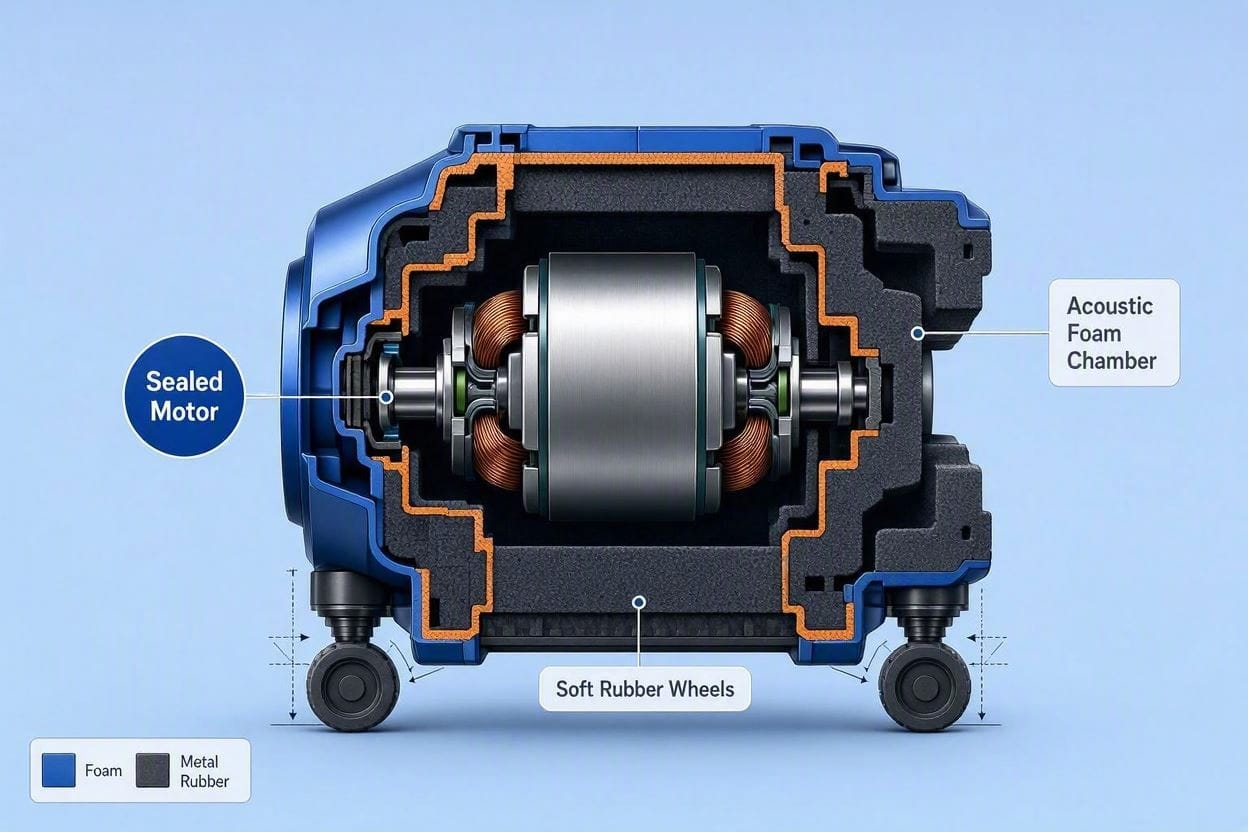
The premium models on this list fix this by using sealed acoustic motor capsules, aerodynamic air channels, and soft rubberized wheels to completely decouple the machine from your hard floors.
1. Miele Complete C3 Silence (The Gold Standard)
If your absolute primary goal is to buy a vacuum that will not wake your sleeping baby, the Miele Complete C3 Silence is the undisputed heavyweight champion of the world.
Unlike cheap uprights, the Miele is a canister vacuum. Miele wrapped the internal motor in heavy, dense acoustic foam insulation. By sealing the motor capsule, they trapped the high-frequency mechanical whine inside the machine. When running on its “Silence” setting, it registers around 55 decibels. If you check our guide on decibels for sleep, you know that 55 dB sounds more like a gentle rain shower or a quiet hum, effectively acting as soothing white noise rather than an alarm.
It also features specialized rubber casters that glide flawlessly over hardwood, entirely eliminating the “rumble” of impact noise.
The Pros
- Acoustic motor encapsulation completely kills the high-pitched screech.
- Soft rubber wheels prevent floor vibrations and impact noise.
- True HEPA filtration prevents dust and allergens from exhausting back into the nursery.
The Cons
- High premium price tag for German engineering.
- Dragging a canister behind you is slightly less convenient than a cordless stick.
2. Tineco Pure ONE S11 (Best Smart Cordless)
If you don’t want to deal with plugging a cord into the wall every time your toddler drops cereal on the floor, you need a cordless stick vacuum. However, most stick vacuums (like older Dysons) are notorious for sounding like screaming drills.
The Tineco Pure ONE S11 solves this problem using incredible software. It features the iLoop Smart Dust Sensor. Instead of running at 100% screaming power all the time, the vacuum’s internal computer detects how much dirt is actually on the floor. If the floor is mostly clean, the motor spins down to a very low, quiet hum. It only ramps up the suction (and the noise) for a split second when it hits a dense pile of dirt.
This intelligent, variable-speed approach ensures the vacuum spends 90% of your cleaning time operating quietly, saving your ears and your battery life.
The Pros
- Smart sensor automatically lowers motor speed and noise on cleaner floors.
- Incredibly lightweight; easily carried with one hand.
- LED brush-head illuminates dirt in dark corners without needing to turn on bright room lights.
The Cons
- When it hits heavy dirt, it will briefly spike to standard vacuum loudness.
- Battery lasts about 40 minutes per charge.
3. Roborock Q Revo (Best Hands-Free Robot)
The quietest way to vacuum is to not do it yourself. If you are entirely focused on keeping the house clean while ensuring the baby stays asleep, the Roborock Q Revo allows you to schedule your peace and quiet.
Using the smartphone app, you can command the robot to avoid the nursery entirely using virtual “No-Go Zones.” You can also toggle the machine into a dedicated Quiet Mode. In Quiet Mode, the robot dials the suction motor back, resulting in a gentle, rolling hum (around 60 dB) that is easily masked by a closed bedroom door.
Because it also features dual-spinning mop pads, it maintains your hard floors daily without you ever having to pull out a loud, heavy upright vacuum.
The Pros
- Dedicated Quiet Mode keeps the mechanical hum remarkably low.
- “No-Go” mapping ensures it never bumps into the baby’s door and wakes them.
- Self-emptying base station means 100% hands-off cleaning for weeks.
The Cons
- The auto-empty sequence at the base station is very loud (only lasts 15 seconds).
- Robot vacuums struggle with high-pile, fluffy carpets.
The 5-Minute Maintenance Hack: How to Silence a Screaming Vacuum
If you already own a decent vacuum but it has slowly started sounding like a screaming banshee over the last few months, you likely do not need a new vacuum. You just need to clear the airways.
The Fix: A vacuum makes noise by pulling air. If your HEPA filter or pre-motor filter is clogged with a thick layer of fine dust, the motor is literally choking. Because it is starved for air, the motor spins significantly faster, creating an agonizing, high-pitched mechanical whine as it struggles.
Pull out your filters, wash them in warm water (if they are washable), or replace them completely. Furthermore, take a pair of scissors and cut the tangled hair wrapped tightly around the floor brush roller. Relieving the tension on the roller bearing will instantly drop the decibel output of your machine, returning it to its factory-quiet hum.
Frequently Asked Questions (FAQ)
Can a Baby Sleep through Vacuuming?
Sometimes, yes! If you are using a quiet vacuum model (under 65 dB) on a carpeted floor, the low-frequency, steady rush of air actually mimics the “whooshing” sound of the womb. It essentially acts as a massive white noise machine. However, if your vacuum is loud and has a high-pitched mechanical screech, it will trigger the baby’s Moro (startle) reflex, waking them instantly.
Why Do Vacuum Cleaners Scare Babies and Pets So Much?
It is not just the volume; it is the frequency. Standard AC brushed motors in cheap vacuums emit a jagged, high-frequency mechanical whine. Human and animal ears are biologically engineered to be highly sensitive to high-frequency sounds, as they mimic distress calls or predators. A deep, low-frequency hum (like a premium insulated vacuum) is far less terrifying to their nervous system.
Is a Canister Vacuum Quieter than an Upright Vacuum?
Generally, yes. Canister vacuums (like the Miele) place the heavy motor inside a thick, sealed pod that trails behind you on the floor. Because it is separate from the wand in your hand, manufacturers can pack the canister with heavy acoustic foam insulation. Standard upright vacuums house the motor in a thin, uninsulated plastic shell right above the floor brush, making them noticeably louder.

Ememobong is the lead researcher and editor at Quiet Dwelling. As a professional technical writer, he specializes in breaking down complex acoustic engineering concepts into simple, actionable steps. His goal is to help people build distraction-free environments for better sleep and deep work.