

*This post contains affiliate links. If you use these links to buy something we may earn a commission at no extra cost to you.
It is the middle of a July heatwave. Your bedroom is sweltering, so you install a standard $150 window air conditioner you picked up from the local hardware store. You turn it on, and the cold air feels incredible.
But when you try to go to sleep, the acoustic torture begins.
First, there is the relentless, vibrating roar of the motor that sounds like a diesel truck idling in your windowsill. Then, the room gets cold enough, and the compressor violently shuts off with a heavy CLUNK that rattles the glass. Twenty minutes later, the room warms up, and the machine jolts back to life, shaking the wall and tearing you out of your deep REM sleep.
We endure this because we believe that staying cool requires putting up with the noise. But appliance engineering has completely transformed over the last few years. By abandoning cheap, single-speed motors and utilizing brilliant new physical designs, you can now cool your bedroom in absolute stealth.
I have analyzed the acoustic profiles and engineering specs of the top cooling units on the market. Here are the absolute quietest window air conditioners that will save your summer sleep.
The Science of Silence: The “Inverter” Secret
If you take away one single piece of advice from this guide, let it be this: Do not buy a non-inverter air conditioner for a bedroom where you sleep.
Standard window ACs rely on single-speed compressors. This means the motor has only two modes: 100% full-throttle power or completely turned off. When the thermostat triggers the compressor, it kicks on with a violent, jarring shudder. As we covered in our clinical guide on how many decibels is too loud for sleep, it isn’t steady background noise that wakes you up; it is sudden spikes in volume that trigger your brain’s alarm system.
The premium models on this list fix this biological nightmare using Inverter Compressors.
According to the Energy Star program, variable-speed inverter compressors act like a dimmer switch. Instead of violently shutting off, they gently ramp up to cool the room, and then smoothly slow down to a whisper-soft micro-speed to maintain the temperature. They run continuously, humming at a soothing, rhythmic baseline. This completely eliminates the jarring “clunk” and provides a consistent sound profile that acts as a natural white noise machine.
1. Midea U-Shaped Smart Inverter AC (The Absolute Best)
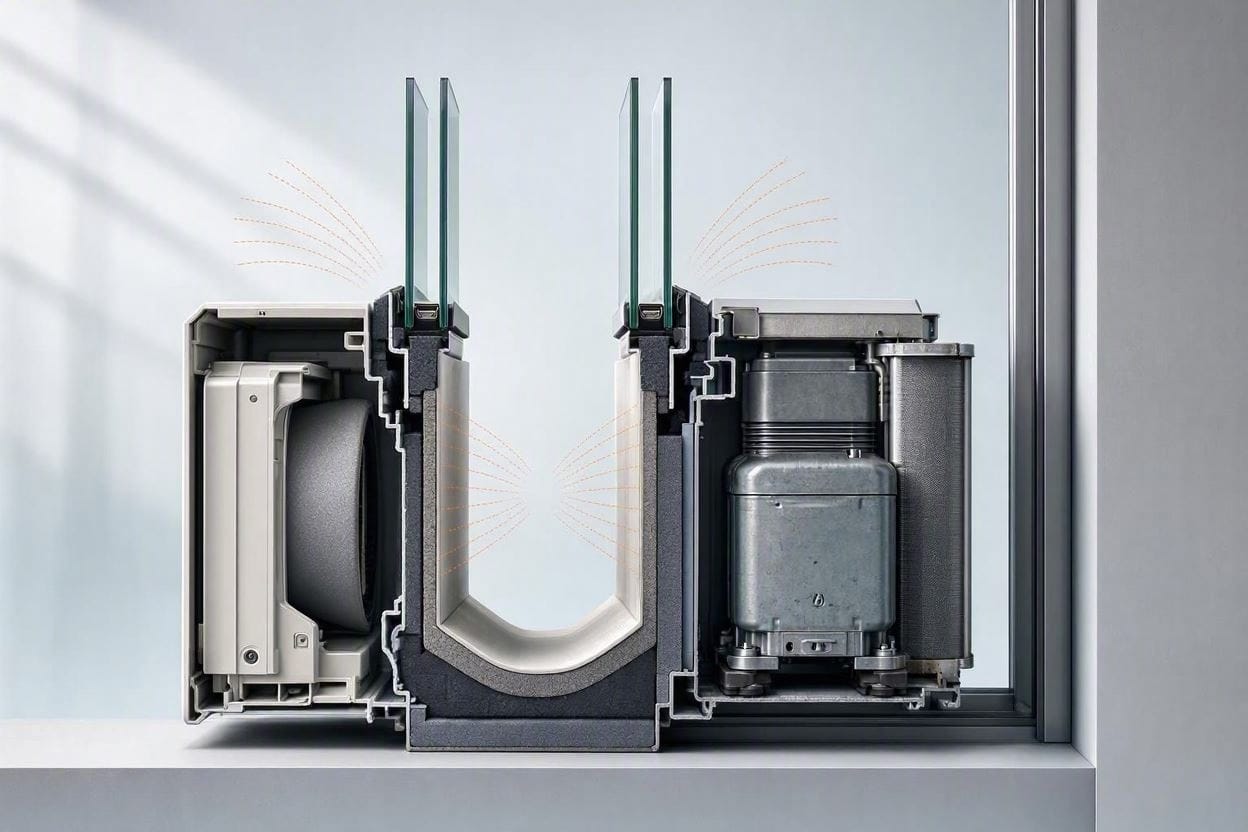
The Midea U completely revolutionized window air conditioning. Before this unit existed, “quiet” and “window AC” did not belong in the same sentence.
The genius is in the physical shape. Midea built a deep “U” groove right into the middle of the machine. The heavy, noisy compressor sits on the outside of your house, and the quiet blower fan sits on the inside. You literally slide your actual glass window down into the groove of the AC. Your window acts as a thick, physical soundproof barrier, trapping the heavy motor noise outside.
Combined with their ultra-quiet DC Inverter technology, this unit operates at an astonishing 42 decibels. You can stand right next to it, have a normal conversation, and completely forget it is running.
The Pros
- The U-shape allows you to still open your window for fresh air!
- Inverter tech eliminates the loud “clunk” of the compressor turning on.
- Smart app allows you to control the unit silently from your bed via Wi-Fi.
The Cons
- The installation bracket is more complex to set up than standard window units.
- You must have a window that opens vertically (up and down), not side-to-side.
2. LG Dual Inverter Window AC (The Premium Beast)
If you don’t want to deal with the complex bracket installation of the Midea U-shape, but still demand absolute acoustic perfection, LG’s Dual Inverter is a masterpiece.
LG uses a proprietary Twin Rotary Compressor. Instead of one large internal component shaking the machine, it uses two twin rotaries that balance each other out, drastically reducing internal friction and vibration. It is also significantly more energy-efficient than standard models.
On its dedicated Sleep Mode, the LG drops to an astonishing 44 dB, which sounds like a very smooth, high-end quiet bedroom tower fan rather than an industrial air conditioner.
The Pros
- Twin rotary compressor virtually eliminates physical vibration against the window frame.
- Traditional square shape makes installation much faster and easier.
- Highly intuitive ThinQ smartphone app control.
The Cons
- Premium, expensive price tag for the dual-inverter tech.
- It is a very heavy unit; you will likely need two people to lift it into the window safely.
3. Windmill Air Conditioner (The Best Aesthetic Pick)
Let’s be honest: most window AC units are incredibly ugly. They look like industrial grilles protruding into your beautiful bedroom. Windmill decided to fix this by creating the most aesthetically pleasing, minimalist AC on the market.
Acoustically, Windmill did something brilliant. Instead of blowing air straight out the front (which shoots the blower noise directly at your bed), they designed the air vents to blow up and outward at a 45-degree angle. This bounces the air off the ceiling, creating a smooth, cooling cascade that significantly muffles the mechanical sound of the fan.
While it does not have the fancy Inverter compressor of the Midea or LG, its smooth airflow design and auto-dimming LED display make it a fantastic, stylish option for guest bedrooms or home offices.
The Pros
- Gorgeous, sleek, modern design with a subtle matte finish.
- Top-blowing vents create superior air circulation and muffle fan noise.
- Comes with pre-assembled, perfectly cut cosmetic side panels (no ugly accordion wings).
The Cons
- Uses a standard fixed-speed compressor, so you will hear a faint “click” when it cycles on.
- The upward airflow might be blocked if you have very low window curtains.
The Foam Hack: Stopping Window Frame Rattling
If you buy a premium AC but it still sounds incredibly loud, the problem is not the motor. The problem is Impact Noise. The heavy mechanical vibration of the compressor transfers directly into your thin window frame. The hollow wall acts exactly like an acoustic amplifier, turning a gentle hum into a booming, annoying rattle.
We detail the physics of this extensively in our guide on Airborne vs. Impact Noise.
The 5-Minute Fix: You must decouple the AC unit from the hard window frame. Go to the hardware store and buy a roll of thick, high-density closed-cell weatherstripping foam tape. Line the entire bottom sill of your window and the top of the AC unit with this thick foam tape before you close the window sash tightly on it. The foam acts as a shock absorber, trapping the kinetic vibration before it can enter the wall. The rattling will instantly disappear!
Wait, can I just use a portable AC? If your homeowner’s association or landlord won’t allow a unit hanging out of your window, you aren’t out of luck. Check out our guide to the best quiet portable air conditioners for floor-standing stealth!
Frequently Asked Questions (FAQ)
Do Window ACs Block Outside Street Noise?
Usually, they make it worse. Standard window AC units use cheap, thin plastic “accordion” wings to fill the gaps on the side of the machine. These plastic wings have zero acoustic mass, allowing street noise to pour right into your bedroom. To fix this, buy foam insulation board, cut it to size, and press it firmly over the plastic accordion wings to block the airborne noise.
Why Does My Window AC Sound Like Splashing Water?
This is actually an intentional design feature! Modern window AC units use a “slinger ring” on the back fan blade. As condensation drips from the cooling coils into the bottom pan, the slinger ring scoops up the water and violently throws it against the hot exterior condenser coils to cool them down. It saves energy, but it sounds like a trickling fountain. It is completely normal and means your unit is highly efficient.
Is a U-Shaped AC Safe For Higher Floors?
Yes. The Midea U-Shaped unit comes with an incredibly robust, heavy-duty steel support bracket that you must drill securely into your windowsill before sliding the AC onto it. The bracket holds the entire weight of the unit safely, so there is no risk of it falling out, even on high-rise apartment buildings.

Ememobong is the lead researcher and editor at Quiet Dwelling. As a professional technical writer, he specializes in breaking down complex acoustic engineering concepts into simple, actionable steps. His goal is to help people build distraction-free environments for better sleep and deep work.