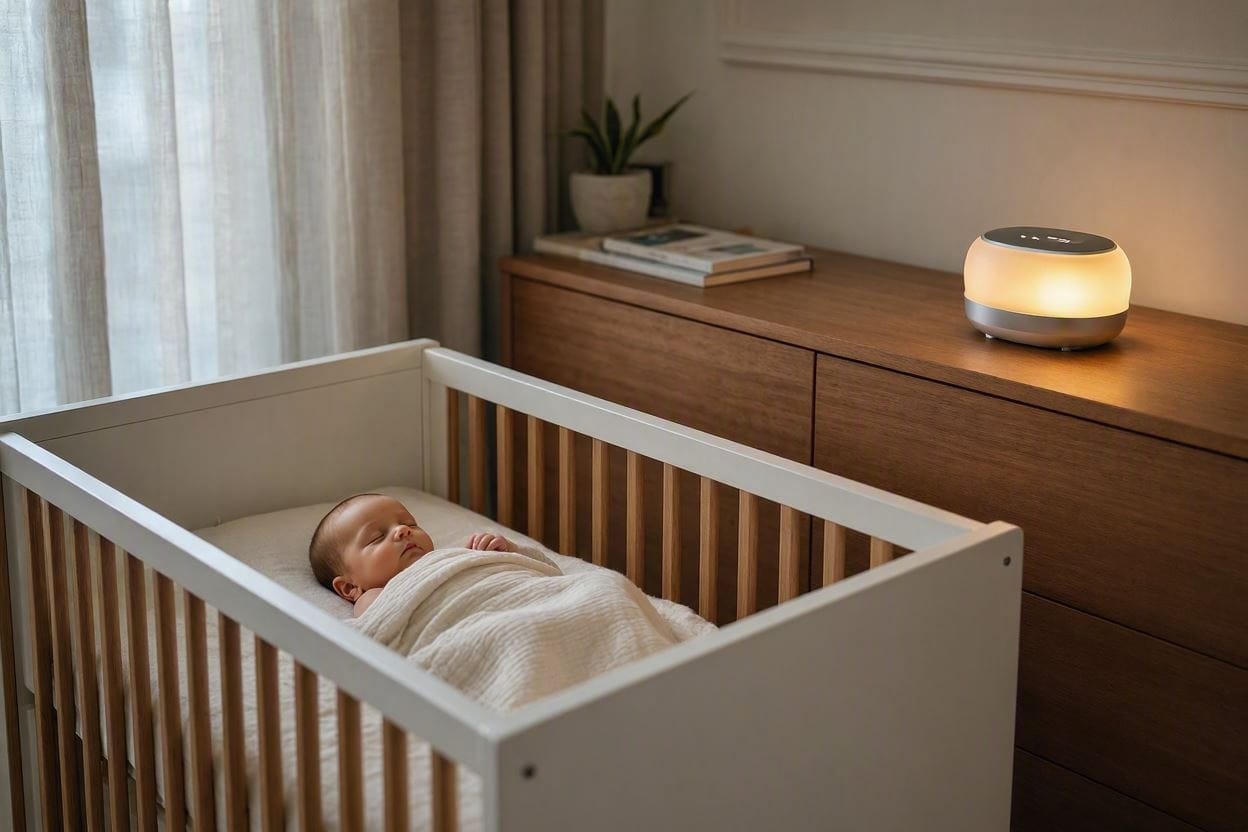
Every new parent knows the “tiptoe ninja walk.” You have just spent forty-five minutes rocking your baby to sleep. You gently place them in the crib, hold your breath, and slowly back out of the room. The house is completely, perfectly silent.
And then, it happens. A floorboard creaks. The dog barks next door. A delivery driver rings the doorbell. Your baby’s eyes snap open, their arms flail out, and the crying begins. Your perfectly silent house was ruined by a single, tiny noise.
In a desperate attempt to protect their baby’s sleep, parents often try to make the house as quiet as a library. But from a biological and acoustic standpoint, absolute silence is actually your worst enemy.
If you want your baby to sleep through the chaotic noises of a normal household, you do not need more silence. You need acoustic masking. Let’s dive into the fascinating neurobiology of infant sleep, why sudden noises trigger panic, and how you can use the physics of sound to keep your baby asleep.
🎯 The Quick Science
The Biological Truth: The womb is not quiet. It is a constantly loud environment (up to 80 decibels) filled with rushing blood and heartbeats. Putting a newborn in a dead-silent room is highly unnatural and unsettling to them.
How Masking Works: Babies aren’t woken up by loud noises; they are woken up by sudden changes in volume. Acoustic masking uses a steady, continuous background sound to “raise the noise floor,” effectively swallowing sudden household noises so your baby’s brain never registers them.
The Moro Reflex: Why Sudden Noise Causes Panic
To understand why a dropping pen wakes your baby, we have to look at infant neurology. Babies are born with a highly active, primitive survival mechanism called the Moro reflex (commonly known as the startle reflex).
When a baby’s brain detects a sudden, sharp environmental change—like a feeling of falling or a sudden, sharp noise—the amygdala (the brain’s fear center) fires instantly. The baby’s body releases a spike of adrenaline, their arms thrust outward, and they wake up in a state of panic.
Here is the critical acoustic secret: The brain does not trigger the Moro reflex based on the absolute volume of a sound; it triggers based on the contrast.
If a room is dead-silent (sitting at roughly 20 decibels), and a door clicks shut in the hallway (hitting 50 decibels), that is a massive, instantaneous 30-decibel spike. It is an acoustic shockwave. Your baby’s brain interprets that sudden 30-decibel jump as an immediate threat.
How Acoustic Masking Works (Raising the Noise Floor)
You cannot stop delivery drivers from knocking, and you cannot stop your older children from playing in the living room. Since you cannot control the noise, you must raise the noise floor of the nursery.
Acoustic masking involves introducing a smooth, continuous, non-distracting sound into the room (like a high-quality sound machine or a fan). By running a sound machine, you artificially raise the ambient volume of the room from a silent 20 decibels up to a steady 45 decibels.
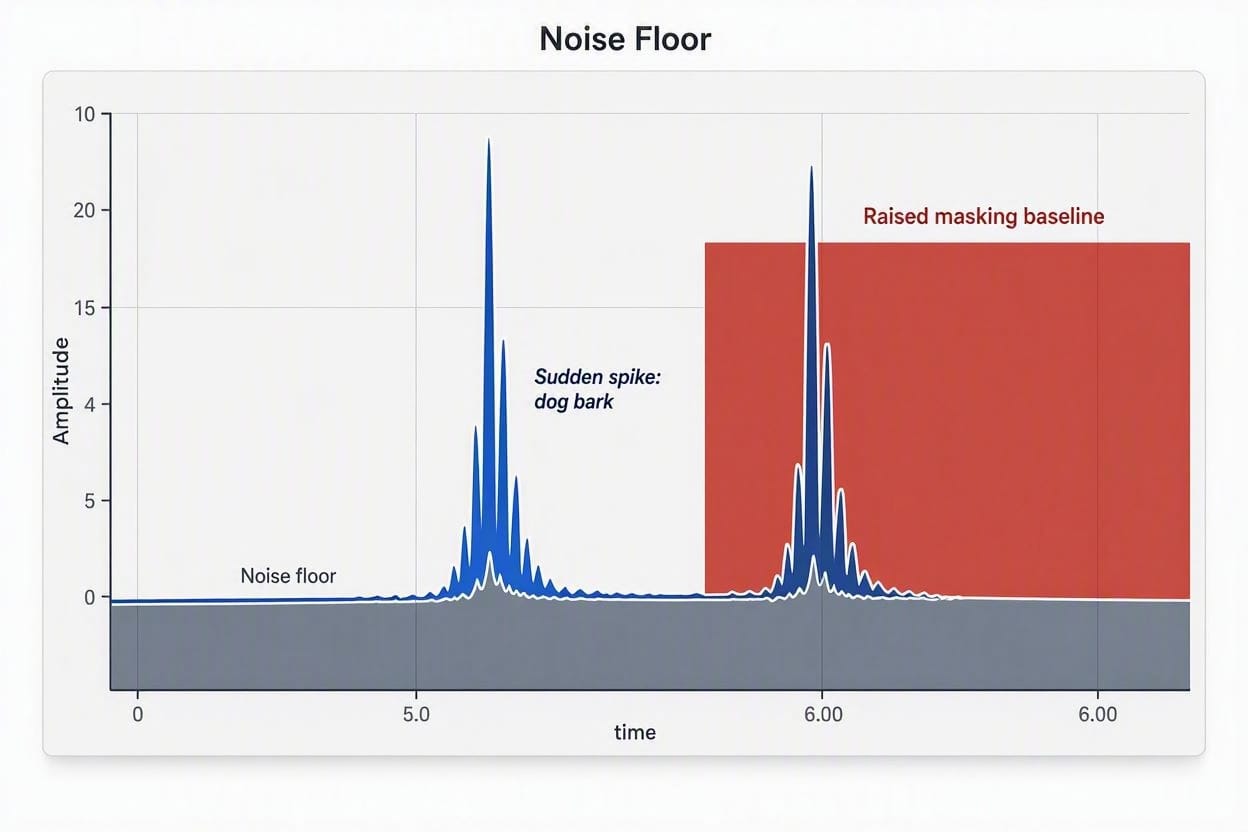
Now, let’s look at the math. If the room’s baseline is sitting at 45 decibels, and someone drops a book in the hallway (creating a 50-decibel noise), the acoustic jump is only 5 decibels. Because the contrast is so tiny, the sound is completely swallowed by the masking noise. The baby’s brain never registers the sharp spike, the Moro reflex never triggers, and your baby continues to sleep peacefully.
(Note: Masking only hides airborne noise. If the noise vibrating into the nursery is structural—like heavy footsteps from above—you need physical decoupling. Read our guide on how to structurally soundproof a nursery for impact noise.)
Pink Noise vs. White Noise for Developing Brains
Most parents rush out and buy a “white noise” machine. But in the world of acoustics, not all noise is created equal. True white noise is actually quite abrasive.
In physics, white noise contains equal energy across all audible frequencies. Because the human ear is highly sensitive to high pitches, white noise sounds incredibly bright, harsh, and hissing (like static on an old television). For a developing infant’s ear, prolonged exposure to high-frequency static can cause auditory fatigue.
Instead, pediatric sleep specialists highly recommend Pink Noise or Brown Noise.
Pink noise reduces the high-frequency screech and boosts the deep, low-frequency bass. It sounds like a heavy rainstorm, a rushing river, or—most importantly—the rushing flow of blood inside a mother’s womb. As we detail in our complete guide to understanding the colors of noise, clinical studies have shown that the low-frequency rumble of pink noise actually physically synchronizes with human brainwaves, prolonging periods of deep, slow-wave sleep.
Safe Acoustic Hygiene (Protecting Their Hearing)
While acoustic masking is a miracle tool for sleep, it must be used responsibly. If you turn a sound machine up to maximum volume and put it right next to a baby’s head, you are doing long-term damage to their fragile auditory system.
According to strict guidelines published by the American Academy of Pediatrics (AAP), infant sleep machines can easily exceed safe hearing limits if used improperly. To practice safe acoustic hygiene, you must follow two rules:
- The Distance Rule: Never place a sound machine directly on the crib railing or right next to the mattress. It should be placed at least 7 feet (200 cm) away from the baby, ideally near the door or window where the disruptive noise is entering the room.
- The 50 Decibel Limit: The continuous masking noise reaching the baby’s ears should never exceed 50 dBA. You can easily test this by downloading a free decibel meter app on your phone, placing your phone in the crib, and adjusting the volume of the machine across the room until it hovers safely under 50 dB. To learn exactly how loud this is in the real world, check our guide on safe decibel levels for sleep.
Frequently Asked Questions (FAQ)
Will My Baby Become Addicted to a Sound Machine?
It is true that babies form sleep associations, meaning they link certain cues (like a dark room, a swaddle, or pink noise) to falling asleep. However, relying on a sound machine is a positive sleep association. It is highly controllable, portable (you can buy travel sound machines for vacations), and drastically improves their sleep quality. When they are older, you can easily wean them off by simply turning the volume down slightly every night over a period of two weeks.
Can I Just Use a Regular Fan For Acoustic Masking?
Yes! A high-quality mechanical fan is actually one of the best organic sources of pink noise. The steady “whoosh” of air rolling off the blades perfectly mimics a natural masking frequency. Just ensure the fan is pointing away from the crib so the baby does not get chilled by the direct breeze.
Will Acoustic Foam Panels Help Mask Outside Noises?
No. This is a massive acoustic myth. Acoustic foam does not block or mask sound; it only absorbs internal echoes inside a room. Taping foam to your nursery walls will do absolutely nothing to stop the sound of a barking dog or a slamming door from entering the room. If you need to stop sound from coming through the walls, you need heavy structural mass, not lightweight foam.

Ememobong is the lead researcher and editor at Quiet Dwelling. As a professional technical writer, he specializes in breaking down complex acoustic engineering concepts into simple, actionable steps. His goal is to help people build distraction-free environments for better sleep and deep work.