
If you live near a busy intersection, an airport flight path, or an active train line, you have likely looked into upgrading your home’s exterior windows to block the noise. During your research, you will inevitably run into two competing acronyms: STC vs OITC.
Window manufacturers often boast about their high STC ratings to prove their glass is “soundproof.” However, relying solely on an STC rating to fix an exterior noise problem is a massive, incredibly common acoustic mistake.
To truly achieve a quiet dwelling and block the deep, rumbling vibrations of city traffic, you must understand the critical difference between the Sound Transmission Class (STC) and the Outside-Inside Transmission Class (OITC).
In this guide, we will break down the exact physics behind both ratings, explain why one fails against heavy traffic, and help you select the right materials to permanently silence your home’s exterior.
The Quick Recap: What is an STC Rating?
To understand the STC vs OITC debate, we must first look at the baseline metric. STC (Sound Transmission Class) is the most widely used acoustic rating system in North America.
Developed decades ago, the STC scale was designed specifically to measure how well interior building partitions (like drywall, office doors, and apartment floors) block standard interior noises.
In a laboratory setting, acousticians test STC materials against sounds like:
- People talking or shouting.
- Televisions and radios.
- Office equipment and ringing phones.
- Light kitchen appliances.
For a deep dive into the math behind this metric and how to apply it inside your home, read our complete guide to understanding STC ratings. However, the critical flaw of STC is that it only measures frequencies down to 125 Hz. It completely ignores deep, low-frequency bass.
What is an OITC Rating?
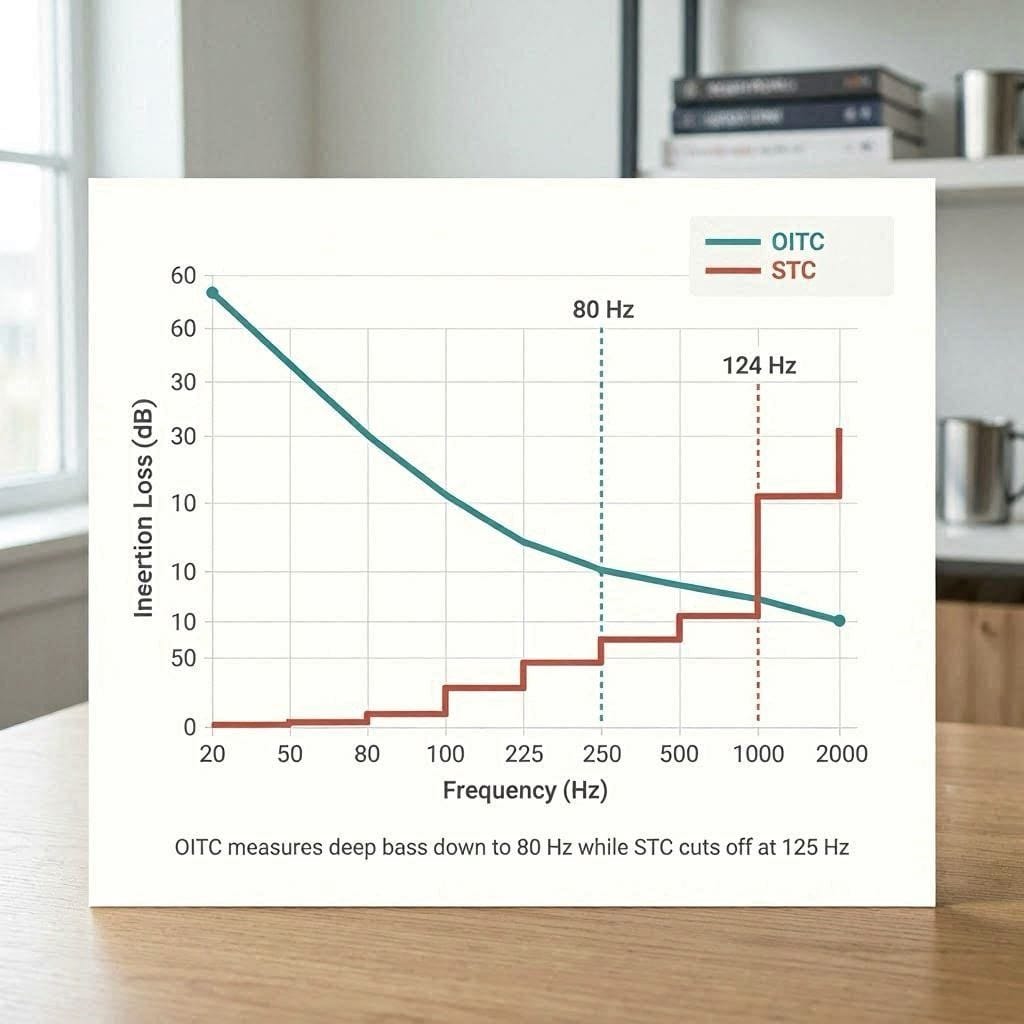
Because STC testing ignored low frequencies, architects and builders realized they needed a new metric to measure exterior building facades. In 1990, the ASTM International organization established the OITC (Outside-Inside Transmission Class).
Unlike STC, OITC was engineered specifically to measure how well exterior walls, doors, and windows block low-frequency, high-energy transportation noise.
In a laboratory, OITC tests measure sound absorption down to 80 Hz. This lower frequency range is critical because exterior noise behaves entirely differently than interior noise. OITC is designed to measure:
- Heavy highway traffic and diesel truck engines.
- Low-flying commercial aircraft.
- Train horns and rail rumble.
- Industrial machinery and construction equipment.
Because low-frequency sound waves are massive and carry immense kinetic energy, they easily pass straight through standard glass and brick. To learn exactly how these powerful waves bypass your walls, read our guide on the wave physics of blocking low-frequency noise.
STC vs OITC: The Side-by-Side Comparison
Why do these two metrics matter so much when buying soundproof windows? Because a window can have a fantastic STC rating but a terrible OITC rating.
Imagine a thick, dual-pane window with a heavy air gap. This window might score an STC of 35, meaning it is excellent at blocking the high-pitched chirp of a bird or the sound of your neighbor talking in their driveway.
However, because the glass is rigid and both panes are the same thickness, they will naturally resonate with the deep hum of a passing garbage truck. That exact same window might only score an OITC of 26. If you bought that window based solely on its STC rating to block highway noise, you would be incredibly disappointed.
| Feature | STC Rating | OITC Rating |
|---|---|---|
| Target Noise Environment | Interior (Room-to-Room) | Exterior (Outside-to-Inside) |
| Frequency Range Tested | 125 Hz to 4,000 Hz | 80 Hz to 4,000 Hz (Captures deep bass) |
| What It Blocks Best | Voices, TVs, crying babies, office chatter | Airplanes, trucks, trains, heavy traffic |
| Primary Material Location | Drywall, insulation, interior doors | Exterior glass, facade walls, brickwork |
How to Improve Your Window’s OITC Rating
If you are suffering from the health effects of environmental noise pollution caused by nearby traffic, you must invest in materials that specifically target the OITC scale.
Here are the structural changes required to boost a window’s OITC performance and block exterior bass frequencies:
Laminated Glass (Damping)
Standard dual-pane windows trap air to block temperature, but they fail at blocking low-frequency sound. Laminated glass is the ultimate solution. By sandwiching a thin layer of PVB (polyvinyl butyral) plastic between two sheets of glass, the window gains viscoelastic damping. When a deep sound wave strikes the glass, the plastic core absorbs the vibration and converts it into heat, drastically raising the OITC rating.
Asymmetrical Glazing (Breaking the Resonance)
If two panes of glass are the exact same thickness, they will vibrate at the exact same resonant frequency. A passing truck will cause both panes to shake in unison, transferring the noise inside. Asymmetrical glazing solves this by using one thick pane (e.g., 1/4-inch) and one thin pane (e.g., 1/8-inch). Because they have different masses, they block different frequencies, ensuring a broad spectrum of traffic noise is neutralized.
Acoustic Window Inserts
If replacing your entire exterior window frame is too expensive, you can add an acoustic window insert. These are custom-cut sheets of heavy acrylic or laminated glass that press-fit into the inside of your existing window frame. They create a massive, 2-to-3-inch dead air gap between your existing window and the insert, providing massive OITC gains. For more budget-friendly methods, check out our guide on how to soundproof windows cheaply.
Frequently Asked Questions (FAQ)
Can a Window Have a High STC Rating But a Low OITC Rating?
Yes. This is incredibly common with standard double-pane thermal windows. The air gap makes them decent at blocking high-frequency interior noises (yielding a respectable STC rating), but their light weight and lack of laminated plastic make them terrible at blocking the low-frequency rumble of traffic (yielding a poor OITC rating).
What is a Good OITC Rating For a House Near a Highway?
If you live near a busy highway or train track, you should aim for exterior windows with an OITC rating of 30 to 35 or higher. Standard builder-grade windows usually sit around an OITC of 22 to 25. Upgrading to the 30+ range will make a highly noticeable difference in your home’s acoustic comfort.
Do Thick Curtains Improve My OITC Rating?
No. “Soundproof” curtains or heavy drapes can absorb some high-frequency echoes inside your bedroom, but they have practically zero physical mass. Because they lack heavy density and structural rigidity, they are completely ineffective at blocking the low-frequency exterior noises measured by the OITC scale.

Ememobong is the lead researcher and editor at Quiet Dwelling. As a professional technical writer, he specializes in breaking down complex acoustic engineering concepts into simple, actionable steps. His goal is to help people build distraction-free environments for better sleep and deep work.