If you are opening up your walls to soundproof a home theater, bedroom, or home office, you face a critical decision. You must choose the right material to fill those empty cavities.
You cannot leave them empty. Empty wall cavities act like physical drum chambers, amplifying sound as it bounces off the rigid drywall sheets.
When you start researching soundproofing insulation, you will immediately run into a fierce debate: Acoustic Mineral Wool vs. Standard Fiberglass.
Mineral wool advocates (often praising brands like Rockwool Safe’n’Sound) claim it is the undisputed champion of quiet construction. Fiberglass supporters argue that standard pink batts are much cheaper, lighter, and perform practically the same behind closed drywall.
But what does the physical laboratory testing actually say? Does mineral wool justify its premium price tag, or are you paying extra for a marketing myth?
In this guide, we will break down the structural physics of both materials, compare their performance ratings, and help you select the perfect insulation to silence your walls for good.
What is Mineral Wool and How is it Made?
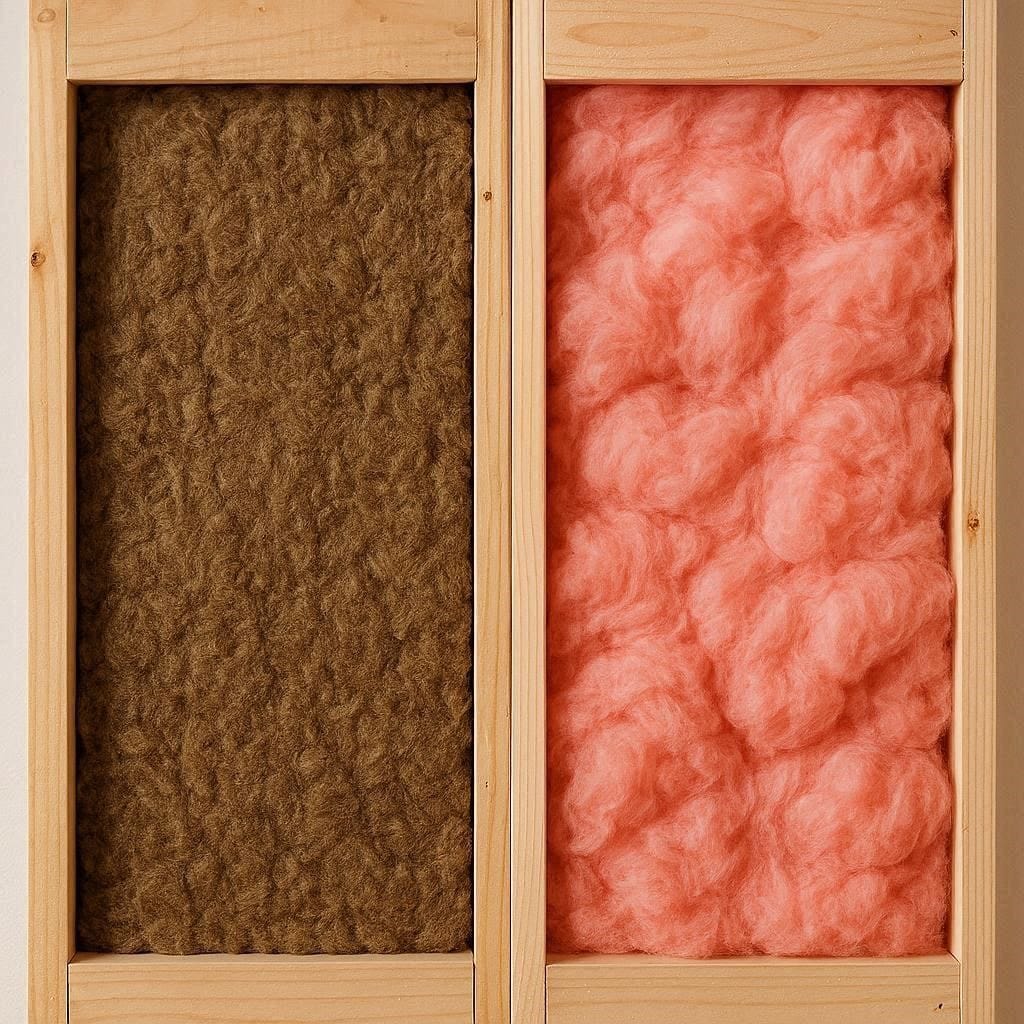
Mineral wool (often called stone wool or rock wool) is an inorganic, highly dense fibrous insulation.
It is manufactured by melting volcanic basalt rock and industrial steel slag at temperatures exceeding 2,900°F (1,600°C). The molten liquid is then spun in high-speed spinning chambers—behaving like an industrial cotton candy machine—which cools the stone liquid into fine, glassy threads. These threads are pressed into dense, rigid batts.
Because it is made literally from stone, mineral wool is incredibly heavy, naturally hydrophobic (repels water), and completely fire-resistant up to 2,150°F.
What is Fiberglass and How is it Made?
Fiberglass is the classic, fluffy pink insulation that has dominated residential construction for decades.
It is manufactured by melting silica sand and recycled glass bottles, spinning the liquid glass into microscopically thin glass fibers. These fibers are bound together using a chemical adhesive and backed with paper or left unfaced to create light, springy batts.
Because fiberglass relies on trapped air to provide thermal resistance, it is highly fluffy and incredibly lightweight. However, this lightweight structure is also its primary weakness when it comes to stopping sound waves.
The Physics of Cavity Absorption
Before we compare the two materials, we must address a common soundproofing mistake: Insulation inside a wall cavity does not block sound on its own.
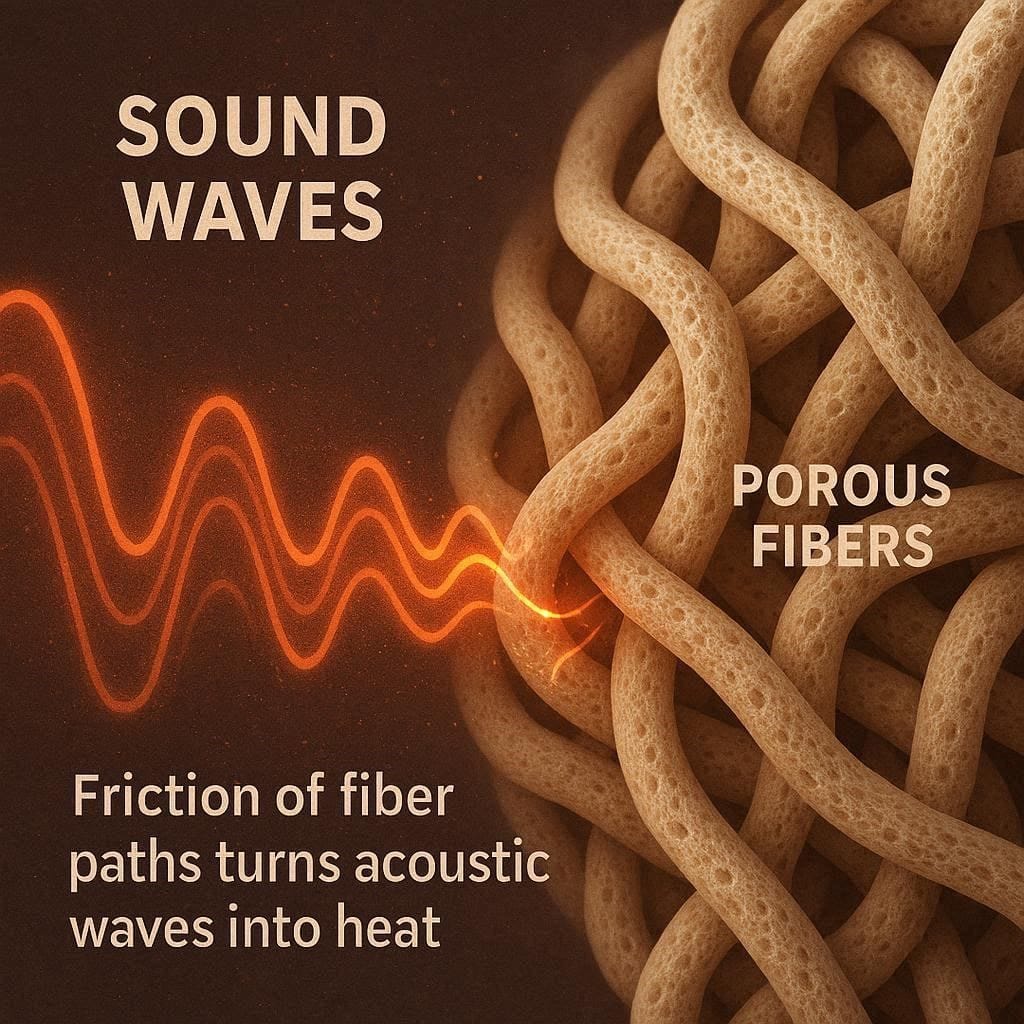
If you hung a sheet of mineral wool or fiberglass between two rooms without drywall, sound would pass right through it. Instead, insulation behaves as an acoustic absorber.
When sound waves strike your wall drywall, some of that kinetic energy forces the drywall to vibrate, passing into the empty air cavity between the studs. If the cavity is empty, the sound waves will bounce back and forth, amplifying the resonance of the wall.
By filling the cavity with porous insulation, those vibrating air molecules are forced to travel through a dense maze of glass or stone fibers. The physical friction of the air molecules moving against these tiny fibers converts the kinetic sound energy into trace amounts of heat. This process is a key part of the absorption pillar in the four principles of soundproofing.
By stopping the echo inside the cavity, insulation prevents the wall from acting like an acoustic amplifier.
Head-to-Head: Soundproofing Performance
To compare these materials objectively, we must look at two primary acoustic ratings: Noise Reduction Coefficient (NRC) and Sound Transmission Class (STC).
| Feature / Spec | Acoustic Mineral Wool | Standard Fiberglass |
|---|---|---|
| Density | High (approx. 2.5 lbs/cu ft) | Low (approx. 0.5 to 1.0 lbs/cu ft) |
| Noise Reduction Coefficient (NRC) | 0.95 to 1.05 (Elite absorption) | 0.80 to 0.90 (Excellent absorption) |
| Wall STC Rating Gain | Increases STC from 34 to 45 (+11 points) | Increases STC from 34 to 39 (+5 points) |
| Low-Frequency Absorption (Bass) | Excellent (Dense structure traps deep waves) | Poor to Moderate (Waves pass through easily) |
| Relative Cost | Expensive ($1.50 – $2.00 / sq ft) | Budget-Friendly ($0.60 – $1.20 / sq ft) |
The Density Advantage of Mineral Wool
As you can see, mineral wool is roughly three times denser than standard fiberglass.
This high density gives mineral wool a massive advantage in two areas:
1. Low-Frequency Performance: High-energy, low-frequency sound waves (like the rumble of theater bass, highway traffic, or heavy machinery) pass easily through light, fluffy fiberglass. The dense stone fibers of mineral wool have the physical inertia needed to slow down these long wavelengths.
2. Standard Stud Performance: In a basic, un-decoupled wall (drywall screwed directly to wood studs), adding mineral wool typically increases the partition’s overall rating to STC 45. Adding standard fiberglass only pushes it to STC 39. That 6-point difference is highly noticeable to the human ear. You can read more about how these decibel changes translate to real-world hearing in our comprehensive guide to understanding STC ratings.
The Double-Stud Exception: When Fiberglass Wins
There is a major exception to the “mineral wool is always better” rule, and it comes down to structural decoupling.
If you are building a high-performance double-stud wall (two separate wood frames with an intentional air gap between them) or using sound isolation clips to float your drywall, the structural bridge is completely broken.
Because the physical connection is broken, the wall is already elite at stopping low-frequency structural vibrations. Under these conditions, laboratory testing shows that standard fiberglass performs almost identically to mineral wool inside the cavity.
According to acoustic testing standards from major material manufacturers like Johns Manville, the performance difference between dense stone wool and standard glass wool inside a fully decoupled double-stud wall is virtually imperceptible to the human ear. If you have already decoupled your wall, you can save a significant amount of money by using cheaper fiberglass without sacrificing your final sound isolation results.
To understand why decoupling is so powerful at stopping structural vibrations from bypassing your insulation entirely, read our structural guide to understanding flanking noise.
Other Factors to Consider
While acoustic performance is vital, you must also consider real-world installation, safety, and longevity:
- Ease of Installation: Mineral wool batts are stiff and rigid, behaving more like dense bread than cotton candy. You can cut them precisely using a serrated knife for a tight “friction fit” that won’t slump or sag over time. Fiberglass is fluffy, floppy, and typically requires staples or wire to prevent it from sagging down and leaving empty, noisy air gaps at the top of your walls.
- Moisture & Mold Resistance: Mineral wool is completely hydrophobic. If water enters your wall, it will drain away rather than soaking into the batt. Fiberglass behaves like a sponge; if it gets wet, it will sag, clump, lose its acoustic/thermal value, and encourage mold growth.
- Skin Irritation: Both materials contain fine fibers that can cause temporary skin itchiness and respiratory irritation during installation. Always wear a mask, gloves, and long sleeves when handling either material.
The Verdict: Which Should You Choose?
To make your final decision, look at the design of your wall assembly:
Choose Acoustic Mineral Wool (Rockwool) if:
- You are insulating standard, single-stud walls without structural decoupling.
- You are soundproofing against low-frequency noises like subwoofers, heavy trucks, or home theaters.
- You are worried about moisture, mold, or want the absolute best fire barrier.
- You want an easy, clean, friction-fit DIY installation that will never sag.
Choose Standard Fiberglass if:
- You are building high-performance double-stud walls or using resilient isolation clips.
- You are working on a tight budget and need to insulate a massive surface area.
- You only need to block high-frequency airborne noise, like voices or light office chatter.
By pairing the right insulation with proper framing, you ensure that your investment translates to real-world, peaceful quiet. If you are struggling with chronic noise issues at night, understanding the physical difference between different types of noise is critical. Read our full comparative guide on airborne vs. impact noise to learn how different vibrations interact with your wall insulation.
Frequently Asked Questions (FAQ)
Does Spray Foam Work Better than Mineral Wool For Soundproofing?
No. While closed-cell spray foam is excellent at sealing air gaps and insulating temperature, it dries rock-rigid. This rigidity allows sound vibrations to travel straight through the foam into your drywall. Open-cell spray foam offers some absorption, but fibrous materials like mineral wool are significantly more cost-effective and efficient at absorbing sound waves inside a wall cavity.
Can I Pack Insulation Too Tightly to Improve Soundproofing?
No, this is a dangerous mistake. Compressing insulation squeezes out the trapped air pockets that are essential for absorbing sound waves. Jamming too much insulation into a wall cavity makes the material rigid, creating a solid physical bridge that actually transmits sound vibrations faster. Always use the correct thickness of insulation for your stud size.
Does Standard Thermal Fiberglass Perform the Same as “Acoustic” Fiberglass?
Yes. Specialized “acoustic” fiberglass is manufactured with a slightly higher density, but standard, off-the-shelf thermal fiberglass batts (like Owens Corning R-13 or R-15) offer almost identical sound absorption performance at a fraction of the cost.

Ememobong is the lead researcher and editor at Quiet Dwelling. As a professional technical writer, he specializes in breaking down complex acoustic engineering concepts into simple, actionable steps. His goal is to help people build distraction-free environments for better sleep and deep work.