

*This post contains affiliate links. If you use these links to buy something we may earn a commission at no extra cost to you.
You are sitting in your living room, trying to enjoy a quiet evening or focus on a book, when suddenly it happens: a low, aggressive rumble kicks on from the kitchen. It hums, it buzzes, and if you live in an open-concept home or a studio apartment, that low-frequency drone can feel like it is drilling straight into your brain.
A noisy refrigerator compressor is one of the most maddening acoustic annoyances in a modern home. When homeowners experience this, their first instinct is usually to call a repair technician or start shopping for a brand-new, expensive appliance.
But in the vast majority of cases, the refrigerator isn’t broken. It is simply suffering from poor acoustic isolation. By applying a few basic principles of soundproofing, you can eliminate the hum, stop the floor from vibrating, and restore the peace in your kitchen for a fraction of the cost of a new fridge.
Diagnosing The Noise: Airborne vs. Impact Vibration
Before you can fix the noise, you need to understand exactly how the sound is traveling from the back of your fridge to your ears. According to guidelines from the U.S. Department of Energy, modern high-efficiency compressors operate at high speeds that naturally generate a mild hum. However, this hum becomes a deafening roar due to two distinct acoustic phenomena.
As we covered in our master guide to airborne vs. impact noise, you must treat both transmission paths to get results:
- Structure-Borne (Impact) Noise: The compressor is a heavy motor that vibrates violently when it kicks on. Because the refrigerator has hard plastic or metal wheels resting directly on a hard tile or wooden floor, those mechanical vibrations travel straight into the floor joists. Your entire kitchen floor effectively becomes a giant speaker, amplifying the low-frequency hum.
- Airborne Resonance: The metal panels on the back of the fridge are thin. When the compressor vibrates, it causes these thin metal access panels to rattle incredibly fast. This high-frequency metallic buzzing bounces off the hard wall behind the fridge and amplifies into the room.
To silence the appliance, we must use two of the 4 Principles of Soundproofing: Decoupling (to stop the floor vibrations) and Damping (to kill the metal rattle).
1. Kilmat 80 Mil Sound Deadening Mat (The Damping Solution)
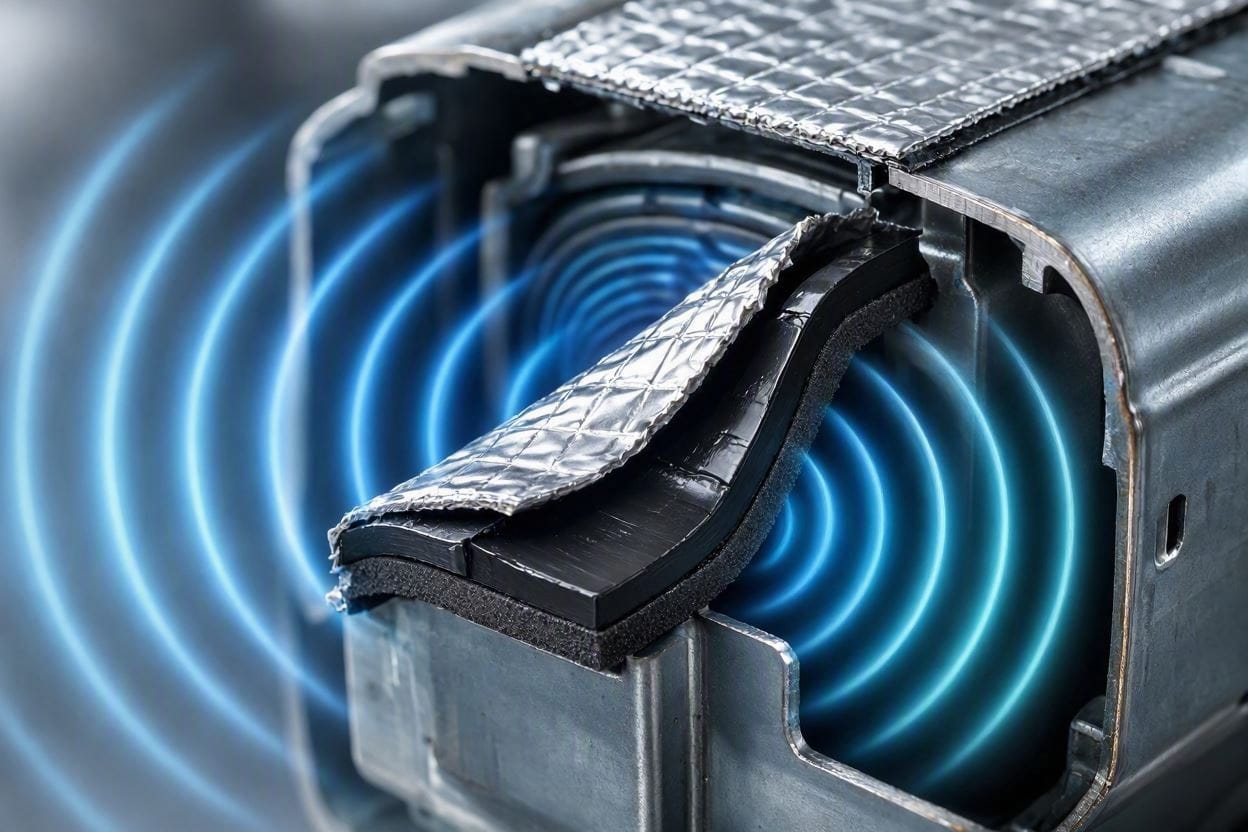
If your refrigerator sounds like there is a loose piece of metal rapidly buzzing or rattling against the back wall, you are dealing with panel resonance. The ultimate solution for this is Constrained Layer Damping (CLD).
Kilmat was originally designed for the automotive industry to stop car doors from rattling when heavy bass music is played, but it is the ultimate secret weapon for noisy appliances. It is a thick layer of viscous butyl rubber backed by aluminum foil. When you cut a few small squares of this and stick it directly onto the compressor housing and the thin metal back-panels of the fridge, it instantly adds mass and absorbs the kinetic energy.
Instead of a high-pitched, metallic rattle, the metal becomes “dead” and produces a muted, dull thud. It stops the airborne noise at the source.
The Pros
- Instantly kills high-frequency buzzing and metallic rattling.
- Peel-and-stick application takes less than 5 minutes.
- Incredibly heat-resistant, making it safe to stick near warm compressor housings.
The Cons
- Requires pulling the refrigerator away from the wall to access the back panel.
- Will not stop low-frequency floor vibrations on its own.
2. Isolate It! Sorbothane Pads (The Decoupling Solution)
If you can feel the floor vibrating when the fridge turns on, or if the hum sounds like a deep, low-frequency bass note, you must decouple the appliance from the floor. Standard rubber pads are often too rigid to absorb heavy motor vibrations, which is why acoustic professionals turn to Sorbothane.
Sorbothane is a proprietary viscoelastic polymer. It behaves like a liquid under pressure, meaning it absorbs shock and vibration better than any other material on the planet. By lifting the four corners of your refrigerator and sliding one of these small pads under each wheel or foot, you sever the mechanical connection to your floor.
The kinetic energy from the compressor travels down the frame, hits the Sorbothane pad, and is safely converted into microscopic heat instead of shaking your kitchen tiles.
The same decoupling logic applies to shared walls — see our guide to soundproofing a rented apartment.
The Pros
- The absolute best material for killing structure-borne impact noise.
- Small, discreet, and visually hidden under the appliance.
- Can also be used under loud washing machines and subwoofers.
The Cons
- Premium material comes with a higher price tag than standard rubber.
- Sorbothane can sometimes leave a residue on hardwood; put a piece of felt beneath them to protect pristine floors.
3. RevTime Anti-Vibration Rubber Mat (The Budget Pick)
If lifting your heavy refrigerator to meticulously place four individual Sorbothane pads sounds like a nightmare, the RevTime Anti-Vibration mat is the perfect, hassle-free alternative. Instead of isolated pads, this is a heavy-duty, high-density rubber mat that sits flat on the floor.
You simply roll the refrigerator entirely onto the mat. The thick rubber provides a massive decoupling barrier between the hard wheels and your hard floor. While it doesn’t have the space-age vibration absorption of Sorbothane, it is vastly superior to letting the fridge sit directly on tile or wood, and it provides an excellent layer of protection against scuffs and water damage.
The Pros
- Incredibly easy installation; just roll the fridge over it.
- Very affordable compared to premium viscoelastic pads.
- Protects expensive hardwood and tile from compressor heat, leaks, and scratches.
The Cons
- The black rubber mat will be slightly visible protruding from the bottom of the fridge.
- Standard rubber doesn’t absorb the lowest bass frequencies as effectively as Sorbothane.
Final Step: Clear the Acoustic Cavity
Once you have applied damping mats to the back panel and decoupled the wheels from the floor, there is one final check. Refrigerators are typically shoved tightly into custom cabinetry alcoves. Acoustically, this creates a hollow resonance chamber.
If the back of the fridge is touching the drywall, or if the sides are pressed tightly against the wooden cabinets, those vibrations will transfer directly into the walls of your home. Ensure there is at least a 1-inch to 2-inch gap around the entire perimeter of the appliance. This air gap prevents structural flanking noise and allows the compressor to vent heat efficiently, which keeps it from having to run as loudly or as often.
By treating the vibration at the source, you can save yourself thousands of dollars on a new appliance and enjoy a peaceful, quiet kitchen once again.

Ememobong is the lead researcher and editor at Quiet Dwelling. As a professional technical writer, he specializes in breaking down complex acoustic engineering concepts into simple, actionable steps. His goal is to help people build distraction-free environments for better sleep and deep work.