This post contains affiliate links. If you use these links to buy something, we may earn a commission.
If you live in an apartment, you probably know the drill. It’s 11:30 PM, you have to be up early for work, and the person living above you has apparently decided to take up indoor bowling. Meanwhile, a dog is barking down the hallway, and the sirens from the street outside are piercing right through your window glass.
Sharing walls, floors, and ceilings with strangers is the hardest part of apartment living. When you search for solutions, professional contractors will tell you to tear down your drywall, install resilient channels, and pack the studs with fiberglass. But as a renter, if you try to demolish a wall, you will be evicted.
So, what can you actually do? I have spent years optimizing rental units for acoustic comfort. The truth is, you cannot achieve 100% recording-studio silence without construction. But by understanding basic acoustic physics, you can easily reduce the noise invading your apartment by 50% to 70%, completely transforming a stressful space into a quiet dwelling.
In this guide, I will show you the exact, renter-friendly, non-destructive steps to soundproof your apartment from the inside out.
🎯 The Quick Verdict: Your Apartment Strategy
To block noise without losing your security deposit, you must attack the three weakest links in your apartment:
- The Front Door: Seal the massive air gaps to stop hallway conversations.
- The Floors: Add dense mass to cushion impact noise and stop vibrations.
- The Windows: Use heavy acoustic curtains or acrylic inserts to block street sirens.
The Science: Airborne vs. Impact Noise
Before buying a single piece of gear, you have to diagnose what kind of noise you are dealing with. According to guidelines from the Acoustical Society of America, sound travels into your apartment in two distinct ways. You cannot treat them both with the same materials.
- Airborne Noise: This is sound that travels through the air. Voices, dogs barking, and televisions are airborne. Because it behaves like fluid, airborne noise easily squeezes through tiny cracks under your door or through cheap window glass.
- Impact Noise (Structural Vibration): This is physical kinetic energy. When your upstairs neighbor drops a heavy box or walks heavily on their heels, the physical impact vibrates the wooden floor joists. That vibration travels straight down into your ceiling and radiates as noise.
You can easily stop airborne noise with airtight seals. Impact noise is much harder to stop, as you have to actually cushion or decouple the physical structure. For a deeper scientific dive, read our master breakdown of Airborne vs. Impact Noise.
Step 1: Silence the Front Door (The Biggest Leak)

Your apartment’s front door is an acoustic nightmare. The “1% Rule” of acoustics states that if a wall has an open air gap making up just 1% of its surface area, it will let up to 50% of the airborne sound through. Look at the bottom of your front door. That 1-inch gap is letting the entire hallway into your living room.
Since you can’t replace the door, you must seal it completely. You need two things: perimeter weatherstripping for the door jamb, and a heavy sweep for the floor.
The Fix: Holikme Twin Door Draft Stopper
If you own the unit, you should screw a commercial-grade aluminum drop-sweep into the door. But for renters, the Holikme Twin Draft Stopper is a brilliant workaround. It consists of two heavy foam cylinders wrapped in fabric that slide right under the door, hugging both the inside and outside.
Because it creates a physical barrier on both sides of the gap, it drastically reduces the diffraction of airborne sound waves slipping underneath. Combine this with peel-and-stick neoprene rubber tape around the sides of the door frame, and your hallway noise will drop to a quiet murmur.
Pros
- 100% renter friendly; no screws or drilling required
- Instantly blocks high-frequency hallway chatter
- Moves with the door, so you don’t have to reposition it
Cons
- Fabric can collect dust and pet hair off the floor
- Will not fit doors with massive (over 2-inch) gaps
Step 2: Treat the Windows (Street Noise)
Standard apartment windows are usually thin, single or double-pane glass that resonate perfectly with the deep, low-frequency rumble of diesel trucks and street traffic. If your landlord won’t upgrade you to laminated acoustic glass, you have to add mass to the window frame yourself.
The Fix: NICETOWN Thermal Blackout Curtains
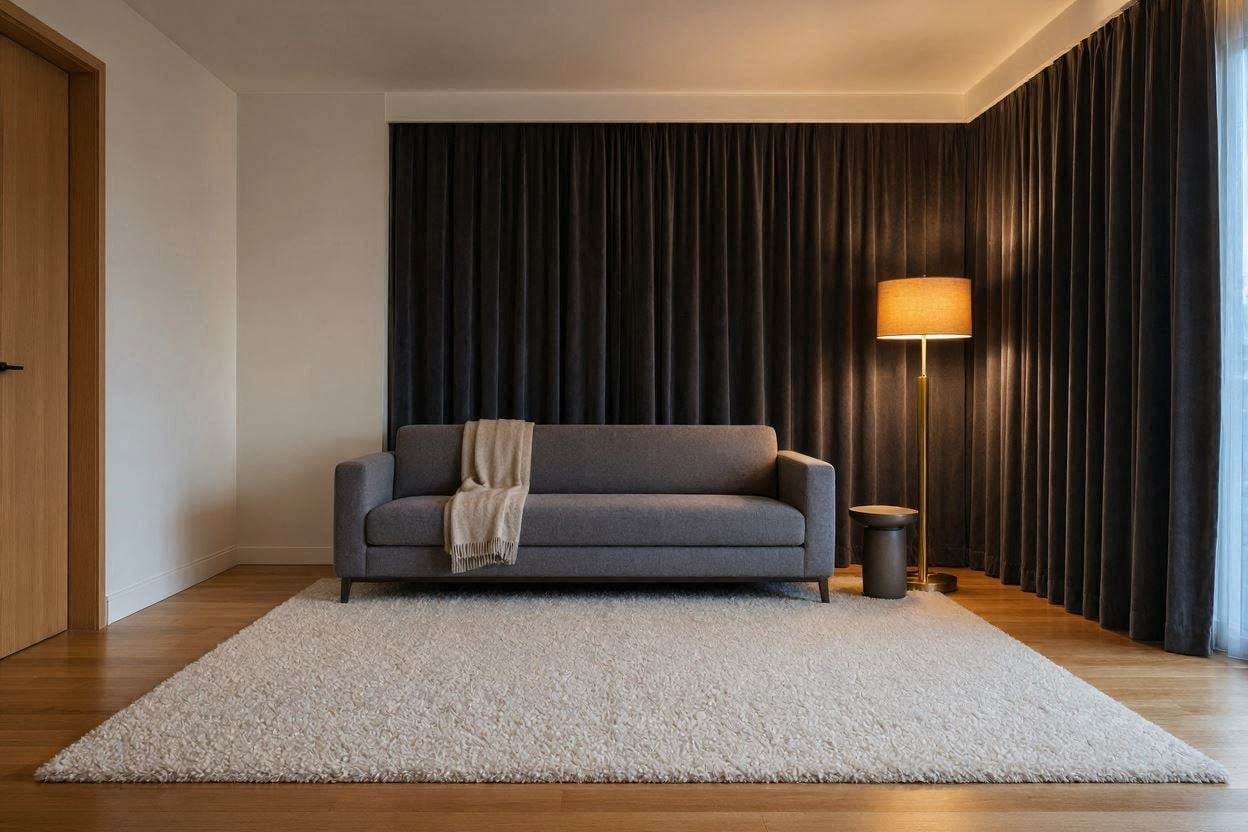
Before we go further: standard curtains do not block noise. To stop a physical sound wave, you need massive weight. The NICETOWN Thermal curtains are some of the thickest, heaviest three-layer drapes on the market.
While they won’t stop the bass of a dump truck, hanging these thick, multi-layered polyester drapes creates a surprisingly effective buffer for high-frequency noises (like sirens and car horns). Furthermore, because they are incredibly thick, they act as massive acoustic absorbers, stopping the street noise from bouncing and echoing off your bedroom walls.
Pros
- Heavy 3-layer weave genuinely muffles high frequencies
- Stops internal room echoes instantly
- Provides 100% light blackout for better sleep
Cons
- Will not stop low-frequency bass or engine rumbles
- Require a very sturdy curtain rod to support the heavy weight
Step 3: The Floors (Cushioning Impact Noise)
If you live above someone else, you have a social responsibility to minimize your own impact noise. Even normal walking on hardwood floors sounds like thunder to the person below you. Conversely, if your downstairs neighbor plays loud music, treating your floor adds density that helps block airborne transmission coming up.
The Fix: RUGPADUSA Thick Acoustic Felt Pad
Do not just throw a cheap, thin rug from IKEA onto your floor and call it a day. The rug itself does very little. The real acoustic magic happens underneath the rug.
You need to purchase a 1/2-inch thick, high-density felt and rubber rug pad. RUGPADUSA manufactures massive, heavy pads designed specifically for sound deadening. When you walk, this thick felt pad acts as a structural shock absorber, catching the kinetic energy of your heel strike before it ever touches the hard floorboards. Pair this with a high-pile rug, and your apartment will feel like a silent, padded sanctuary.
Pros
- Drastically improves IIC (Impact Insulation Class) ratings
- Rubber bottom prevents the rug from sliding
- Makes cheap rugs feel incredibly luxurious to walk on
Cons
- They are heavy and difficult to move by yourself
- Adds 1/2 inch of height, which may interfere with door clearances
Step 4: Shared Walls & Acoustic Masking
What if the noise is coming directly through the drywall you share with your neighbor? As a renter, you cannot add heavy drywall or Green Glue. You have two options.
First, you can strategically arrange your furniture. Push a massive, floor-to-ceiling bookshelf against the shared wall and pack it tightly with heavy books. As we discussed in our guide on using furniture for soundproofing, the books act as a dense mass barrier, forcing the sound wave to expend extra energy to get through.
Second, if you cannot block the noise, you must mask it. Introduce a smooth, continuous background sound into your apartment to raise the ambient noise floor. This makes the sharp, sudden peaks of your neighbor’s voice less jarring to your brain.
If you don’t want to use a standard white noise machine, I highly recommend investing in one of the best quiet air purifiers. Running a high-quality purifier on a medium setting provides a soothing, rushing “pink noise” hum that masks neighbor activity while simultaneously cleaning your indoor air.
Frequently Asked Questions (FAQ)
Will Taping Egg Cartons to My Apartment Wall Block Noise?
No, absolutely not. Egg cartons are made of thin, lightweight cardboard. They possess zero acoustic mass and will not stop airborne sound from passing through a shared wall. Furthermore, covering your wall in dry paper is a massive, highly dangerous fire hazard. Leave the egg cartons in the recycling bin.
How Do I Stop Noise From My Own Appliances?
Many apartments feature laundry closets right next to the living room. If your washing machine is shaking the floor, buy thick rubber anti-vibration pads to put under the feet. This decouples the machine from the floor joists. If you are shopping for a new one, check out our guide to the best quiet washing machines that utilize direct-drive motors.
Can My Landlord Stop Me From Soundproofing?
Your landlord can stop you from performing structural modifications (like screwing Mass Loaded Vinyl into the studs or altering the framing). However, non-destructive, renter-friendly methods, like hanging heavy curtains, applying removable weatherstripping tape, and laying down thick rugs, are entirely within your rights as a tenant.

Ememobong is the lead researcher and editor at Quiet Dwelling. As a professional technical writer, he specializes in breaking down complex acoustic engineering concepts into simple, actionable steps. His goal is to help people build distraction-free environments for better sleep and deep work.