
*This post contains affiliate links. If you use these links to buy something we may earn a commission at no extra cost to you.
There is nothing quite as jarring as being dead asleep during a heavy spring rainstorm, only to be jolted awake by the sudden, deafening mechanical whine of a sump pump kicking on—followed immediately by a violent “CLUNK” that shakes the floorboards.
If you have a finished basement, a guest bedroom, or a home theater located downstairs, a loud sump pump completely ruins the acoustic environment. Homeowners often assume this noise is just a necessary evil of keeping a basement dry. But in modern acoustic engineering, a loud pump is actually a sign of cheap construction and poor fluid dynamics.
By upgrading to a heavy-duty cast-iron submersible pump and eliminating the dreaded “water hammer” effect, you can protect your basement from flooding in near-total silence. In this guide, we are reviewing the absolute best quiet sump pumps on the market and breaking down the science of silent plumbing.
The Science of Silence: Pedestal vs. Submersible Pumps
When dealing with sump pump noise, the style of pump you choose dictates exactly how the sound travels through your home. There are two primary types of sump pumps, and acoustically, they could not be more different.
1. Pedestal Sump Pumps (The Noise Offenders)
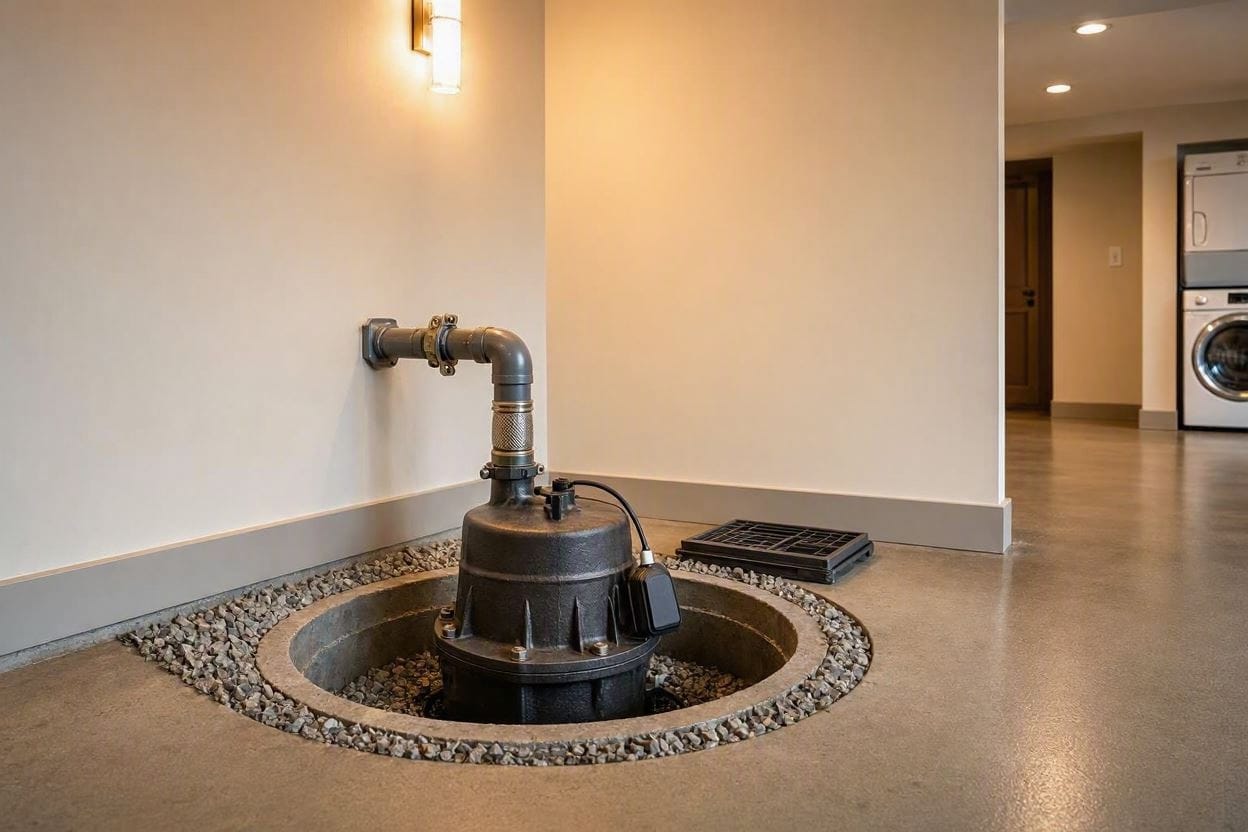
A pedestal pump features a motor that sits on a tall shaft, resting entirely above the floor of the basement while a small impeller reaches down into the water pit. Because the motor operates in the open air, the high-frequency mechanical whine is broadcast directly into the room. Even worse, the motor vibrates intensely, transferring structure-borne impact noise straight into your concrete slab.
2. Submersible Sump Pumps (The Quiet Solution)
The Federal Emergency Management Agency (FEMA) and professional plumbers highly recommend submersible pumps. With this design, the entire motor is enclosed in a waterproof casing and dropped to the very bottom of the sump pit, completely submerged in water.
From an acoustic standpoint, this is brilliant. As we discuss in our breakdown of the 4 Principles of Soundproofing, the surrounding water acts as massive acoustic damping. The water absorbs the sound waves and engine heat, meaning a high-quality submersible pump operates at a barely detectable low-frequency hum.
1. Zoeller M53 Mighty-Mate (The Gold Standard)
If you ask any master plumber what submersible pump they install in their own home, the answer is almost always the Zoeller M53. When it comes to killing mechanical vibration, mass is your best friend. The M53 features a massive, heavy-duty cast-iron switch case, motor, and pump housing.
Because cast iron is incredibly dense, it does not rattle or resonate like cheap plastic pumps. When it kicks on under the water, the acoustic mass of the iron absorbs the kinetic energy of the 1/3 HP motor. The result is a pump that drains up to 2,680 gallons per hour with a muffled, ultra-quiet purr that you will rarely hear from the floor above.
The Pros
- Dense cast-iron construction naturally deadens motor vibration.
- Operates fully submerged, utilizing water as an acoustic blanket.
- Legendary reliability; these pumps often last over 10-15 years.
The Cons
- At 21 pounds, it is very heavy to maneuver into the pit.
- The mechanical float switch can make a very faint “click” when activated.
2. Liberty Pumps 287 (The Premium Pick)
If you have a deeper basement or experience heavy water flow during spring storms, you need a pump that can move water aggressively without sounding like a jet engine. The Liberty Pumps 287 steps up to a 1/2 HP motor, capable of pushing over 4,000 gallons per hour, while remaining whisper-quiet.
Its secret is its “UniBody” casting. Many standard pumps are bolted together in two or three pieces, and those metal joints vibrate and chatter as the motor runs. The Liberty 287 is cast as one solid, seamless piece of iron. No joints means no structural rattling, resulting in a buttery-smooth, incredibly quiet operation.
The Pros
- UniBody cast-iron housing eliminates joint vibration and chatter.
- Features a specialized V-Slice cutter to prevent debris jams.
- Massive 1/2 HP power while remaining astonishingly quiet under load.
The Cons
- Premium commercial-grade engineering comes with a higher price tag.
- May be overkill for small, shallow sump pits.
3. Wayne CDU980E (The High-Capacity Pick)
For homeowners who want maximum flow rate and modern engineering, the Wayne CDU980E is an acoustic marvel. Instead of a traditional oil-filled motor, it uses a high-efficiency, oil-free 3/4 HP motor that operates so smoothly you often have to look at the water moving to know it is on.
It utilizes a hybrid acoustic construction: a heavy cast-iron base for stability and structural damping, paired with a sleek stainless steel housing. It is specifically marketed for its quiet operation, making it an excellent choice for sump pits located directly beneath living spaces or basement bedrooms.
The Pros
- Moves an incredible 4,600 gallons per hour with minimal acoustic output.
- Stainless steel housing is completely rust-proof.
- Top-suction design prevents the pump from sucking up noisy gravel from the bottom of the pit.
The Cons
- The mechanical float switch can occasionally get caught on the side of narrow pits.
- Stainless steel doesn’t have quite the same mass as solid cast iron for extreme vibration damping.
The Ultimate Trick: Eliminate The “Water Hammer” Clunk
Even if you install the quietest submersible pump in the world, you might still hear a violent, echoing “THUD” every time the pump turns off. This is not the pump itself; it is a phenomenon known as Water Hammer.
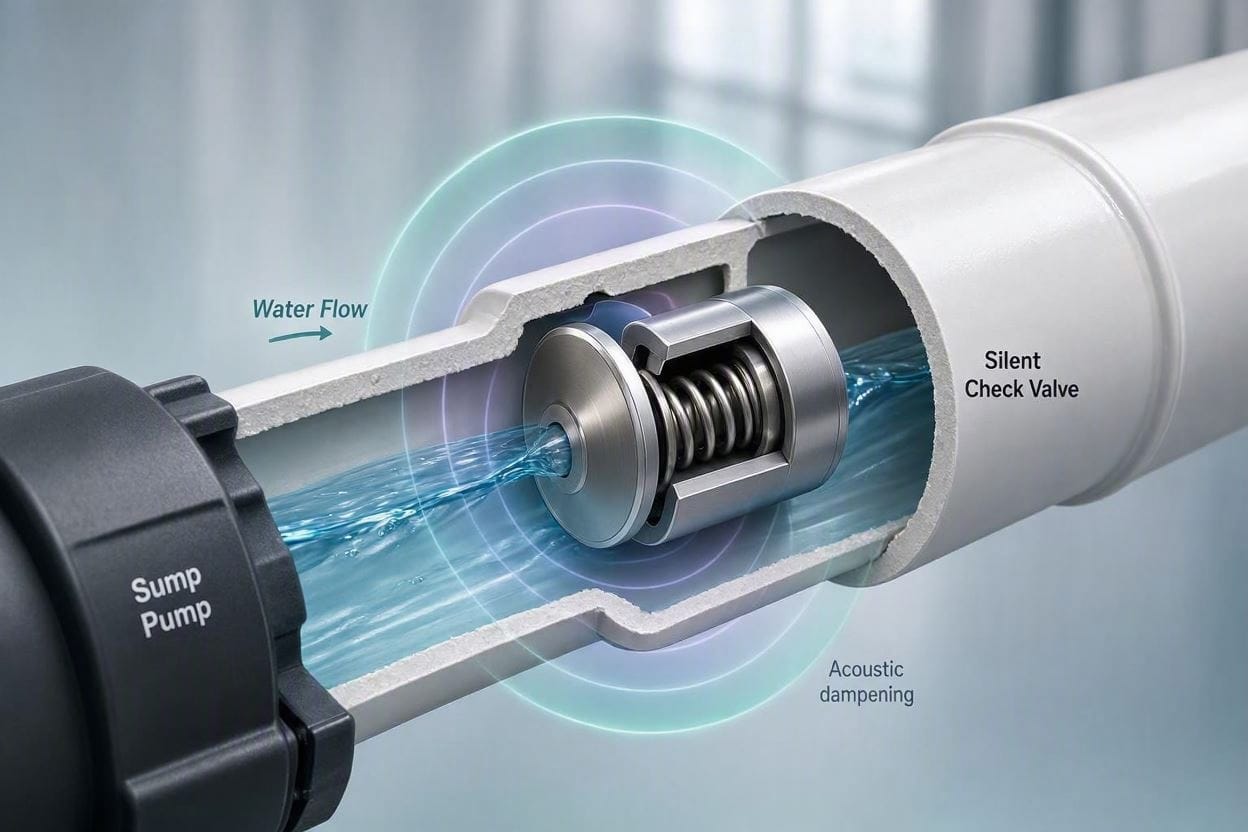
When the pump pushes a column of water up the PVC pipe and finally shuts off, gravity instantly pulls all that heavy water back down. A standard “flapper” check valve snaps shut violently under the weight of the water, sending a massive acoustic shockwave straight into your floor joists.
The Fix: Install a Silent Check Valve
To truly soundproof your sump pump, you must replace your standard flapper valve with a Silent Check Valve (like the Campbell Quiet Check Valve). These valves use a spring-loaded chamber. As the water pressure decreases, the spring smoothly and softly closes the valve before gravity can pull the water down.
The result? No slamming, no thudding, and no waking up the house. By combining a cast-iron submersible pump with a silent check valve, your finished basement will remain perfectly dry and blissfully quiet.

Ememobong is the lead researcher and editor at Quiet Dwelling. As a professional technical writer, he specializes in breaking down complex acoustic engineering concepts into simple, actionable steps. His goal is to help people build distraction-free environments for better sleep and deep work.