
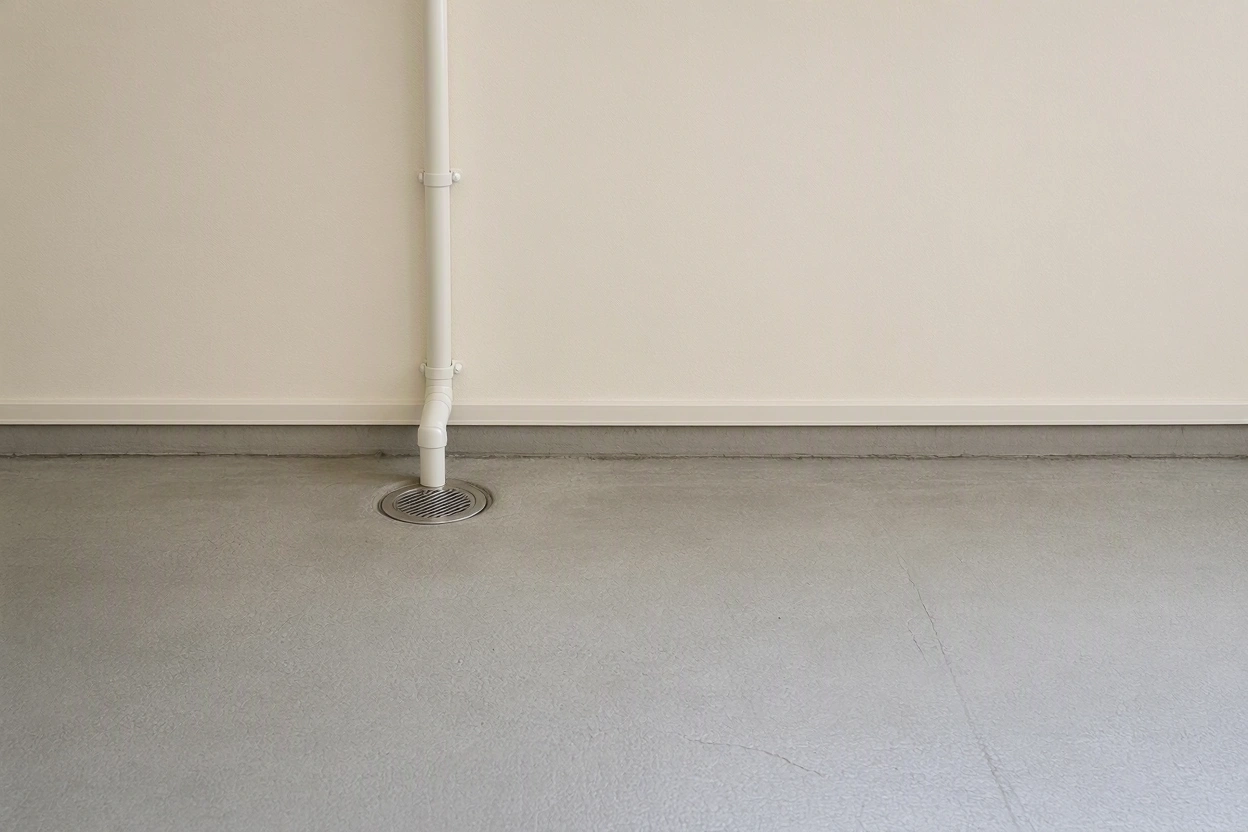
Nobody installs a sump pump for the pleasure of listening to it. You install one so that a wet spring doesn’t turn your basement into a pond, and you accept that a mechanical device sitting in a hole in your floor is going to make some noise.
What you don’t expect is that a pump which runs for maybe a few minutes an hour becomes the loudest thing in the house at two in the morning. Or that the clunk as it shuts off feels like it goes through your ribs. Or that the pump which is meant to protect your home turns into the reason you can’t sleep above it.
Sump pump noise is real, it is common, and almost all of it comes from a specific and fixable set of sources. This is the guide to finding yours.
Why Sump Pumps Sound Worse Than They Are
Three factors make a sump pump more disruptive than its raw noise level suggests.
It sits in the floor. A sump pit is a hole cast into a concrete slab, and a pump installed inside it is mechanically coupled to the single largest, stiffest, most efficient sound radiator in your house. This is a not a small detail. Vibrating a concrete slab is very much like vibrating a drum head the size of a whole floor — and that is precisely why a pump rated at a modest decibel level can be audible throughout the building.
It runs in bursts, on a float trigger. You cannot predict when it will start, so you cannot tune it out. Intermittent noise you cannot anticipate is consistently rated as more annoying than steady noise at the same level — which is why a pump that runs for two minutes every hour is more irritating than a fridge humming continuously.
Its noise is low frequency. Motor rumble and the thud of a check valve closing sit heavily in the lower bands, where sound behaves very differently. Low-frequency vibration travels through solid structure rather than air, which is why the pump can be quieter outside the basement than above it. If that mechanism is unfamiliar, our guide to how to block low frequency noise explains why bass is a structural problem rather than a wall-thickness problem.
This is structurally transmitted noise — the same phenomenon we cover in what is flanking noise, because vibration entering the building frame bypasses every air gap you might otherwise rely on.
The Four Sources Of Sump Pump Noise
Diagnose by sound. Each one points to a different fix.
1. The motor — the constant rumble
A steady, low rumble while the pump is running is motor vibration, transmitted through the pump housing into its feet, into the pit floor, and out into the slab. This is the dominant complaint, and it is largely a coupling problem rather than a motor problem. Most sump pumps are genuinely not very loud devices; they are very good at transferring what noise they make.
2. The discharge pipe — the hum and the drum
The vertical discharge pipe is an excellent conductor of vibration and, if it contacts a wall, a joist or a floor above, it becomes a speaking tube into the rest of the house. Rigid PVC in hard contact with structure transmits motor vibration directly and often amplifies it, because the pipe itself can resonate at the motor’s frequency.
This is frequently the reason a pump is far louder in the room above than in the basement. The sound is not coming through the air; it is travelling up the pipe and radiating from wherever the pipe touches the building.
3. The check valve — the clunk
Every sump pump has a check valve to stop water flowing back into the pit when the pump stops. When the pump shuts off, that valve slams shut under the weight of the water column above it, producing a hard clunk or thud that is very often the single most annoying sound in the whole installation.
This is impact noise, not continuous noise. It is also the one that travels furthest through the structure, because a sharp transient carries across a wider frequency range and excites building surfaces more effectively than a smooth tone.
4. The pit and the water — the splash and the gurgle
Water entering the pit, churning around the impeller, and draining back down the discharge when the pump stops all produce sound. Gurgling and splashing inside a concrete pit can be surprisingly loud because the pit acts as a small enclosure with hard, reflective walls — the same acoustic problem we break down in echo vs. reverberation.
What Usually Does Not Work
Cross these off before spending anything.
- Putting a lid on the pit and calling it done. A lid helps a little with airborne noise, but almost all sump pump noise is structural, and a lid does nothing for vibration travelling through the slab. It also matters how the lid fits — a loose, rattling cover adds a new noise of its own.
- Wrapping the pump in insulation or foam. The pump sits in water. Wrapping it traps debris and moisture, risks interfering with the float, and does very little, because the vibration leaves through the base rather than the air.
- Foam panels on the basement walls. Thin acoustic foam absorbs mid and high frequencies. Your pump’s output is low frequency and passes straight through. This is the absorption-versus-blocking confusion we unpack in soundproofing vs. sound absorption.
- Setting the pump on a soft sponge or a block of foam. Soft material compresses under load, lets the pump rock and shift, and can introduce new vibration. It also degrades in a wet pit. Isolation needs a firm material rated for the load.
- Removing the check valve to stop the clunk. You will get water flowing back into the pit every cycle, causing the pump to restart more often — more noise overall, and a shorter pump life. Never do this.
The Best Order To Fix Sump Pump Noise
Work down. The first three steps address the overwhelming majority of real complaints, and none of them requires replacing the pump.
Step 1 — Find out what is actually making the noise
Run the pump deliberately — lift the float by hand — and listen from three places: standing at the pit, in the room directly above, and at the pipe where it leaves the basement. Where the noise is loudest tells you the pathway.
- Loudest at the pit and fading with height → motor vibration into the slab (step 2)
- Loudest above and along the pipe run → discharge pipe coupling (step 3)
- A single hard crack at shutdown → check valve (step 4)
While you are there, check the water: a pump running with a partly blocked inlet or in gritty water can be genuinely loud because the impeller is working harder than it should. Clearing the pit of sediment is free and sometimes solves the whole complaint.
Step 2 — Decouple the pump from the slab
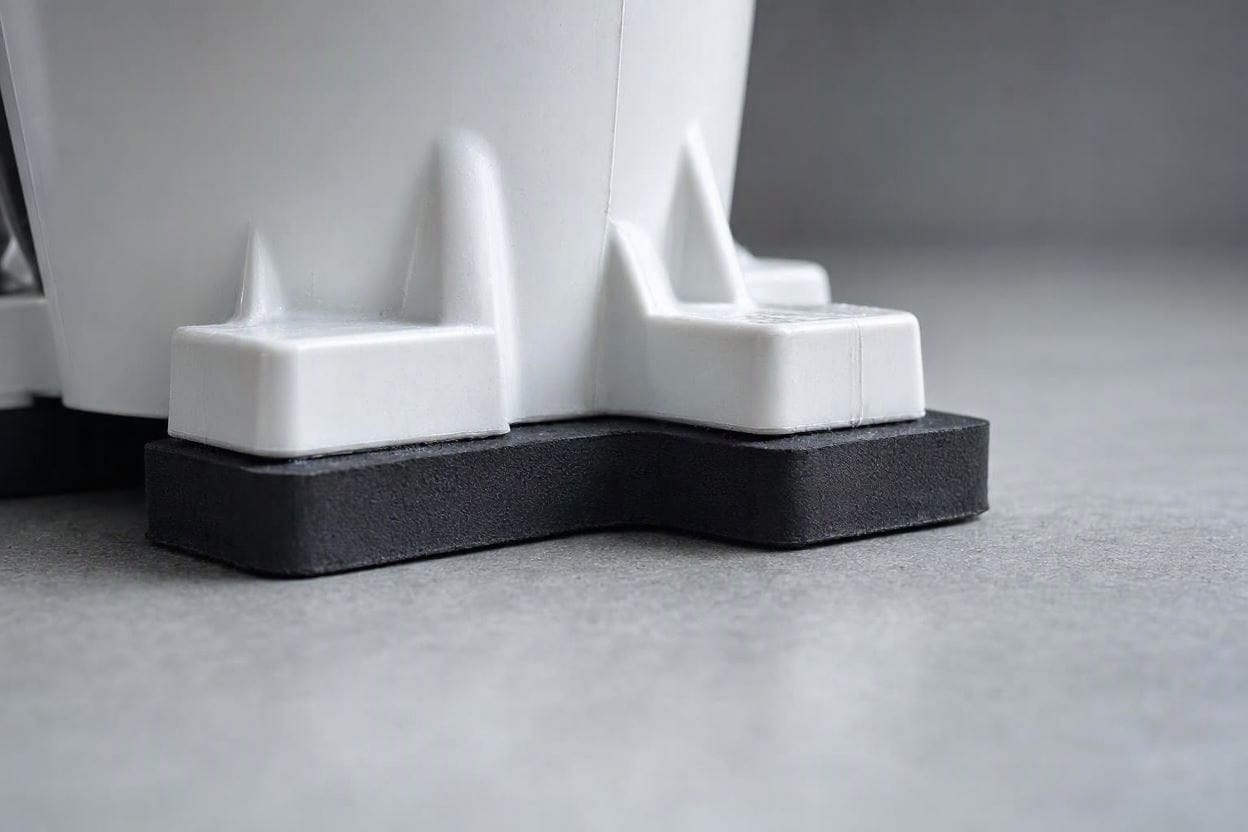
The highest-value fix, and the one that addresses the concrete-slab problem directly. Set the pump on a firm, dense rubber anti-vibration pad rated for the pump’s weight — not a sponge, not craft foam. The goal is to interrupt the mechanical path between the motor housing and the slab while keeping the pump stable and level. It is the same reason a hollow core door rattles while a solid one stays quiet — the mass and damping matter as much as the barrier.
If the pump hangs from a pipe rather than standing in the pit, isolation works differently: the mounting bracket is your coupling point, and a flexible connector between the pump and the rigid pipework is the equivalent fix.
This is the same decoupling principle that governs effective soundproofing everywhere. Mass alone does not stop structure-borne vibration; you have to break the path. Our explainer on the 4 principles of soundproofing covers how decoupling sits alongside mass and damping, and Green Glue soundproofing shows the damping half — converting vibration into a small amount of heat rather than letting it travel.
Step 3 — Break the pipe’s contact with the structure
Trace the discharge pipe from the pump to where it exits the house. Anywhere it touches a joist, a stud, a wall or a floor, it is transmitting. Fixes, in order of effort:
- Isolate the contact points. Where the pipe passes through a floor or wall, use a proper pipe isolator, rubber grommet or acoustic sealant rather than a hard, direct contact.
- Add a flexible section. A short length of flexible coupling between the pump and the rigid discharge pipe absorbs vibration before it enters the pipework. This is the single most effective change for a pump that is loud elsewhere in the house.
- Support it properly. A pipe that is unsupported over a long run will sway and drum. Add cushioned clips at regular intervals so the pipe is held firmly but never hard against structure.
- Check the exit. Where the pipe discharges outside, make sure it is not resting against the exterior wall or a downpipe, which radiates the noise outward.
Step 4 — Soften the check valve clunk
You cannot eliminate the check valve, but you can substantially reduce the impact. Options:
- Fit a quiet or spring-loaded check valve designed to close more gradually than a standard swing valve. This is the cheapest targeted fix for the clunk specifically.
- Ensure the valve is correctly oriented and not installed horizontally where it can slam harder.
- Add a water hammer arrestor near the valve if the pipe is long. This absorbs the pressure transient rather than letting it travel into the structure as a bang.
- Isolate the valve body itself from rigid contact with walls and joists, the same way you would the pipe.
Step 5 — Deal with airborne noise in the basement
Only after the structural fixes. At this point you are managing water noise and residual air noise around the pit — a properly fitted, non-rattling lid with a soft gasket, and soft furnishings or absorption in the basement room if you use it. If the sump sits under a bedroom floor, this is a floor-and-ceiling problem at that point, and the standard decoupling, mass and damping combination applies.
The health case for solving this rather than living with it is well established — the World Health Organization’s guidance on environmental noise identifies sleep disturbance as one of the documented effects of chronic noise exposure, alongside cardiovascular and cognitive impacts. World Health Organization
Step 6 — If the room above is still affected
Where the pump is under a habitable room, the practical last layer is often masking rather than elimination, especially at night. A steady broadband sound raises the noise floor so the pump’s intermittent rumble stops pulling your attention. Our comparison of pink noise vs. white noise explains which colour suits a low-frequency rumble best, and white, pink and brown noise explained goes deeper on the physics. If you share the room with a light sleeper, a quiet bedroom fan doubles as a mask and a comfort source.
If You Are Buying A Pump
Buy for the noise spec, not just the flow rate. Pump ratings vary more than most buyers realise, and a pump sized correctly for your pit will run shorter cycles at lower effort than an oversized one that surges.
Two installation decisions matter more than the model. Choose the quietest mounting you can — a submersible pump sitting on an isolated base in the pit is far quieter in practice than one hard-mounted or hanging rigidly from pipework. And plan the pipe route before you drill: minimising hard contact with joists and floors, and including a flexible section at the pump, is a decision that is free at installation and expensive to retrofit.
The Honest Caveat
A sump pump cannot be made silent. It moves water with a spinning impeller, it triggers on a float, and it sits in the one place in your house most efficient at carrying vibration into the structure. What you can realistically achieve is a pump you stop noticing — and in most homes, proper isolation under the pump plus a flexible section in the pipework is the difference between a nuisance and a non-issue.
And if your pump is running far more often than it used to, or running continuously, that is a drainage problem rather than an acoustic one. More frequent running means more noise, and it is usually the first sign that something else needs attention. Fix that before you spend anything on sound.
Frequently Asked Questions
Why is My Sump Pump So Loud?
Almost always because of vibration travelling through structure rather than sound travelling through air. The pump sits in a pit cast into a concrete slab, which is an extremely efficient radiator rather than a sound absorber. The pump itself is usually modest, but its vibration is coupled directly into a large, stiff surface and into any rigid pipework it touches. Isolating the pump and breaking the pipe’s contact with the building fixes most complaints.
What is the Loud Clunk When My Sump Pump Stops?
That is the check valve closing. When the pump switches off, the water column in the discharge pipe falls back and slams the valve shut, producing a hard impact noise. It travels through the structure further than the continuous rumble does, because a sharp transient excites building surfaces across a wide frequency range. Fitting a quiet or spring-loaded check valve and isolating the valve body from rigid contact are the standard fixes.
Can I Put a Rubber Pad Under My Sump Pump?
Yes, if it is a firm, dense rubber anti-vibration pad rated for the pump’s weight — not a soft sponge or craft foam. Soft material compresses under load, lets the pump rock and shift, and can make vibration worse rather than better, and it degrades in a wet pit. The point of the pad is to interrupt the mechanical path into the slab while keeping the pump stable and level.
Will a Lid on the Sump Pit Reduce the Noise?
A little, and only for airborne noise. The vast majority of sump pump noise is structural vibration passing into the slab and up the pipework, which a lid does nothing to address. A lid is still worth having for safety, odour and evaporation control — but fit it properly with a soft gasket, because a loose cover that rattles adds a new noise of its own.
Why Can I Hear My Sump Pump More Upstairs than in the Basement?
Because the sound is travelling through the building, not the air. The discharge pipe acts as a speaking tube: motor vibration enters the rigid pipe and radiates from wherever it touches a joist, a wall or a floor above. A flexible coupling between the pump and the rigid pipework, plus cushioned clips instead of hard contact, is the standard fix for this specific pattern.
Can I Remove the Check Valve to Stop the Clunking?
No. Without a check valve, water drains back into the pit after every cycle, so the pump has to restart more often than it should. That means more running noise overall, not less, and a considerably shorter pump life. If the clunk is the problem, fit a quiet or spring-loaded check valve or add a water hammer arrestor instead.
Why is My Sump Pump Running More Often than it Used to?
That is a drainage or water-table change rather than an acoustics problem — a blocked or undersized pit, failing drainage around the foundation, or a stuck float can all cause it. It is worth investigating on its own merits, because more frequent running means more noise and a shorter service life. A pump that runs continuously usually indicates a fault or a genuine water problem, not just a noisy pump.

Ememobong is the lead researcher and editor at Quiet Dwelling. As a professional technical writer, he specializes in breaking down complex acoustic engineering concepts into simple, actionable steps. His goal is to help people build distraction-free environments for better sleep and deep work.