If you have spent more than five minutes researching how to stop noise from traveling through your walls or ceilings, you have undoubtedly seen the same product recommended over and over again: Green Glue. But despite its massive popularity, green glue soundproofing is one of the most misunderstood concepts in DIY home construction.
The biggest misconception? People assume it is just a strong construction adhesive used to glue acoustic panels to a wall.
In reality, Green Glue is not an adhesive at all. It is a highly specialized, viscoelastic damping compound engineered to physically alter how sound waves travel through solid building materials. When used correctly, it is one of the single most cost-effective ways to drastically increase the acoustic performance of your home.
In this guide, we will break down the exact physics behind green glue soundproofing, explain how viscoelastic damping stops low-frequency bass, and show you the correct way to apply it to your drywall.
What is Green Glue Soundproofing?
Green Glue is a liquid, water-based, viscoelastic damping compound.
To understand what that means, we need to look at how a standard wall behaves. When a sound wave (like a loud voice or a barking dog) hits a rigid sheet of drywall, the acoustic energy forces the drywall to vibrate. That vibration travels straight through the wall studs and vibrates the drywall on the other side, turning the entire wall into a giant speaker.
To stop this, acoustic engineers use “damping”—one of the core four principles of soundproofing.
Damping is the process of deadening a structural vibration. Green Glue achieves this through its unique viscoelastic properties. When it cures, it remains permanently flexible and rubbery. It never dries into a hard, rigid shell like standard wood glue or construction adhesive.
How Does Green Glue Work? (The Physics of Shear Stress)
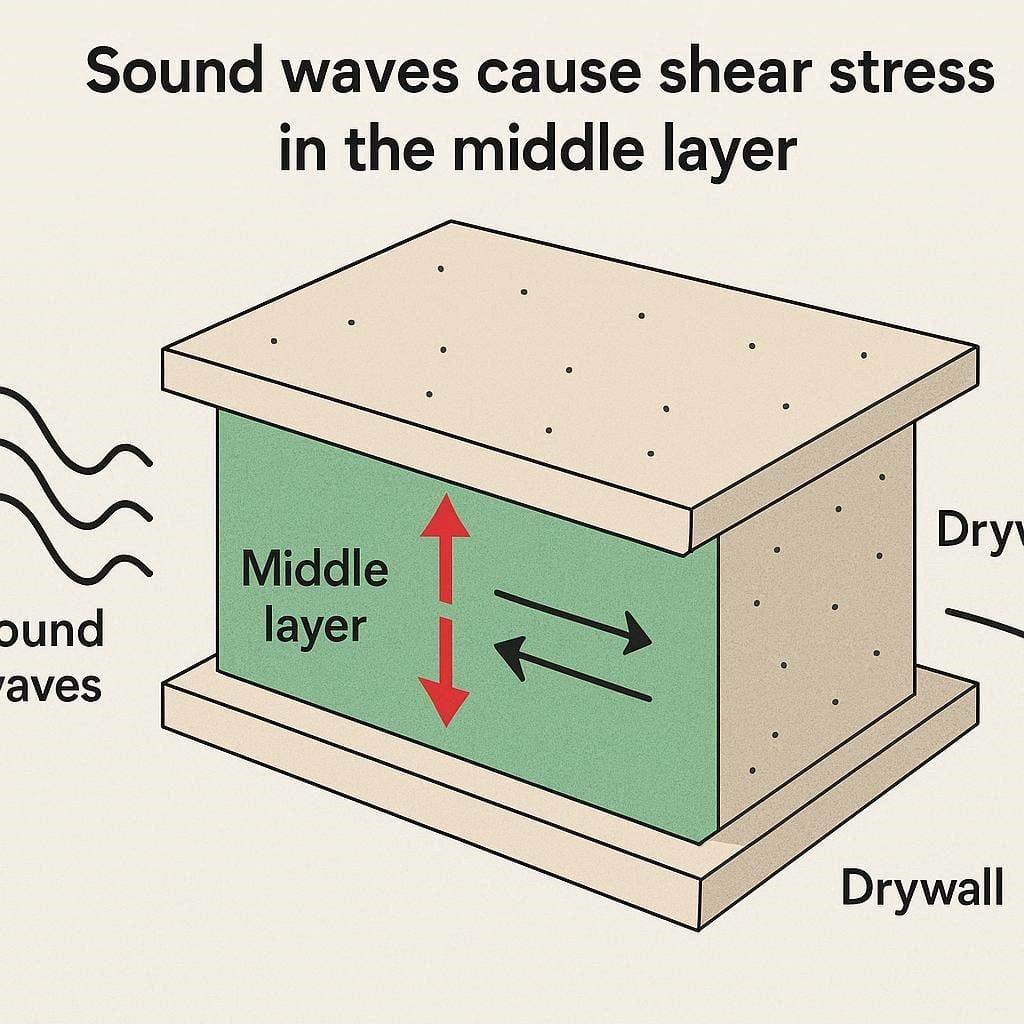
The magic of green glue soundproofing relies on a physical process called shear stress.
Green Glue is designed to be sandwiched tightly between two rigid, heavy layers of building material (almost always two sheets of 5/8-inch drywall). It does absolutely nothing if you just paint it on the outside of a wall.
Here is exactly what happens when a sound wave hits a Green Glue wall assembly:
- The massive sound wave strikes the first layer of drywall, causing it to vibrate and bend microscopically.
- Because the second layer of drywall is separated by the rubbery Green Glue, it does not bend at the exact same time or in the exact same direction.
- This creates microscopic friction. The two sheets of drywall slide against each other, pulling and shearing the flexible Green Glue sandwiched between them.
- The molecular friction inside the Green Glue instantly converts the kinetic sound vibration into trace amounts of thermal energy (heat).
By literally turning sound waves into microscopic heat, the vibration dies inside the wall cavity instead of passing into your bedroom. This process is highly documented in architectural acoustics and is recognized by the Acoustical Society of America as one of the most efficient ways to mitigate structural resonance.
Green Glue vs. Mass Loaded Vinyl (MLV)
Homeowners often debate whether to use green glue soundproofing or Mass Loaded Vinyl (MLV). Both are incredible materials, but they serve different primary functions.
| Feature | Green Glue (Damping Compound) | Mass Loaded Vinyl (MLV) |
|---|---|---|
| Primary Physics Principle | Damping (Converts vibration to heat) | Limp Mass (Adds heavy dead-weight) |
| Best Used Against | Low-frequency bass, thuds, and wall resonance | Airborne noise (voices, TVs, traffic) |
| Installation Method | Sandwiched between two sheets of drywall | Nailed directly to wall studs before drywall |
| Cost Efficiency | Highly cost-effective per square foot | Significantly more expensive |
For the ultimate, laboratory-grade wall, professionals often use both. However, if you are on a budget and already plan to use a double layer of drywall, Green Glue offers a massive STC (Sound Transmission Class) rating boost for a fraction of the cost of MLV.
How to Apply Green Glue Correctly
Applying green glue soundproofing is incredibly easy, making it a favorite for DIY homeowners. However, failing to follow the specific application rules will ruin the acoustic effect.
The Golden Rules of Application:
- It is NOT an Adhesive: Green Glue has virtually zero holding power. You cannot use it to glue drywall to the wall. You must physically screw the second layer of drywall into the wall studs, compressing the Green Glue sandwich.
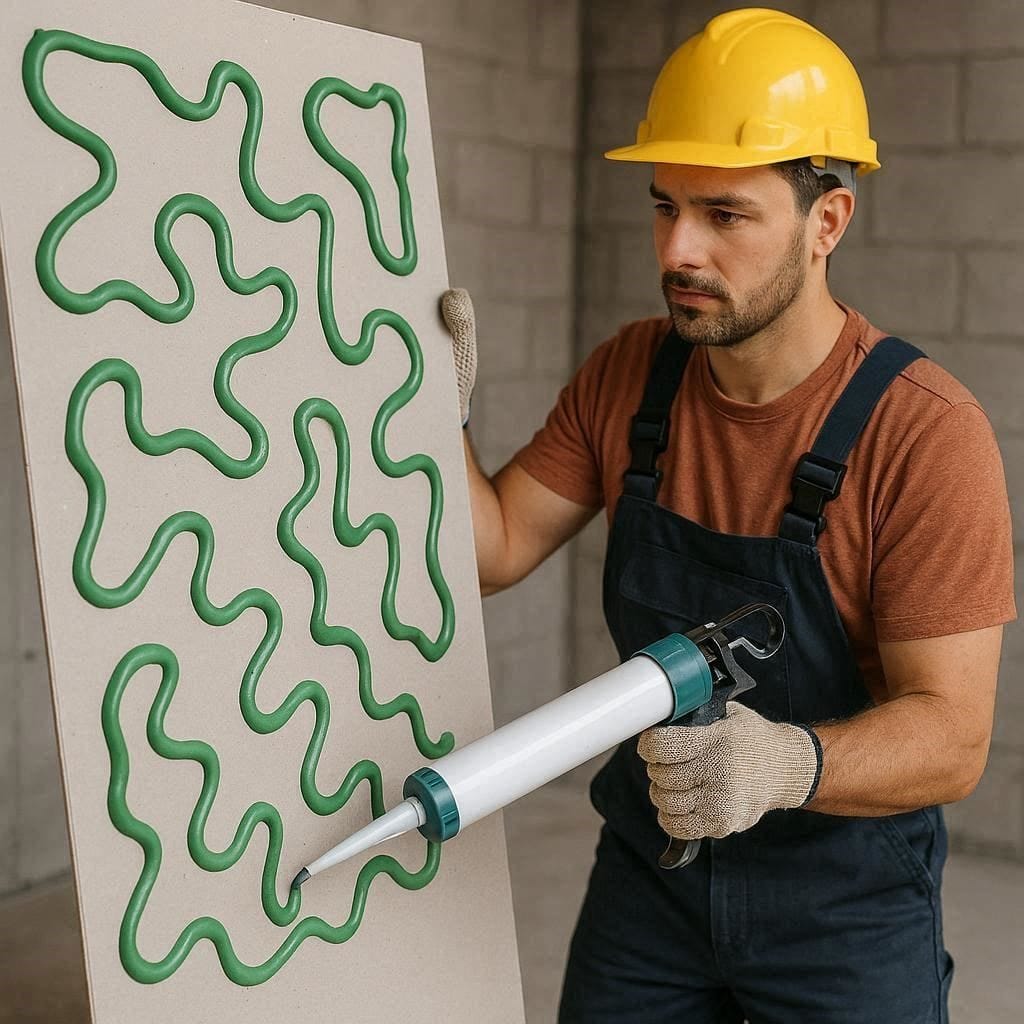
- The “Squiggle” Pattern: Do not try to trowel it flat like cement. Apply it using a standard large caulking gun in a random, chaotic squiggle pattern across the entire back of the drywall sheet. When you press the drywall to the wall, the squiggles will compress and spread out perfectly.
- Coverage Ratios: The manufacturer recommends using exactly two tubes (28 oz each) per standard 4×8 foot sheet of drywall. Using less than this will drastically reduce the damping effect.
- The Cure Time: Because it is water-based, it takes time to cure. You will not hear the full soundproofing effect immediately. It takes roughly 30 days for the compound to fully cure and reach its peak acoustic damping performance.
Can Green Glue Stop Flanking Noise?
While green glue soundproofing is elite at deadening the direct vibration of a wall, it cannot solve structural issues entirely on its own.
If you have an un-decoupled ceiling or an open air gap under your door, sound waves will simply bypass the treated wall and enter your room through those structural loopholes. This is known as flanking transmission. To ensure your investment actually works, you must pair your damping compound with proper acoustic sealants and decoupling methods. Read our comprehensive guide on diagnosing and stopping flanking noise to learn more.
Frequently Asked Questions (FAQ)
Can I Use Standard Silicone Caulk or Construction Adhesive Instead Of Green Glue?
No. Standard construction adhesives (like Liquid Nails) dry incredibly hard and rigid, which creates a solid bridge that transmits sound perfectly. Standard silicone caulk remains flexible, but it lacks the highly specific viscoelastic properties required to create shear-stress friction. Using anything other than a dedicated damping compound will negate the soundproofing effort entirely.
Do I Have to Tear Down My Existing Walls to Use It?
No! That is the best part of green glue soundproofing. You can leave your existing drywall exactly as it is. Simply apply the compound to the back of a new sheet of drywall, press it directly over your existing wall, and screw it into the studs. Make sure to seal the perimeter gaps with acoustic caulk.
Does Green Glue Work on Floors and Ceilings?
Yes. It is highly effective when sandwiched between layers of rigid subflooring (like OSB or plywood) to dampen impact noise from footsteps, or between layers of ceiling drywall to stop airborne noise from traveling vertically.

Ememobong is the lead researcher and editor at Quiet Dwelling. As a professional technical writer, he specializes in breaking down complex acoustic engineering concepts into simple, actionable steps. His goal is to help people build distraction-free environments for better sleep and deep work.