
Every fan in your home makes noise for the same three reasons, and they are worth separating because they respond to completely different fixes. One comes from the motor. One comes from the blade passing through the air. And one is not really noise from the fan at all — it is vibration the fan has handed to whatever it is attached to.
Most buying advice conflates these. A product is described as “whisper quiet” on the strength of one number, and the number usually describes the motor at its lowest setting. That tells you almost nothing about the other two sources, which in many homes are the ones you actually hear.
This is the reference article behind all our fan guides — window, ceiling, desk, tower and bathroom exhaust. Read it once and you will be able to judge any fan on the specification sheet, whatever type it is.
Source One: The Motor
The single most consequential difference between a quiet fan and a loud one is the type of motor driving it, and there are only two you are likely to encounter.
AC motors — the traditional design
An alternating-current motor runs directly from your mains supply. Current flows through coils in alternating directions at the supply frequency — 50 Hz in the UK and Europe, 60 Hz in North America — and the resulting magnetic field turns the rotor.
The acoustic problem is built into that description. The motor is being driven at a fixed frequency, which means it produces a tonal hum at that frequency and its harmonics. It is not a broadband noise; it is a specific note, sitting in the bottom end of the range where human hearing is relatively insensitive in absolute terms but highly sensitive to annoyance. A steady 50 Hz hum is one of the most irritating sounds a home appliance can produce, and it is exactly what a cheap AC fan delivers.
AC motors are also inefficient at low speeds. Where a fan needs to run slowly for quiet operation, an AC motor typically cannot — which is why cheap fans tend to have a low setting that is still fairly loud.
DC and brushless motors — the modern answer
A brushless DC motor inverts the mains supply to DC and then switches it electronically through the coils at whatever frequency the controller chooses. That is the crucial difference: the drive frequency is variable rather than fixed. The controller can run the motor slowly and smoothly, or fast, without the motor being locked to a single tonal hum.
The mechanical difference matters too. A brushless motor has no brushes rubbing against a commutator, which removes a whole source of friction, wear and broadband noise. Combined with better bearings and smoother switching, the practical result is a fan that can run at genuinely low speed without the characteristic mains hum.
This is why every quiet fan guide — whatever the fan type — ends up recommending DC or brushless designs. It is not marketing; it is the difference between a fixed-frequency hum and a motor you can actually slow down.
Source Two: Blade Geometry And Airflow
The second source is the noise of the air itself, and this is where most buyers are misled by the phrase “more blades is better” or “bigger is better.” Neither is quite right.
Turbulence is the noise
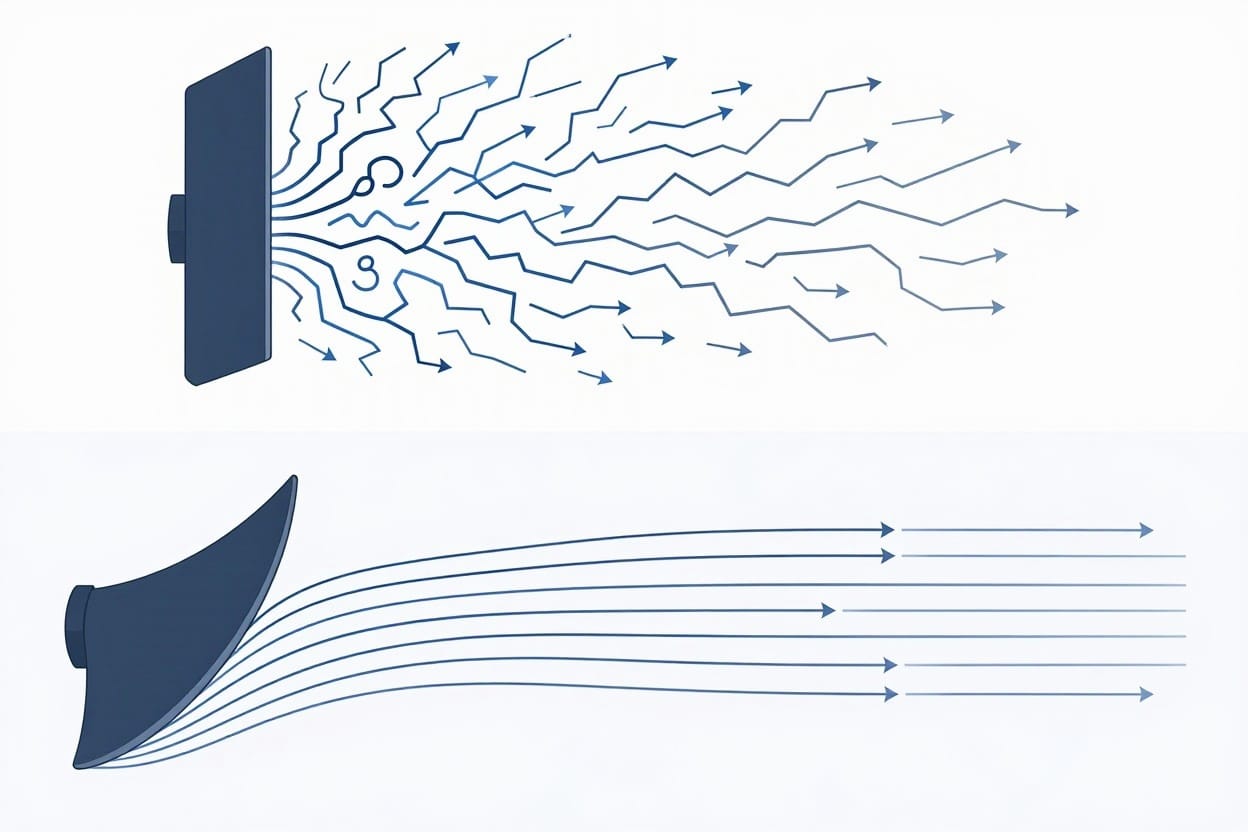
Moving air makes noise when it becomes turbulent — when smooth laminar flow breaks up into chaotic eddies. A fan blade chopping through the air at speed leaves a wake of turbulence behind it, and that turbulent air is what you hear as a rushing, hissing sound.
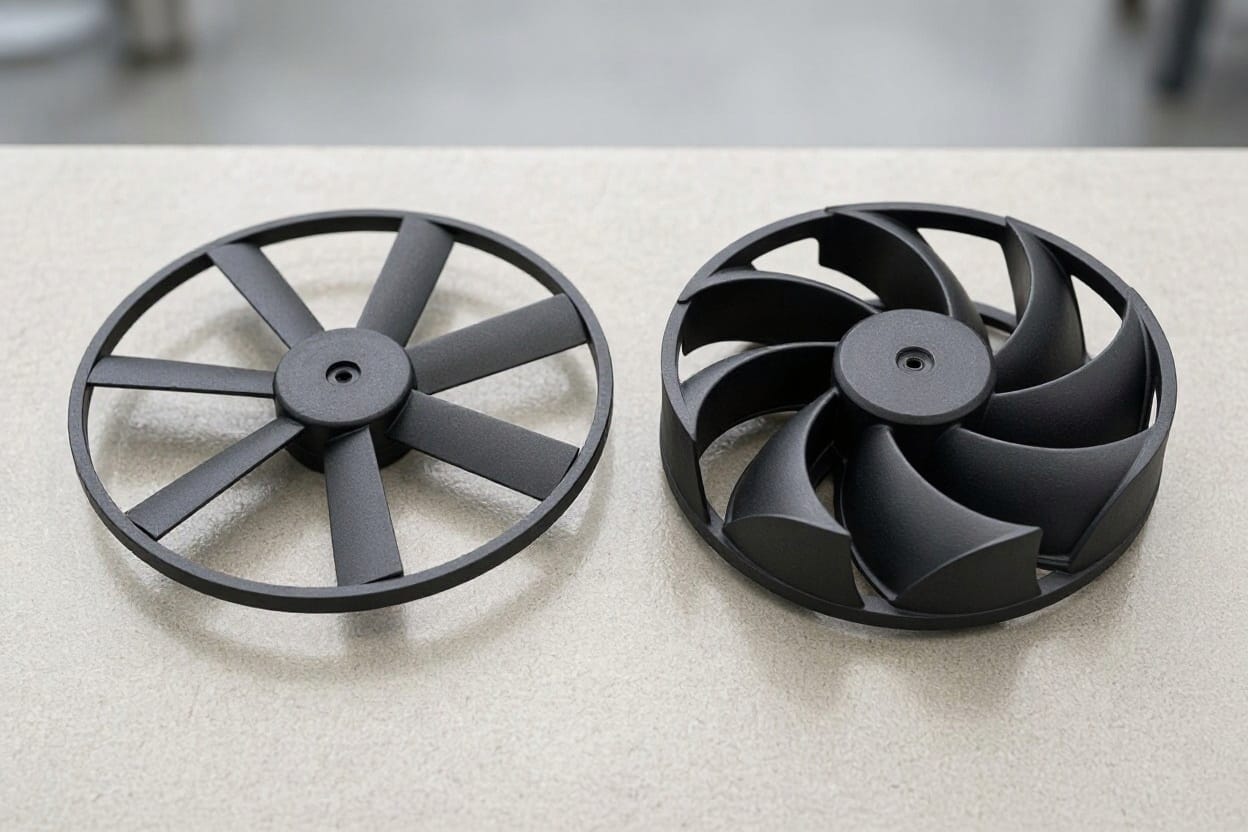
The shape of the blade determines how much turbulence there is. A flat, thin blade driven at speed produces a great deal of it. A deeply scooped, aerodynamically profiled blade grabs air more gently and pushes it in a tighter, smoother column, producing the same airflow with much less chaotic mixing.
This is why two fans rated at the same airflow can sound completely different. One is moving its air smoothly; the other is thrashing it.
Fan diameter versus rotational speed
There is a straightforward physical relationship here worth holding onto: to move a given volume of air, a small fan must spin faster than a large one, and faster fans are louder.
Airflow scales roughly with the swept area of the blades, which scales with the square of the diameter. A larger fan sweeps far more air per revolution, so it can turn slowly and still deliver the same throughput as a small fan spinning hard. Since noise rises steeply with rotational speed, the larger, slower fan wins every time.
That single principle explains a lot of everyday experience. It is why a large ceiling fan moving air gently is far more restful than a small desk fan at full tilt. It is why tower fans — which are tall and narrow by design, with small impellers — have to work harder than a wide pedestal fan for the same airflow. And it is why, in any fan roundup, a physically larger model running slow will usually beat a compact one running fast.
Blade count and pitch
More blades do not automatically mean quieter. What matters is the balance between pitch, blade count and rotational speed.
- Fewer blades, deeper pitch — each blade grabs more air, so the fan can turn slowly. This is the design behind the best quiet fans.
- More blades, shallower pitch — smoother airflow per blade but often requiring higher speed. Common in cheap multi-blade designs.
- Cross-flow (cylindrical) impellers — a drum-shaped wheel inside a housing, used in tower fans and some window models. Produces a wide, even sheet of air rather than a jet, and can be very smooth if the housing is well-designed, but the housing itself adds turbulence if it is not.
The takeaway is not that one configuration is always better — it is that a well-designed slow fan beats a poorly-designed fast one, and that “bladeless” designs are no exception. A bladeless fan still contains a high-speed impeller hidden in its base; it is simply enclosed. Some people find the resulting whine more unpleasant than a conventional fan’s hum, for the reasons set out below.
Source Three: What The Fan Is Attached To
This is the source most people never consider, and in many homes it is the loudest of the three. It is also not really a property of the fan at all.
Every fan vibrates. Those vibrations leave the machine through its base or its mounting points and enter whatever it is sitting on or bolted to. If that surface is rigid, large and resonant — a desk, a window frame, a ceiling joist, a duct — it does not absorb the vibration, it radiates it as sound, and often amplifies it in the process.
This is the same mechanism we cover in what is flanking noise and how to block low frequency noise: a vibration travels through solid structure, bypassing the air entirely, and reappears as noise somewhere you did not expect. It is why a window fan can sound louder inside the bedroom than out, and why a ceiling fan’s hum seems to come from the ceiling itself rather than from the fan.
And it is why the type of noise matters so much. Vibration that has entered a structure is low-frequency by the time you hear it, and low frequencies are the hardest of all to treat afterwards. Soft materials barely touch them.
The fix, in principle
You cannot stop a fan vibrating, but you can stop that vibration reaching the structure. The technique is decoupling — breaking the mechanical path between the machine and the surface.
- Under a desk or portable fan: a firm, dense pad rather than a soft one. Soft foam compresses under load, lets the unit rock, and often makes transmission worse. Our guide to the 4 principles of soundproofing explains why decoupling works where softness fails, and Green Glue soundproofing covers the damping half of the equation — converting vibration into a tiny amount of heat rather than letting it travel.
- Under a window fan: the acoustic blocks and frame seals sold with better models do exactly this job. Filling the gap around the unit stops vibration reaching the frame and also closes the acoustic hole the fan would otherwise leave.
- Under a ceiling fan: a vibration-isolating downrod mount, or simply a properly balanced fan blade set, since imbalance is the usual source of wobble.
- On ducted fans: flexible connectors either side of the unit, and acoustic ducting on the run. A rigid duct is a speaking tube into the rest of the building.
Why Low-Frequency Hum Is Harder To Live With
It is worth understanding why the motor hum is so much more objectionable than the airflow rush, even when the two are measured at the same level.
Three reasons, and they compound.
It travels through structure. Low-frequency sound passes through walls, floors and furniture rather than being absorbed or reflected by them. A hum that has entered the building frame cannot be treated afterwards by anything you place in the room.
It is tonal and steady. A single frequency with no variation gives your brain nothing to habituate to. Broadband noise like a fan’s airflow rush blends into the background; a pure tone stands out of it. If you want the mechanism behind that, our explainer on white, pink and brown noise covers how frequency distribution changes the character of a sound.
The ear is insensitive to it but the body is not. Low frequencies sit where human hearing is least acute, which is why a hum can be described as quiet and still be unbearable. Perception and annoyance are not the same measurement.
The annoyance factor is not just subjective. The World Health Organization’s systematic review on environmental noise and sleep found that nocturnal noise exposure is more strongly associated with negative health effects than daytime exposure, and that continual low-level noise disrupts sleep even when it does not wake the sleeper — which is why a fan running all night is judged by a different standard to one running at midday. WHO Environmental Noise Guidelines: Systematic Review on Noise and Effects on Sleep
This is also why masking works so well against a hum, and why the colour of the masking sound matters. Pink and brown noise carry more low-frequency energy than white and therefore mask a deep tone more effectively — see pink noise vs white noise for which character suits which noise.
How To Judge A Fan On Its Specification
With the three sources in mind, here is what actually tells you whether a fan will be quiet.
- Motor type first. DC or brushless beats AC for quiet operation, in every fan category. If a listing does not state the motor type, assume AC.
- Diameter before airflow rating. A larger fan running slowly beats a smaller one running fast, even at identical airflow. Compare physical size, not just the flow number.
- Blade profile. Deeply curved and aerodynamically shaped beats flat and thin. Manufacturer photography often shows this clearly enough to judge.
- The noise figure and the setting it was measured at. A single decibel number is almost always the lowest speed. Ask what the fan sounds like at a speed that moves useful air.
- Mounting and isolation. Does the design include vibration isolation, frame seals or flexible couplings? If the fan is going on a resonant surface, this matters more than a decibel or two.
- Variable speed control. A fan with fine speed steps lets you find the setting where airflow is adequate and noise is acceptable. A fan with three crude settings does not.
The Honest Caveat
No fan is silent. Its entire purpose is to move air, and moving air makes noise — that is physics rather than a manufacturing shortfall. What varies enormously is which noise you get: a tonal mains hum you cannot escape, or a soft broadband rush that disappears into the background.
That is the practical goal. Not a fan you cannot hear, but a fan whose sound is the kind your brain stops attending to. Choosing a brushless motor, buying larger than you think you need, and decoupling it from whatever it stands on is how you get there.
Frequently Asked Questions
Why are Fans so Loud?
Three separate sources. The motor produces a tonal hum, and AC motors are locked to the mains frequency so it is a fixed note rather than a varied one. The blades produce airflow noise through turbulence, which depends on blade shape and rotational speed. And the fan’s vibration enters whatever it stands on or is bolted to, which then radiates it as sound — often the loudest of the three and not the fan’s fault at all.
Are DC Fans Quieter than AC Fans?
Yes, and it is the most significant single factor in fan noise. An AC motor is driven at the fixed mains frequency, so it hums at that note and cannot run smoothly at very low speed. A brushless DC motor has a variable drive frequency, no brushes, and can run slowly and smoothly — which is why every quiet fan recommendation ends up being a DC or brushless design.
Is a Bigger Fan Quieter than a Small One?
Generally yes, for the same airflow. Airflow scales with the swept area of the blades, so a larger fan moves far more air per revolution and can turn more slowly to achieve the same result. Noise rises steeply with rotational speed, so the larger, slower fan wins. This is why a large ceiling fan is gentler than a small desk fan at comparable output.
Are Bladeless Fans Quieter?
Not necessarily. A bladeless fan still contains a high-speed impeller inside its base — the blades are hidden, not eliminated. The airflow tends to be smooth, but the small, fast impeller can produce a higher-pitched whine that some people find more irritating than the lower hum of a conventional bladed fan.
Do More Blades Make a Fan Quieter?
Not on their own. What matters is the balance between blade count, blade pitch and rotational speed. Fewer blades with deeper pitch grab more air per revolution, letting the fan turn slowly, which is the usual route to quiet operation. More blades with shallow pitch often require higher speeds to move the same air.
Why Does My Fan Hum rather than Just Whoosh?
Because the hum is coming from the motor and the whoosh from the air. An AC motor produces a tonal note at the mains frequency and its harmonics — a steady hum with no variation, which the brain cannot habituate to. Airflow noise is broadband and blends into the background. If your fan hums, the motor is the source, and a DC or brushless model is the fix.
Why is My Fan Louder in one Room than Another?
Because much of the noise you hear is structure-borne rather than airborne. Vibration passing through a resonant surface — a hollow desk, a window frame, a ceiling joist, a rigid duct — radiates as sound elsewhere in the building. Move the same fan to a solid floor with a firm pad under it and it will often sound dramatically quieter, without the fan itself changing at all.
What is the Quietest Type of Fan?
It depends on the job rather than a single winner. A large DC ceiling fan is quietest in absolute terms because of its size and slow rotation. For a bedroom, a DC tower or pedestal fan with a cross-flow impeller is a good compromise. For a window, a sealed-chamber design with acoustic blocks is the quietest option. In every case, a brushless motor and adequate diameter matter more than the type.

Ememobong is the lead researcher and editor at Quiet Dwelling. As a professional technical writer, he specializes in breaking down complex acoustic engineering concepts into simple, actionable steps. His goal is to help people build distraction-free environments for better sleep and deep work.