
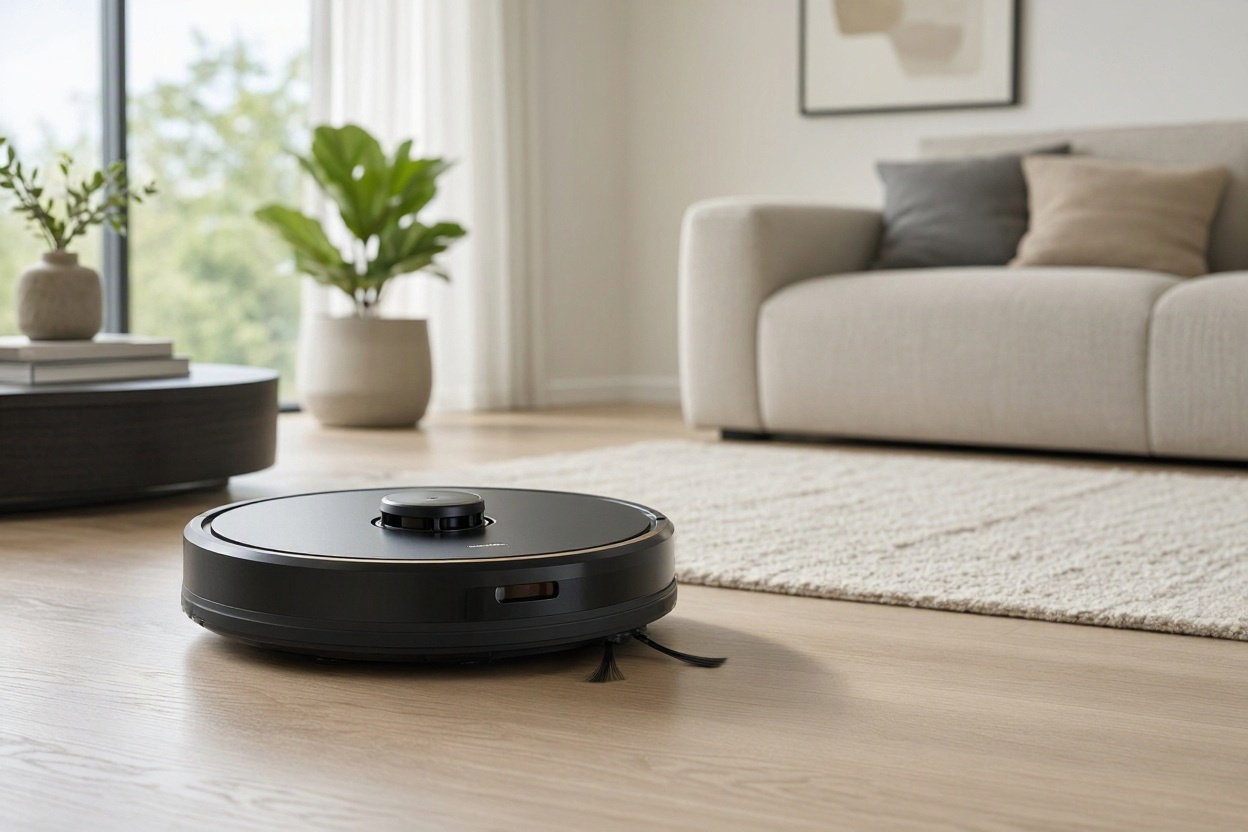
Robot vacuums are advertised as the appliance that quietly keeps your floors clean while you get on with your life. Then you switch one on and discover it sounds like a small aircraft taxiing across the living room.
The honest answer is that most robot vacuums are genuinely loud — comparable to a conventional upright vacuum or a loud hairdryer — and the marketing around quiet operation refers almost entirely to a specific low-power mode that cleans considerably less aggressively.
What makes this manageable rather than disappointing is that a robot vacuum has something no other loud appliance has: it decides when to run. Understanding that changes the entire problem.
Why Robot Vacuums Are Noisy
Three sources, and they dominate in this order.
The suction motor — the main event. A robot vacuum has to generate enough airflow to lift debris through a small intake, and it does that with a compact high-speed motor. Small, fast motors are inherently louder than large, slow ones, because moving a given volume of air requires more rotational speed from a smaller impeller. This is the same principle that explains why large slow fans are gentler than small fast ones.
The suction motor is the dominant noise source, and it is a constant, tonal whine rather than a broadband rush. That tonal quality is part of why it is more grating than its volume alone would suggest.
The brush bar and side brush — mechanical chatter. The main roller spins at high speed against the floor, and the rotating side brush flicks debris into the intake path. Both produce a mechanical rattle and a scraping sound, and both change character depending on the floor surface. On hard flooring this is a light brush against a hard surface; on carpet it is a deeper rasp as the roller digs into pile.
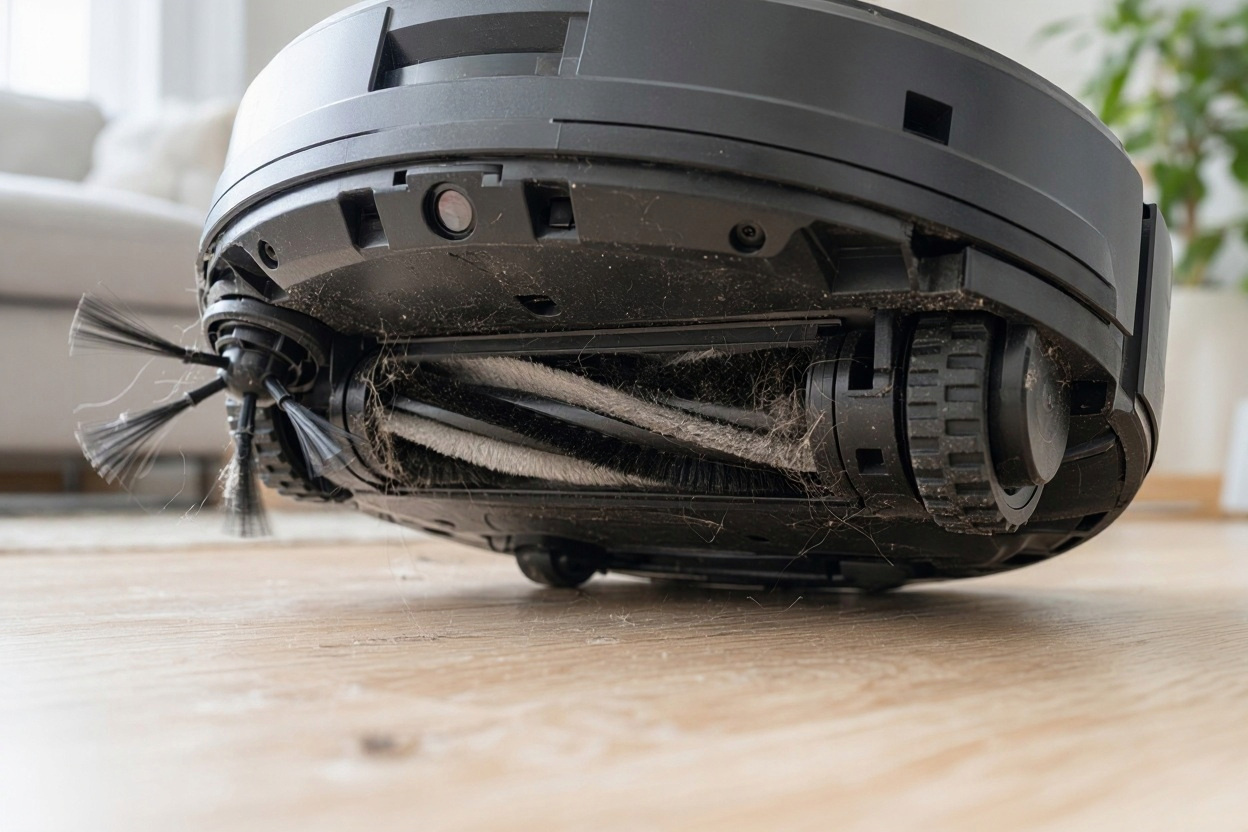
Debris caught in the brush makes this much worse — hair and fibre wound around the roller ends is the single most common reason a robot vacuum gets noisier over time.
Wheel motors and body resonance. The drive wheels produce a small hum, and the plastic body and dustbin can resonate with the brush motor. A loose dustbin or a rattling filter cover adds a buzz that people often mistake for motor noise.
None of these transmit significantly into building structure the way a washing machine spin does — robot vacuums are light and their vibrations are largely airborne. That matters, because it means the fix for a robot vacuum is scheduling and maintenance rather than isolation. If you want the contrast, our guide to washing machine noise covers a genuinely structure-borne problem.
How Loud Are Robot Vacuums In Decibels?
Robot vacuums generally sit somewhere between the mid 50s and low 70s dB, measured at around one metre — with the spread driven almost entirely by the power mode.
| Mode | What It Sounds Like |
|---|---|
| Quiet / eco | A soft hum and light brush noise. Often genuinely unnoticeable in another room. |
| Standard | Clearly audible throughout an open-plan home, but easily talked over. |
| Max / turbo | Loud enough to raise your voice over. Comparable to a standard upright vacuum. |
For calibration, our guide to what a decibel is explains why the scale is logarithmic — a 10 dB rise sounds roughly twice as loud, so the gap between eco and turbo mode is much larger than the numbers imply. And for the overnight question specifically, how many decibels is too loud for sleep gives the practical threshold.
The specification trap is real here. Manufacturers quote their quietest mode — which is also the mode that picks up the least. A listing that says “as quiet as 55 dB” is describing eco mode on hard flooring. If you run it on turbo over carpet, you will hear something quite different.
What Usually Does Not Work
- Buying purely on the quietest advertised figure. That figure describes eco mode, which cleans least. You need to know how each mode sounds, and how much suction you lose at the quiet setting.
- Running it on max in an open-plan home. Turboly loud and often unnecessary — most daily debris is handled perfectly well at standard mode, which is noticeably quieter.
- Putting a rug over the dock. It blocks the robot’s access and its charging contacts, and it does nothing acoustically. The dock is not the noise source.
- Assuming a soft floor covering will quieten it. Carpet actually makes brush noise worse than hard flooring, because the roller digs into pile and works harder. Hard floors are the quieter surface.
- Ignoring the brush. A roller wound with hair is louder, less effective and harder on the motor. Cleaning it is free and is frequently the whole fix.
The Real Fix: Schedule It Away From You
A robot vacuum is the one loud appliance you can run when nobody is home, and this is genuinely the solution rather than a workaround. Most models offer schedules, delayed starts, or app-triggered runs, and most also support room-by-room cleaning.
The practical patterns, in order of effectiveness:
- Schedule it while you are out. The obvious one. Fifteen minutes before you normally leave, and you return to clean floors and no memory of the noise.
- Run it on a different floor to the one you are using. Many models support multi-floor maps. A robot cleaning the upstairs bedroom while you work downstairs is effectively silent from where you sit.
- Use room selection. If your robot supports it, clean the kitchen and hallway during the day and leave the rooms you occupy alone.
- Use eco mode for daily maintenance and save turbo for weekly deep cleans. Daily light passes at low power keep floors at a baseline, and the louder deep clean happens once a week when you can plan around it.
- Consider the overnight question carefully. Robots are quieter than most appliances, but their sound is intermittent and moving — which is exactly the character of noise that disrupts sleep. If you have a bedroom on the same floor, do not schedule it at night.
If Yours Is Louder Than It Used To Be
- Clean the roller brush and side brush. Hair and fibre wound around the roller ends creates drag, chatter and heat, and makes the motor work harder. This is the single most common cause and the cheapest fix.
- Empty the dustbin and clean the filter. A full bin or a clogged filter restricts airflow, so the motor spins faster to compensate. Washable filters need regular rinsing and thorough drying.
- Check the wheels and castors. Hair wrapped around the drive wheels produces a grinding rattle that sounds exactly like a failing motor.
- Look for debris in the brush housing. Small hard objects — a bottle cap, a piece of gravel, a Lego brick — caught in the brush housing produce a sharp, repeated knock.
- Check the dustbin and filter covers seat properly. A loose bin or filter lid buzzes in sympathy with the motor, and people frequently diagnose this as motor failure.
- Check the charging contacts and dock. A robot that runs at low battery to reach its dock works harder and sounds strained.
If you have done all of that and the motor itself has developed a grinding, screeching or intermittent rattle, that is a mechanical fault — usually a worn brush motor or drive wheel assembly. Those are replaceable parts on most models, and worth replacing rather than replacing the whole machine.
Choosing A Quieter One
The specifications that actually matter, in order:
- Noise at each power mode, not one figure. If a listing gives a single number, assume it is eco mode on hard flooring.
- A genuinely useful quiet mode. Some eco modes clean well; some barely pick anything up. Look for reviews that describe real cleaning performance at low power, not just the rating.
- Brush design. Rubber dual-roller brushes tend to be quieter against hard floors than bristle brushes, and they resist hair tangling considerably better — which means they stay quiet over time.
- Scheduling and room mapping. Not an acoustic feature on paper, but it is how the noise problem is actually solved. Multi-floor mapping and room selection are worth more than a few decibels.
- Floor-type sensing. Robots that raise the brush and reduce suction automatically on hard floors run quieter on the surfaces where you are likely to be nearby.
- Self-emptying docks. Worth knowing about: the dock itself produces a very loud burst for a few seconds when it empties the bin. If your dock is sited near a living space, that burst is much louder than the robot itself.
For specific models chosen on these criteria, our guide to quiet handheld vacuums covers the same principles in a related category — brush design and motor architecture matter in both.
The Honest Caveat
A robot vacuum cannot be genuinely quiet while it is doing meaningful work. It lifts debris through a small intake using a compact high-speed motor, and that produces sound — the physics does not allow otherwise. What you can realistically achieve is a machine you are never present to hear, and scheduling is a more complete solution than any specification.
One thing worth saying plainly: if you bought a robot vacuum expecting it to be unobtrusive, and you are home all day, you will find it intrusive regardless of which model you chose. That is not a fault in the machine — it is a mismatch between the product’s design premise and your routine. If you need quiet cleaning while you are present, a conventional quiet vacuum used briefly is often the more practical answer.
Frequently Asked Questions
Are Robot Vacuums Loud?
Generally yes. Most models run between the mid 50s and low 70s decibels depending on power mode, which is comparable to a conventional upright vacuum. The quiet figures quoted in marketing describe eco mode, which cleans considerably less aggressively than the standard or turbo settings.
Can I Run a Robot Vacuum at Night While I Sleep?
It is not a good idea if the bedroom is on the same floor. Robot vacuums are quieter than most appliances, but their sound is intermittent and moving, and that character of noise is far more disruptive to sleep than a steady tone. Scheduling it for when you are out during the day is the better solution.
Why is My Robot Vacuum So Loud?
The most common causes are hair wound around the roller brush or drive wheels, a full dustbin, or a clogged filter forcing the motor to spin faster. A loose dustbin or filter cover vibrating against the body is also frequently mistaken for motor noise. Clean the brushes and filter first — it is free and resolves most cases.
Are Robot Vacuums Louder on Carpet or Hard Floors?
Louder on carpet. The roller brush digs into the pile and works harder, producing a deeper rasp, and many robots also increase suction automatically when they detect carpet. Hard flooring is the quieter surface for brush noise.
Does Eco Mode Actually Clean, or is it Just Quieter?
It cleans less, but on hard floors it handles everyday dust and light debris perfectly adequately. The trade-off is most obvious on carpet and with heavier debris. Many people run eco mode daily for maintenance and save the higher power settings for a weekly pass.
Are Self-Emptying Robot Vacuum Docks Loud?
Yes, considerably. The dock produces a brief, very loud burst of suction for a few seconds while it empties the robot’s bin — noticeably louder than the vacuum itself. If the dock sits near a living space or a bedroom, that burst is worth planning around.
How Do I Make My Robot Vacuum Quieter?
Clean the roller and side brushes, empty the bin and rinse the filter, and check the wheels for wound hair. Then run it in eco mode for daily passes and schedule it for when you are out. Because robot vacuum noise is largely airborne rather than structural, scheduling and maintenance do far more than any acoustic product.

Ememobong is the lead researcher and editor at Quiet Dwelling. As a professional technical writer, he specializes in breaking down complex acoustic engineering concepts into simple, actionable steps. His goal is to help people build distraction-free environments for better sleep and deep work.