*This post contains affiliate links. If you use these links to buy something we may earn a commission at no extra cost to you.
You have done everything right. You bought the premium hybrid mattress, you set your thermostat to a cool 68 degrees, and you diligently put away your smartphone an hour before sliding under the covers. Yet, you are still tossing and turning. When your alarm goes off, you wake up feeling physically exhausted, groggy, and drained.
The culprit might not be your caffeine intake or your screen habits. It is highly likely you are suffering from an invisible enemy: nighttime noise pollution.
Many of us proudly declare that we are “heavy sleepers.” We think we have gotten used to the low-frequency hum of an old refrigerator, the aggressive clicking of a cheap ceiling fan, or the distant rumble of late-night street traffic. But clinical neurobiology tells a completely different story. Your ears never sleep.
Even when you are deeply unconscious, your auditory system acts as a 24-hour warning radar, scanning your environment for threats. When the ambient volume crosses a specific, scientifically proven decibel threshold, your body reacts instantly. So, exactly how many decibels is too loud for sleep? Let’s dive into the cold, hard science.
The Golden Rule: What the World Health Organization (WHO) Recommends
If we want to understand exactly how noise impacts our sleep cycle, we have to look to the global gold standard of health research.
According to the highly researched Environmental Noise Guidelines published by the World Health Organization (WHO), maintaining strict acoustic hygiene in your bedroom is non-negotiable for cardiovascular and cognitive health. The WHO has established two very specific acoustic limits for a sleeping environment:
- The Baseline Limit (30 dB): The continuous, ambient background noise in your bedroom should never exceed 30 decibels (dBA). This is the equivalent of a quiet whisper or a gentle breeze.
- The Spike Limit (45 dB): Individual, sudden noise events (like a loud car passing by, a dog barking, or an air conditioning compressor kicking on) should never exceed 45 decibels (dBA) at your pillow.
If the sounds in your bedroom regularly spike past 45 decibels, your brain physically cannot sustain the deep, slow-wave sleep required to repair your body.
Understanding the Decibel Scale (The Logarithmic Reality)
To truly understand bedroom noise, you must grasp a critical scientific fact: the decibel scale is logarithmic, not linear.
This means that a sound measuring 40 dB is not just “slightly louder” than a sound measuring 30 dB. To the human ear, an increase of 10 decibels is perceived as being twice as loud, and it represents a ten-fold increase in raw acoustic energy.
Let’s look at how common household noises stack up against the strict sleep guidelines established by the Centers for Disease Control and Prevention (CDC):
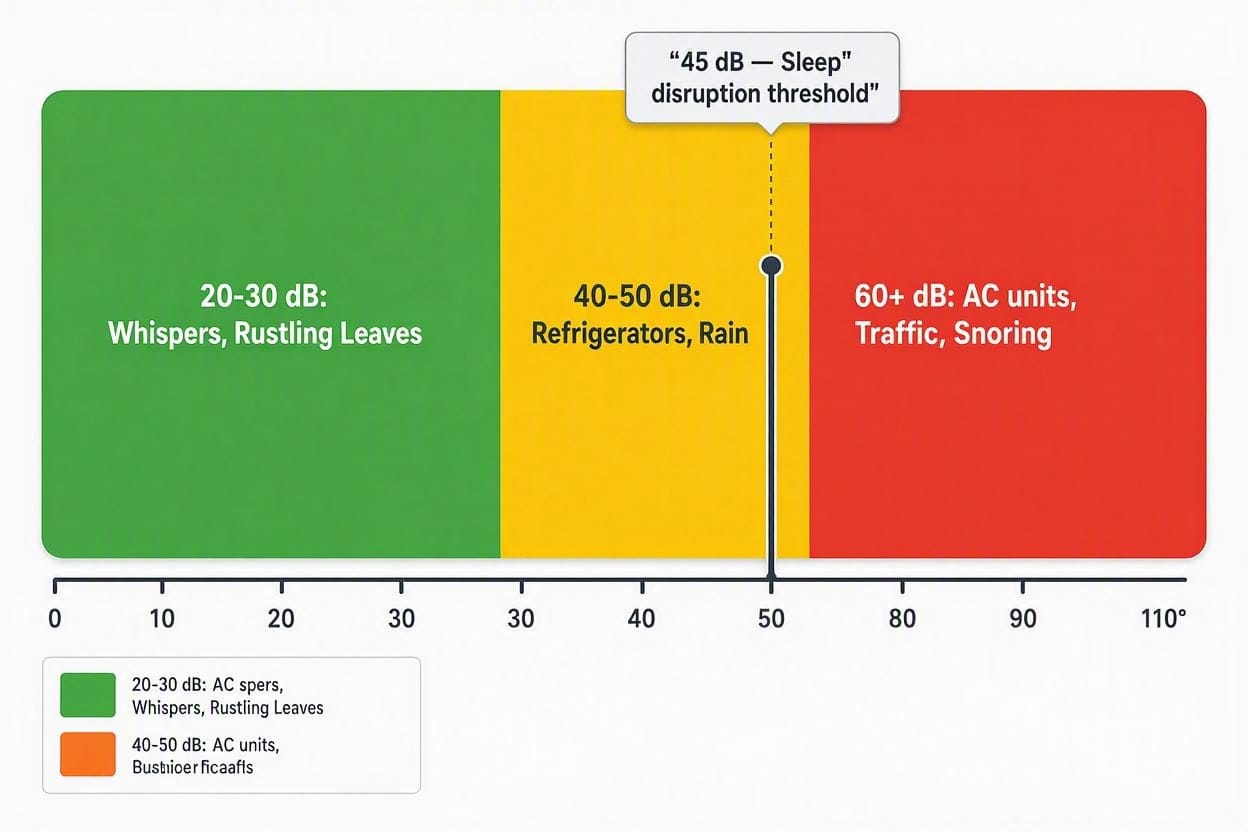
- 20 dB (The Ideal Zone): Rustling leaves, a quiet rural night. Virtually impossible to trigger sleep disruptions.
- 30 dB (The WHO Limit): A quiet library, a high-end quiet tower fan on its lowest setting. Perfect for deep restorative sleep.
- 45 dB (The Danger Threshold): A standard mini-fridge compressor kicking on, or steady rainfall. Will trigger micro-arousals in light sleepers.
- 60 dB (Sleep Destroyer): Normal conversation, a cheap window air conditioner, or a snoring partner. Actively prevents REM sleep and spikes cortisol.
The Biology of Noise: Micro-Arousals & Cortisol
What actually happens in your brain when a 50 dB sound hits your ears at 3:00 AM?
Even though your eyes are closed, the sound wave enters your ear and travels to the amygdala—the primitive, emotional fear center of your brain. The amygdala does not know that the sudden noise is just your neighbor’s car door slamming. It interprets the sudden spike in acoustic pressure as an immediate physical threat.
Your autonomic nervous system reacts by triggering a micro-arousal. Your brain waves suddenly speed up, violently shifting you out of deep, slow-wave sleep (the phase where your body releases growth hormones and repairs cellular tissue) and back into a lighter sleep stage.
Your heart rate elevates, your blood pressure spikes, and your adrenal glands release a micro-dose of cortisol (the stress hormone). You usually will not remember waking up. But if your old, cheap window AC unit clicks on and off twenty times a night, you will suffer twenty micro-arousals. You will wake up feeling utterly exhausted, trapped in a state of chronic, low-grade acoustic stress.
🚨 IS YOUR AIR CONDITIONER RUINING YOUR SLEEP?
Standard AC compressors regularly blast past 60 dB, violently pulling you out of REM sleep. You don’t have to suffer through the heat.
Actionable Steps to Reclaim Your Silence
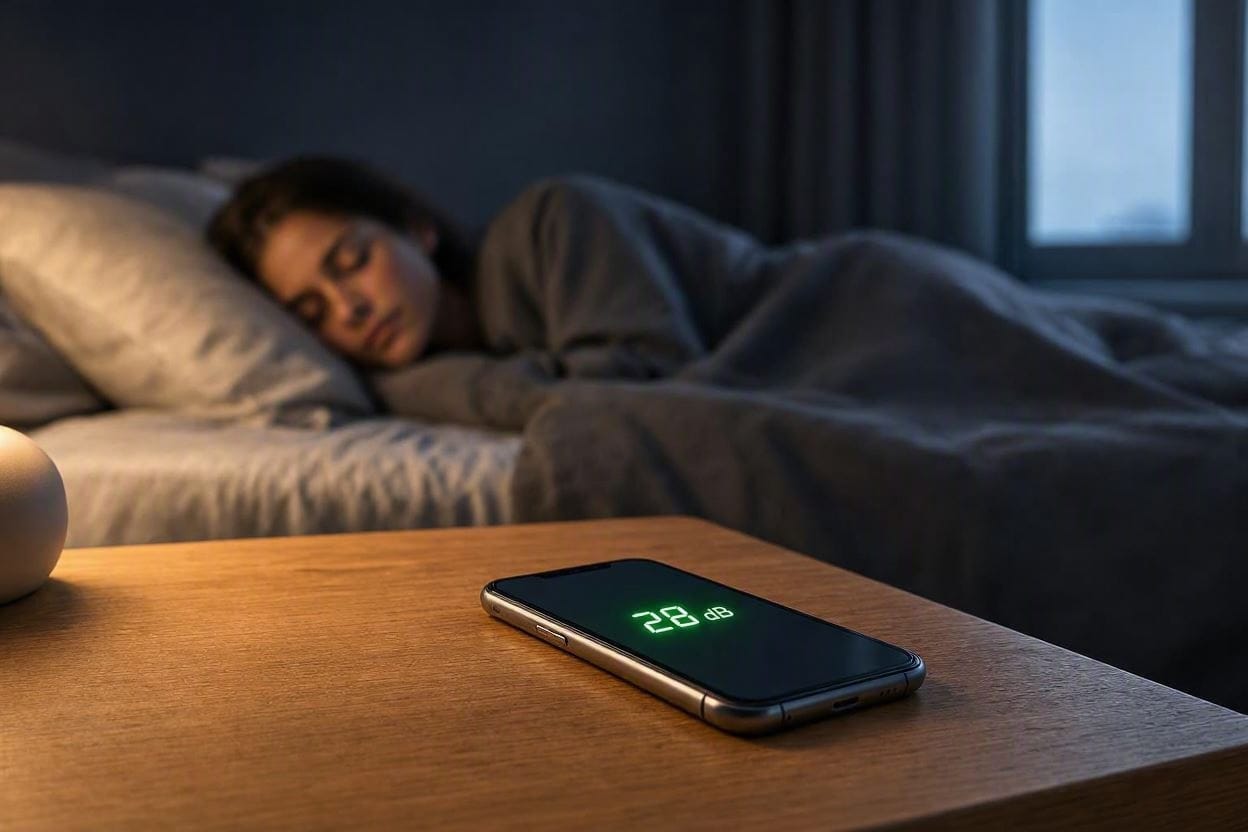
If you suspect your bedroom is too loud, you don’t need expensive equipment to prove it. Download a free decibel meter app (like the NIOSH Sound Level Meter app) on your smartphone. Place it on your nightstand as you go to bed. If the baseline is hovering over 40 dB, or you see sudden spikes above 50 dB, it is time to intervene.
Here are three scientifically proven ways to fix your bedroom acoustics:
1. Deploy Acoustic Masking (Pink Noise)
If you cannot stop an external noise (like highway traffic or a snoring partner), you must mask it. By introducing a steady, continuous background sound into your room, you raise the “noise floor.” When the ambient room volume is a steady 35 dB, a sudden 45 dB car horn is far less jarring to your amygdala.
Instead of harsh “white noise,” use Pink Noise. Pink noise has deeper, softer bass frequencies (sounding like a rushing river) and is clinically proven to enhance deep sleep. You can read our full breakdown of this science in our guide: Pink Noise vs. White Noise for Sleep. A high-quality quiet air purifier running on medium is one of the best physical pink noise generators you can buy.
2. Decouple Your Furniture
If the noise waking you up is structural—like the thud of heavy footsteps from an upstairs neighbor or the vibration of a washing machine spinning—you are dealing with Impact Noise. The vibration is traveling through your floorboards and straight up the legs of your bedframe. Place thick, high-density rubber anti-vibration pads under your bedposts to decouple your bed from the floor, trapping the kinetic energy before it reaches your mattress.
3. Seal the Airborne Leaks
Sound behaves like water; it will pour through the smallest crack. The gap at the bottom of your bedroom door is letting 50% of your household noise in. Install a heavy-duty silicone door sweep, and read our guide on how to truly soundproof a window to block out sirens and street traffic permanently.
If you rent an apartment and cannot structurally soundproof your walls to block out noisy neighbors, your best defense is treating your immediate ears. Wearing the best headphones for sleeping allows you to play masking pink noise directly into your ear canal, and modern designs are now thin enough to cause zero pain for side sleepers
Frequently Asked Questions (FAQ)
Is pure, dead silence actually bad for sleep?
Surprisingly, yes. If a room is an anechoic chamber (measuring below 15 dB), your ears adjust and become hyper-sensitive. In a state of absolute acoustic deprivation, the smallest sound—like your house naturally settling or a floorboard creaking—will sound like a gunshot and instantly startle you awake. A steady, low-volume sound profile of around 25 to 30 dB is much healthier for the human brain.
Are Earplugs Safe to Wear Every Single Night?
While wearing foam earplugs is a great temporary fix for hotel stays or a sudden noisy neighbor, relying on them every night carries risks. Constant use can compress earwax deep into the canal, leading to painful blockages and ear infections. Treating your room’s acoustics and upgrading loud appliances is always the safer, long-term health strategy.
What is a Safe Decibel Level For a Baby’s Nursery?
Infants have highly sensitive, developing auditory systems. Pediatricians strongly recommend that continuous noise in a nursery (including the volume of a white noise machine) should never exceed 50 dBA. Furthermore, a sound machine should be placed at least 7 feet away from the crib, never attached directly to the crib railing.

Ememobong is the lead researcher and editor at Quiet Dwelling. As a professional technical writer, he specializes in breaking down complex acoustic engineering concepts into simple, actionable steps. His goal is to help people build distraction-free environments for better sleep and deep work.