If you search the internet for “how to soundproof a room,” you will find a dizzying array of bad advice. You will see people recommending egg cartons on the walls, hanging cheap moving blankets over windows, or taping lightweight foam triangles to the ceiling.
Unfortunately, these DIY hacks fail because they ignore the fundamental laws of physics.
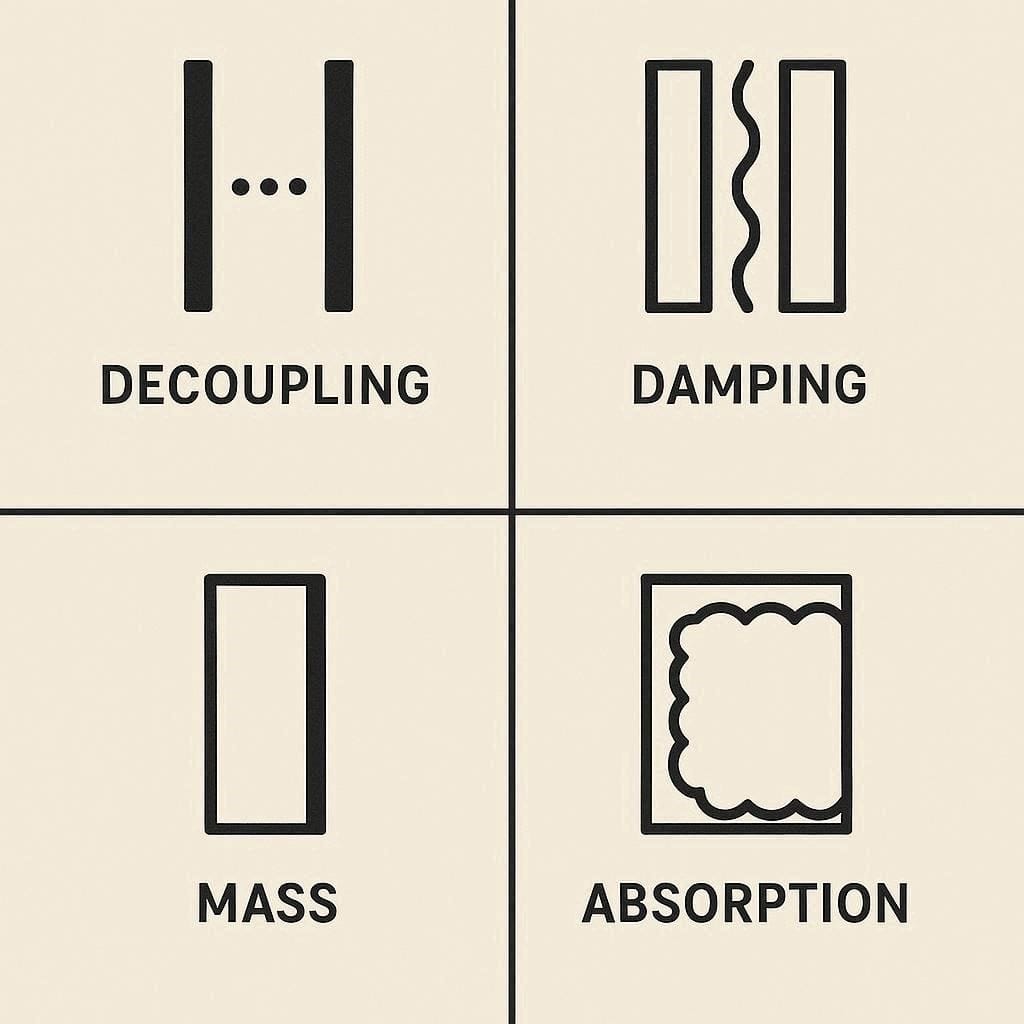
Sound waves are physical energy. To stop them from passing through a wall, ceiling, or floor, you must physically manipulate that energy. In architectural acoustics, this manipulation is achieved through what engineers call the four principles of soundproofing:
- Decoupling
- Damping
- Adding Mass
- Absorption
Whether you are trying to block a neighbor’s television, silence a home recording studio, or secure a peaceful bedroom, you must design your assemblies using these four pillars. In this comprehensive guide, we will break down the science behind each principle, how they work together, and how to apply them to your home.
Decoupling: Breaking the Physical Path
Decoupling is the most effective way to block structural, low-frequency vibrations, but it is also the most misunderstood.
Sound travels incredibly fast and efficiently through solid, rigid objects. In a standard residential wall, drywall is screwed directly to wood or metal studs on both sides. This creates a solid, continuous physical bridge. When sound waves strike the drywall in Room A, the vibration travels instantly through the rigid studs and vibrates the drywall in Room B, radiating outward as airborne noise.
Decoupling is the act of breaking this physical connection. By creating an intentional air gap inside the wall assembly, you force the sound vibration to jump across a physical break, losing almost all of its kinetic energy in the process.
How to Apply Decoupling
- Double Stud Walls: Building two separate rows of wall studs with an intentional 1-inch air gap between them so the framing elements never physically touch.
- Staggered Stud Walls: Utilizing a wider top and bottom plate, but alternating the studs so that the drywall on each side is only attached to every other stud.
- Resilient Sound Isolation Clips: Screwing rubberized isolation clips into standard studs, snapping a metal “hat channel” into the clips, and hanging the drywall from the channel. The rubber acts as a shock absorber, floating the drywall away from the framing.
Failing to decouple your wall junctions can lead to massive acoustic leaks. To understand how sound vibrations bypass even thick walls through un-decoupled floors and ceilings, read our guide on understanding flanking noise.
Damping: The Energy Converter
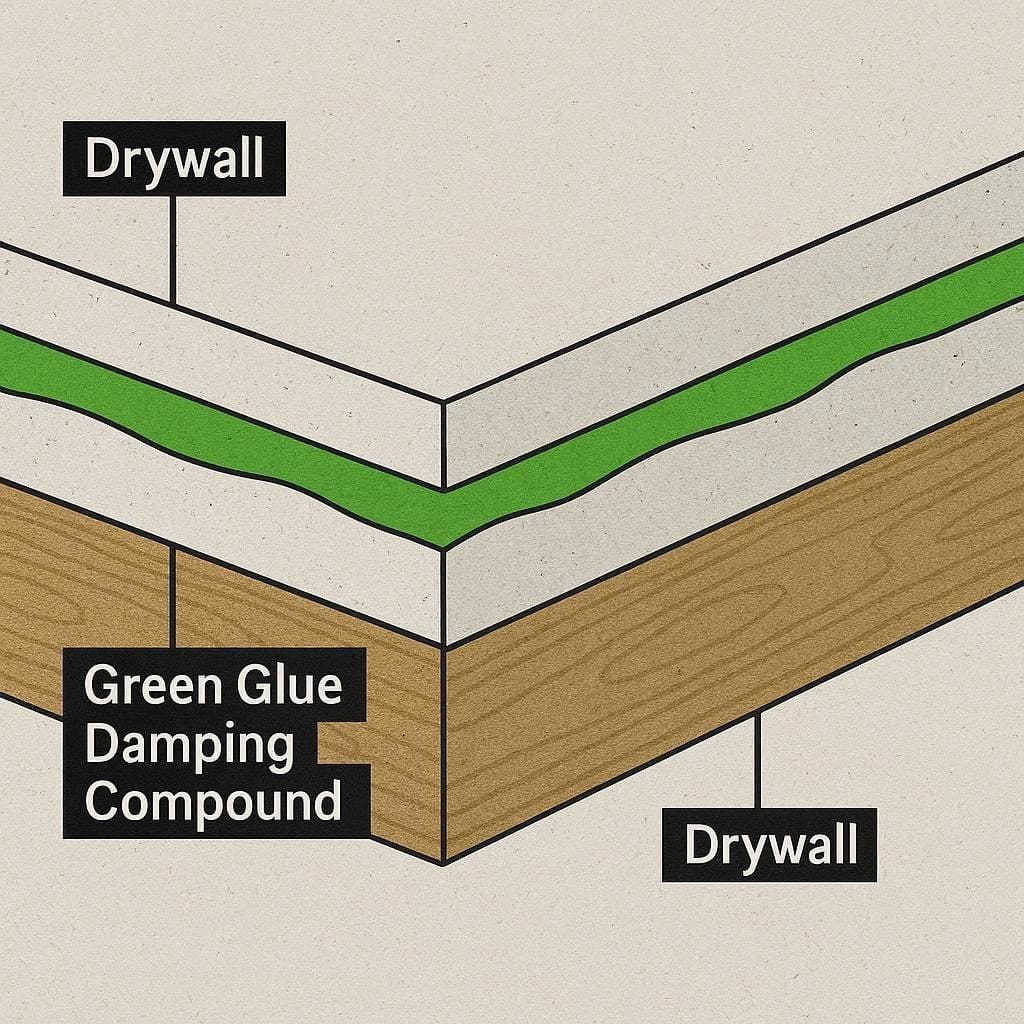
Even if you decouple a wall, solid sheets of drywall will still naturally vibrate like a drumhead when struck by airborne sound. This natural vibration is called resonance.
Damping is the process of deadening this vibration by converting kinetic energy into trace amounts of heat.
This is achieved using a specialized material known as a viscoelastic damping compound (the most famous of which is Green Glue). When you sandwich a thin layer of damping compound between two rigid layers of drywall, the sound waves trying to pass through the wall force the two sheets of drywall to slide micro-millimetres against each other in opposite directions. This movement creates “shear stress” on the damping compound, which immediately converts the kinetic vibration into harmless thermal energy.
How to Apply Damping
- Drywall Sandwiches: Always apply a viscoelastic damping compound between two layers of 5/8-inch drywall.
- Door Upgrades: Adding a second rigid layer to a hollow-core door with a layer of Green Glue sandwiched in between.
Damping is highly effective at killing low-frequency bass rumbles and impact vibrations. It prevents the wall itself from becoming a speaker cone that amplifies the noise.
Adding Mass: The Ultimate Sound Blocker
If you stand in front of a heavy brick wall and scream, practically zero sound will pass through to the other side. If you do the same in front of a thin bedsheet, the sound travels right through it.
This is the law of mass: Heavy, dense materials require significantly more physical energy to vibrate than light, thin materials. If a sound wave lacks the power to physically vibrate a barrier, it cannot pass through it.
To block airborne noises like talking, shouting, or television audio, you must make your walls and ceilings as heavy as physically possible. This is also why lightweight acoustic foam panels are completely useless at blocking sound—they simply do not have the mass required to stop a sound wave.
How to Apply Mass
- 5/8-inch Type X Drywall: Standard interior drywall is 1/2-inch thick and relatively light. Upgrading to fire-rated 5/8-inch Type X drywall adds massive density.
- Mass Loaded Vinyl (MLV): A thin, incredibly heavy, limp-rubber sheeting that is hung over wall studs before drywall is installed to add high-density mass without adding massive physical bulk to the wall.
Adding mass is the primary way to increase a partition’s overall Sound Transmission Class rating. For a detailed breakdown of how to measure the effectiveness of mass, read our guide to understanding STC ratings.
Absorption: The Echo Killer
Absorption is the most common soundproofing principle, but it is also the one most people get wrong.
Absorption does not block sound from entering a room. Instead, it absorbs sound waves within an open cavity, preventing them from bouncing around and echoing.
Imagine a completely empty drywall cavity inside a wall. When sound enters that cavity, it will bounce back and forth off the rigid studs and drywall, creating a drum-like resonance that amplifies the sound inside the wall. By filling that empty cavity with open-cell, porous material (like mineral wool or fiberglass insulation), the sound waves are forced to travel through a maze of tiny fibers. The friction of the air molecules moving against the fibers converts the acoustic energy into heat, neutralizing the echo.
How to Apply Absorption
- Cavity Insulation: Never leave a wall or ceiling cavity empty. Always pack it tightly with dense mineral wool (such as Rockwool Safe’n’Silent) or standard fiberglass batts.
- Acoustic Panels: Hanging porous fiberglass or open-cell foam panels on the surface of your walls to absorb internal echoes and improve the sound quality inside your room.
Because absorption only dampens internal air movement, it must always be paired with Decoupling and Mass to stop structural impact vibrations. To learn how different vibrations interact with these framing elements, read our full guide on airborne vs. impact noise.
Quick Summary of the 4 Principles
To help you select the right method for your project, refer to this quick reference table:
| Principle | What It Does | Target Noise Type | Common Material |
|---|---|---|---|
| Decoupling | Breaks the physical, structural bridge. | Impact vibrations & low bass | Sound isolation clips, double studs |
| Damping | Converts kinetic vibrations into heat. | Resonant wall noise & footstep thuds | Green Glue, viscoelastic compounds |
| Mass | Adds heavy density to block airborne waves. | Airborne noise (voices, TV) | 5/8″ Drywall, Mass Loaded Vinyl (MLV) |
| Absorption | Kills echoes and resonance in empty cavities. | Internal room echoes & hollow wall resonance | Rockwool insulation, fiberglass batts |
Frequently Asked Questions (FAQ)
Can I Soundproof a Room Using Only One of these Principles?
No. This is why most DIY projects fail. If you add massive drywall but do not decouple, the sound will travel straight through the studs. If you decouple but leave the cavities completely empty (no absorption), the wall will act as a resonance chamber and amplify the sound. For real success, you must combine all four principles into a single, cohesive assembly.
Is Egg Carton Acoustic Treatment a Real thing?
No. This is a persistent myth. Egg cartons are made of lightweight, thin cardboard. They have zero mass (cannot block sound), cannot decouple, cannot damp structural vibrations, and are too thin and solid to offer any meaningful absorption. Using egg cartons on your walls is simply a fire hazard that does absolutely nothing to quiet your space.
What is the Difference Between Soundproofing and Acoustic Treatment?
Soundproofing is the act of blocking sound from entering or leaving a room (relying on Mass, Damping, and Decoupling). Acoustic treatment is the act of improving the sound quality *inside* the room (relying solely on Absorption to eliminate echoes). You soundproof a bedroom to sleep quietly, but you acoustically treat a recording studio so your microphone doesn’t pick up echo.

Ememobong is the lead researcher and editor at Quiet Dwelling. As a professional technical writer, he specializes in breaking down complex acoustic engineering concepts into simple, actionable steps. His goal is to help people build distraction-free environments for better sleep and deep work.