If you live near a busy highway, share a wall with a neighbor who loves their home theater subwoofer, or reside near an industrial zone, you know how agonizing a constant structural rumble can be. You have likely spent hours searching for exactly how to block low frequency noise.
Most people attempt to solve this problem by taping acoustic foam to their walls, hanging heavy curtains, or pushing a bookshelf against the drywall. Unfortunately, these methods result in absolute failure. You can still feel the bass rattling your chest and shaking your floorboards.
This failure happens because low-frequency sound behaves entirely differently than standard, mid-range noise. You cannot simply “absorb” deep bass; you have to physically combat its kinetic energy.
In this guide, we will break down the wave physics of low-frequency sound, explain why your standard walls fail to stop it, and outline the exact structural soundproofing methods required to reclaim your quiet dwelling.
The Physics of Low-Frequency Sound Waves
To understand how to block low frequency noise, you must first understand the shape and power of the sound wave itself.
Sound travels in waves. The “frequency” of a sound dictates its pitch, which is measured in Hertz (Hz). According to the Acoustical Society of America, human hearing ranges from 20 Hz (very deep bass) up to 20,000 Hz (a piercing, high-pitched whistle).
The lower the frequency, the longer the physical wavelength:
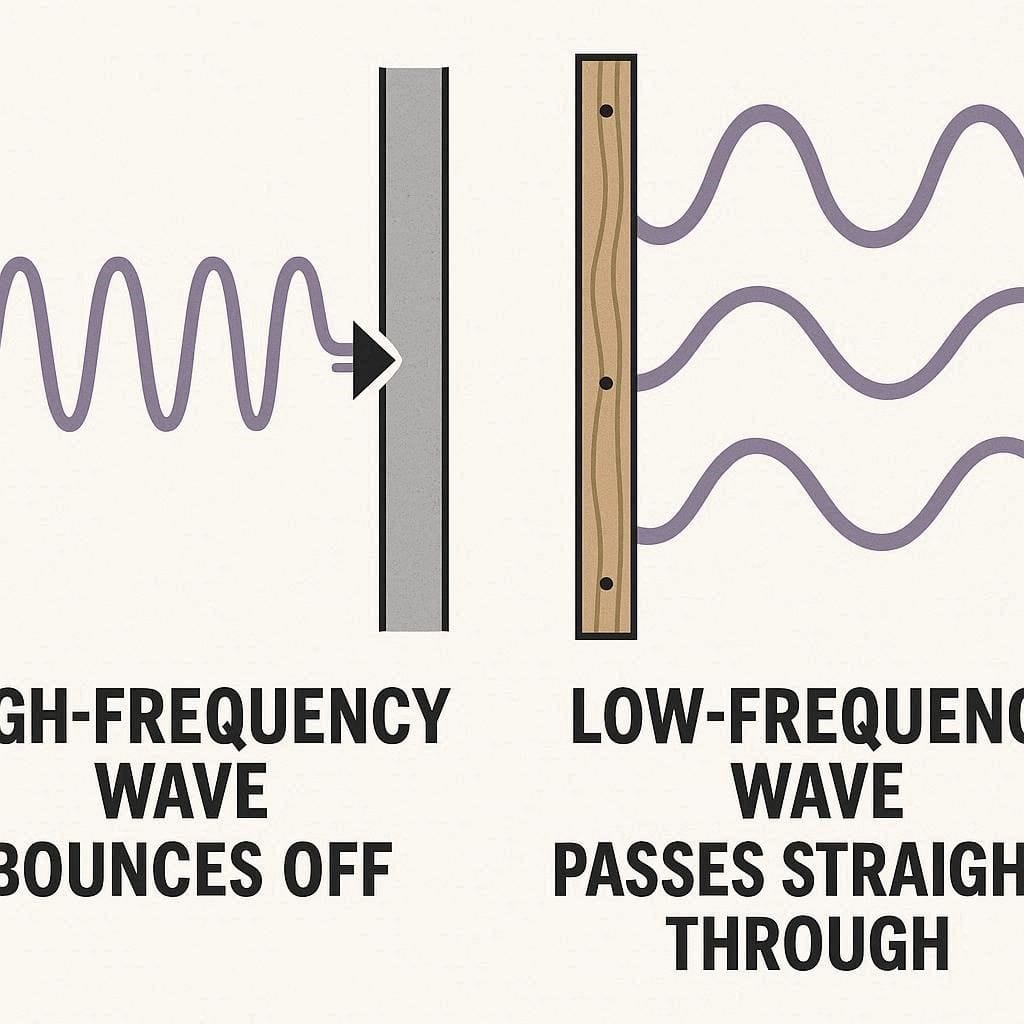
- A high-frequency sound at 10,000 Hz has a wavelength of roughly 1.3 inches. Because it is short and weak, it is easily stopped by a thin barrier, like a closed window or a standard door.
- A low-frequency bass note at 40 Hz has a massive wavelength of over 28 feet.
These massive, long waves contain an immense amount of kinetic energy. When a 28-foot bass wave hits your house, it does not bounce off. It literally passes straight through your siding, vibrates your wooden wall studs, and forces the drywall inside your bedroom to vibrate like a giant speaker cone. The sound waves effectively turn the structure of your home into a mechanical amplifier.
Why Standard Soundproofing Fails Against Bass
When measuring how well a wall stops sound, the construction industry uses a metric called STC (Sound Transmission Class). While an STC rating is helpful for blocking voices and televisions, it completely ignores low frequencies.
If you build a wall using lightweight acoustic foam or basic fiberglass insulation, you are only treating the high frequencies. Deep bass waves will roll straight through porous, lightweight materials without losing any kinetic energy. To learn more about this common mistake, read our guide to understanding STC ratings and their limitations.
How to Block Low Frequency Noise: The 3 Structural Steps
To stop a massive, high-energy wave, you must employ the heavy artillery of architectural acoustics. You cannot use soft materials; you must use structural mass and physical separation.
Here are the three principles you must combine to block low-frequency noise:
Step 1: Massive Density (The Law of Mass)
Low-frequency waves have the power to easily move light objects. To stop the wave, you must make the wall so heavy that the sound wave simply lacks the kinetic energy to push it.
Standard 1/2-inch drywall weighs about 1.6 pounds per square foot. This is far too light. To stop bass, you should upgrade your barrier by adding a layer of 5/8-inch Type X drywall combined with a layer of Mass Loaded Vinyl (MLV). MLV is an incredibly heavy, limp rubber barrier that adds massive, dead weight to your wall cavity, making it extremely difficult for bass waves to vibrate the structure.
Step 2: Structural Decoupling (Breaking the Bridge)
Even if you add massive weight to a wall, if the drywall is screwed directly into the wooden studs, a powerful subwoofer will still vibrate the wood, bypassing the drywall entirely. This is called flanking transmission.
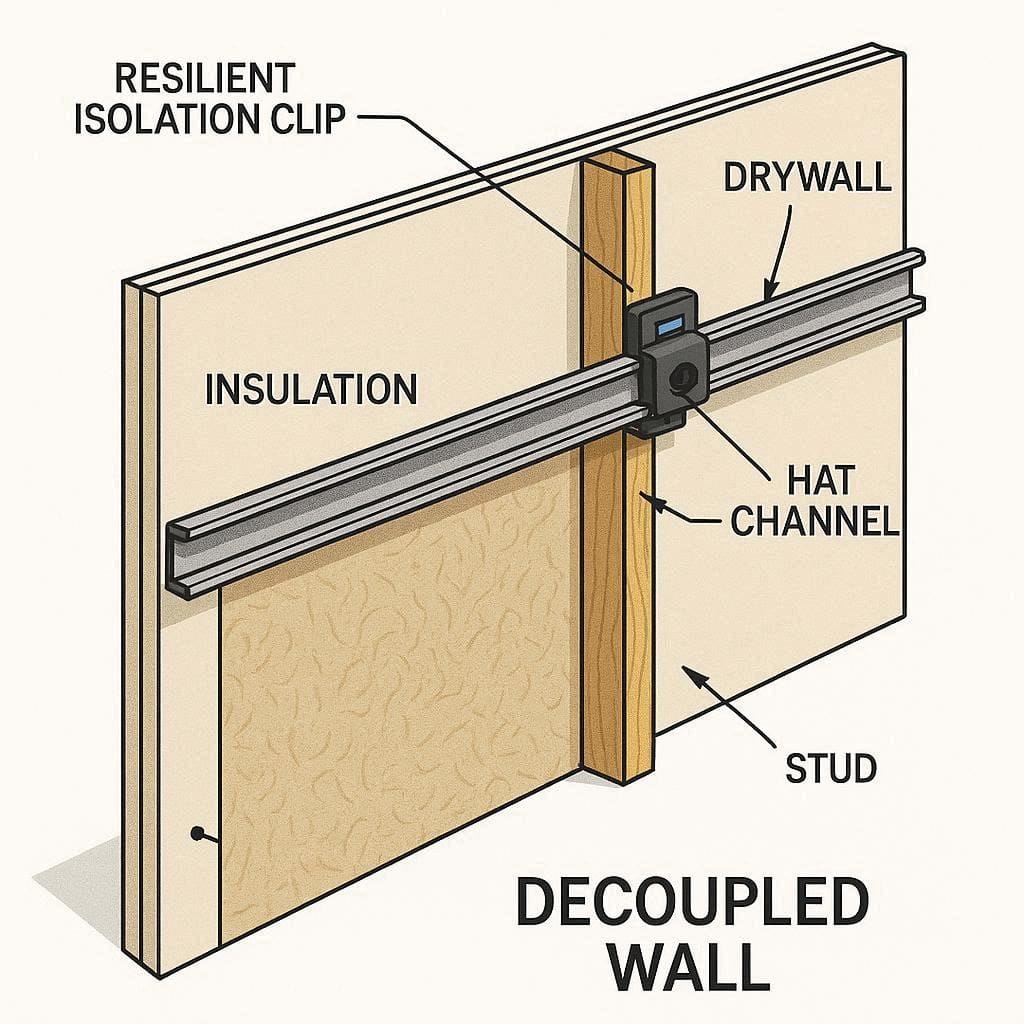
The absolute most effective way to block low-frequency noise is decoupling. This means breaking the physical connection between the room where the noise originates and the room you want to keep quiet.
- Sound Isolation Clips: By attaching rubberized clips to your wall studs and hanging your drywall on metal “hat channels” snapped into those clips, you float the wall. The rubber acts as a shock absorber, deadening the bass vibration before it reaches your drywall.
- Double Stud Walls: In extreme cases (like a home recording studio), you can build two completely separate wall frames with an air gap in between, ensuring the wooden studs never touch.
Step 3: Viscoelastic Damping (Converting Energy to Heat)
Even a heavy, decoupled wall has a natural resonance point. To kill the final remnants of a low-frequency vibration, you must use damping.
By sandwiching a layer of viscoelastic damping compound (such as Green Glue) between two heavy sheets of drywall, you create a shear-stress environment. When the bass wave tries to vibrate the drywall, the two sheets slide microscopically against each other. The damping compound instantly converts that kinetic vibration into trace amounts of thermal energy (heat). For a deeper dive into how this chemical process works, read our master guide on the four principles of soundproofing.
The Health Dangers of Unchecked Low-Frequency Noise
Blocking low-frequency noise is not just about comfort; it is a critical component of cardiovascular health.
Because low-frequency noise easily penetrates standard housing materials, it is one of the leading causes of sleep fragmentation in urban environments. A comprehensive study by the World Health Organization (WHO) on Environmental Noise highlighted that continuous exposure to low-frequency hums (like traffic or industrial machinery) triggers the release of cortisol and adrenaline, even while you are asleep.
Your brain registers the deep vibration as a physical threat, maintaining a low-grade stress response that elevates blood pressure and disrupts deep slow-wave sleep. To understand the biology of this stress response, explore our guide on the health effects of noise pollution.
Frequently Asked Questions (FAQ)
Do Bass Traps Block Low Frequency Noise From Leaving a Room?
No. This is a very common misconception. Foam “bass traps” placed in the corners of a room are designed to absorb low-frequency echoes inside that specific room, which improves the audio quality for the listener. They have practically zero mass and will do absolutely nothing to block the bass from traveling through the wall into the next apartment.
Can Active Noise-Canceling Headphones Block Bass?
Yes. Active Noise Canceling (ANC) technology is actually most effective at targeting low-frequency sound. Because low-frequency waves are long and predictable (like the steady drone of an airplane engine), the internal processor can easily generate a perfectly inverted “anti-noise” wave to neutralize the rumble. Read more about how destructive interference works here.
How Do I Stop Bass From Vibrating through My Floor?
To stop low-frequency impact vibrations from traveling vertically, you must treat the floor-ceiling assembly. This typically involves laying down a thick, dense acoustic underlayment (like recycled rubber) beneath your flooring, or decoupling the ceiling drywall of the room below using resilient channels.

Ememobong is the lead researcher and editor at Quiet Dwelling. As a professional technical writer, he specializes in breaking down complex acoustic engineering concepts into simple, actionable steps. His goal is to help people build distraction-free environments for better sleep and deep work.