
There are few things more frustrating than walking into your bedroom, closing the door for privacy, and immediately realizing you can still hear every conversation, television, and footstep echoing from the hallway. It often feels as if the door isn’t even there.
Many homeowners assume their walls are just too thin, but in reality, the primary acoustic leak in almost every modern home is the bedroom door itself.
Most builder-grade homes and apartments use standard interior doors that are fundamentally designed to fail at soundproofing. To actually stop noise from entering your room, you need to understand the structural physics of your doorways.
In this guide, we will break down the acoustic differences between solid core vs hollow core doors, explain the “drum effect” that amplifies hallway noise, and show you the ultimate structural upgrade to reclaim a perfectly quiet bedroom.
The Science: Why Your Bedroom Door Amplifies Noise
To understand why your current door is letting so much noise in, we have to look at how sound waves interact with building materials. Specifically, we need to examine two acoustic phenomena: the “Drum Effect” and the Law of Mass.
The Hollow Core “Drum” Effect
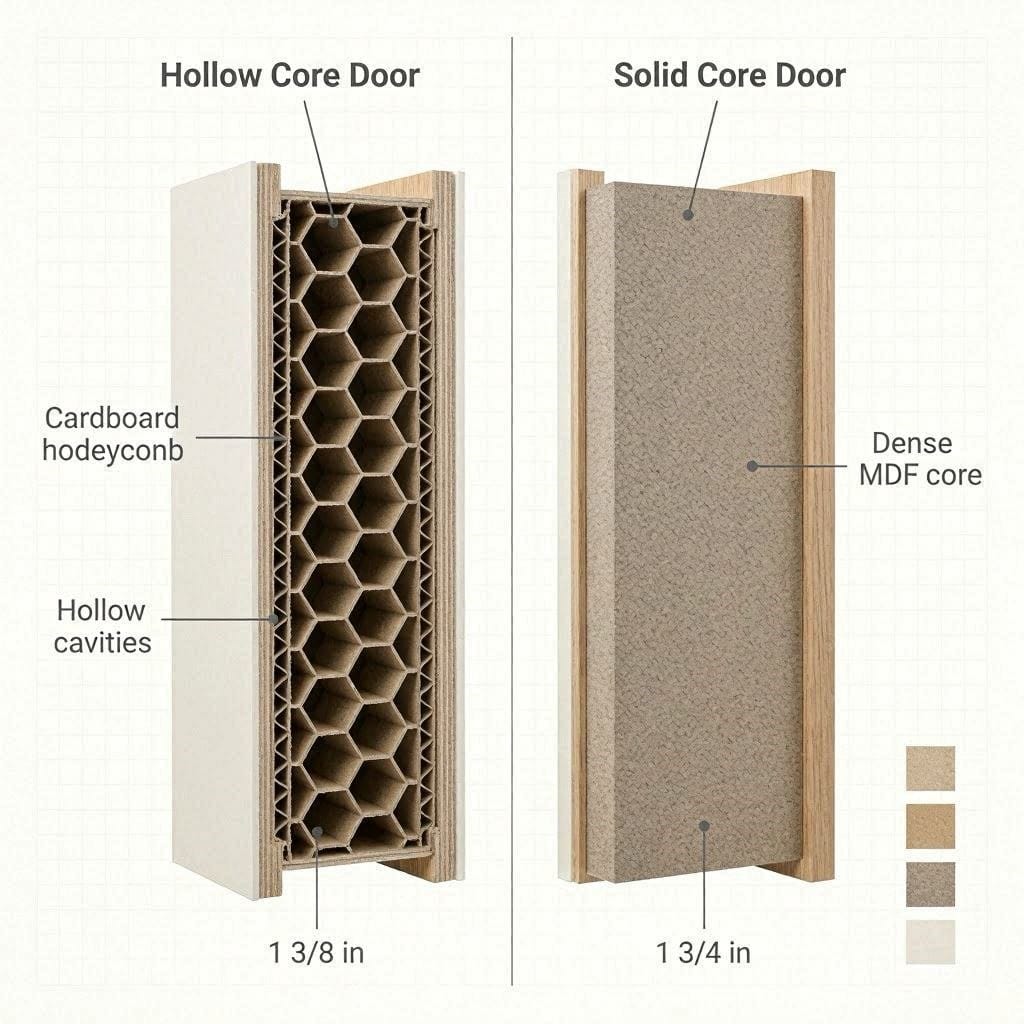
If you live in a house built in the last forty years, your interior bedroom and bathroom doors are almost certainly hollow core. These doors are constructed using a cheap pine wood frame covered by two millimeter-thin sheets of wood veneer. The inside of the door is mostly empty air, supported only by a flimsy cardboard honeycomb structure.
In acoustics, an enclosed pocket of air between two thin, rigid barriers creates a resonance chamber. When a low-frequency sound wave (like a deep voice or a television bass) hits the outside veneer of a hollow core door, the sound wave easily passes through the thin wood and enters the hollow air cavity.
Instead of stopping the noise, the hollow cavity actually allows the sound waves to bounce around and amplify, acting exactly like the inside of a snare drum or an acoustic guitar. The door vibrates and effectively broadcasts the hallway noise straight into your bedroom.
The Law of Mass
In our master guide to the four principles of soundproofing, we explain that stopping airborne kinetic sound waves requires massive, heavy structural density.
Because a hollow core door is primarily cardboard and air, it weighs roughly 25 to 30 pounds. It possesses virtually zero acoustic mass. It simply does not have the physical weight required to force a sound wave to expend its energy.
The Practical Solution: The 2-Step Acoustic Upgrade
To genuinely soundproof an interior doorway, you cannot rely on cheap DIY hacks. Pinning heavy moving blankets or taping lightweight acoustic foam panels to the back of a hollow door will not work, as those materials only absorb internal echoes; they do not block heavy sound transmission.
To block the noise, you must implement this two-step structural fix:
Step 1: The Door Upgrade (Solid Core vs Solid Wood)
You must replace the hollow drum with a heavy, dense barrier. When shopping for a replacement door, you will encounter two main options:
- Solid Wood Doors: Made entirely from natural, joined wood panels (like oak or mahogany). While beautiful, they are incredibly expensive, prone to warping with humidity, and ironically, not the absolute best for soundproofing because natural wood grain has varying densities.
- Solid Core Doors: These are the ultimate acoustic champions. A solid core door looks identical to a hollow core door on the outside, but the inside is filled edge-to-edge with a heavy, engineered wood composite (usually dense MDF or particleboard).
A solid core door typically weighs between 70 and 90 pounds. That engineered, uniform density acts as a massive acoustic dead-weight, completely killing the resonant “drum effect.” It is also significantly cheaper than a natural solid wood door.
Step 2: The Perimeter Seal (The 1% Rule)
Upgrading to a heavy solid core door is useless if you do not complete Step 2. In architectural acoustics, the 1% Rule dictates that if an open air gap makes up just 1% of a wall’s surface area, it will let up to 50% of the sound pass through.
Look at the bottom of your bedroom door. There is likely a 1/2-inch to 1-inch gap between the door and the flooring. Sound behaves like a fluid; it will simply squeeze through that gap and flood your room with noise (a physical process known as diffraction).
To seal the door perfectly, you must install:
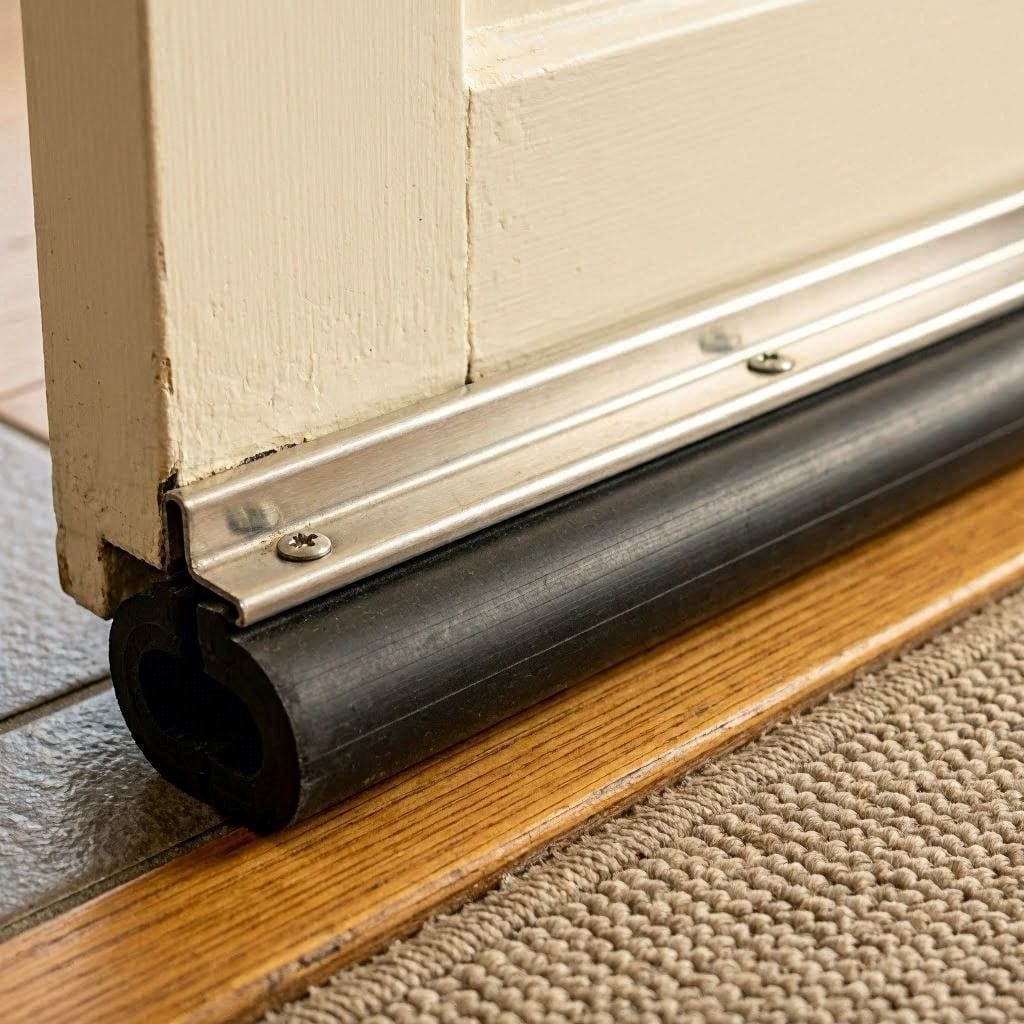
- An Automatic Door Bottom (or heavy sweep): A mechanical sweep that drops a dense neoprene rubber gasket tightly against the floor when the door closes.
- Acoustic Perimeter Seals: Dense silicone bulb seals installed around the sides and top of the door jamb frame, ensuring a 100% airtight compression fit when the door clicks shut. You can learn more about how air gaps ruin soundproofing in our guide: Does Weatherstripping Block Noise?
Acoustic Performance: STC Door Comparison Table
To help you visualize exactly how much quiet you gain by upgrading your doors, we look to the STC scale. The Sound Transmission Class (STC) is the industry-standard metric for measuring how many decibels of sound a barrier can block.
According to structural testing guidelines established by the International Code Council (ICC), here is how different interior doors perform:
| Door Type & Setup | Est. STC Rating | Real-World Privacy Level |
|---|---|---|
| Hollow Core Door (Unsealed Gaps) | ~20 | Zero privacy. Normal hallway conversations are easily understood. |
| Solid Wood Door (Unsealed Gaps) | ~27 | Loud speech is easily understood; normal speech is mumbled. |
| Solid Core Door (Unsealed Gaps) | ~30 | Good mass, but sound heavily leaks through the bottom gap. |
| Solid Core Door (Fully Sealed Perimeter) | ~35 to 40 | Excellent privacy. Normal speech is blocked; loud speech is a faint murmur. |
Frequently Asked Questions (FAQ)
Are Solid Core Doors Heavier to Hang?
Yes. Because a solid core door weighs nearly three times as much as a hollow core door, you cannot always use the existing hinges. You will likely need to upgrade to heavy-duty, ball-bearing hinges, and you must ensure the hinges are screwed deeply into the wall’s structural framing studs, not just the thin door jamb.
Do Cheap Draft Stoppers Work for Soundproofing?
Cloth draft stoppers (often shaped like a long tube filled with sand or polyester) are great for stopping cold air, but they are relatively poor at stopping sound. According to the Acoustical Society of America, stopping kinetic sound waves requires dense structural barriers. A cheap cloth tube lacks the rigid mass of a mechanical drop-sweep and does not form an airtight compression seal against the floor.
Can I Just Fill My Hollow Core Door with Spray Foam?
While technically possible, it is highly unadvised and rarely works. Expanding spray foam is extremely light and possesses almost zero acoustic mass. Filling the door with foam might slightly reduce the “drum” echo inside the door, but it will not add the heavy physical weight required to actually block airborne noise from passing through the thin outer veneers.

Ememobong is the lead researcher and editor at Quiet Dwelling. As a professional technical writer, he specializes in breaking down complex acoustic engineering concepts into simple, actionable steps. His goal is to help people build distraction-free environments for better sleep and deep work.