If you are struggling to sleep because of a noisy neighbor, loud street traffic, or a booming home theater next door, you have likely searched online for a cheap, DIY soundproofing solution. Almost immediately, you will be bombarded with ads for lightweight, egg-crate acoustic foam panels.
They are cheap, they look like professional studio equipment, and they are incredibly easy to stick to your bedroom walls. But before you cover your drywall in foam wedges, you need the answer to one critical question: do acoustic foam panels actually work?
The short answer is No. Acoustic foam panels do absolutely nothing to soundproof a room or block outside noise.
While foam is a valuable tool in audio engineering, it is marketed with incredibly deceptive terminology to homeowners. In this guide, we will break down the fundamental physics of why acoustic foam fails to block sound, explain what foam is actually designed to do, and show you the real materials required to achieve a quiet dwelling.
The Big Myth: Soundproofing vs. Sound Absorption
To understand why a foam panel fails to stop the sound of a passing garbage truck or a barking dog, you must understand the difference between the two main pillars of architectural acoustics. They are completely different physical processes.
- Sound Absorption (What Foam Does): Absorption improves the sound quality inside a room. It stops sound waves from bouncing off hard walls, preventing echoes and reverberation.
- Soundproofing (What Foam Cannot Do): Soundproofing physically blocks sound waves from entering or leaving a room. It requires dense, heavy structural barriers.
Foam panels are acoustic absorbers. They are designed for podcasters, musicians, and home theater enthusiasts who want to stop their own voices from echoing inside their room. For a deeper dive into this critical distinction, read our master guide on Soundproofing vs. Sound Absorption.
The Physics: Why Foam Cannot Block Sound
Sound is a mechanical wave of kinetic energy. When a sound wave travels through the air and hits your bedroom wall, it attempts to physically vibrate the wall. If the wave has enough energy to vibrate the drywall, that vibration transfers into your room as airborne noise.
To stop a physical wave of energy, you must obey the Law of Mass. According to foundational physics principles established by the Acoustical Society of America, the heavier and denser a material is, the more acoustic energy it takes to vibrate it.
This is where acoustic foam fails completely:
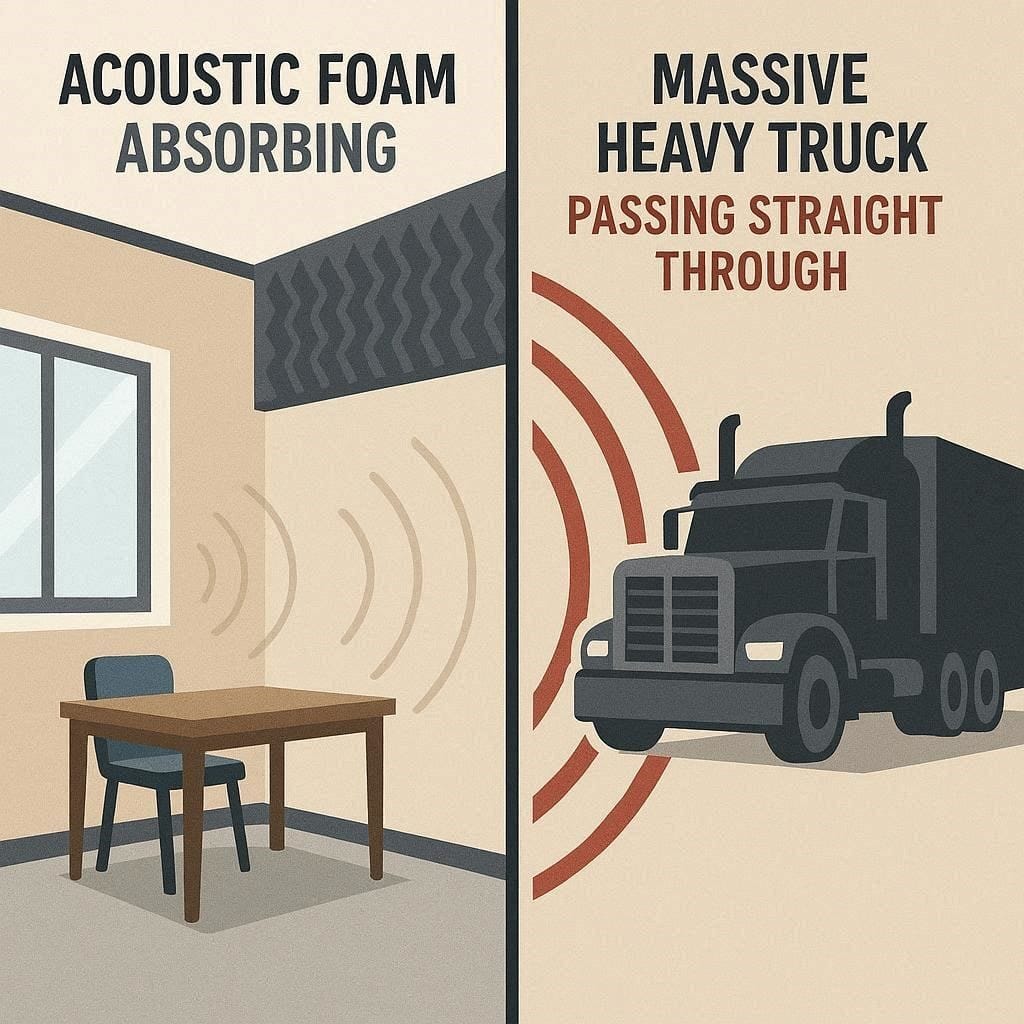
- Lack of Mass: Polyurethane acoustic foam is over 90% air. It is incredibly light and fluffy. When a heavy, low-frequency sound wave (like bass or traffic) hits a foam panel, it doesn’t even notice the foam is there. It passes straight through the foam, vibrates the drywall behind it, and enters your ears.
- Lack of Decoupling: Taping foam directly to a wall does not break the structural connection of the building. Impact noises (like footsteps from upstairs) will still travel directly through the wooden wall studs and bypass the foam entirely.
What Do Acoustic Foam Panels Actually Do?
If they don’t block noise, why do professional recording studios use them?
When you speak in an empty room with bare drywall and hardwood floors, your voice bounces back and forth off the hard surfaces, creating a harsh, ringing echo. This is highly distracting for microphones.
Acoustic foam has a high NRC (Noise Reduction Coefficient) rating. Its porous, open-cell structure acts like a maze for sound waves. When sound enters the foam, the air molecules rub against the microscopic polyurethane struts. This physical friction converts a tiny amount of the acoustic energy into trace amounts of heat, killing the echo.
If you want to make your home office sound better on Zoom calls, or you are building a vocal booth, foam is a fantastic tool to improve the room’s internal acoustics. However, it will not stop your roommate from hearing your Zoom call through the wall. You can learn exactly how these metrics are calculated in our guide to understanding NRC ratings.
If Foam Doesn’t Work, What Does?
If you are suffering from the health effects of environmental noise pollution and need to physically block sound from entering your bedroom, you must put down the foam and invest in structural, high-density materials.
Here are the three most effective materials actually used in professional soundproofing:
Mass Loaded Vinyl (MLV)
Unlike light, airy foam, Mass Loaded Vinyl is an incredibly heavy, dense, limp-rubber membrane. A single 1/8-inch thick sheet of MLV can weigh over a pound per square foot. When installed behind drywall or under floors, it acts as an acoustic dead-weight, instantly killing the transmission of airborne sound waves. Read more in our guide: What is Mass Loaded Vinyl?
Type X Drywall (5/8-inch)
Standard residential drywall is 1/2-inch thick and relatively light. By adding a second layer of dense, 5/8-inch fire-rated drywall over your existing walls, you drastically increase the partition’s physical mass. This is the most cost-effective way to boost a wall’s STC (Sound Transmission Class) rating.
Acoustic Mineral Wool Insulation
If you have empty wall cavities, they act like resonance chambers (like the inside of an acoustic guitar). Filling these cavities with dense, heavy rock wool (like Rockwool Safe’n’Sound) absorbs the internal wall resonance and adds significant density to the partition, making it much harder for bass waves to pass through.
Frequently Asked Questions (FAQ)
Will Putting Acoustic Foam On My Ceiling Stop Upstairs Footsteps?
No, absolutely not. Footsteps are structural impact noise. The heavy vibration travels straight through the floor joists and ceiling drywall. Soft foam taped to the ceiling has zero ability to stop structural vibration. To stop footsteps, you must physically decouple the ceiling using resilient channels. Read our full guide on Airborne vs. Impact Noise to learn more.
Does Thick Egg-Carton Foam Block More Sound than Flat Foam?
No. The 3D shapes (like egg crates, pyramids, or wedges) are simply designed to increase the surface area of the panel to absorb high-frequency echoes more efficiently. The shape does not add structural mass, so it remains entirely ineffective at blocking sound transmission.
Can I Use Moving Blankets Instead Of Acoustic Foam?
A heavy moving blanket will actually absorb more internal room echoes than thin, cheap foam because it has higher density. However, just like foam, a moving blanket is an acoustic absorber, not a sound blocker. Hanging a blanket over your door will slightly muffle high-frequency sounds, but it will not stop standard airborne noise.

Ememobong is the lead researcher and editor at Quiet Dwelling. As a professional technical writer, he specializes in breaking down complex acoustic engineering concepts into simple, actionable steps. His goal is to help people build distraction-free environments for better sleep and deep work.