

If you live near a busy intersection, a highway, or an airport flight path, your windows are the absolute weakest acoustic link in your home. They are literal holes in your wall covered by millimeter-thin sheets of fragile glass.
You have likely already tried the budget-friendly DIY fixes. You have meticulously sealed the air gaps with acoustic caulk, applied heavy-duty weatherstripping, and perhaps even hung heavy soundproof curtains over the frame. But when a heavy diesel truck rolls by or a loud motorcycle revs its engine, the deep, low-frequency rumble still rattles your bedroom and wakes you up.
When the cheap hacks fail to stop heavy kinetic sound waves, it is time to look at the structural physics of your glass.
In this comprehensive guide, we are going to break down the heavy-duty, permanent structural upgrades—specifically acoustic window inserts and laminated acoustic glass—that actually block massive airborne sound waves, allowing you to finally reclaim your quiet dwelling.
The Science: Why Standard Windows Leak Noise
To understand how to soundproof windows, we must first address the biggest myth in the window replacement industry: the “soundproof” double-pane window.
The Double-Pane Myth (Sympathetic Resonance)
Millions of homeowners spend thousands of dollars replacing their old, drafty single-pane windows with standard “Energy Star” double-pane windows, expecting the noise to disappear. While double-pane windows are fantastic for trapping heat, they are often terrible at blocking low-frequency street noise.
Why? Because of a physics principle called sympathetic resonance. In a standard double-pane window, both sheets of glass are the exact same thickness (usually 1/8-inch). Because they have the same mass, they share the exact same resonant frequency. When the deep rumble of traffic hits the outer pane, the glass vibrates. That vibration easily passes through the trapped air gap and causes the inner pane to vibrate in perfect unison, transferring the bass straight into your room.
The Solution: Asymmetrical Glazing and Damping
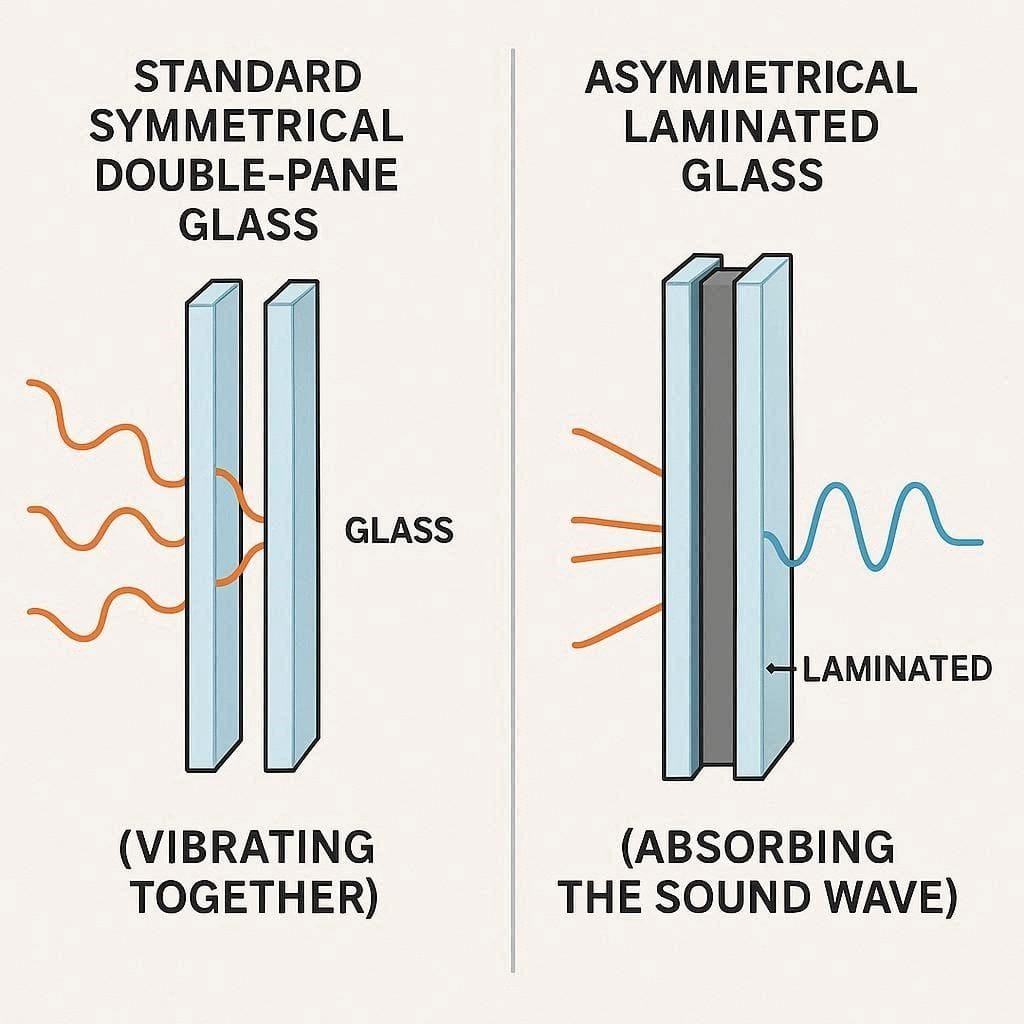
Professional acoustic windows defeat this resonance using two specific techniques:
- Asymmetrical Glazing: Instead of using two identical panes, acoustic windows use two different thicknesses of glass (for example, one 1/4-inch pane and one 1/8-inch pane). Because the panes have different masses, they block different frequencies. A sound wave that easily vibrates the thin pane will struggle to vibrate the thick pane, breaking the chain of transmission.
- Viscoelastic Damping (Laminated Glass): To kill the sound wave entirely, acoustic glass utilizes the soundproofing principle of Damping. The thick pane is actually two sheets of glass sandwiching a microscopic layer of PVB (Polyvinyl Butyral) plastic. When a sound wave strikes the glass, the plastic core stretches microscopically, instantly converting the kinetic sound vibration into harmless heat.
Practical Application: How to Soundproof Your Windows
Now that you understand the physics, how do you actually apply this to your home? You have two primary routes, depending on your budget and whether you own or rent.
Route A: Acoustic Window Inserts (The Best Overall Solution)
If you cannot afford to rip out your existing window frames—or if you are a renter or live in a historic home—acoustic window inserts are the ultimate solution. Companies like Indow Windows manufacture these custom-cut panels.
An acoustic insert is a heavy, thick sheet of optical-grade acrylic edged with a silicone compression tube. You simply press-fit the insert into the inside of your existing window frame.
Why they work so well: Inserts utilize the principle of Decoupling. By placing the insert a few inches away from your existing exterior glass, you create a massive 2-to-3-inch “dead air” gap. This deep air space acts as a massive shock absorber, forcing low-frequency traffic noise to expend all its energy before it ever reaches the acrylic layer.
Route B: Full Window Replacement (Laminated Glass)
If your current windows are rotting or you are already planning a full home renovation, replacing the entire window frame is the most permanent route.
What to ask your contractor for: Never just ask for “quiet double-pane windows.” You must specifically request asymmetrical laminated glass. Furthermore, you must verify the window’s OITC (Outside-Inside Transmission Class) rating. STC ratings only measure high-frequency interior noises (like voices). OITC ratings, established by ASTM International standards, specifically measure how well the glass blocks the low-frequency rumble of heavy transportation noise.
Acoustic Window Performance Comparison
To help you visualize the expected acoustic reduction of each method, refer to this STC and OITC metric comparison table:
| Window Type | Est. STC Rating | Est. OITC Rating | Acoustic Performance |
|---|---|---|---|
| Standard Single Pane | ~26 | ~21 | Zero privacy. You can hear every car pass. |
| Standard Double Pane | ~28 | ~24 | Muffles birds/voices, fails against heavy traffic. |
| Acoustic Window Insert (Over Single Pane) | ~42 | ~35 | Massive reduction in all airborne noise. Traffic becomes a whisper. |
| True Laminated Acoustic Glass | ~45+ | ~38+ | Elite isolation. Near-complete silence from exterior environments. |
Frequently Asked Questions (FAQ)
Do Thermal Windows Block Sound?
Generally, no. Thermal insulation and acoustic insulation require completely different physical properties. Thermal windows trap Argon gas to prevent heat transfer, but the thin, symmetrical glass does very little to stop the massive kinetic energy of a low-frequency sound wave. According to research from the Acoustical Society of America, stopping deep bass frequencies requires heavy mass and wide, decoupled air gaps.
Can I Open My Windows if I Install an Acoustic Insert?
Yes! This is one of the biggest benefits of acoustic window inserts. Because they are not permanently glued or screwed into the frame, you can easily pull them out on a beautiful spring day to let the fresh air in, and pop them back into the window frame tightly before you go to sleep.
Are Acoustic Window Inserts Worth the Money?
If you are struggling with chronic sleep disruptions due to street noise, yes. While they can cost between $300 and $500 per window depending on the size, they are significantly cheaper than tearing out the drywall to install a $1,500 custom laminated window, and they offer nearly identical acoustic performance due to the massive air gap they create.

Ememobong is the lead researcher and editor at Quiet Dwelling. As a professional technical writer, he specializes in breaking down complex acoustic engineering concepts into simple, actionable steps. His goal is to help people build distraction-free environments for better sleep and deep work.