*This post contains affiliate links. If you use these links to buy something we may earn a commission at no extra cost to you.
We all know the 5:30 AM stealth mission. You wake up early, tip-toe into the dark kitchen, and carefully try to brew a fresh cup of coffee before the baby, your partner, or your roommates wake up.
You press the “Brew” button, and immediately, your kitchen is filled with acoustic chaos. If you have an espresso machine, a violent, rattling buzz vibrates against your granite countertops. If you have a drip coffee maker, it ends the brew cycle with a horrific, sputtering hiss as water sizzles on a glass hot plate, followed by five piercing, un-mutable electronic BEEPS.
Your peaceful morning is completely shattered.
Most coffee appliances are built for speed and affordability, completely ignoring acoustic hygiene. But as open-concept homes become more popular, appliance engineers have finally started prioritizing silence. By moving away from cheap vibratory pumps and hissing hot plates, you can achieve barista-level coffee in near-total silence.
I have tested the top kitchen tech on the market. Whether you want a flawless pour-over or a rich shot of espresso, here are the absolute best quiet coffee makers that will preserve your morning peace.
The Science of the Screech: Why Are Coffee Makers So Loud?
To buy a truly quiet coffee maker, you have to understand the two very different mechanical processes happening inside drip brewers versus espresso machines.
The Drip Coffee Problem: Hissing Hot Plates
Cheap drip coffee makers (like a standard $30 Mr. Coffee) use an aluminum heating tube that relies on steam pressure to push water up to the showerhead. At the end of the brew cycle, the water runs out, and the machine violently boils the last remaining drops, causing a horrific sputtering and hissing sound.
Furthermore, they keep the coffee warm using a glass carafe on a heated metal plate. As coffee drips onto this searing hot plate, it sizzles loudly. The secret to a silent drip brewer is upgrading to a Thermal Stainless Steel Carafe, which eliminates the need for a noisy hot plate entirely.
The Espresso Problem: Vibratory vs. Rotary Pumps
If you own a standard espresso machine, it uses a Vibratory (Vibe) Pump. These pumps are cheap and tiny. To generate 9 bars of pressure, a metal piston inside the pump violently snaps back and forth 60 times a second. This aggressive mechanical action shakes the entire machine, vibrating the drip tray and rattling your coffee cups.
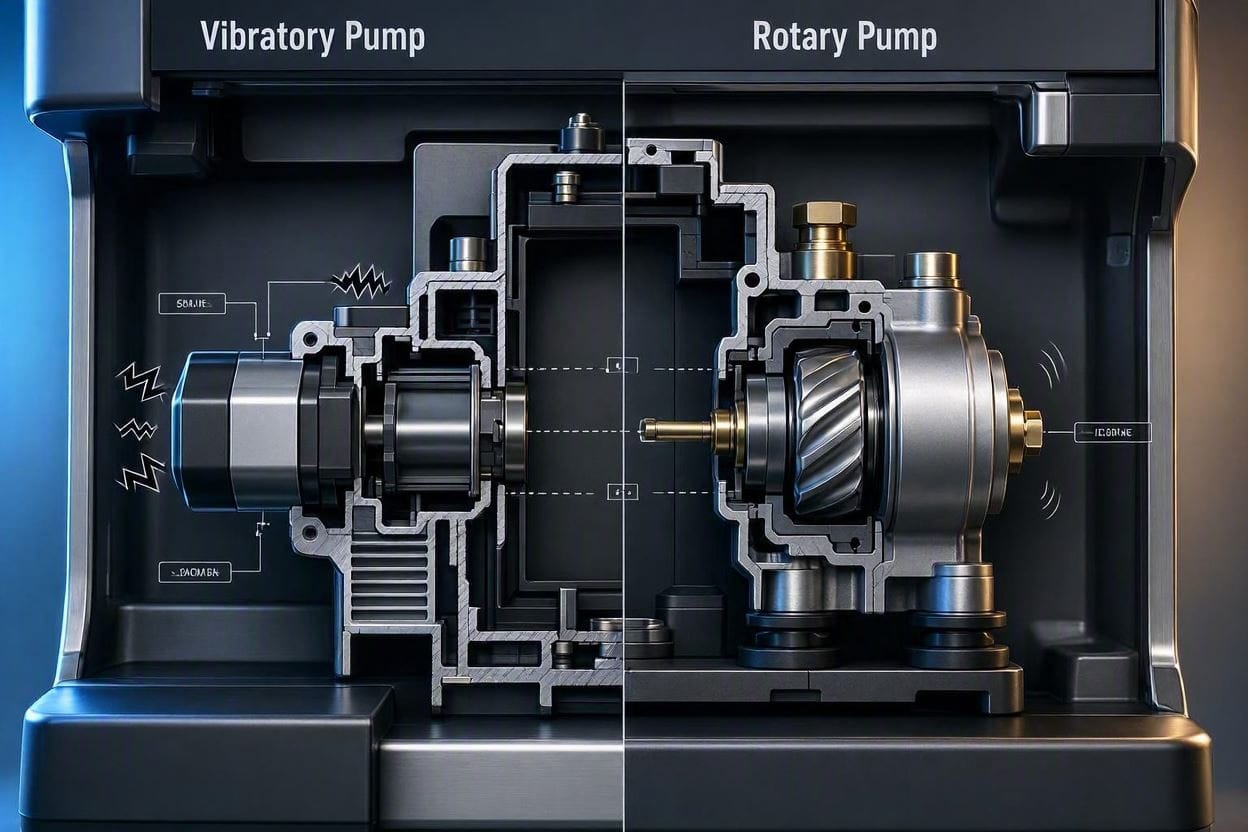
Premium espresso machines solve this by using Rotary Pumps. A rotary pump is a large, heavy, commercial-grade motor that spins smoothly rather than snapping back and forth. It moves water effortlessly, resulting in a gentle, deeply muffled hum rather than a violent rattle.
1. Technivorm Moccamaster KBT Thermal (Best Drip Maker)
If you want standard drip coffee, the Technivorm Moccamaster is the undisputed king. Hand-built in the Netherlands, it is one of the few home brewers certified by the Specialty Coffee Association (SCA) for maintaining perfect brewing temperatures.
Acoustically, it is a masterpiece. It uses a heavy-duty copper boiling element that heats water rapidly and quietly. There is no violent sputtering at the end of the brew cycle. Because the KBT model uses a double-walled stainless steel thermal carafe, there is no hot plate to sizzle and hiss.
Best of all? It has an analog physical switch. It does not beep when you turn it on, and it does not beep when the coffee is done. Absolute silence.
The Pros
- Zero electronic beeping or alarms.
- Thermal carafe eliminates the loud sizzle of a glass hot plate.
- Brews a full pot in a whisper-quiet 6 minutes.
The Cons
- No programmable timer (you must turn it on manually).
- Premium price tag for a drip coffee maker.
2. Lelit Bianca V3 (The Premium Espresso Pick)
If you are an espresso enthusiast and your budget allows for it, the Lelit Bianca is a prosumer dream machine. It entirely bypasses the noise issues of cheaper machines like the Breville Barista Express by utilizing a commercial-grade Rotary Pump.
When you pull a shot on the Bianca, the machine emits a smooth, low-frequency hum. You can easily hold a whispered conversation while the shot is pouring. Furthermore, Lelit engineered the stainless steel casing perfectly; the drip tray and cup warmer sit flush, meaning there is no metallic rattling while the pump runs.
It is expensive, but it delivers absolute cafe-quality espresso in complete acoustic stealth.
The Pros
- Rotary pump provides an incredibly smooth, low-volume hum.
- Plumbable (you can connect it directly to your water line).
- Flow-control paddle for the ultimate espresso extraction.
The Cons
- Highly expensive prosumer price tag.
- Takes about 15-20 minutes to fully heat up before use.
3. Nespresso VertuoPlus (The Best Budget Pod Maker)
Most single-serve pod machines (like Keurigs) use small, violent vibratory pumps to force water through the plastic pod. This results in a sharp, rattling sputter.
The Nespresso VertuoPlus uses a completely different technology called Centrifusion. Instead of aggressively punching water through the pod, the machine spins the capsule at 7,000 RPMs, blending the water and coffee grounds using centrifugal force.
Because it relies on smooth spinning rather than high-pressure pumping, it operates with a very quiet, futuristic whirring sound. It is incredibly fast, highly affordable, and the quietest pod brewer on the market.
The Pros
- Centrifusion spinning is drastically quieter than Keurig pumps.
- Produces a rich, thick layer of crema on every cup.
- Motorized head opens and closes silently with a tap.
The Cons
- You are locked into buying expensive Nespresso-branded pods.
- Not a true “espresso” (it is concentrated coffee).
The Mousepad Hack: Stopping Countertop Vibrations
Even if you buy a premium, hushed espresso machine, you might turn it on and hear a deep, structural rumbling noise echoing through your kitchen cabinets. This is caused by Impact Noise.
When a heavy motorized appliance sits directly on a hard granite or laminate countertop, the microscopic vibrations from the motor transfer directly into the wood of the cabinetry below. The hollow cabinets act exactly like the body of an acoustic guitar, amplifying the vibration into a loud, booming bass note that travels easily through walls. We detail this phenomenon heavily in our guide on Airborne vs. Impact Noise.
The 5-Minute Fix: You must decouple the machine. Take a thick, neoprene computer mousepad, a specialized silicone espresso mat, or a folded microfiber kitchen towel and place it directly underneath your coffee maker. The soft, dense material acts as an acoustic shock absorber, trapping the kinetic vibration before it can enter the hard countertop. The booming rumble will instantly disappear.
Complete Your Silent Coffee Station: A quiet brewer is useless if your grinder wakes the house up first! Check out our guide to the best quiet coffee grinders, and ensure your morning water prep is stealthy with one of our top-rated silent electric kettles.
Frequently Asked Questions (FAQ)
Are French Presses Quieter than Electric Coffee Makers?
Yes! A French press requires zero electricity, meaning there are no pumps, motors, or beeps. It is 100% silent. However, you still have to boil the water to use it. If you want a completely silent French press routine, you must pair it with a specialized quiet kettle that doesn’t scream or whistle when the water reaches boiling point.
Can I Turn the Beep Off on My Keurig or Standard Coffee Maker?
Usually, no. Manufacturers hardwire the piezo buzzer directly into the appliance’s motherboard as a safety and alert feature. Unless the machine specifically advertises a “mute” or “stealth” function in the manual, you cannot disable the beep without taking the machine apart and physically destroying the internal speaker.
Why Does My Espresso Machine Rattle My Coffee Cups?
If your cups are vibrating and rattling on the metal drip tray during extraction, it is because of the vibratory pump shaking the chassis. To fix this instantly, place a small, thin rubber bar mat or a folded paper towel directly on top of the metal drip tray, and place your coffee cup on top of that. The rubber/paper will absorb the vibration and silence the rattle.

Ememobong is the lead researcher and editor at Quiet Dwelling. As a professional technical writer, he specializes in breaking down complex acoustic engineering concepts into simple, actionable steps. His goal is to help people build distraction-free environments for better sleep and deep work.