*This post contains affiliate links. If you use these links to buy something we may earn a commission at no extra cost to you.
Handheld vacuums have a strange reputation problem. They are genuinely useful – for car interiors, stairs, couch cushions, pet hair, and the tiny messes that never justify dragging out a full-size vacuum – but they are also often absurdly loud for how small they are. You buy one for a thirty-second cleanup and end up apologizing to everyone in the house for the noise.
The reason comes down to physics. A handheld has to generate meaningful suction from a very small motor crammed into a tight plastic shell with almost no room for insulation. That combination produces exactly the wrong acoustic profile: high motor RPM, turbulent airflow through narrow passages, and a thin uninsulated housing that vibrates and broadcasts the whole thing. Handheld vacuums typically land in the 70 to 80 dB range, which is roughly as loud as a busy street.
Independent lab testing confirms the spread. One measured handheld came in at 73 dBA, while several others on the same list peaked above 110 dBA – a level that can damage hearing after just a few minutes of exposure, according to the National Institute on Deafness and Other Communication Disorders. seven vacuums in the test list peaked above 110 dBA, a level that can damage hearing after a few minutes
So the gap between a well-designed handheld and a cheap one is not small. It is the difference between a 30-second job you barely notice and one that clears the room. Here are the best quiet handheld vacuums in 2026, along with what actually determines how loud one is.
What Actually Makes a Handheld Vacuum Loud
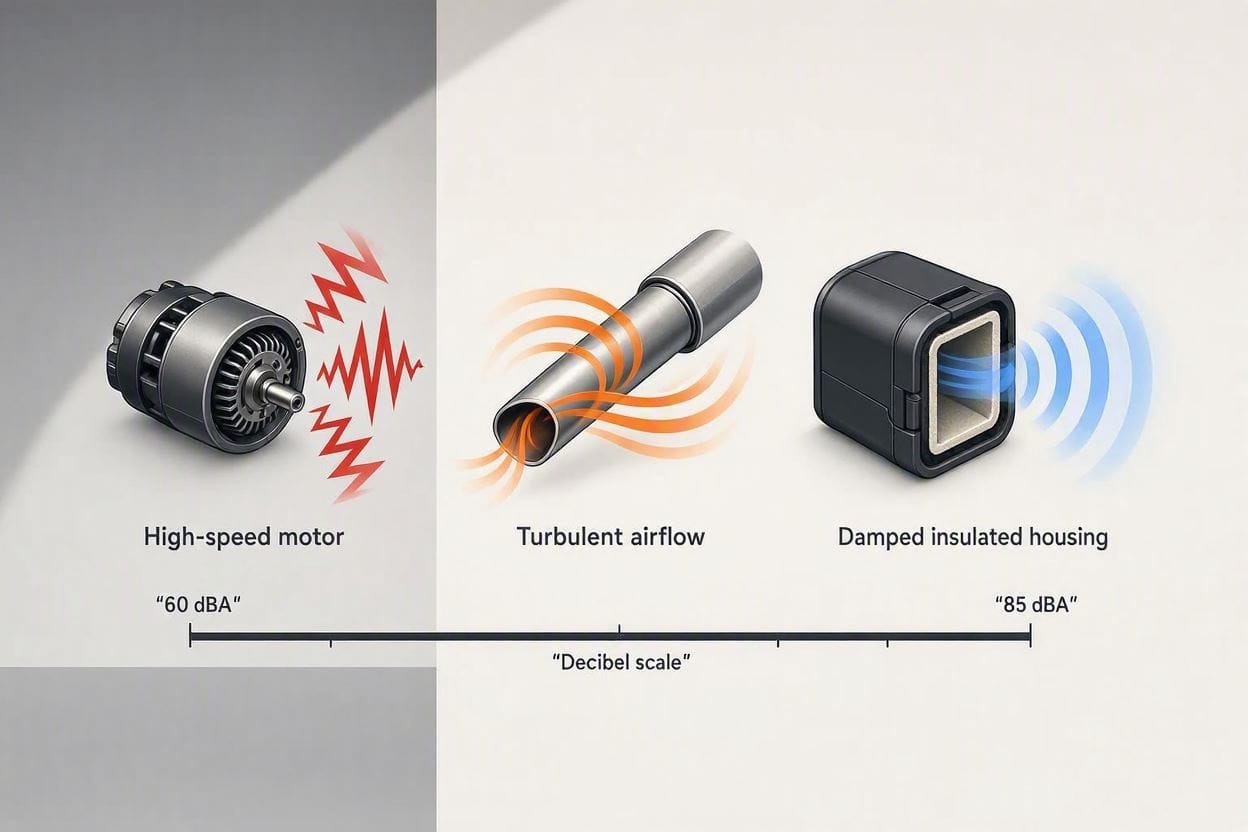
Vacuum noise comes from three distinct places, and understanding them makes the marketing claims easier to judge:
- Motor speed and vibration. Faster motors are the primary sound source, generating high-frequency noise from internal component movement. This is why RPM is the single biggest acoustic variable in a handheld.
- Air turbulence. Air whistling through narrow pipes, vents, and nozzles produces a surprising amount of noise – often the piercing part of the sound rather than the warm mechanical part.
- Housing resonance. Thin plastic shells with no damping vibrate and act like a speaker, turning internal vibration into audible noise. This is where build quality and mass matter most.
Vacuum noise analysis consistently points to motor speed and vibration as the primary driver, followed by air turbulence through narrow passages.
A genuinely quiet handheld addresses all three. That usually means a brushless motor, better internal damping or a denser housing, and a lower-speed or eco mode that trades some suction for a dramatic drop in noise.
What Counts as Quiet for a Handheld Vacuum
Industry guidance is fairly consistent here. A vacuum is generally considered quiet when it operates around 60 to 70 decibels, and cordless models often run quieter than corded ones because they use smaller motors, especially in eco or low-power modes.
The very best robot and handheld models can reach as low as 55 to 60 dB, which is comparable to a quiet dishwasher running.
For a handheld specifically, here is a practical benchmark:
- Under 65 dB – genuinely quiet, comfortable for apartments and sleeping households
- 65-72 dB – acceptable, noticeably better than average
- 72-80 dB – typical handheld territory, loud but usable in short bursts
- Over 80 dB – avoid if noise matters to you, especially above 110 dB where hearing risk begins
1. Shark WandVac WV201 (The Best Overall Quiet Pick)
The Shark WandVac is the most consistently well-reviewed handheld vacuum in independent lab testing, and it earns this spot for a simple reason: it manages strong performance without sounding like a jet engine.
What makes it stand out is the combination of low weight and competent acoustics. At just 1.4 pounds, it is one of the lightest handhelds in lab testing, which matters because lighter models can use smaller, slower motors without sacrificing usability for the kinds of quick jobs a handheld is actually for. the Shark WandVac is one of the lightest handheld vacuums in testing at 1.4 pounds
It also handles pet hair well – an area where many handhelds fall short – and the vacuum and attachments store on the charging base, which keeps it genuinely grab-and-go. If you want one handheld that is quiet enough for apartment life and still capable enough to justify owning, this is the safest starting point.
Shark WandVac WV201
- Acoustic profile: Quieter than most handhelds thanks to a lighter frame and smaller motor, without the harsh high-frequency whine of cheap models
- Key feature: 1.4 lb weight with strong pet hair performance and base-mounted storage
- Best for: Apartments, quick car and couch cleanups, and households where noise matters
2. Black+Decker DustBuster CHV1410L (The Quiet Budget Classic)
The DustBuster name has been around for decades, and the CHV1410L is one of the models that has kept the line relevant. Lab testing specifically noted it as one of the quieter handhelds, with a pretty good average runtime of around 23 minutes – longer than many competitors in the same price bracket.
What this model gets right acoustically is restraint. It does not chase maximum suction with a frantic high-RPM motor, which is exactly the design choice that keeps the noise manageable. Instead it delivers enough power for crumbs, dust, and light debris without the aggressive scream that makes some competing budget handhelds unbearable.
The tradeoff is honest: lower suction than premium models, and a non-swappable battery. But for the price, it is genuinely one of the most livable handhelds you can buy – quiet enough to use without warning the entire house first.
Black+Decker DustBuster CHV1410L
- Acoustic profile: One of the quieter handhelds in independent testing, with a controlled motor note rather than a piercing whine
- Key feature: Around 23 minutes of runtime, longer than many rivals at this price
- Best for: Budget-conscious buyers who want quiet over maximum suction
3. Shark UltraCyclone Pet Pro Plus (The Pet Hair Specialist)
Pet hair is the one job handheld vacuums most often fail at, and it is also the job that tempts people to buy overpowered, extremely loud machines. The Shark UltraCyclone Pet Pro Plus takes a different approach, pairing a motorized attachment with a compact, manageable frame rather than brute suction.
Independent testing measured this model at around 73 dBA, which puts it in the acceptable-to-good bracket for a handheld while still delivering strong cleaning performance, particularly on pet hair and small spaces.
The motorized pet tool is the key feature here. It agitates hair out of upholstery and carpet rather than relying purely on airflow, which means the vacuum can achieve better results without being driven at maximum power the whole time. That is a genuine acoustic advantage disguised as a cleaning feature.
Be aware of the honest limitations: a small dust bin and a short runtime of roughly 15 minutes. For quick pet hair passes on the couch or in the car, that is usually enough.
Shark UltraCyclone Pet Pro Plus
- Acoustic profile: Measured around 73 dBA – loud in absolute terms, but controlled for a pet-focused handheld
- Key feature: Motorized pet attachment cleans hair without forcing maximum motor speed
- Best for: Pet owners cleaning upholstery, stairs, and car interiors
4. Dyson Car+Boat (The Premium Deep-Clean Handheld)
Dyson’s handheld lineup has long been the benchmark for suction in a compact form, and the Car+Boat model is purpose-built for exactly the jobs handhelds get used for: car interiors, upholstery, and tight spaces where a full-size vacuum is impractical. Consumer Reports includes it among the best handhelds of 2026.
From a noise standpoint, Dyson’s advantage is engineering rather than raw quietness. Their motors are designed for efficiency at high RPM, and while they are not the quietest handhelds on this list, they avoid the chaotic, rattling quality that cheaper high-power models produce. The sound is more of a concentrated whoosh than a shriek.
This is the pick for someone who wants maximum cleaning capability in a handheld and is willing to accept a louder, more intense sound in exchange. If your priority is deep cleaning the car twice a season rather than quiet operation, this is the strongest performer here.
One practical tip that applies to any powerful handheld: wear earplugs during longer cleaning sessions. The National Institute on Deafness and Other Communication Disorders notes that sound levels over 70 dBA can damage hearing after enough exposure, and extended car cleaning is exactly the scenario where that risk becomes real. sound levels over 70 dBA can damage hearing after enough exposure
Dyson Car+Boat
- Acoustic profile: Intense but clean-sounding, with efficient motor design that avoids rattling and chaotic resonance
- Key feature: Purpose-built for car interiors and upholstery with premium suction
- Best for: Owners who prioritize cleaning power over quiet operation
5. Black+Decker Flex BDH2020FL (The Flexible Quiet Alternative)
The Flex is interesting because it solves a usability problem that quietly contributes to noise complaints: reach. A vacuum with a flexible hose lets you clean awkward spaces – under car seats, behind furniture, along stair risers – without contorting yourself into positions that lead to longer, more frustrating, noisier sessions.
Consumer Reports includes the Flex BDH2020FL among the best handhelds of 2026, alongside the DustBuster and Dyson models already mentioned.
Acoustically, it sits in the same family as the DustBuster – a controlled motor note rather than an aggressive scream. The flexible design also means fewer sessions where you run it continuously for several minutes because you cannot reach the mess. Shorter runtime per session means less total noise exposure, which matters more than people think.
Black+Decker Flex BDH2020FL
- Acoustic profile: Controlled motor note in the same quieter family as the DustBuster line
- Key feature: Flexible hose design for reaching under seats and into awkward gaps
- Best for: Car detailing and anyone who cleans hard-to-reach areas regularly
How To Choose a Quiet Handheld Vacuum
If noise is a genuine priority, here is what to weigh before buying:
- Look for a brushless motor. Brushless motors generally deliver stronger suction with better efficiency and durability, and they often run quieter than brushed alternatives.
- Check for an eco or low-power mode. Most of the usable noise reduction comes from running the motor slower. A two-speed model gives you quiet mode for daily touch-ups and full power only when you need it.
- Prioritize weight over suction specs. Heavier handhelds tend to use bigger, louder motors. If your jobs are small and frequent, a lighter, quieter model is the better choice.
- Check measured decibel data, not marketing claims. “Quiet technology” is meaningless without a number. Independent lab measurements are far more reliable than the box.
- Consider runtime honestly. A short runtime sounds like a downside, but it also means shorter sessions and less accumulated noise exposure. For quick cleanups, 15-23 minutes is plenty.
- Look for sound-dampened housing. Denser plastics and internal insulation reduce the housing resonance that turns vibration into audible noise.
If you want the broader picture on vacuum noise across categories, our guides to quiet cordless stick vacuums and quiet robot vacuums cover the same engineering tradeoffs at different form factors. And if you are dealing with a loud vacuum you already own, troubleshooting mechanical noise applies to more than just fans.
Final Verdict
If you want the best balance of quiet operation and everyday usefulness, the Shark WandVac WV201 is the clear first choice. It is light, effective on pet hair, and noticeably less abrasive than the average handheld.
If budget matters most, the Black+Decker DustBuster CHV1410L delivers genuinely quieter performance at a fraction of the cost, with longer runtime than most rivals.
And if you are cleaning up after pets specifically, the Shark UltraCyclone Pet Pro Plus gets the job done with a motorized tool that reduces the need to run the vacuum at full scream.
The bigger point is that handheld vacuums do not have to be unpleasant. The market has quietly produced genuinely better options in the last few years, and choosing one of them means those thirty-second cleanups stop being something you dread doing.
Frequently Asked Questions
How Loud is a Typical Handheld Vacuum?
Most handheld vacuums produce between 70 and 80 dB. Quiet models can drop to 65 dB or lower, while some poorly designed cheap models peak above 110 dB, which is genuinely hazardous with extended use.
Are Handheld Vacuums Louder than Full-Size Ones?
Often, yes, because they cram a powerful motor into a tiny uninsulated housing. Cordless models can sometimes be quieter than corded ones because they use smaller motors, especially in eco mode.
Do Quiet Handheld Vacuums Sacrifice Suction?
Not necessarily. Lower noise usually comes from running the motor more efficiently rather than removing power. Brushless motors, for example, often improve both efficiency and noise. But the loudest models are usually the most powerful.
Can I Use a Handheld Vacuum in an Apartment Without Annoying Neighbors?
Yes, provided you choose a model under about 70 dB and avoid running it for long stretches. Short bursts on a quieter handheld are usually not disruptive through shared walls, especially during daytime hours.
What is the Quietest Handheld Vacuum for Pet Hair?
The Shark WandVac WV201 is the best combination of quiet operation and pet hair performance in current testing. The Shark UltraCyclone Pet Pro Plus is also strong for pet hair, measuring around 73 dBA.

Ememobong is the lead researcher and editor at Quiet Dwelling. As a professional technical writer, he specializes in breaking down complex acoustic engineering concepts into simple, actionable steps. His goal is to help people build distraction-free environments for better sleep and deep work.